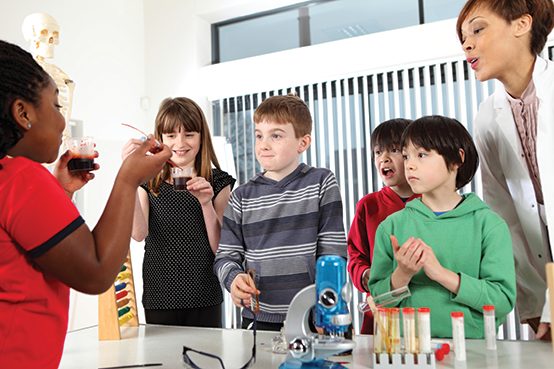
A new vision for science education is grounded in the idea that science is both a body of knowledge and a set of linked practices for developing knowledge.
The Next Generation Science Standards (NGSS) present an unprecedented opportunity to transform science education for all students. Past standards separated content from process, but the NGSS expect students to develop an integrated understanding of science as a body of knowledge and a set of practices for developing new knowledge. They require students to apply crosscutting concepts that unify science and engineering — including such concepts as structure and function, cause and effect — to deepen their understanding of those core ideas. Every performance expectation for students in the NGSS reflects this integrated, three-dimensional view of what it means to learn science.
These standards are distinctive for another reason: State education agencies and stakeholders in science education developed them using a National Research Council consensus report, A Framework for K-12 Science Education: Practices, Crosscutting Concepts, and Core Ideas (2012). A committee of prominent scientists, science educators, education researchers, and state leaders wrote the framework. Its intent is to build upon the foundation of the first generation of science standards documents while working toward developing standards around a few core ideas that students would revisit over multiple school years. The framework also called for a sharper focus on equity and diversity in science education. All students should be expected to reach high academic standards and to have adequate opportunities to learn science. Science educators should identify interests, experiences, and cultural practices relevant to young people’s everyday lives, and instruction should use these to support science learning.
Implementing the NGSS will demand significant changes for everyone in schools and districts — students, teachers, and school and district leaders.
There is energy and excitement behind the NGSS in the science education community. The development process, facilitated by Achieve Inc., involved 26 lead states, 41 writers, and hundreds of science teachers, scientists, engineers, and education researchers who provided feedback on drafts, helping build momentum and support. Already, 11 states and the District of Columbia (amounting to 26% of the U.S. student population) have adopted the NGSS, and more are likely to follow. Science leaders across the country have embraced the vision of the framework, whether or not their states are planning to adopt NGSS. The NGSS is distinct from the Common Core State Standards, which focus on English language arts and mathematics, but the NGSS names specific links to the Common Core for each group of performance expectations.
Implementing the vision of the framework and NGSS will not be easy. Few schools have access to curriculum materials aligned to the framework’s vision. Such materials are especially rare in schools that serve low-income students and students from groups that are under-represented in science and engineering. The framework calls for big shifts in teaching that require extensive professional development. Few teachers engage students in practices that require more intensive student discussion but that are essential to the framework, practices such as developing and using models, constructing explanations, and engaging in argument from evidence. In addition, few assessments measure the three-dimensional performance expectations of the NGSS. Finally, too few students are exposed to rich science instruction in elementary school, which compromises the goal of building a rich understanding of science among all students across their K-12 careers.
Implementation strategies
Though the NGSS are new, more than a decade of policy research on standards implementation in reading, mathematics, and science education gives insights about how education decision makers can support improvements to teaching and learning.
Provide high-quality curriculum materials to teachers and students.
Curriculum materials matter. Whether teachers adopt, adapt, or design curriculum materials, those materials matter because they are how students encounter the standards. High-quality materials provide models for how to help students meet challenging learning goals in standards, and they provide tools to help teachers improve their practice (Davis & Krajcik, 2005). Materials also include the tools needed for students to actually do science — lab equipment, for example — and these must be accessible to all students in all schools. Leaders can use a new rubric for judging the quality of materials for NGSS (http://tinyurl.com/ny9s4ej).
We recently concluded an evaluation of research-based science curriculum materials designed to support integrated science teaching and learning. No single set of materials today is aligned to the NGSS, though some integrate the science and engineering practices that get greater emphasis in the new standards than in the first generation of standards, such as explanation and developing and using models. The Project-Based Inquiry Science (PBIS) curriculum units that were the focus of our study are one such example. Developed with support from the National Science Foundation by a team of science content experts and learning scientists, PBIS is among the first widely available materials that reflect what we know about how students learn science. Our initial study found positive effects on teaching and learning for all groups of students. The study took place within a large urban district with high percentages of low-income students and students from under-represented groups.
Provide professional development focused on performance expectations for students linked to classroom teaching and sustained over time.
Professional development was a critical support for implementing the first generation of science education standards. The kind of professional development that made a difference to instruction was focused on core science content, gave teachers specific ideas for how to engage in more student-centered teaching, and was sustained over time (Garet et al., 2001; Supovitz & Turner, 2000). Particularly effective strategies included supporting teachers in analyzing their own practice and student work with colleagues (Heller et al., 2012; Roth et al., 2011) and preparing teachers to adapt high-quality instructional materials (Penuel, Gallagher, & Moorthy, 2011).
Science leaders across the country have embraced the vision of the National Research Council framework, whether or not their states are planning to adopt the Next Generation Science Standards.
In our PBIS study, professional development conducted over multiple sessions throughout the two years of the study focused intensively on aspects of the framework that represent significant departures from most teachers’ typical instruction. We provided teachers with images and experiences of three-dimensional science learning. For example, teachers had to construct, share, and revise models that explain why you can compress and expand air in a syringe. As part of the activity, teachers experimented with syringes and made drawings that depicted things they couldn’t see (the motion of particles inside the syringe) to account for what happens when the syringe is pulled back, pushed, and pushed when the open tip is closed. The activity was designed to help teachers understand that air is made of “stuff” and also to help them gain experience with how cycles of developing and sharing models, conducting investigations, and revising models to respond to peer critiques are integral to science learning. Teachers also learned about the nature of models of systems, a key crosscutting concept.
Monitor and support implementation.
When standards-based reforms are introduced into schools and districts, teachers and educational leaders have to continually adapt them as those reforms begin to change day-to-day practices (Weinbaum & Supovitz, 2010). Educational leaders especially need data about implementation in order to know whether and how reforms are taking hold in their schools and to design better supports for implementation. Recent reports conclude that assessing students’ opportunities to learn science are critical for systems, especially to promote equity of opportunity to learn (National Research Council, 2013a, 2013b). Monitoring opportunity to learn is an important equity strategy and should focus on whether there is adequate time allotted to science instruction, access to high-quality curriculum materials and necessary equipment for investigations, and access for all teachers to professional development.
In our PBIS study, we monitored and supported teachers’ implementation in several key ways. Teachers completed instructional logs, which told study leaders and coaches for teachers how far into the unit teachers were at a given time and what opportunities were allotted to students to engage in science practices. We collected videos of some teachers at work along with samples of assignments and associated student work. We also worked closely with a coach in the district to identify challenges teachers reported as they implemented the materials with students, which helped us adjust professional development plans and ensure teachers had the needed supplies to implement investigations with students. Finally, we conducted qualitative analyses that focused on teachers’ attention to equity in classroom instruction.
Develop and use assessments that measure knowledge-in-use.
At present, few tasks assess how students apply disciplinary core ideas and crosscutting concepts through science practices. Teachers will need to develop tasks that strategically diagnose student progress toward proficiency on the NGSS and to inform their instruction and lesson designs. Districts will need to develop a system of assessments for monitoring and improving classroom learning because no single assessment can measure all the performance expectations for any given grade level (National Research Council, 2013a). This is important because when states began to use tests to monitor progress on prior standards, those tests had a big effect, though not always what was intended. Only in states where the content tested reflected challenging learning goals for students did teaching shift in ways that fostered deeper student learning (Au, 2007).
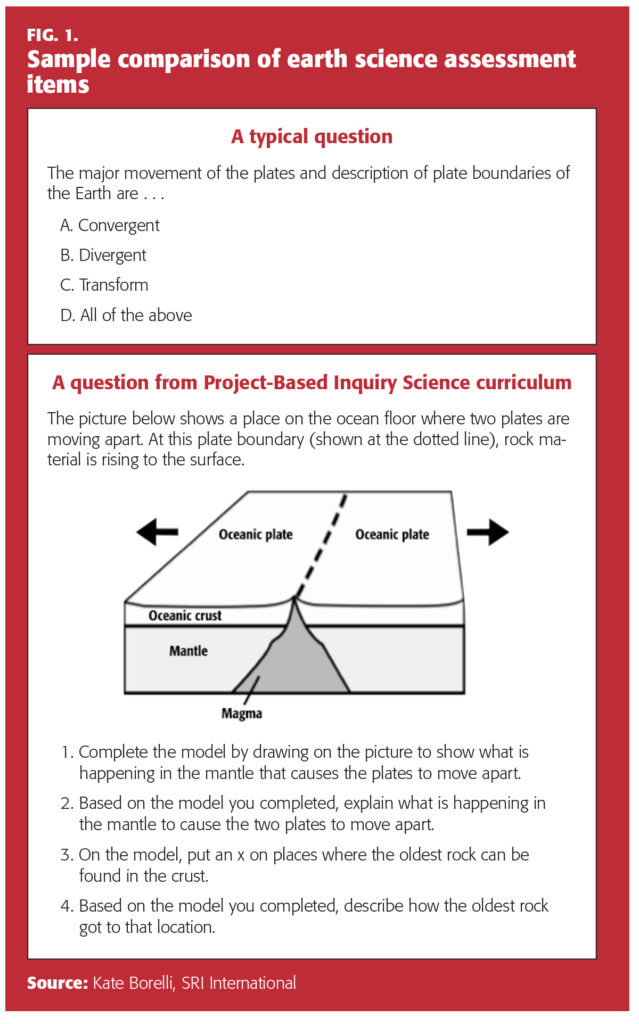 The PBIS study required us to develop and test new assessments that could measure next generation science learning goals. We followed a process called evidence-centered design, an approach to writing tasks, piloting them, and revising them based on evidence of student performance. Our tasks placed two science practices at the center: constructing explanations, and developing and using models. Every open-ended task on our assessments required students to demonstrate understanding of a disciplinary core idea by engaging in one of those two practices. The tasks looked very different from traditional test items that primarily test for recall (see Fig. 1). The rubrics developed for each of these tasks integrated a disciplinary core idea, a practice, and a crosscutting concept. Our pilot tests showed that we could reliably score these items and that they were sensitive to instruction, two key criteria for validity in assessments.
Treat implementation as presenting learning opportunities for everyone in the system.
Implementing the NGSS will demand significant changes for everyone in schools and districts — students, teachers, and school and district leaders. All too often, though, we forget that implementing new standards requires purposeful design of learning opportunities for everyone. Teachers and leaders will have to learn on the fly as they invent new strategies to address challenges that arise with implementation. Implementing the NGSS will be easier if we think of teachers and leaders as colearners, instead of demanding compliance to specific indicators of standards that few people understand well.
In the PBIS study, we encountered a challenge with principals, some of whom interpreted teachers’ instructional strategies as inconsistent with new state evaluation guidelines indicating what was good teaching. Teachers understandably were concerned that their jobs were in jeopardy. To assist principals in learning about the implications of the framework for science instruction, our study team quickly developed a guide that could help principals see connections between the state-required observation protocol and the framework. Teachers found this tool especially helpful, as they thought it could help facilitate conversations with their principal not only about the study but also about good science teaching.
Sustaining the changes
Multiple organizations are working to support implementation of the vision of the framework and meeting the ambitious performance expectations of NGSS. These include organizations of leaders in states and districts, professional organizations for science teachers, intermediary organizations, and business groups. They are not only developing resources for teachers and educational leaders, they are also supporting planning for the long term, that is, for how to sustain the kinds of changes demanded by the framework and NGSS.
Educational leaders can play a key role in building an infrastructure for developing and sustaining improvements to science education in the long term. They can advocate for sustained professional development, identify resources to support building-level teacher teams, and develop curriculum selection and adaptation processes that simultaneously build understanding of NGSS and capacity to implement the standards. Educational leaders are essential, too, for realizing the vision of science for all by promoting strategies and identifying resources for equitable access to powerful science learning opportunities and equitable participation in science classrooms. We can and must create a new, more equitable system of science education in which all students are prepared to do science and use science to make their communities better places to live.
References
Au, W. (2007). High-stakes testing and curricular control: A qualitative metasynthesis. Educational Researcher, 36 (5), 258-267.
Davis, E.A. & Krajcik, J. (2005). Designing educative curriculum materials to promote teacher learning. Educational Researcher, 34 (3), 3-14.
Garet, M.S., Porter, A.C., Desimone, L.M., Birman, B.F., & Yoon, K.S. (2001). What makes professional development effective? Results from a national sample of teachers. American Educational Research Journal, 38 (4), 915-945.
Heller, J.I., Daehler, K.R., Wong, N., Shinohara, M., & Miratrix, L.W. (2012). Differential effects of three professional development models on teacher knowledge and student achievement in elementary science. Journal of Research in Science Teaching, 49 (3), 333-362.
National Research Council. (2012). A framework for K-12 science education: Practices, crosscutting concepts, and core ideas. Washington, DC: Author.
National Research Council. (2013a). Developing assessments for the Next Generation Science Standards. Washington, DC: National Academies Press.
National Research Council. (2013b). Monitoring progress toward successful STEM education: A nation advancing? Washington, DC: National Academies Press.
Penuel, W.R., Gallagher, L.P., & Moorthy, S. (2011). Preparing teachers to design sequences of instruction in Earth science: A comparison of three professional development programs. American Educational Research Journal, 48 (4), 996-1025.
Roth, K.J., Garnier, H.E., Chen, C., Lemmens, M., Schwille, K., & Wickler, N.I.Z. (2011). Videobased lesson analysis: Effective PD for teacher and student learning. Journal of Research in Science Teaching, 48 (2), 117-148.
Supovitz, J.A. & Turner, H.M. (2000). The effects of professional development on science teaching practices and classroom culture. Journal of Research in Science Teaching, 37 (2), 963-980.
Weinbaum, E.H. & Supovitz, J.A. (2010). Planning ahead: Make program implementation more predictable. Phi Delta Kappan, 91 (7), 68-71.
Learn more about the Next Generation Science Standards
National Research Council. (2013). Next Generation Science Standards: For states, by states. Washington, DC: National Academies Press.
Achieve Inc., which facilitated the standards process, maintains an extensive web site that contains all of the standards plus the history of the development of the standards and resources for implementation.
CITATION: Penuel, W.R., Harris, C.J., & DeBarger, A.H. (2015). Implementing the next generation science standards. Phi Delta Kappan, 96 (6), 45-49.
ABOUT THE AUTHORS

Angela Haydel DeBarger
ANGELA HAYDEL DEBARGER is a senior researcher at SRI International’s Center for Technology in Learning, Menlo Park, Calif.
Christopher J. Harris
CHRISTOPHER J. HARRIS is a senior researcher at SRI International’s Center for Technology in Learning, Menlo Park, Calif.
William R. Penuel
WILLIAM R. PENUEL is a distinguished professor of learning sciences and human development at the University of Colorado, Boulder.