Chicago Arts Partnerships in Education brings teachers, artists, and students together in inquiry-oriented communities of creators and learners.
Since the spring of 2020, when the COVID-19 pandemic shuttered most of the nation’s public schools, countless observers have raised grave concerns about the lack of educational resources available to low-income families, the poor quality of remote instruction, the low rates of attendance and participation in online classes, and, as a result, the terrible consequences for many students. We share these concerns; however, we worry that recent debates about how schools should respond to this crisis have focused too much attention on the problem of “learning loss,” a phrase that directs attention to matters of quantity (i.e., the amount of instruction students have or haven’t received and how much of the curriculum they have or haven’t mastered), while distracting from questions about the quality of the instruction and resources our schools have provided to different student populations, both before and during the pandemic (Dorn et al., 2020).
If learning loss were the only problem, then the best way to fix it would be to make up for what has been lost by giving students more of what we’ve always given them — more instruction, more content, more hours in the school day, more summer school classes, and so on. But as Maxine McKinney de Royston and Shirin Vossoughi (2021) point out, this would do nothing to address the inequitable policies and practices that have caused the pandemic to have such terrible consequences in the first place, with quite different effects on students from differing racial and economic backgrounds. Rather than focusing yet again on trying to fix students’ supposed deficits by giving them more of the same, they argue, now is the time to work with youth, positioning them “as knowledgeable instructional partners” and reframing “communities as learning spaces and resources.”
We agree that the challenge facing us today isn’t just to catch up on lost instructional time but to work with students and communities to rethink what school can and should look like. More specifically, we argue that the arts, which have often been relegated to the margins of the core curriculum, can be brought to the center, helping to create more open and equitable models for teaching and learning.
From certainty to openness
For far too long, our public schools have worshipped at the altar of certainty. At every grade level and in every subject, the curriculum has been pegged to standards, which predetermine what is to be learned and when. Every year, principals receive reports showing exactly how their school does or doesn’t measure up to expectations. Teachers are told what material to teach on which day, while having their performance monitored and evaluated with mathematical precision. And students have their every course grade, sick day, and disciplinary incident entered into a database.
Of course, the pandemic has upended this whole system, making it impossible for education policy makers and officials to know, with the usual degree of certainty, how things are progressing for students, teachers, and administrators, or even what ends they’re pursuing. In many online classrooms, it’s uncertain whether students are paying attention at all, much less whether they’re engaged and learning. And in many schools and districts, students’ physical and mental health needs have taken priority over short-term academic goals. As Barnett Berry (2020) explains, the crisis has called upon educators “to reach out to students, check in on them and their families, and support them as whole children, not as test takers” (p. 16).
Historically, arts educators have played a key role in efforts to provide a whole-child approach (Nelson, 2009) that balances the teaching of academic content with efforts to honor young people’s desire to define and creatively express their own hopes, fears, and experiences (Gutiérrez & Jurow, 2016). At Chicago Arts Partnerships in Education (CAPE), that tradition of arts integration has always informed our work. Typically, we facilitate long-term partnerships (at least one to two school years) between teachers in the Chicago Public Schools and teaching artists from the community. Together, the partners create arts-based curricula that they teach together during the school day or in after-school programs, and they participate in shared training throughout the program.
For far too long, our public schools have worshipped at the altar of certainty.
Over the last year, however, we’ve had to find ways to adapt our approach to meet the challenges of the pandemic. Specifically, we’ve joined teachers and students in their remote classrooms, helping them decide, together, how to make art in their online spaces, both to support the teaching and learning of academic content and to make sense of their personal and collective experiences in this uncertain time.
Openness as a starting point
In our work with the Chicago schools, we’ve often touched on the concept of “openness,” which is not just a key topic in the world of contemporary art (which often embraces an open-ended process of responding to art, resisting the idea that each artwork must have a fixed, certain meaning) but also plays an important role in our approach to teaching and learning: By bringing art into classrooms, we aim to challenge closed-minded assumptions about the goals of education, the rigid boundaries that separate the subject areas, and the sense of hierarchy that defines teachers’ interactions with students.
But as COVID-19 set in and schools moved online, we decided not just to touch on the idea of openness but to make it our guiding principle, since it would allow us to put a positive spin on the uncertainties of life in 2020 and 2021. As awful as the pandemic has been, it has forced open many questions that our school systems have long treated as off-limits and closed to serious consideration — for instance, how should teachers and students interact with each other? What is most important for young people to learn? And to what extent should the curriculum be open to uncertainty, chance, and choice, rather than restricted to predetermined and easily measured outcomes?
For us, discussions about openness begin with the Italian writer Umberto Eco (1989), who argued that while any work of art can have multiple meanings, an “open” work is one that actively welcomes multiple meanings, offering no set guidelines for interpretation (Peters & Roberts, 2015). There are three forms of artistic openness, said Eco: People can be open to interpretation, allowing an artwork to “[take] on a fresh perspective for itself” (p. 4) every time it is experienced; they can be open to semantics, or willing to let words and images take on multiple meanings; and they can be open to the “work in movement,” or willing to let the artist and the audience go back and forth over how to interpret the art (p. 12).
Cary Campbell (2018) has explored Eco’s poetics of openness through a pedagogical lens, viewing openness as an important value for students to cultivate, not just when they interpret works of art but as they draw on and try to make sense of their own life experiences. Similarly, the educational theorist Paulo Freire (1972, 1998) argued that teachers should be open to students’ own interpretations of what they learn in school, encouraging them to engage in genuine, open-ended dialogue with (and sometimes challenge) what they read and study, so that “the teacher is no longer merely the-one-who-teaches, but one who is himself [sic] taught in dialogue with the students” (Freire, 1972, p. 80). Educators must have some level of comfort with uncertainty, as he saw it, because “to learn is to construct, to reconstruct, to observe with a view to changing — none of which can be done without being open to risk” (p. 67).
Creating a community for inquiry
Several years ago, and drawing on these ideas from Eco, Campbell, Freire, and others, we developed what we call an “artist/researcher” model to guide CAPE’s work with the Chicago schools. That is, our approach treats students, teachers, program staff, and teaching artists as coinvestigators on a research project, using art as a means of studying important questions and gaining new understandings about the world (Sikkema, 2016). For example, in one project, CAPE teacher/artist partners Phil Cotton and Margy Stover asked themselves and their students the question, “What is a classroom?” and, with that question in mind, designed and built their own concept of a student’s chair.
Usually, when we start working with a school, our first challenge is to help teachers and teaching artists become more comfortable with this kind of open-ended inquiry, which challenges the assumption that the teacher must serve as the sole authority whose job is to keep the class within the specific boundaries defined by the curriculum (and, often, by upcoming standardized tests). Further, we make it a priority to open the classroom to participation by families and community members, building the relationships that allow artists/researchers to tap into local knowledge and ideas and incorporate them into their work.
During the 2019-20 school year, CAPE staff began leading professional development sessions in which teacher and artist partners shared big ideas and inquiry questions to guide their curriculum for the school year. The group consisted of teams that had been working together for years and new teams that were working together for the first time. The pairs began by learning about each other’s interests and the questions they’d like to pursue. Then, once they’d found a place where their interests overlapped, we asked them to come up with a big idea (i.e., an overarching concept) that they’d like to explore together, as well as a specific, open-ended question that would guide their inquiry (i.e., a “who, what, why” question that would guide them in art making). As in previous years, teachers, teaching artists, and students in CAPE programs used arts practices as research methods for making sense of the big ideas and inquiry questions that the partners generate.
By bringing art into classrooms, we aim to challenge closed-minded assumptions about the goals of education, the rigid boundaries that separate the subject areas, and the sense of hierarchy that defines teachers’ interactions with students.
In most cases, as teacher and teaching artist partners bring their inquiries to the students, the students will react and offer new ideas and questions themselves, which steers the direction of the curriculum. This approach allows room for failure: An initial inquiry question might not get answered, but the uncertainty teachers and students share as they look for answers could lead to more fruitful and interesting questions. For example, as we discuss below, an inquiry about how we use technology to communicate led to students exploring electronic music composition, graphic design, and ice cream recipes — none of which were part of the instructors’ initial activities, but rather resulted from conversation and investigation prompted by the original questions.
This example illustrates vividly the value of openness, which teachers explored in a January 2020 professional development meeting in which they read and discussed excerpts of Campbell’s (2018) essay “Educating openness: Umberto Eco’s poetics of openness as a pedagogical value.” Teachers and teaching artists drew connections between their practices and the concept of openness and planned in pairs and small groups how to make openness a core practice in their work.
For CAPE teachers, artists, and students, the content, pedagogy, art making, and final products remain open enough to allow participants to be vulnerable as they express what they don’t know, to shift roles according to the knowledge and abilities each participant brings to the inquiry, and to take the project in multiple directions as they unfold. With these core ideas and methods, CAPE teachers and teaching artists adhere to a mindset of openness, an ethic of equity that centers student voice and choice, and a method that is unique to the arts.
Art in a time of remote learning
The open mindset that CAPE is built on proved to be crucial in spring 2020 and onward, when teacher and artist teams in CAPE’s after-school program had to be honest and vulnerable with their students about how they, as adult educators, were not sure how the remote experience would turn out. At this point in the school year, the classes were all mid-project and had to embrace openness and uncertainty to shift to this radically new virtual context.
Amplifying student political voice
Because the CAPE partners were in a vulnerable and unpredictable place as remote learning began, they were primed to adopt an attitude of openness about the roles participants would take in their online projects: Who would be the originator of an idea, who would be the explorer of a question, who would be the leader of a process — these roles were movable and malleable among students and instructors.
For North-Grand High School students working with teacher Getsemani Nava, CAPE artist Nick Meryhew, and guest collaborator Anisa Olufemi McGowan from ACRE (Artists’ Cooperative Residency & Exhibitions), roles shifted organically as participants’ content exploration took them in many different directions. Their work began as an investigation of the relationships of sound and history, guided by a question from Anisa: “How can sound express your history?” The instructors did not provide any specific parameters for how students should explore this question but supported students as they each responded to the prompt in their own way. As students explored the topic, they made connections between the 1918 pandemic and jazz music and between the Black Lives Matter movement and the Black Power movement. Students independently researched these ideas using a variety of sound resources, such as field recordings, interviews, news sources, and music.
The class met twice per week, with students sharing the development of their personal and collaborative pieces. They worked at their own pace, taking the investigation in whatever direction made sense to them. When one student’s inquiry dovetailed with those of others, they worked in small groups, with different members taking the lead at different times. The students ultimately chose to create a final project in the form of a collection of mixtapes that captured their personal experience and understanding of events in 2020. To produce the mixtapes, students experimented with digital music and sound art to create audio collages in which they shared direct and personal connections with history, current events, and each other. Students alternated between found sounds from many sources, music they liked and/or created, and spoken word reflections, but they avoided direct narration of events.
Throughout the project, the teacher and teaching artists provided feedback and technical support. If a student wasn’t sure what direction to take with their work, the instructors would ask other students to offer up ideas or prompt them with questions to inspire them to reapproach their work with fresh eyes and ears. In general, the online meeting space was one of a collective of artists, in which members supported and pushed each other toward their personal creative goals.
Much of the resulting work was politically charged, but that charge was determined by the students, not the instructors, and framed as layered and complex. The open nature of the class environment encouraged students to embrace their own complex thoughts and identities and provoked questioning and dialogue in an equitable space where both students and instructors cocreated meaning and new understandings of their local and broader contexts.
Creating an open curriculum with students
At New Sullivan Elementary, an exploration of the broad question “How do we use technology to communicate?” led students and educators to cocreate a curriculum that revolved around a shared interest in ice cream. The instructors began with ice-breaker conversations about their favorite foods, which led them to pinpoint ice cream as something that was universally liked, endlessly engaging, and easy to make, with potential to spin off related investigations (i.e., ice cream throughout history, the science behind ice cream, and more). The transition away from the original inquiry question about communication happened naturally after the question about favorite foods revealed how exciting the topic of ice cream was. So, in keeping with CAPE’s open approach, instead of forcing their preplanned activities on the students, the instructors leveraged the topic of ice cream as the way to explore various forms of technology-based communication. Thus, ice cream served as an apparatus for a deeper exploration of visual arts, science, cultural and linguistic histories, and much more.
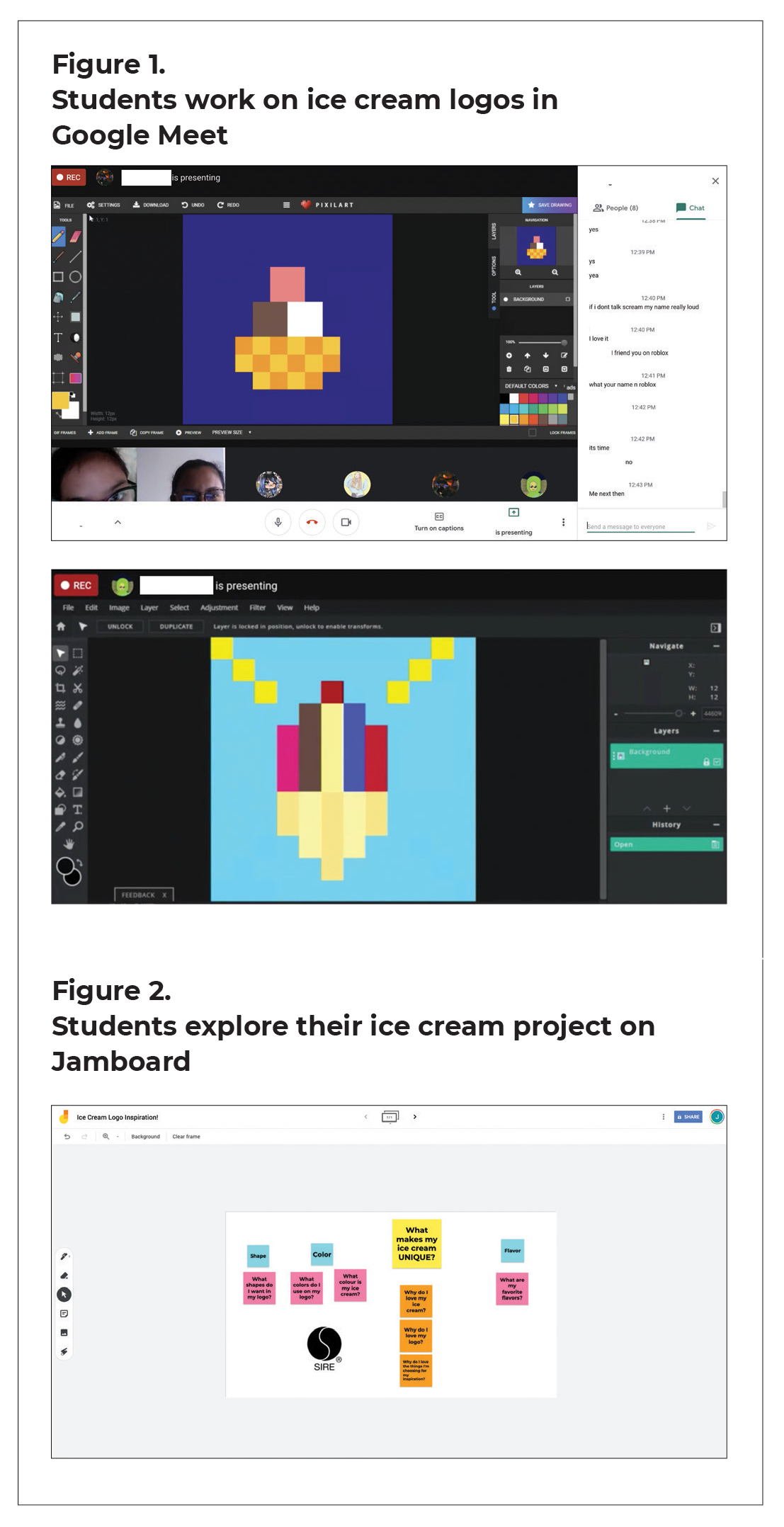
Teacher Leticia Pineda, CAPE teaching artist Jordan Knecht, and ACRE guest Marcellus Armstrong met with students on Google Meet four days per week for two-hour sessions throughout the summer of 2020. The instructors helped the students explore a variety of online art, music, and language platforms, eventually using them to make ice cream jingles and logos (Figures 1 and 2) both individually and in small-group collaborations. The teacher and artists encouraged students to apply an open approach, feeding their propensity for tangents and excitement about their online and in-home research.
As they thought about how they could use technology to communicate, students began using language translation platforms to send each other messages in languages they don’t speak, such as Korean, which led to further questions and investigations. For example, using the Yoruba language translator eventually led students to a Nigerian funk band that had created a music track about ice cream, which in turn led to deeper investigations of Nigerian cuisine, a Nigerian-inspired ice cream made by students, and comparisons of Nigerian and Mexican dishes.
As this ice cream curriculum was unfolding online, an open mindset prompted the teacher, teaching artists, and students to have wide-ranging conversations about whatever they had on their minds. One conversation began with the teaching team asking students what they wanted to change about the world, and students talked about wishing for an end to war, racism, and the coronavirus. Although these topics were not clearly connected to ice cream, these seeming digressions served real student needs and sent the message that their perspectives are valuable. Creating such a space for open dialogue helped these Black, Latinx, and African immigrant students feel more connected to each other and empowered them to share their views. Reflecting on this particular conversation, Leticia and Jordan wrote, “While we remained open as teachers to further discussing these topics, we let students lead us with their interests. It is best to open up the space and opportunity for these discussions, without forcing students to dwell in negativity. It turned out for this class, students seemed to need most a space to spend time with other people and share.”
During this project, the participatory, collaborative, and nonlinear methods of art making merged into an aesthetic of curriculum development. The adult leaders developed the open mindset that enabled them to see that what might appear to be random or unconnected wanderings from students could, in fact, lead to new discoveries, circle back to original questions, and inform part of the final work. Moreover, such open wandering gave students a powerful sense of their place as project leaders, which is not possible in a standard curriculum design with closed, predetermined outcomes. Like Leticia and Jordan note, the process of engaging in the material, the collaboration among fellow peers, and experimenting with various technologies proved to be more fruitful than the final product itself.
A different kind of learning
Early on during remote learning, CAPE teacher Beth Barrow-Johnson wrote, “The teachers are getting to know a LOT more about the families. We see and hear their homes in the video conferences. Likewise, my students have met [my dog] Velveeta and have seen at least one room of my house. It really changes the relationship.” Beth’s note points to how remote education both expanded and localized learning spaces, beyond schools and into homes, and changed the dynamics between teachers and students. Through a mindset of openness and ethic of equity, CAPE teachers and teaching artists created arts-centered learning spaces that supported vulnerability, role shifting, and multidirectionality of learning.
Lamentably, the experience of remote learning thus far has been framed by many as a kind of unfortunate pause, briefly interrupting students’ linear, step-by-step progress toward mastery of specific reading and math standards. To us, it would be far better to see the pandemic experience as a powerful counterargument against universal curriculum, top-down professional development, and the compartmentalization and containment of parent and neighborhood voice. Education is often dominated by a quest for clear, measurable, and immediate results. But the real effects of educational experiences often take time to reveal itself. Programs like CAPE show that it is possible to pull back from standardized curricula, compliance-oriented formulas, regulations, and centralized management and move toward a more equitable education that prizes inquiry and exploration, student voice, and relationship building.
References
Berry, B. (2020). Teaching, learning, and caring in the post-COVID era. Phi Delta Kappan, 102 (1), 14-17.
Campbell, C. (2018). Educating openness: Umberto Eco’s poetics of openness as a pedagogical value. Signs and Society, 6 (2), 305-331.
Dorn, E., Hancock, B., Sarakatsannis, J., & Viruleg, E. (2020, December 8). COVID-19 and learning loss — disparities grow and students need help. McKinsey & Company.
Eco, U. (1989). The open work (A. Cancogni, Trans.). Harvard University Press. (Original work published 1962).
Freire, P. (1972). Pedagogy of the oppressed (M.B. Ramos, Trans.). Herder. (Original work published 1968).
Freire, P. (1998) Pedagogy of freedom: Ethics, democracy, and civic courage (P. Clarke, Trans.). Rowman & Littlefield.
Gutiérrez, K. & Jurow, A. S. (2016). Social design experiments: Toward equity by design. Journal of the Learning Sciences, 25 (4), 565-598.
McKinney de Royston, M.M. & Vossoughi, S. (2021, July 18). Fixating on pandemic “learning loss” undermines the need to transform education. Truthout.
Nelson, H. (2009). Arts education and the whole child. Principal, 88 (3), 14-17.
Peters, M.A. & Roberts, P. (2015). Virtues of openness: Education, science, and scholarship in the digital age. Routledge.
Sikkema, S. (2016, June 15). Introducing the CAPE Artist/Researcher. Chicago Arts Partnerships in Education.
ABOUT THE AUTHORS

Scott Sikkema
SCOTT SIKKEMA is the education director at Chicago Arts Partnerships in Education and a contributor to The Corona Chronicles: On Leadership, Processes, Commitments, and Hope.
Jenny Lee
JENNY LEE is the research program coordinator at Chicago Arts Partnerships in Education.
Joseph Spilberg
JOSEPH SPILBERG is the associate director of education at Chicago Arts Partnerships in Education.
Maggie Dahn
MAGGIE DAHN is a postdoctoral researcher at the University of California, Irvine.
Nickolina Yankova
NICKOLINA YANKOVA is a graduate student at the University of California, Irvine.
Kylie Peppler
KYLIE PEPPLER is an associate professor at the University of California, Irvine.