Schools, districts, lawmakers, teachers, and unions are abuzz over plans and initiatives that change tenure protections. In this conversation, are we asking the right questions and looking at the best data?
“[T]he way tenure works for public school teachers today is that once they have it, they have a job for life — regardless of performance. That, I would say, is what is harmful to children . . .
— Michelle Rhee
“Tenure protects academic freedom. In the absence of tenure, teachers may be fired for any reason. Teachers may be fired if the principal doesn’t like them or if they are experienced and become too expensive. Teachers may be fired for being outspoken.”
— Diane Ravitch
Teacher tenure reform proposals abound these days; over the last few years a number of states have changed tenure rules such that they now provide teachers less job security or less job security early in their careers. Debates over the efficacy of tenure are long-standing (Scott, 1986), but tenure reform is now more prominently in the public eye given the high-profile Vergara vs. California lawsuit as well as recent high-profile legislative battles in states like Ohio and Wisconsin.
This focus on tenure also is a natural outgrowth of the large body of research showing that differences between individual teachers can have profound effects on student achievement. Not only do they swamp the effects of other schooling resources, such as class size (Goldhaber, 2002; Rivkin, Hanushek, & Kain, 2005), but some estimates show the differences between having an effective teacher versus an ineffective one are equivalent to more than a full grade level of student test achievement (Hanushek, 1992). More recent work shows that teacher effectiveness is predictive of student test achievement and also of a variety of important outcomes later in life such as the likelihood that students go on to college and their labor market earnings (Chetty, Friedman, & Rockoff, 2014).
Much of the rhetoric in debates about teacher tenure has centered on whether it makes it impossible for systems to fire ineffective tenured teachers (McGuinn, 2010; Edwards, 2014). It is important to note that tenure does not preclude teachers from being fired; rather it requires that just cause and due process precede a firing. Due process laws vary by state, but, in general, tenured teachers are entitled to a hearing, and districts must provide evidence of misconduct before a tenured teacher is fired. And evidence suggests that very few tenured teachers are ever fired. For example, of the over 100,000 Illinois’ tenured teachers, only 44 were dismissed from 1991 to 1997 (Goldstein, 2001).
But, as some contend (e.g. Matus, 2009), the high costs associated with the teacher dismissal process may be tantamount to a guarantee that teachers won’t be fired for poor performance. While the typical legal costs of firing tenured teachers vary by state, it can often be several times a teacher’s annual salary, exceeding $250,000 (Associated Press, 2008).
Yet there are also arguments that weakening tenure will lead to a lower-quality teacher workforce. Teaching is not a terribly lucrative profession, but it does afford a good deal of job security and certainty about compensation. It is possible that weakening this aspect of a teacher’s job could make it a less desirable profession. Indeed some argue that the recent drop in individuals choosing to pursue a career in teaching is related to what’s being called the war against teachers, with tenure reform representing one front in that war (Goldstein, 2014).
While there is strong rhetoric on both sides of the tenure debate, our opinion is that direct empirical evidence fails to support the claim that the current wave of reforms affect the teacher labor market or student achievement.
Background
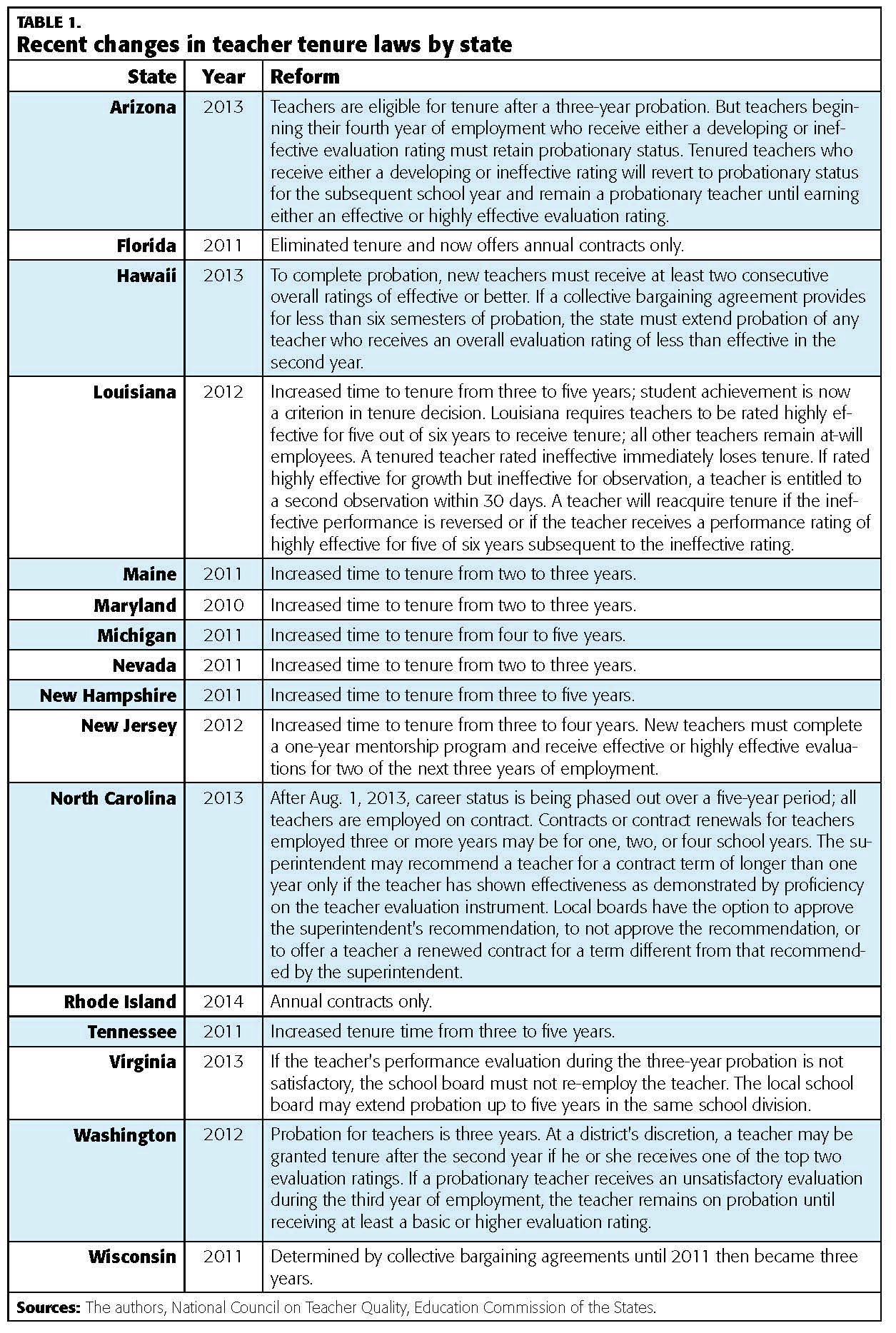
After New Jersey enacted the first comprehensive statewide tenure law in 1909, a number of states followed suit; by the 1940s, about 70% of teachers were tenured (McGuinn, 2010). The changes to tenure laws over the last couple of years represent the most active restructuring of teacher job protections since that time. Nearly all states have tenure laws but, since 2010, many have weakened tenure-based job protections. (See Table 1.) One impetus for this was the U.S. Department of Education’s Race to the Top program (Kahlenberg, 2015) that calls for using teacher evaluations to inform decisions regarding “removing ineffective tenured and untenured teachers and principals after they have had ample opportunities to improve, and ensuring that such decisions are made using rigorous standards and streamlined, transparent, and fair procedures” (U.S. Department of Education, 2010, Section D2.iv.d).
More recently, the courts have taken a position on tenure. The landmark Vergara v. California (2014) decision struck down tenure-related provisions of the California Education Code as unconstitutional, with California Superior Court Judge Rolf Treu writing that “grossly ineffective teachers substantially undermine the ability of [children] to succeed in school” (p. 7). A similar lawsuit has been filed in New York, with more expected to be filed in states with similar tenure laws, including New Jersey and Connecticut (Bidwell, 2014).
Tenure reform, teacher quality, and student achievement
Arguments about the potential effects of tenure reform are pretty straightforward — though as we describe below, there is very little empirical evidence that directly speaks to their merits. On one side of the debate are the teachers’ unions, who advocate that the due process provisions of tenure are an important deterrent to unjust dismissals.
Tenure-style protections are not unique to public school teachers but are common in higher education and government service. In public service occupations, tenure is an important safeguard against public officials using public jobs as an avenue of patronage to supporters (Chubb & Moe, 1988). And, as noted above, the job security afforded by tenure also likely helps make teaching a more attractive profession than it may be otherwise, perhaps drawing more talent into teaching.
On the other side are a variety of tenure reformers who make two distinct arguments against rewarding tenure early in a teacher’s career.
- Tenure mutes the economic incentives for individuals to be productive on the job.
- Tenure limits the ability to use dismissal as a key workforce quality management tool.
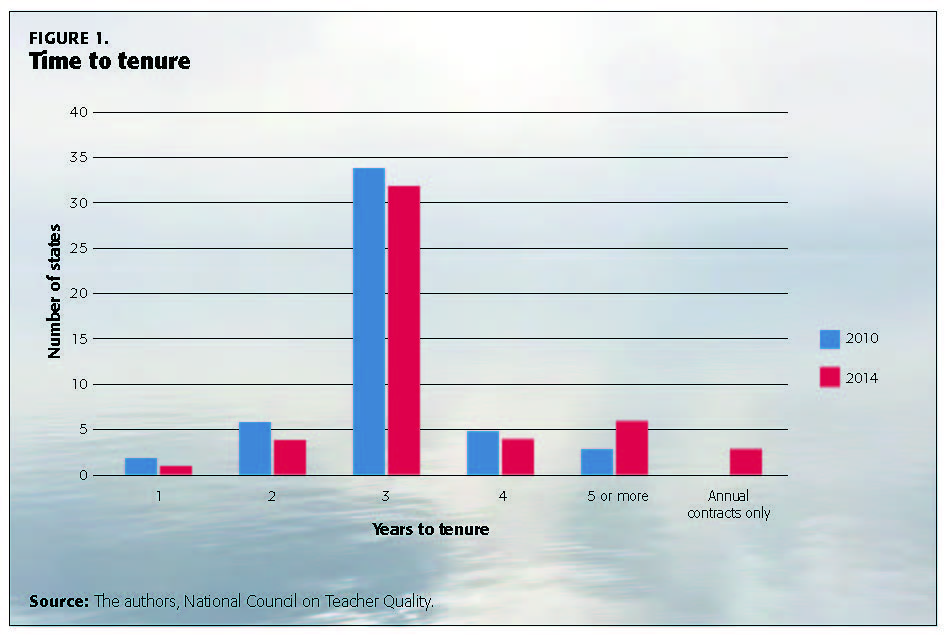
Because it is so much more costly to fire a tenured teacher — again, prohibitively costly according to some — decisions about teacher quality are often made without enough information about classroom performance. Consequently, it is common to see calls for extending the pretenure probationary period (or eliminating tenure altogether) so policy makers have a longer window of time to assess a teacher’s potential and make better decisions about which teachers ought to be allowed to continue in the profession (Hanushek, 2009, 2011). The idea that policy makers need more time to assess potential is the central argument in the Vergara lawsuit. In a Vergara friend of the court brief, the authors of this article argued that California’s two-year period does not provide enough time to evaluate new teachers, and they point to evidence from other states to show that lengthening the unnecessarily short probationary period makes it possible to tie tenure decisions to demonstrated teacher effectiveness (The New Teacher Project & National Council on Teacher Quality, 2015). Most states with tenure laws award tenure after three years, but there is a noticeable recent shift toward longer probationary periods. (See Figure 1.)
Empirical evidence
Little research directly assesses the effect of tenure reform on teacher or student outcomes, but a number of studies simulate the effects of more selective teacher retention or dismissal policies (Goldhaber & Hansen, 2010; Hanushek, 2009; Staiger & Rockoff, 2010; Rothstein, 2015; Winters & Cowen, 2013), referred to as “teacher deselection.”
Winters and Cowen (2013) simulate policies that remove teachers with poor effectiveness ratings (as measured by value-added models) in consecutive years to policies that remove teachers with poor ratings averaged over multiple years. They find that tenure and dismissal policies have the potential to improve the quality of the teacher workforce by as much as .01 to .04 standard deviations of student test achievement, but the magnitude of the effect depends on a number of factors, including the policy design, the underlying variation of teacher quality, and the rate of self-selected exits.
Goldhaber and Hansen (2010) simulate the effect of removing teachers whose early-career, value-added effectiveness ratings place them in the bottom quartile and find that replacing these low-performing teachers with teachers who have effectiveness ratings of the average beginning teachers would increase student achievement by about .025 standard deviations. These estimates are slightly smaller than what is typically estimated as the difference between a novice teacher and a teacher with two or three years of experience.
A more recent study (Chetty et al., 2014) that has received a good deal of attention suggests that teacher quality not only affects students’ test achievement but also a number of later life outcomes such as the likelihood that students attend college and their earnings. Chetty et al. (2014) suggest that replacing a teacher who is in the bottom 5% of the effectiveness distribution with an average teacher would increase students’ lifetime income by $267,000 per classroom taught. (The ability to do this, however, hinges on being able to identify which teachers are at the bottom of the distribution; space precludes an extended discussion of this, but, in short, the identification of a teacher’s position in the performance distribution is not a trivial matter.)
The above studies focus solely on the implications of deselection without considering the potential broader effects of changes to tenure on the teacher labor market. If tenure reforms lessen the security of the teaching profession and, in doing so, they adversely affect the quality of those seeking to teach, tenure reforms may lead to worse outcomes, including more ineffective teachers in the workforce (Baratz-Snowden, 2009). Rothstein (2015) attempts to account for the broader implications of tenure reform, including how it might affect the desirability of the teaching profession. Through simulations, he explores a variety of potential tenure policies that allow for entry and exit decisions of teachers to depend on information that teachers have about their own ability (he also explores alternative teacher compensation models). Under his baseline model, he finds an optimal probationary period of three years, but very little difference in the net effects of decisions made after two, three, and four years, arguing that the benefits of using a longer probationary period to make better decisions about teacher effectiveness are largely offset by having ineffective teachers in schools for a longer time. The optimal dismissal rate under this scenario is about 40%, a figure that we believe is politically infeasible; this is also why he estimates teacher salaries would have to be increased substantially (by 24%) to attract additional applicants to replace teachers exiting the workforce.
Tenure reforms will have little effect if principals are reluctant to dismiss marginal probationary teachers and may have a negative effect if potentially effective prospective teachers are deterred from entering the profession due to increased risk.
The deselection studies explore how tenure might affect student achievement by focusing on what kind of teachers enter and exit the profession under particular policies. A second argument for tenure reform is related to the effort level of teachers, which is often ignored in simulations. Again, the argument here is that people will work harder if they know that performance affects their job security. This reasoning is supported by research outside education contexts showing that job protection policies, like tenure, affect worker effort, measured by their absence behavior (Scoppa, 2010). In teaching, there is also some evidence that absence behaviors respond to financial incentives or various changes in absence policies (Duflo & Hanna, 2005; Stoddard & Kuhn, 2008). One study in Australia showed that teachers’ absences positively correlated with their coworkers’ absences, suggesting workplace norms dictate some absence behavior, which the study authors interpret as shirking (Bradley, Green, & Leeves, 2007). These authors also estimate that teachers on temporary contracts — analogous to probation — have over 20% fewer days of absence, all things equal. The negative correlation on temporary contract status may be partially related to low experience or low unmeasured teacher productivity; the authors do not examine this.
More pertinent to our focus, Jacob (2010) found that a change in the collective bargaining agreement in Chicago leading to reduced job security (consistent with what would occur were time to tenure pushed back) reduced teacher absences by about 10%.
Jacob also offers more tentative evidence that the policy change had a direct effect on student achievement that went beyond the effect that might be expected from reduced teacher absences, suggesting that teachers increased effort in many areas.
All of this suggests that absence behavior is at least somewhat discretionary and thus a legitimate measure of teacher effort. More important, absences matter for student achievement. A particularly compelling study from Herrmann and Rockoff (2010) estimates that the student achievement effects of teacher absences are comparable to replacing an average teacher with a 10th percentile math teacher or 20th percentile reading teacher for each absent day. And over the course of a school year, the accumulation of 10 absences is associated with a 2% to 3% reduction in student test scores (Clotfelter, Ladd, & Vigdor, 2007). Therefore, tenure reform could affect student achievement by increasing the effort of teachers while they’re in the classroom and by decreasing the number of discretionary absences, which in turn would raise student achievement.
A new study by Jones (2015) comes closest to measuring the effect of time to tenure on the teacher workforce. This research uses interstate variation in the time to tenure to assess its relationship to the time teachers spend with students and their parents outside the classroom and the money they spend on classroom materials. In the year teachers are being evaluated for tenure, they spend more of their own money on classroom materials and communicate more often with students and their parents, but these behaviors revert to a baseline level after teachers receive tenure.
Conclusions
Given that most of the studies suggesting the implications of tenure reform are based on simulations, it is not terribly surprising that people reach vastly divergent conclusions about the effects of changing tenure laws.
While many advocates for students are calling for tenure reform, Rothstein (2014) concludes that, “Attacking tenure as a protection racket for ineffective teachers makes for good headlines. But it does little to close the achievement gap and risks compounding the problem” (p. A27).
The potential for tenure policies to affect the teacher workforce and student achievement is based on the level of discretion that is exercised, the quality of the decisions that principals and administrators make regarding which teachers should be dismissed, and the perceptions of teachers and prospective teachers. Tenure reforms will have little effect if principals are reluctant to dismiss ineffective probationary teachers and may have a negative effect if potentially effective prospective teachers are deterred from entering the profession due to increased risk (Goldhaber, 2015). Because the labor market effects of tenure reform depends so crucially on the response of different human beings at different points in the teacher pipeline, reaching strong research-based conclusions about how reform would affect the teacher workforce and hence students is simply impossible.
References
Associated Press. (2008, June 28). Superintendent: Bad teachers hard to fire. Associated Press. www.msnbc.msn.com/id/25430476
Baratz-Snowden, J. (2009). Fixing tenure: A proposal for assuring teacher effectiveness and due process. Washington, DC: Center for American Progress. http://ampr.gs/1ITsbdH
Bidwell, A. (2014, July 9). Activists take teacher tenure battle to more states. U.S. News & World Report. http://bit.ly/1JxIzAB
Bradley, S., Green, C., & Leeves, G. (2007). Worker absence and shirking: Evidence from matched teacher-school data. Labour Economics, 14 (3), 319-334.
Chetty, R., Friedman, J.N., & Rockoff, J. (2014). Measuring the impacts of teachers II: Teacher value-added and student outcomes in adulthood. American Economic Review, 104 (9), 2633-2679.
Chubb, J.E. & Moe, T.M. (1988). Politics, markets, and the organization of schools. The American Political Science Review, 82 (4), 1066-1087.
Clotfelter, C., Ladd, H., & Vigdor, J.L. (2007). Teacher credentials and student achievement: Longitudinal analysis with student fixed effects. Economics of Education Review, 26 (6), 673-682.
Duflo, E. & Hanna, R. (2005). Monitoring works: Getting teachers to come to school. NBER Working Paper #11880.Cambridge, MA: National Bureau of Economic Research.
Edwards, H.S. (2014, October 30). The war on teacher tenure. Time.
Goldhaber, D. (2002). The mystery of good teaching. Education Next, 2 (1), 50-55.
Goldhaber, D. (2015). Exploring the potential of value-added performance measures to affect the quality of the teacher workforce. Educational Researcher, 44 (2), 87-95.
Goldhaber, D. & Hansen, M. (2010). Using performance on the job to inform teacher tenure decisions. American Economic Review, 100 (2), 250-255.
Goldstein, A. (2001, July 20). Ever try to flunk a bad teacher? Time.
Goldstein, D. (2014). The teacher wars: A history of America’s most embattled profession. New York, NY: Doubleday.
Hanushek, E.A. (1992). The trade-off between child quantity and quality. Journal of Political Economy, 100 (1), 84-117.
Hanushek, E.A. (2009). Teacher deselection. In D. Goldhaber & J. Hannaway (Eds.), Creating a new teaching profession (pp. 165-180). Washington, DC: Urban Institute Press.
Hanushek, E.A. (2011). The economic value of higher teacher quality. Economics of Education Review, 30, 466-479.
Herrmann, M. & Rockoff, J. (2010). Worker absence and productivity: Evidence from teaching. (Working paper 16524). Cambridge, MA: National Bureau of Economic Research.
Jacob, B.A. (2010). The effect of employment protection on worker effort: Evidence from public schooling. NBER Working Paper #16524. Ann Arbor, MI: University of Michigan.
Jones, M.D. (2015). How do teachers respond to tenure? IZA Journal of Labor Economics, 4 (1), 8.
Kahlenberg, R.D. (2015, Summer). How due process protects teachers and students. American Educator, 39 (2), 4-11. www.aft.org/ae/summer2015/kahlenberg
Matus, R. (2009, March 28). It’s hard to fire teachers, even if they are bad. St. Petersburg Times. http://bit.ly/1JxQb6e
McGuinn, P. (2010). Ringing the bell for K-12 teacher tenure reform. Washington, DC: Center for American Progress. www.americanprogress.org/wp-content/uploads/issues/2010/02/pdf/teacher_tenure.pdf
National Council on Teacher Quality. (2008). State teacher policy yearbook: What states can do to retain effective new teachers. Washington, DC: Author. http://bit.ly/1n7zqVz
Rivkin, S., Hanushek, E., & Kain, J. (2005). Teachers, schools, and academic achievement. Econometrica, 73 (2), 417-458.
Rothstein, J. (2014). Taking on teacher tenure backfires: California ruling on teacher tenure is not whole picture. New York Times, A27. http://nyti.ms/1mKtHof
Rothstein, J. (2015). Teacher quality policy when supply matters. American Economic Review, 105 (1), 100-130.
Scoppa, V. (2010). Shirking and employment legislation: Evidence from a natural experiment. Economics Letters, 107 (2), 276.
Scott, J. (1986). Teacher tenure. ERIC Digest 19. http://bit.ly/1TJidvT
Staiger, D. & Rockoff, J. (2010). Searching for effective teachers with imperfect information. Journal of Economic Perspectives, 24 (3), 97-118.
Stoddard, C. & Kuhn, P. (2008). Incentives and effort in the public sector: Have U.S. education reforms increased teachers’ work hours? Economics of Education Review, 27 (1), 1-13.
The New Teacher Project & National Council on Teacher Quality. (2015, September 16). Amicus curiae brief in support of respondents, Vergara v. California. http://bit.ly/1Rwdizp
U.S. Department of Education. (2010, April 14). Overview information; Race to the Top Fund; notice inviting applications for new awards for fiscal year (FY) 2010. Federal Register, 75, (71). http://1.usa.gov/1ZMmxBC
Vergara v. California. (2014, June 10). Cal. Super. Ct. No. BC484642, 2014 WL 2598719.
Winters, M. & Cowen, J. (2013). Would a value-added system of retention improve the distribution of teacher quality? A simulation of alternative policies.” Journal of Policy Analysis and Management, 32 (3), 634-654.
Citation: Goldhaber, D. & Walch, J. (2016). Teacher tenure: Fog warning. Phi Delta Kappan, 97 (6), 8-15.
ABOUT THE AUTHORS

Dan Goldhaber
Dan Goldhaber is the director and vice president of the National Center for Analysis of Longitudinal Data in Education Research at the American Institutes for Research and the director of the Center for Education Data and Research and a professor in the School of Social Work at the University of Washington.
Joe Walch
JOE WALCH is a research consultant at the Center for Education Data and Research at the University of Washington Bothell, Seattle, Wash.