
Communication between school and families is difficult in a business-as-usual situation, but, when a mental health issue is involved, teachers must be especially careful to observe best practices.
“You are hurting my child!” he shouted, red-faced, furious, and pointing his finger about an inch from my face. I (Kathleen Minke) was a young school psychologist, unaccustomed to such emotional intensity in an IEP (Individualized Education Program) meeting. Discussing eligibility for services for a student with “emotional disturbance” can be a delicate process. But this felt very personal. I felt blamed, defeated, and angry. I believed that this child had been hurt by many of the people in the room, but surely I was not one of them. And, although the father’s ire was directed at me, everybody there was angry with somebody else and blamed them for the problems.
How did we get to this point where productive problem solving was pretty much impossible? How did our shared goal of this child’s success become lost in our inability to communicate? What I learned that day became a cornerstone of my professional life: Effective family-school collaboration is essential for promoting student success at school, but collaborative relationships must be proactively developed and intentionally nurtured. These relationships are particularly critical when children are struggling behaviorally or emotionally.
What do youth who abuse drugs, attempt suicide, experience abuse, are anorexic or bulimic, and suffer from anxiety, obsessions, or compulsions have in common? They all go to school. As noted elsewhere in this special issue, large numbers of school-age children have significant mental health needs, but relatively few receive treatment. When children do receive treatment, it is likely to be at school (Farmer et al., 2003). Although data are limited, interventions appear to be more effective when parents participate (Shucksmith, Jones, & Summerbell, 2010).
We know that contemporary families are stretched thin. Large numbers of children and their families cope with chronic stressors such as poverty, discrimination and racism, and family instability. Add to this the stress of having a child with behavioral and mental health needs, and even the most functional families can be overwhelmed. In the IEP meeting example above, the family had been attempting to manage their child’s explosive behaviors for years with limited success. They felt blamed, isolated, and ineffective, which strained not just the relationship between the family and school but also relationships within the family. For many families, too little time, too little money, and too few social supports interfere with parents’ ability to actively participate, even when they want to do so.
School-based mental health providers confront a number of challenges when they try to engage families in school-based services.
Parents’ views about their roles in schooling
Families, with unique histories and cultures, differ substantially in how they view their roles with respect to schooling. Some parents believe schools are responsible for academic learning, while families are responsible for moral education. They may be puzzled by requests to help with homework. For other parents, school is a safe place for their children while they focus on providing the family’s basic needs; requests to participate at school may be seen as interference with other important parenting obligations. Even when parents believe that engaging with their children academically is part of their role, they may not believe that they have the necessary skills to do so effectively.
Parents’ views about mental health services
Families also differ in how they perceive emotional and behavioral problems in their children, as well as the extent to which professional help is acceptable. Some are reluctant to inform the school about their child’s mental health problem for fear of stigma. Others view mental health issues through a faith-based or cultural lens. We have worked with families who saw their child’s Down Syndrome as a punishment from God, and others who saw their child’s disability as a divine gift. These interpretations clearly call for different approaches to engagement. Still other families have a deep distrust of “the system” that does not respect their language, traditions, and spiritual beliefs, and that has the power to remove children from their homes.
School-based challenges to engagement
In the same way that parents are stressed by lack of time, money, and other resources, schools are challenged by competing demands, shrinking budgets, and lack of community support. Schools tend to respond reactively to crises rather than proactively through prevention. Many schools allot time for only a single parent-teacher conference during the year, thus severely limiting the opportunity to develop productive working relationships with families. Large classes can limit teachers’ opportunities to engage with all families, and many teachers do not receive adequate preparation to engage families effectively. Schools may consider traditional activities such as back-to-school nights as sufficient outreach despite their limited effectiveness in engaging busy families.
Multiple ways educators become aware of a potential problem
The varied ways in which students’ mental health problems come to light at school can shape the process of family engagement. Teachers may notice changes in a student’s behavior, attention, or work and reach out to parents. The initial communication can be fraught with tension from a sense of intrusion and bearing bad news. Behavior problems may lead to discipline that creates defensiveness from the family. A student might reach out to a staff member directly asking for help, or peers might let a staff member know they’re worried about a friend. Staff must know how to reinforce trust with students while also engaging parents and appropriate personnel. Even when parents raise a concern themselves, they can come to the conversation with reluctance, anxiety, and/or suspicion about how the school will respond.
Strategies for engaging families
To partner effectively with families, educators must build positive relationships with them. Such relationships help prevent minor difficulties from becoming major issues. They provide a foundation for effective problem solving when children’s challenges are more serious and require more intensive services.
Building positive relationships with families helps prevent minor difficulties from becoming major issues.
Collaborative relationships are characterized by trust, clear communication, responsiveness, and recognition of shared goals. These relationships don’t develop by accident; they require time and repeated opportunities to communicate. Teachers’ primary role in mental health service provision is to develop these foundational relationships with families. But given the constraints on both sides, how should educators proceed?
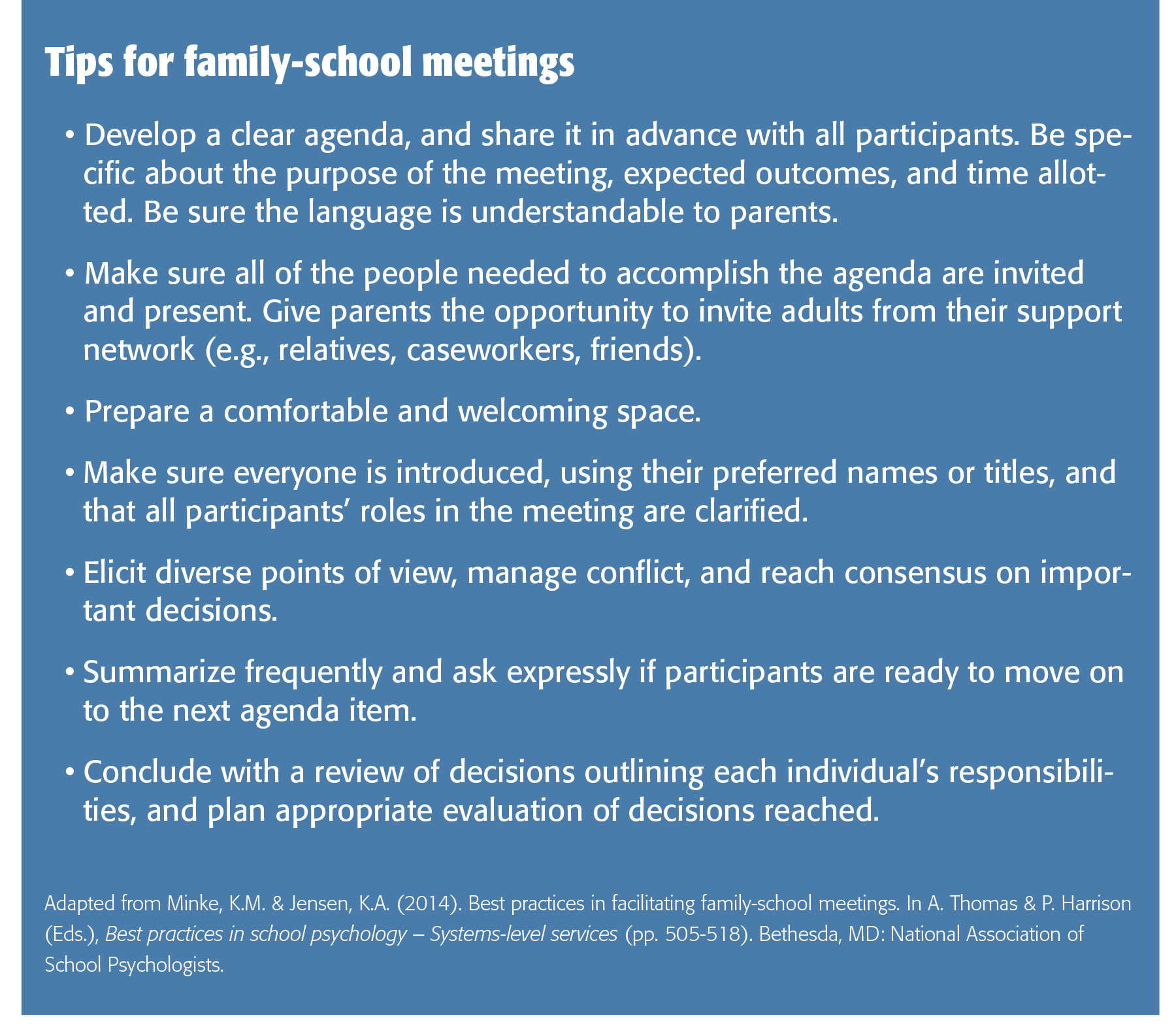
There are many excellent resources to help educators develop more effective family-school partnerships. However, teachers are inundated with “good ideas” that ask them to add activities to their already overflowing plates of responsibility. Therefore, in our work, we try to think how teachers can do whatever they are currently doing a little differently rather than doing more. The differences are designed to increase the likelihood that collaborative relationships will result. We divide the topics into three areas: thinking differently, communicating differently, and doing differently.
Thinking differently
- “She doesn’t work. I don’t understand why she can’t come to the school when we ask.”
- “The child just doesn’t get support at home.”
- “I’ve tried everything and nothing works with this family.”
Each of these statements, commonly heard in school staff rooms, reflects underlying beliefs and assumptions about families, which can negatively influence how we approach relationships with families. If we believe that parents don’t care about education and that change is impossible, we don’t have a very strong foundation for partnership. So it is important to think about the beliefs about families, problems, and solutions that guide our work, and challenge those that do not lead to productive relationships. In our graduate classes, we sometimes show the first few minutes of the movie “Home Alone,” where the family is preparing to go on vacation. We ask some students to write down all the problems they observe in the family. They do this easily, citing limited parental authority, disorganization, and lack of empathy. Other students write adjectives to describe the family. These are almost always negative descriptors such as chaotic, rude, out-of-control. Finally, some students are asked to write down the family’s strengths. They find this more difficult but generally note things like extended family bonds, good financial resources, and humor. They learn two things from this exercise. First, we really do see what we look for. It may take effort, but every family has strengths that we can make a point of discovering. Second, families are much more likely to want to work with us if we recognize their strengths and not just their problems and challenges.
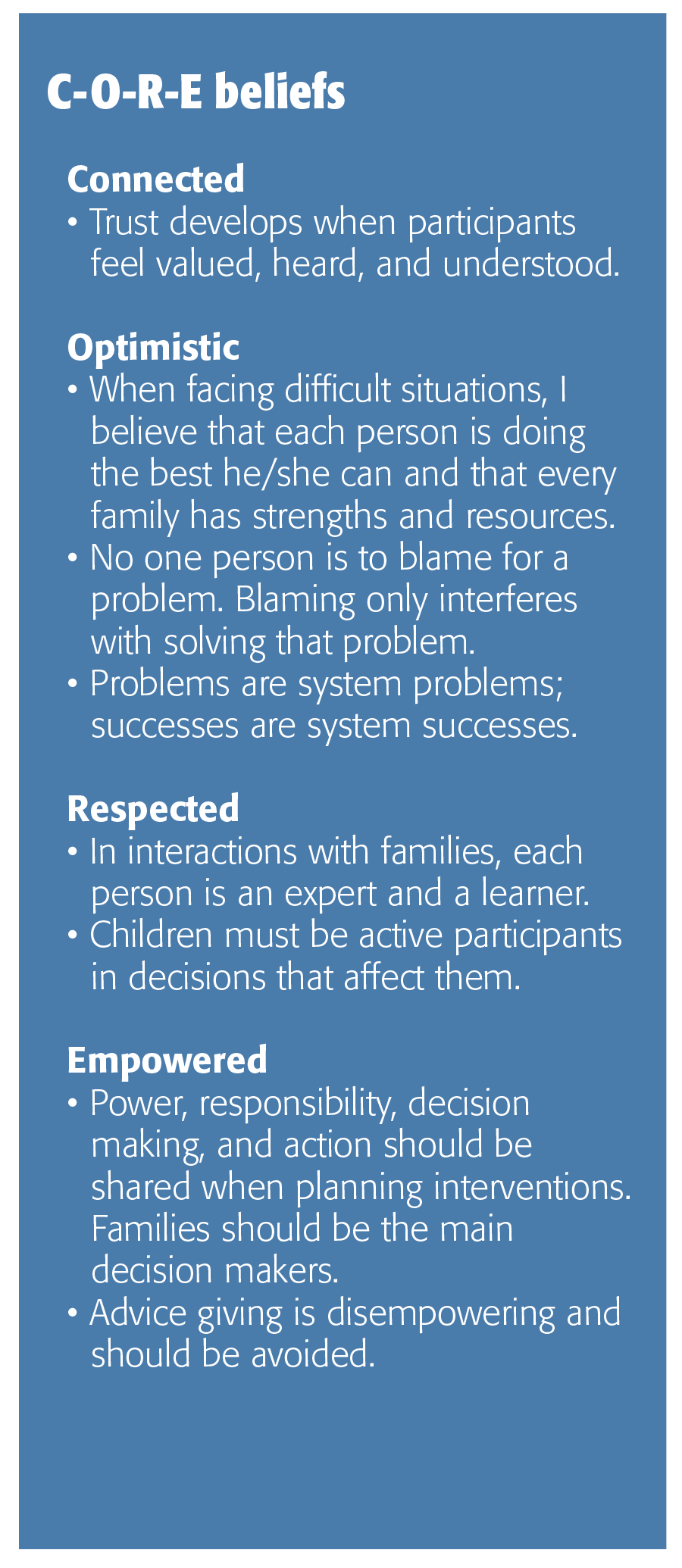
So what attitudes and beliefs should educators bring to the family-school relationship? Start with the assumption that others care about the child and that you have a shared goal of finding solutions that will support the child’s development. In our work, we summarize the thinking differently part with the acronym CORE. That is, following every interaction, we want families and educators to leave feeling more Connected, Optimistic, Respected, and Empowered than they did at the start of the interaction (see C-O-R-E beliefs sidebar; see also Minke, 2010 for more details). Consider the role of blaming in family-school interactions. When problems arise, parents may blame teachers and teachers may blame parents. Sometimes the adults get together and decide to blame the child! However, figuring out who is to blame does nothing to solve the problem. In fact, it actually impedes problem solving, as those who assign blame absolve themselves from responsibility for the solution and those who feel blamed generally become resentful and disengaged. In contrast, if our thinking is guided by the beliefs that everyone is doing the best he/she can and that we need to learn from others involved in the problem situation, we are much more likely to ask questions that will help us understand others, rather than judge them, and seek the strengths and resources that might have previously gone unidentified.
Communicating differently
Teachers often are called on to deliver very difficult information about a child’s lack of progress, and they do so with little or no training in effective communication strategies. Several years ago, we talked with parents and teachers about their experiences in parent-teacher conferences (Minke & Anderson, 2003). While we expected parents to find these conferences stressful, we were surprised that teachers felt the same way. They worried about their ability to say what needed to be said clearly but kindly. They worried about being attacked verbally or even physically. They used descriptors like “nerve wracking,” “sweating bullets,” and “unbearable” to describe their emotions. We found that learning some basic communication strategies greatly increased teachers’ confidence in delivering and receiving difficult information.
Skilled communication does not start with what you say, but rather with how you listen. And listening doesn’t begin with what others say, but rather with what they are communicating nonverbally. If a parent says she’ll agree to a psychoeducational evaluation for her daughter but is staring at the floor, sighing, and slumping in her chair while she says it, you can bet that more conversation is needed if you want to increase the chances of follow through. In this example, you might say, “Mrs. Howard, you look a little discouraged right now, and I’m wondering if you’re feeling uncomfortable with the assessment idea. Can we talk about this some more?”
Similarly, families from various cultural groups will differ in their preferences for how close people sit to one another, amount of eye contact, directness of communication, and many other variables. You can never assume that you know these preferences on the basis of membership in a particular group. Again, ask clarifying questions. A general rule of thumb: If you observe behaviors that make you think others are uneasy, ask. Ignoring nonverbal behavior will decrease your chances of forging a productive relationship.
Effective communication also involves understanding what the other person is trying to tell you. We use the acronym PRAY to summarize the communication skills needed for successful conversations. After someone finishes speaking, you Pause to gather your thoughts. Try to figure out what main message is being communicated, including emotions, whether implied or stated; then Reflect by making an empathic response that lets your partner know you understand their meaning. An empathic response has three parts:
- Restate or paraphrase what the other has said;
- Describe the emotions stated or implied; and
- Ask the other if you adequately understood their meaning.
You may stay in the Pause and Reflect phase for several turns, especially if there is a high degree of emotion. When ready, Ask for additional information, recognizing that parents often have valuable ideas to contribute and that people are more likely to follow through on ideas that they generate. Finally, if needed, offer Your ideas on the situation at hand. So, for example, a parent speaking quickly and with distress says, “Anna just won’t do what I tell her. How can I get her to get her homework done?” You might say, after pausing to gather your thoughts, “You are really worried about Anna not listening, and homework is a big part of the problem. Is that right? Tell me more about what happens at homework time.” Only after gathering a lot more information, including what the parent has already tried, might you make a suggestion about addressing this problem. A useful approach is to say, “Some families have tried [strategy X], while other families have tried [strategy Y]. Which do you think might work in your family?” This gives parents a choice and increased ownership of the intervention.
Space does not permit a full discussion of communication strategies, and they take a good bit of practice to learn well. Consult school psychologists and other school-based mental health service providers for ideas and training. Materials from training we use in Delaware’s Positive Behavior Supports project are available at delawarepbs.org.
 Doing differently
Many teachers get frustrated after having carefully planned parent involvement activities only to have a poor turnout; this can happen especially among families most in need of support. A good first step is to list of all of your current family engagement activities and gather needs assessment data from participants. Ask how you could encourage more parents to participate. Then investigate whether existing opportunities actually facilitate building positive relationships. If you have a back-to-school night, consider how you might make changes to serve parents who work nights — perhaps by offering the same event at a different time. If people do not have transportation, consider holding the event in a convenient community center. If families find the school intimidating, consider expanding the invitation to all family members, not just parents. Activities that bring educators into the community where children live can be especially helpful (Griffin, 2011). It is also helpful to ask parents their preferred mode of communication — phone, email, backpack notes, etc. — so that all families are aware of engagement opportunities. Christenson and Sheridan (2001) list typical activities and ways to make them more collaborative and relationship enhancing.
Consider also the ratio of positive to negative communications with parents. Starting the year by learning from parents about their views on how their child learns best, their hopes and dreams for the year, and their ideas on how you can best help them achieve those dreams can set the stage for productive working relationships. Include those questions in a brief survey that is part of student registration, or of the back-to-school activities. Some teachers make a space in their grade books to track regular positive contacts, making sure that every child’s parent receives positive feedback at least monthly.
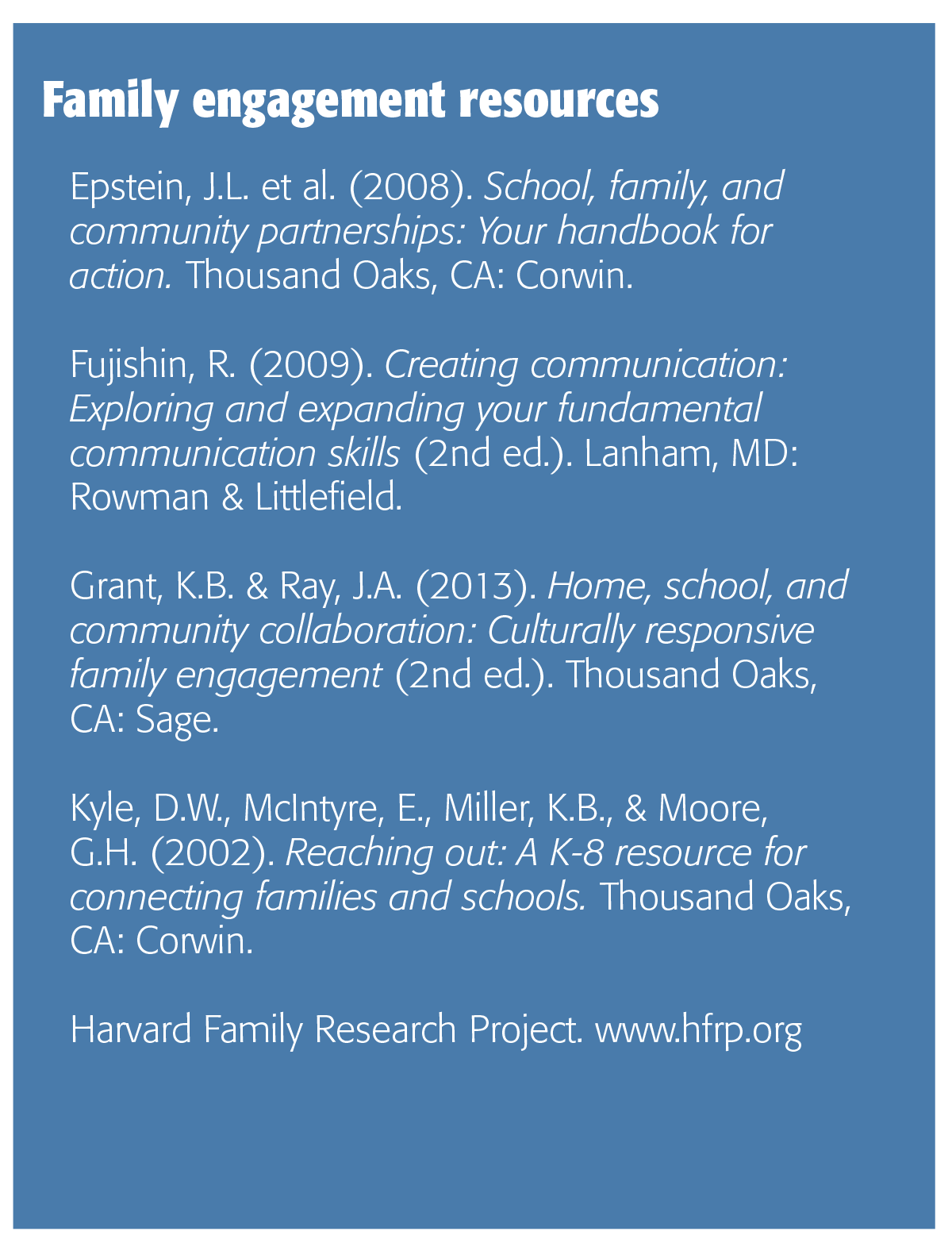
These positive contacts pay dividends when problems arise. The classroom teacher is often the first to introduce the idea that more intensive problem solving could help. Parents who believe the teacher has their child’s best interest at heart are more likely to engage in problem-solving activities than those who don’t. Applying good communication and relationship-building strategies in problem-solving meetings is also important. As a teacher, you’ll collaborate with others in creating effective team meetings; some tips are provided in the Tips for Family-School Meetings sidebar.
Conclusion
In the complex lives of today’s children and families, providing mental health supports requires the time and attention of concerned adults at home and at school. Thinking back to that IEP meeting, had we developed better relationships in advance and used more effective strategies in the meeting, we might have been far more successful in reducing blame, helping educators see the family’s need for support, and helping the parents see the importance of mental health services for their son. By carefully and deliberately developing positive relationships with students’ families, you will lay the foundation for a strong partnership that will support more effective interventions for students who need them.
References
Christenson, S.L. & Sheridan, S.M. (2001). Schools and families: Creating essential connections for learning. New York, NY: Guilford.
Farmer, E.M., Burns, B.J., Philip, S.D., Angold, A., & Costello, E.J. (2003). Pathways into and through mental health services for children and adolescents. Psychiatric Services, 54, 60-67.
Griffin, D. (2011). Parent involvement with African-American families in expanded school mental health practice. Advances in School Mental Health Promotion, 4 (2), 16-26.
Minke, K.M. (2010). Helping teachers develop productive working relationships with families: The CORE model of family-school collaboration. International Journal for School-Based Family Counseling, 2, 1-13. www.schoolbasedfamilycounseling.com/journal.html
Minke, K.M. & Anderson, K.J., (2003). Family-school conferences: An effective means to encourage parent involvement in education. Elementary School Journal, 104 (1), 49-69.
Shucksmith, J., Jones, S., & Summerbell, C. (2010). The role of parental involvement in school-based mental health interventions at primary (elementary) school level. Advances in School Mental Health Promotion, 3 (1), 18-29.
Citation: Minke, K.M. & Vickers, H.S. (2014). Get families on board to navigate mental health issues. Phi Delta Kappan, 96 (4), 22-28.
ABOUT THE AUTHORS

Harleen S. Vickers
HARLEEN S. VICKERS is a former school nurse and a retired assistant professor in the school counseling program at the University of Delaware, Newark, Del.
Kathleen M. Minke
KATHLEEN M. MINKE is a professor in the school psychology program at the University of Delaware, Newark, Del.