
A curriculum that incorporates an expansive understanding of leadership opens doors for all students.
When they were 10 and 12 years old, sisters Melati and Isabel Wijsen noticed an overwhelming amount of plastic threatening their island home in Bali. At the time, enough plastic to fill a 14-story building was generated in Bali every single day. The sisters founded the Bye Bye Plastic Bags crew with the goal of eliminating plastic bags. Within three years, the remote village where they piloted the project was two-thirds of the way to plastic-bag free. Since then, the Bali president has pledged the entire country would become plastic-bag free, and the Bye Bye Plastic Bags team has expanded to include more than 50 global groups and has spoken to more than a million students.
This story of youth leadership demonstrates several important components of leadership, including problem identification, flexible thinking, prototyping, persistence, and the ability to mobilize others. It also shows us that some students, like Melati and Isabel, are natural leaders (Boerma et al., 2017). Our research team is examining how we can develop all students as leaders, whether they lead national movements or classroom group projects.
When Melati and Isabel Wijsen (2015) spoke about their school experiences, they mentioned that their teachers shared stories of famous leaders who changed the world (such as Mahatma Gandhi); however, they did not discuss learning specific leadership skills. Many educators want to help students take initiative and grow as leaders, yet they lack training or curriculum to support these efforts. Our Project Brilliance seeks to support teachers and schools as they systematically develop leadership skills within students.
We believe all students have brilliance and that educators can identify and support that brilliance. Thus, to understand how to develop leadership skills, we have explored existing conceptual leadership frameworks, established a consistent definition of leadership, and created learning experiences to develop students’ leadership skills.
Leadership development research
Historically, experts viewed leadership as an innate ability, later defining it as a specific set of behaviors. Recently, the understanding of leadership has deepened, recognizing the intricate interplay between the environment, individual motivation, and the harmony between leaders and their teams (Benmira & Agboola, 2021).
Leadership development has been widely discussed and studied within the industry/organizational (I/O) psychology field (Avolio et al., 2004; Jones & Olkens, 2005; Mastrangelo, Eddy, & Lorenzet, 2014; Vogel et al., 2020). U.S. companies spend billions of dollars on leadership training initiatives, translating to approximately $1,252 per employee (Gurdjian, Halbeisen, & Lane, 2014; Ho, 2016).
Evidence suggests this investment pays off. A recent meta-analysis (Lacerenza et al., 2017) examined results across 335 leadership training programs, finding these programs significantly increase participants’ skills and knowledge in areas relevant to leaders (such as communication skills and relationship-building). Trainees’ ability to transfer those skills to their own organizations affected the organizations’ ability to reach their objectives, including increasing profits and reducing turnover. Therefore, it is unsurprising that much of the research and development surrounding leadership training is focused on the adult population (Tackett et al., 2022).
We believe all students have brilliance and that educators can identify and support that brilliance.
Despite researchers and theorists working from different fields, they have reached several shared conclusions about what leadership training looks like among adults (Vogel et al., 2020). And we synthesized their ideas into our working definition: Leadership is the ability to influence, motivate, and enable others to work toward a common goal.
Exploring preK-12 leadership development
Given the success of I/O training programs, we were excited to examine the types of programs used in preK-12 settings. However, when we looked for research on leadership training for preK-12 students, we were surprised to identify only four studies that presented empirical findings. All four studies examined summer enrichment opportunities for middle or high school students. Each program used different initial assessments, program curricula, and pedagogical methods.
Beyond these empirically studied programs, other leadership programs and curricula have been developed, such as the Changing Tomorrow curriculum (Avery & VanTassel-Baska, 2021; VanTassel-Baska & Avery, 2021a, 2021b) and the Leader in Me programs (Covey et al., 2014). But we were unable to identify any peer-reviewed studies of these programs’ outcomes. Therefore, we focused our review on four leadership programs that have been examined in peer-reviewed journals.
Leadership Studies Program
In the Leadership Studies Program (Kames, Meriweather, & D’Llio, 1987), students took a leadership skills inventory in which they rated themselves on their leadership skills (e.g., interpersonal, communication, planning, and personal development). Using these student ratings, teachers selected activities to help students grow in their weakness areas. Critically, the teachers did not receive specific training on promoting students’ growth in leadership. At the end of the program, students rated themselves significantly higher on all measured leadership skills.
Superintendent’s Leadership Conference
This program prioritized the cognitive, affective, and physical components of leadership (Smith, Smith, & Barnette, 1991). Students in the program listened to a speaker on each of these topics and participated in a follow-up discussion. For example, under the cognitive domain, students were taught communication, problem solving, decision making, risk-taking, planning, and group dynamics and then worked together in a tower-building competition. For the physical aspects, students participated in trust falls and other physical games, with follow-up instruction connecting the games to real life. After participating in this program, students scored themselves higher in openness and persuasion than they did before the program but not on organizing information for team members. Students also reported that three months after the program they were using knowledge and skills developed in the program.
Creative Leadership Training Program
This program emphasized cognitive aspects of leadership, such as goal setting, planning, problem solving, interpersonal communication, decision making, and conflict resolution (Chan, 2000). The program presented students with biographies of leaders and historical figures and challenged students to recognize their leadership characteristics. Students also did team-building exercises examining group dynamics and establishing shared group goals. On a self-rating scale before and after the program, students demonstrated significant growth in many different areas, including self-confidence, courage, and debating ability.
Civic Leadership Institute
This curriculum prioritized societal leadership and included instruction on racism, poverty, education reform, youth violence, and public health (Lee et al., 2007, 2008). Students engaged in discussions and debates, listened to guest speakers, visited local historical sites, and met with local leaders from advocacy groups, politicians, and community organizers. Again, using self-rating scales, students demonstrated a greater awareness of civic issues and community connection and commitment; however, they did not demonstrate significant growth in civic behavior and leadership skills.
Collectively, these programs provide initial evidence for the success of leadership training programs in middle and high school students. However, these studies have several limitations that future work should address. Specifically, within our project, we are expanding student access by implementing the program among elementary students from low-income and diverse backgrounds. We will use treatment and control groups to establish program effectiveness, and we will measure leadership skills using live scenarios to better capture real-life situations.
A framework for student leadership
As mentioned, research on leadership development is abundant for adults but scarce for preK-12 students. PreK-12 students inevitably display different characteristics and needs than those within an adult population. To bridge this gap, we propose a versatile framework based on a clear premise: Leadership involves guiding, inspiring, and empowering others to pursue a shared objective. This definition intentionally avoids detailing specific leadership competencies, focusing instead on the essence of a leader’s role in driving team success. It suits both adults and students, offering a foundation for leadership across different developmental levels.
Effective leaders steer their teams toward actions that achieve collective aims (Bertrand, Mullainathan, & Shafir, 2004; Feldhusen & Pleiss, 1994). This leadership role typically involves wielding social influence, facilitating communication, spearheading problem-solving efforts, and setting group goals. These responsibilities differ by role and context, so any model for leadership development must be flexible enough to adapt to these variations.
Levels of leadership
Leadership roles vary widely, ranging from directing class projects, overseeing employees, to leading nations. Yet explicit discussions of leadership in schools tend to focus on eminent leaders. The Changing Tomorrow series, for example, uses lessons from the lives of Walt Disney, Clara Barton, and Ben Carson (Avery & VanTassel-Baska, 2021; VanTassel-Baska & Avery, 2021a, 2021b). Similarly, other programs engage students with sessions featuring legislators and notable business figures (Lee et al., 2007, 2008). Even our previously discussed activists, Melati and Isabel Wijsen (2015), described learning about heroic leaders.
While such approaches are undoubtedly inspiring, students have trouble connecting the lives and opportunities of these great leaders to their own lives. For example, one study finds that tales of eminent leaders seem distant from students’ everyday realities, struggles, and ambitions (Lin-Siegler et al., 2016). Not everyone dreams of leading major corporations or entering politics. Leadership is as critical in day-to-day tasks as it is in achieving lofty goals. Just as we do not teach students to be mathematicians by studying Euclid, Hypatia, or Pythagoras, we cannot teach students to be leaders by only learning about Walt Disney. In math, students learn addition, fractions, and specific theorems, rather than learning the whole of “math.” Similarly, young leaders can learn a progression of skills and processes, rather than learning the whole of “leadership.”
The leadership continuum
We developed the 4L Continuum to provide a framework for understanding the different levels of leadership and identifying the necessary skills at each level. We were inspired by the 4C Model of Creativity (Kauffman & Beghetto, 2009), which suggests there are different levels of creative influence — from little-c (decorating a room) to Big C (painting a widely recognized masterpiece). Much like creativity, leadership encompasses everything from everyday scenarios to transformative global change. Not every leader needs to be Steve Jobs.
Our framework (Figure 1) starts with self-leadership (Mini-L); progresses through leading small groups (Little-L); advances to guiding other professionals (Pro-L); and culminates in driving broad systemic change (Big-L). A student who leads a science group project embodies leadership just as much as a corporate CEO does, albeit on a different scale. Each level of leadership necessitates unique skills and attitudes.
Understanding that not every individual aspires to or is suited for Big-L leadership is crucial. Engaging in Mini-L, Little-L, or Pro-L leadership is equally valid and significant. This framework helps identify what activities can elevate individuals to their preferred level of leadership, while emphasizing that aspiring to Little-L is commendable and valuable. It’s about finding one’s fit in the broad expanse of leadership possibilities, nurturing the skills for that specific level, and making a difference within one’s chosen sphere.

Student leadership skills
Mini-L leadership incorporates key components from self-regulation theories, such as planning, goal-setting, employing strategies, monitoring, and reflecting (Zimmerman, 2012). All of these can be taught and leveraged in leadership situations. Moreover, to enhance early abilities in supporting and leading others, we have emphasized little-L leadership, as it unfolds in formal and informal small-group settings common in preK-12 classrooms. By recognizing the significance of this level, curriculum development professionals can strategically design programs that cater to the nuances of leading in collaborative classroom environments.
Developing little-L leadership
To understand how to develop Little-L leadership skills and processes in elementary students, we collected information regarding students’ concepts of leadership. When we asked students what makes a good leader, many students simply repeated common uses of the word “leader” they often hear in a classroom setting:
- Following the rules and doing what you are supposed to.
- Doing a lot of work.
- Following directions.
- Being the line leader.
These responses demonstrate a somewhat narrow, passive definition. Student “leaders” are simply modeling behaviors that will support the teacher and class goals, but the students are not actively encouraging and enabling others.
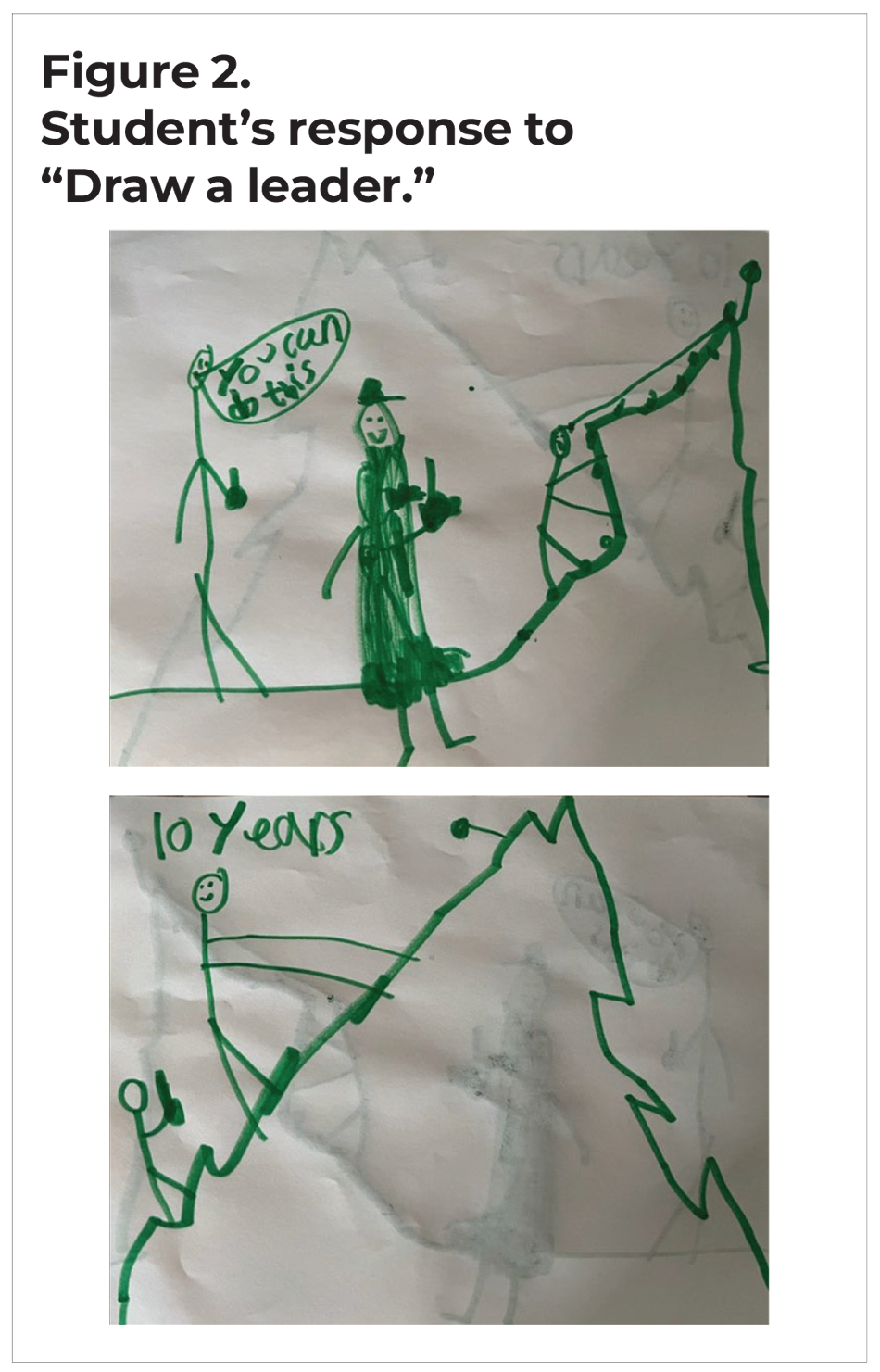
We also asked a different group of students to draw a leader. This yielded several interesting responses, but our favorite was a student’s drawing that showed a leader helping someone climb to the top of the mountain to press a button. While we were uncertain about the button’s purpose, the picture clearly demonstrates key components of a broader leadership definition, including a leader offering motivation and support to accomplish a specific goal. This student extended this leader’s influence on the back of the drawing with a picture of the original climber leading a new climber 10 years later (see Figure 2).
Through these conversations, we noticed students’ definitions were extremely specific (line leader) or very generic (doing the right thing). They needed instruction in both leadership vocabulary and skills. Establishing the vocabulary of leadership helps students distinguish between following directions and enabling others to accomplish a task, and skill instruction is important to students who may not be natural leaders. We are embedding this instruction into existing content areas so teachers do not need to implement a separate leadership program but can integrate it when students work in small groups.
Specifically, Little-L leadership requires both strategic and interpersonal skills. These leaders must inspire their team to work together to complete the project on time and within the specified guidelines. This requires a constellation of interpersonal skills, including motivating, providing feedback, and earning team members’ trust. Further, Little-L leaders need to be strategic thinkers who can identify goals and objectives, develop a plan, and assign appropriate roles to team members. These skills and processes became our project’s key objectives, which we embedded within our Brilliant Storytellers curriculum (a reading/language arts curriculum embedded within a performing arts context).
Interpersonal skills
Little-L leaders need interpersonal skills to build and sustain relationships with others. To build these relationships, leaders must communicate clearly, provide constructive feedback, and inspire their team members for success. We interviewed one teacher who described how her students naturally displayed these skills during a student council election. Specifically, two students recognized the student body wanted multiple perspectives within their class president, so they decided to run as co-presidents. They created their platform, communicated it with the student body, and developed an advertising campaign.
While some have natural interpersonal skills, many students can build or improve these skills. In Brilliant Storytellers, we help students explore interpersonal skills by taking on the role of a director. A director needs to be able to read the script, develop ideas for how actors will move through the scene, plan a rehearsal, and provide feedback. These processes require deep understanding of the script (reading comprehension), but also present an opportunity for students to develop leadership skills. To address interpersonal skills, we are building lessons on how directors provide actionable feedback. We are teaching students that feedback is neither good nor bad, but rather it is helpful or not. We ask students to give feedback that will help team members improve, and we teach specific sentence starters to guide them.
Not everyone dreams of leading major corporations or entering politics. Leadership is as critical in day-to-day tasks as it is in achieving lofty goals.
One powerful approach that we share is to simply notice — or give information (Ginott, 1965). For instance, the leader may notice the speaker is swaying while delivering a speech and say, “I see that you are swaying.” Children who receive the information then decide how they need to respond. They can explain why swaying is important, or they can adjust their behavior. Within the directing unit, students call this process “giving notes,” the same phrase directors use, which adds authenticity to the feedback.
Strategic skills
Another essential aspect of Little-L leadership is the development of strategic skills, specifically identifying goals and objectives, developing a plan, and assigning team members’ appropriate roles. One teacher we interviewed gave an excellent example of a student naturally demonstrating that set of skills. This band director caught COVID and missed a week of class right before a concert. One of the seniors created a plan for the band to continue to practice, improve, and be prepared for the concert. The student filmed the class practices, emailed the teacher, got feedback, and shared it with the rest of the band. This enabled the band to put on the concert, even without their director. This high school student strategically led the team to accomplish the goal.
The band student naturally demonstrated strategic skills, but intentional instruction in these skills is possible in any subject. For example, within Brilliant Storytellers, directors must develop plans for their rehearsals. Initially, we give them a template with options for an opening activity, practice goal, activities that match the goal, and a debrief on what they noticed. The key to embedding this instruction in any group activity is providing student leaders time to prepare for leading. Often, we simply identify a student as the group leader in the moment; however, good leaders prepare for their team. They may use a meeting agenda, a lesson plan, or a rehearsal guide, but they use their planning skills to increase collaboration and to promote successful outcomes.
The future of leadership development
Curriculum developers can create engaging lessons and activities that mirror real-world small group dynamics, providing students with authentic experiences to enhance their interpersonal and teamwork skills. Leadership education that is relevant, impactful, and applicable to all students’ immediate experiences builds a more comprehensive understanding of leadership. Knowing specific components of leadership and examples of how students can display these skills enables teachers to embed intentional instruction and assessment of these skills in every classroom.
Within leadership skill development, students and teachers need to understand that while there are naturally gifted leaders, every student has the potential to grow their leadership skills — no students’ abilities are fixed. With time, patience, and instruction, every student can grow to be a brilliant leader.
Note: This work is funded through Jacob K. Javits Gifted and Talented Students Education Program, United States Department of Education PR/Award #S206A220014
References
Avery, L.D. & VanTassel-Baska, J. (2021). Changing Tomorrow 3: Leadership curriculum for high-ability high school students (Grades 9-12). Routledge.
Avolio, B.J., Gardner, W.L., Walumbwa, F.O., Luthans, F., & May, D.R. (2004). Unlocking the mask: A look at the process by which authentic leaders impact follower attitudes and behaviors. The Leadership Quarterly, 15 (6), 801-823.
Benmira, S. & Agboola, M. (2021). Evolution of leadership theory. British Medical Journal- Leader 5, 3-5.
Bertrand, M., Mullainathan, S., & Shafir, E. (2004). A behavioral-economics view of poverty. American Economic Review, 94 (2), 419-423.
Boerma, M., Coyle, E.A., Dietrich, M.A., Dintzner, M.R., Drayton, S.J., Early II, J.L., . . . & Williams, N.T. (2017). Point/Counterpoint: Are outstanding leaders born or made? American Journal of Pharmaceutical Education, 81 (3), 58.
Chan, D.W. (2000). Developing the creative leadership training program for gifted and talented students in Hong Kong. Roeper Review, 22 (2), 94-97.
Covey, S.R., Covey, S., Summers, M., & Hatch, D.K. (2014). Leader in me: How schools around the world are inspiring greatness, one child at a time (2nd ed.). Simon and Schuster.
Feldhusen, J.F. & Pleiss, M.K. (1994). Leadership: A synthesis of social skills, creativity, and histrionic ability? Roeper Review, 16 (4), 293-294.
Ginott, H.G. (1965). Between parent and child. Three Rivers Press.
Gurdjian P., Halbeisen T., & Lane K. (2014). Why leadership-development programs fail. McKinsey Quarterly.
Ho, M. (2016, November). Investment in learning increases for fourth straight year. Talent Development.
Jones, B.F. & Olken, B.A. (2005). Do leaders matter? National leadership and growth since World War II. The Quarterly Journal of Economics, 120 (3), 835-864.
Kames, F.A., Meriweather, S., & D’Llio, V. (1987). The effectiveness of the leadership studies program. Roeper Review, 9 (4), 238-241.
Kaufman, J.C. & Beghetto, R.A. (2009). Beyond big and little: The four c model of creativity. Review of General Psychology, 13 (1), 1-12.
Lee, S.Y., Olszewski-Kubilius, P., Donahue, R., & Weimholt, K. (2007). The effects of a service-learning program on the development of civic attitudes and behaviors among academically talented adolescents. Journal for the Education of the Gifted, 31 (2), 165-197.
Lee, S.Y., Olszewski-Kubilius, P., Donahue, R., & Weimholt, K. (2008). The Civic Leadership Institute: A service-learning program for academically gifted youth. Journal of Advanced Academics, 19 (2), 272-308.
Lin-Siegler, X., Ahn, J.N., Chen, J., Fang, F.F.A., & Luna-Lucero, M. (2016). Even Einstein struggled: Effects of learning about great scientists’ struggles on high school students’ motivation to learn science. Journal of Educational Psychology, 108 (3), 314.
Mastrangelo, A.R. Eddy, E., & Lorenzet, S.J. (2014). The relationship between enduring leadership and organizational performance. Leadership & Organization Development Journal, 35 (7), 590-604.
Lacerenza, C.N., Reyes, D.L., Marlow, S.L., Joseph, D.L., & Salas, E. (2017). Leadership training design, delivery, and implementation: A meta-analysis. Journal of Applied Psychology, 102 (12), 1686-1718.
Smith, D.L., Smith, L., & Barnette, J. (1991). Exploring the development of leadership giftedness. Roeper Review, 14 (1), 7-12.
Tackett, J.L., Reardon, K.W., Fast, N.J., Johnson, L., Kang, S.K., Lang, J.W., & Oswald, F.L. (2023). Understanding the leaders of tomorrow: the need to study leadership in adolescence. Perspectives on Psychological Science, 18 (4), 829-842.
VanTassel-Baska, J. & Avery, L. (2021a). Changing Tomorrow 1: Leadership curriculum for high-ability elementary students (Grades 4-5). Routledge.
VanTassel-Baska, J. & Avery, L. (2021b). Changing Tomorrow 2: Leadership curriculum for high-ability middle school students (Grades 6-8). Routledge.
Vogel, B., Reichard, R. J., Batistič, S., & Černe, M. (2021). A bibliometric review of the leadership development field: How we got here, where we are, and where we are headed. The Leadership Quarterly, 32 (5), 101381.
Wijsen, M. & Wijsen, I. (2015, September). Our campaign to ban plastic bags in Bali [Video]. TEDGlobal.
Zimmerman, B. J. (2013). From cognitive modeling to self-regulation: A social cognitive career path. Educational Psychologist, 48 (3), 135-147.
This article appears in the May 2024 issue of Kappan, Vol. 105, No. 8, p. 8-13.

ABOUT THE AUTHORS

Lisa DaVia Rubenstein
Lisa DaVia Rubenstein is an professor in the Department of Educational Psychology at Ball State University, Muncie, IN.
Sydney Katherine Johnson
Sydney Katherine Johnson is a doctoral student of educational psychology at Ball State University, Muncie, IN.
Allison Southworth
Allison Southworth is a doctoral student of educational psychology at Ball State University, Muncie, IN.
Gerardo Ramirez
Gerardo Ramirez is an associate professor in the Department of Educational Psychology, at Ball State University, Muncie, IN.