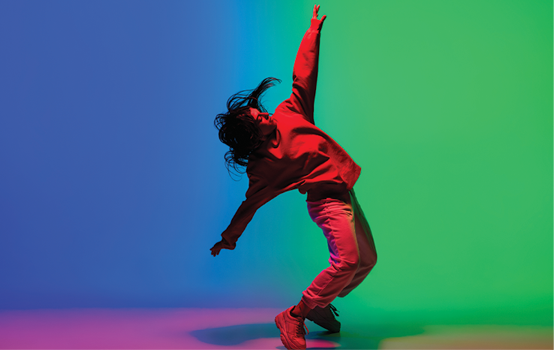
I don’t remember where we were going. I only recall being a child, maybe eight years old, sitting in the back seat of the car witnessing something cosmological. A song played — its name I, too, have forgotten. I just remember my father and uncle in the front seats nodding their heads in sync, the holy spirit of hip-hop washing over them.
That moment was an example of how hip-hop has always been much more than music. It’s a higher power. It joins together a people stolen from their homeland. It’s an expressive form of freedom that now touches every corner of the world — a freedom railroad no longer underground.
This past year, hip-hop celebrated its 50th anniversary. This is an opportune moment, then, to take a step back and reassess what hip-hop has meant for the American education system and what it means moving forward. We should consider how not just teachers and school leaders but also policy makers should be making the genre a part of their work.
A history of exclusion
There is poetic justice to the idea of hip-hop as an education policy tool. The cultural movement began in 1973 when DJ Cool Herc scratched a record for the first time during a back-to-school jam he hosted for his sister. It was a sound born to whisper wishes of academic accomplishment to its young audience.
This initial setting casts irony over the ensuing uneasy relationship between hip-hop and America’s schools. As hip-hop culture incorporated rap, the culture spread. And as it blossomed into a form of Black youth political and cultural expression, schools serving those Black youth barred hip-hop from the halls.
This was deliberate. Schools knotted the tie between rap music and the school-to-prison pipeline by making its use in schools a punishable offense. The arguments for policing rap music have always hearkened negative stereotypes of hip-hop culture. It was (and still often is) seen as the music of gang activity, of the glorification of violence, of sexually explicit behavior (Rose, 2008). These harmful messages appear in rap music, but also in jazz, rock ‘n’ roll, heavy metal, and country — genres born out of anti-establishment, countercultural sentiments.
Still, the flimsiness of the arguments against hip-hop did not stop students, mostly Black, from facing school discipline for embracing it. Back in 1990, a Tallahassee, Florida, high school principal suspended 200 students for boycotting classes after the principal barred a Black student, Clayton Gavin, from performing a rap song he wrote for Black History Month. A decade after the boycott in Florida, an Arkansas school board voted to expel a male student for writing a rap song about an ex-girlfriend that contained, according to official court documents, “two violent, misogynistic, and obscenity-laden rants.” The case (Doe v. Pulaski County Special School District) climbed up to the federal court of appeals where the court upheld the expulsion. While the student’s suspension may have been justified in that instance, this case established legal precedent in the federal courts for students to be punished when creating or engaging with rap music that can be perceived as threatening or harmful. Bringing rap to school became a risky act nationwide.
The value of incorporation
What’s the problem with keeping hip-hop out of schools if hip-hop brings harm? The problem is that the perception that hip-hop is harmful obstructs people’s view of the magical parts. Underneath the seedy subgenres, there is — and always has been — beauty, art, literature, and science (Perry, 2005). For example, Grandmaster Flash’s quick mix theory involves a precise mathematical technique for looping (and therefore sampling) sounds from preexisting records. Early emcees were known as poets. An analysis by visual journalist Matt Daniels (2019) reveals that within their first 35,000 lyrics, the average successful hip-hop artist uses more than 4,000 unique words. For context, the average rock artist uses about 3,400 unique words in that span, while the average country artist uses closer to 3,000 different words. Hip-hop is an art form and an intellectual enterprise.
In a subfield called Hip-Hop-Based Education (HHBE), cultural anthropologists and critical pedagogy scholars have provided empirical evidence that hip-hop-based curricular interventions deepen student engagement, facilitate their growth in knowledge of academic concepts, and train them in critical analysis skills (Alim, 2006; Dimitriadis, 2009; Hill, 2009; Ladson-Billings, 2021; Love, 2013). This begins with recognizing hip-hop as a tool that directly links the identities and lived experiences of kids, particularly Black kids, to a range of concepts and skills. As Marc Lamont Hill (2009) puts it, “youth often consume hip-hop culture in ways that reorganize their conceptions of youth culture” (p. 121).
Over the past three decades, we have seen scholars and educators developing hip-hop curricula. H. Samy Alim (2006) describes a hip-hop nation language, and multiple curricular models naturally center on the idea of leveraging this language to expand students’ literacy. We see its influence across the nation, from Waterloo, Iowa, where Shuaib Meacham leads a hip-hop literacy camp to New York City, where the Department of Education offers a
hip-hop literacy program.
Hip-hop curriculum is not limited to literacy. Scholars have developed and implemented digital math and science curricula that use hip-hop to deepen kids’ knowledge (Emdin, 2013). In fact, scholars at Columbia University have developed a “menu board calorie literacy” instrument into a hip-hop curriculum model to help kids learn about healthy nutrition. Hip-hop has become a curricular movement.
Toward a future of hip-hop in education
So, where do we go from here? For hip-hop’s second 50 years, one focus needs to be on integrating hip-hop into the system level of education. How can we use hip-hop as not just a special tool on the margins but as a more central and legitimized component of American education? There are several pathways to take.
One route is standard assessment reform. Many of the same kids whose achievement scores point to cultural biases in testing are the very youth who have gravitated to hip-hop as a form of cultural expression. Why not merge the two? We need state assessments for literacy, math, science, and civics that integrate hip-hop culture. Imagine if state tests in reading comprehension featured questions that incorporated hip-hop lyrics or asked kids about the process of making hip-hop music. What if state math exams built questions around the mathematics of hip-hop DJ mixing? “How many bars of music does it take to create four different loop extractions?” (The answer is 16.)
Another route is through teacher preparation. Every state has certification standards for teachers that anyone aspiring to enter the teacher workforce must meet. Most states require teachers complete a certification program at an accredited university. Why not require certification programs to offer some pedagogical training rooted in hip-hop culture? Again, if there is clear evidence that hip-hop-related interventions motivate student engagement, certification programs should offer teachers the opportunity to receive this training.
The third route I want to mention is using hip-hop to better connect schools to the culture. Not every child grows up to be a doctor, lawyer, professor, or engineer. In fact, many of our kids, especially our Black kids, enter what I refer to as the culture economy. They go on to plan and promote musical or cultural events. They become musical artists or get involved with musical or visual production. They become influencers, podcasters, and people who profit from their ability to discuss and shape culture.
This a troubling oversight within education. How many of the kids we write off as high school or college dropouts find economic survival through hip-hop culture? We do not know the answer because the American education system continues to reject the idea of hip-hop culture as something central and constructive. Accepting hip-hop could completely change the way we view success in our society. Instead of ignoring nontraditional paths, we can build curricular models that more intentionally equip those who enter the culture economy with academic, technological, and civic skills.
I was born into hip-hop. That is, I was born into something magical. It is magical because the aesthetics of hip-hop — the head nod, the two-step, the funky faces made over the perfect lyric — were never formally taught to me. It was a quiet inheritance, a dowry received through the love of movements and sounds. Hip-hop is a sense of comfort. It is the warmth of knowing that “2pac cares / if don’t nobody else care.” This is the magic we should spread.
What will hip-hop look like in another 50 years? It is hard to fully imagine, but this next half century presents a golden opportunity. We can use hip-hop to help us reimagine education policy.
I can nod to the sound of that.
References
Alim, H.S. (2006). Roc the mic right: The language of hip-hop culture. Routledge.
Daniels, M. (2019, Jan. 21) The largest vocabulary in hip-hop. The Pudding.
Dimitriadis, G. (2009). Performing identity/performing culture: Hip-hop as text, pedagogy, and lived practice (Vol. 1). Peter Lang.
Emdin, C. (2013). Pursuing the pedagogical potential of the pillars of hip-hop through urban science education. The International Journal of Critical Pedagogy, 4 (3).
Hill, M.L. (2009). Beats, rhymes, and classroom life: Hip-hop pedagogy and the politics of identity. Teachers College Press.
Ladson-Billings, G. (2021). Culturally relevant pedagogy: Asking a different question. Teachers College Press.
Love, B.L. (2015). What is hip-hop-based education doing in nice fields such as early childhood and elementary education? Urban Education, 50 (1), 106-131.
Perry, I. (2004). Prophets of the hood: Politics and poetics in hip-hop. Duke University Press.
Rose, T. (2008). The hip-hop wars: What we talk about when we talk about hip-hop—and why it matters. Civitas Books.
This article appears in the April 2024 issue of Kappan, Vol. 105, No. 7, pp. 60-61.

ABOUT THE AUTHOR

Jonathan E. Collins
Jonathan E. Collins is an assistant professor of political science and education at Teachers College, Columbia University, New York, the associate director of the Teachers College, Columbia University Center for Educational Equity, and the founder and director of the School Board and Youth Engagement (S-BYE) Lab.