One journalist recreated the feeling of a complicated reopening despite not being able to be in the schools. How’d she do it?
By Alexander Russo
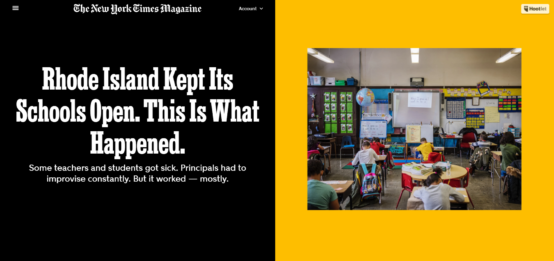
When reporter Susan Dominus published her latest feature story in the New York Times magazine earlier this month, it generated a lot of attention.
The response was no big surprise. The feature story focused on Rhode Island, one of the few Democratic-controlled states where officials had managed to reopen schools in the fall for in-person learning. And it provided a vivid and relatively uncommon depiction of what it’s like inside a reopened school system.
In the following interview, Dominus explains how she reported and wrote a story that included political, legal, and logistical elements along with strong characters and emotions – without going into school buildings.
“I wanted to get into a level of detail that brought home the day-to-day experience of uncertainty and unpredictability happening at schools,” Dominus told me. Educators and administrators “weren’t trained in public health, and yet were being extremely resourceful about how they approached a health issue of serious consequence.”
This interview has been edited and condensed for clarity.
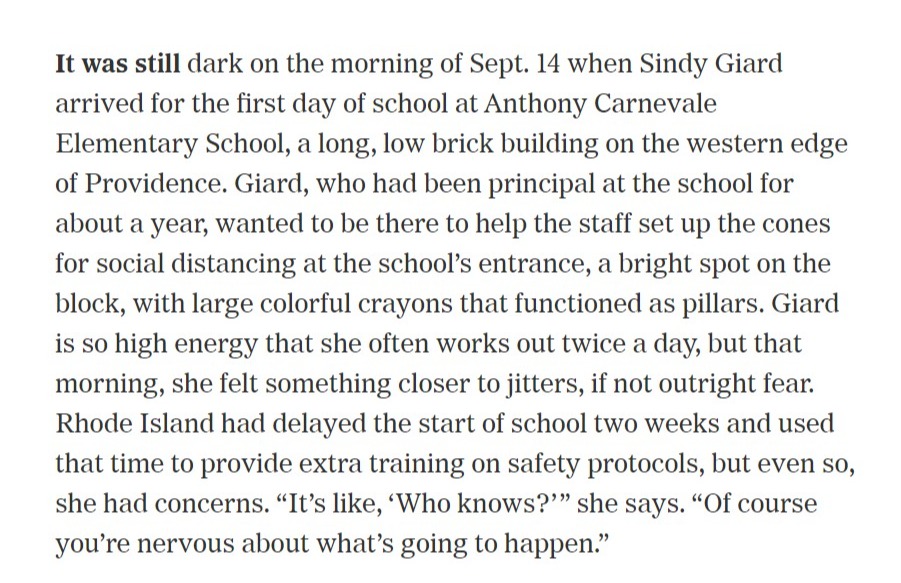
Above: An excerpt from the middle section of the piece, in which Dominus describes the experiences of educators and parents as schools reopened.
Just in case there’s anyone who hasn’t read it, can you give us the quick and dirty summary of your piece, Rhode Island Kept Its Schools Open. This Is What Happened?
Dominus: The story I wrote is about the state of Rhode Island, where Gov. Gina Raimondo had decided back in June, unlike most blue state governors, that she was going to make opening the schools a major priority. I was curious to see how she was able to do that — and also about what the experience was like for teachers, working in schools in a state where COVID rates were extremely high.
What were you trying to do that hadn’t been done already?
Dominus: I wanted to tell the arc of a school system that started open in September and pretty much stayed that way through the end of December. What was the experience of having those schools open during a time of high COVID? I wanted to get into a level of detail that brought home the day-to-day experience of uncertainty and unpredictability happening at schools for the people in charge and the teachers. They weren’t trained in public health, and yet were being extremely resourceful about how they approached a health issue of serious consequence. There has been a lot of demonization of teachers this year, obviously; here were teachers just doing their jobs, under pretty tough circumstances, which I found compelling. The question of school openings has been very black and white. But one can believe that the schools should be open while also acknowledging that, in practice, that project took a toll on educators.
What was the experience of having those schools open, and how did it play out in state politics?
Dominus: I focused on Providence, where the school year was extremely challenging and there were a lot of disruptions because of quarantines. The case numbers were high in the community, which meant that cases were also inevitably cropping up in the schools, and that also created a lot of stress. Contact tracing was overwhelmed, so it was hard for people to know the origins of the COVID-positive cases, but there was no report (from the union, at least) of in-class super-spreading events, and by the end of January, many of the teachers I spoke to, and one union representative, said that staffing, more than safety, felt like the real issue.
The kids who were attending school in-person had better academic outcomes than those who were remote and there were other important public health outcomes, like vaccination rates, that seemed to connect to the schools being open. It was moving to me what teachers were willing to do in order, or rather, had to do, to try to keep it together, because it wasn’t easy. On a state level, there was tension at times between the governor and the superintendents who felt they needed to close their districts’ schools for various limited periods. But Raimondo generally walked a line between setting high expectations, while also trying hard to provide resources and innovative problem-solving.
“They weren’t trained in public health, and yet were being extremely resourceful about how they approached a health issue of serious consequence.”
How did you pick Rhode Island and Providence?
Dominus: I thought that Governor Raimondo was herself an interesting story. There were other Democratic governors who were encouraging school openings, at least in the blue states, but there was no other governor who was that intent on it. As I write in the article, she actually threatened to help parents sue in a district that was disinclined to open. And I was interested in Providence because it was an example of a district with tremendous challenges – crumbling infrastructure, high failure rates, pockets of real poverty – that opened even with those fairly serious concerns. If they could make it work, it might give other districts with the same challenges some measure of confidence. And it might make more privileged districts confront their own hesitations.
What were the stakes for Raimondo?
Dominus: At one point I asked her, ‘Aren’t you taking a big risk?’ And she said that to some degree, yes. But as she saw it, they were tracking the numbers so closely that they could always close the schools in the event they were seeing major spread there — and do so quickly. So why not just try?
Health risks aside, how did Raimondo thread the needle in terms of state politics and union resistance? Charisma and commitment only get you so far.
Dominus: I spoke to leaders from two different state unions, both of whom said that Raimondo listened to their concerns early on and generally addressed them. The Providence Teachers Union did not have the benefit of the same level of communication – they were not invited to early planning meetings, for example, and felt shut out of the loop, which was painful and did not inspire confidence in their members. They are in contract negotiations right now. And the Providence school system had already been deemed so problematic, pre-pandemic, that it is now in state takeover. One former superintendent told me that given those conditions, the union likely had real reasons to make a show of good faith – which is to say, they showed up for class, even though they weren’t happy about it, especially in the beginning.
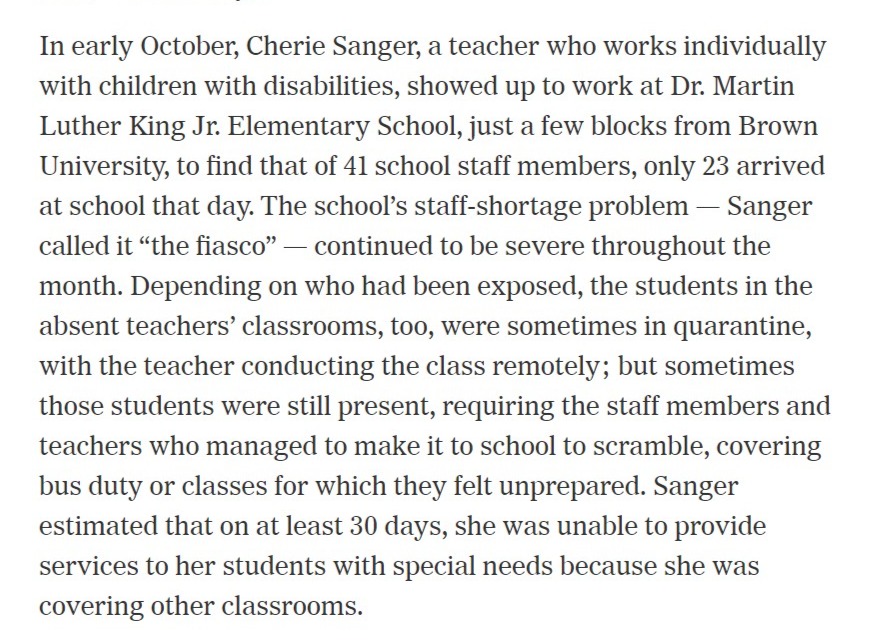
Above: Dominus detailed how educators in Providence had to scramble to cover classes and keep students and staff safe.
You had to report most of this story remotely, after the fact. How does that work, reconstructing events that have passed?
Dominus: In order to be on the scene, I would have been infiltrating their pods. And that was just not an option in an ongoing way because they were trying to preserve the integrity of those pods. Reporting it out was less frustrating than I thought it would be. For some of these administrators, this was likely the most intense educational experience of their lives – and therefore the details they were able to recall are very vivid.
What are some of the strategies you used to make sure that you, as someone from outside this community, were depicting what was happening in a way that is sensitive to racial, economic, and cultural differences?
Dominus: Because Providence schools serve a mostly Latino and Black community, I wanted to be sure that many of the educators I spoke to also represented that community and understood the families they were trying to help — what their concerns, needs, and hesitations might be. This would have felt like a very different story, I think, if many of the important players, including the state education commissioner, Angelica Infante-Green, were not themselves people whose life experiences reflected those of the families in their schools.
“Reporting it out was less frustrating than I thought it would be. For some of these administrators, this was likely the most intense educational experience of their lives – and therefore the details they were able to recall are very vivid.”
Are there any parts of the story that you fought to get int?
Dominus: I had written a detail about how in one middle school, in one day, three students came down with some kind of illness, which the principal feared was COVID. I wanted to illustrate that the principal had to be resourceful on the spot — that there were many situations the schools just couldn’t anticipate. I wrote about a solution he came up with that day called podding in place, but then I realized, later in the publishing process than would have been ideal, that the reader really would want to know what eventually happened. Did all three kids have COVID? Did other kids in their classrooms get sick? (The short answer: One had COVID; no one in that child’s classroom subsequently tested positive.) The day we went to press, I felt that I needed to add that – to resolve the obvious question.
Is there anything that you wish you’d done differently?
Dominus: I always have regrets after a piece publishes. There is always room for more nuance, more number crunching, more on-the-other-hands, more clarity and exposition. I wish I knew more about how schools in practice are functioning in Florida, another place where schools have been open since the fall. I would have liked to have been inside more meetings where decisions were being made at the state level in Rhode Island. And I wish we could have had full results of a CDC study, still pending, comparing COVID rates in schools where the quarantining policy is less stringent to those with standard quarantine procedure.
What’s your personal stake in the school reopening story?
Dominus: I wouldn’t say that I have a personal stake in the school reopening story, other than wanting to see that actual data is shared and understood. And like everyone else, I want to see that kids are generally getting the best education they possibly can. It might be fair to say I have a somewhat personal connection to the story, just in the sense that I have school-age kids, twin boys in high school. They have been going to school with a hybrid model, and I am incredibly grateful for that. It’s far from perfect. But I have a lot of respect for the teachers who show up every day and have shown up since September. It’s obviously a very tough year all around in so many ways.
ABOUT THE AUTHOR
Alexander Russo
Alexander Russo is founder and editor of The Grade, an award-winning effort to help improve media coverage of education issues. He’s also a Spencer Education Journalism Fellowship winner and a book author. You can reach him at @alexanderrusso.
Visit their website at: https://the-grade.org/