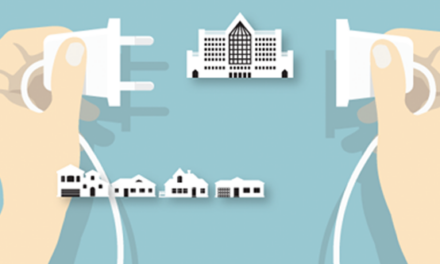
Equal access to educational technology doesn’t necessarily translate to equitable opportunities to learn.
A lightning bolt cut across the sky. Soaked from the waist down, I gripped my umbrella and ran across the quad at Sheldon Junior High to get to Ms. Finnerty’s 8th-grade science class. It was 7:48 a.m. on a Thursday and I was very, very late. A freak thunderstorm had set in, catching me in a downpour, but those of us who work in schools know that we must adhere to the bell schedule, rain or shine.
I entered the classroom to find it in chaos. Students were chatting loudly, their seats turned away from their laptops. Many were up and out of their chairs, horsing around with friends. Ms. Finnerty, who usually ran a tight ship, was at a loss for what to do. She crumpled into her chair and beckoned for me to come over. “Did you see that lightning?” she asked. “It must have hit the district. The internet just went down for the whole school.”
These days, Finnerty explained, internet access is “like oxygen.” Digital technologies are everywhere in her school. Nearly everybody carries a mobile device, the classrooms all have computers, students use web-based platforms all day long, and teachers constantly rely on their interactive whiteboards. So, when the internet goes down, so does instruction.
As Ms. Finnerty’s class made abundantly clear, digital access matters. When students and teachers can’t log in, they miss out on teaching and learning. It’s no surprise, then, that in the late 2010s, when I began to conduct research on digital technology use in schools, everybody (educators, researchers, and policy makers alike) seemed to be talking about how to close the digital divide. Long before the pandemic prompted an urgent rush to equip children with computers, Wi-Fi, and internet service, many policy advocates saw the goal of “one laptop per child” as their holy grail.
In the back of my head, though, I’ve always wondered: While digital access may be necessary for today’s students to succeed, does that make it sufficient? From idealists in the ed tech world, I’ve often heard that it does: If every student had access to the best digital tools and resources, then education would be far more equitable. But is that true?
How young people use technology, and how adults perceive them
Around 20 years ago, researchers began to find that young people of all racial-ethnic groups and from a range of socioeconomic backgrounds (with the notable exception of those whose families lived below the poverty level) were adopting internet-connected technologies (including smartphones, tablets, computers, and video gaming devices) at rates far surpassing adults (Ito et al., 2009; National Telecommunications and Information Administration, 2000). Also, in some years, Black and Latinx teens were using internet-connected smartphones more often than their white peers (Lenhart et al., 2010; Madden et al., 2013).
Even as gaps in digital access were narrowing, so too were digital skills gaps. To stay connected with their peers, young people had no choice but to become adept at using digital technology; if you weren’t on social media, you were left out. Further, while many educators assumed that these online activities had nothing to with teaching and learning, scholars soon discovered that in the process of using social media, making videos, posting them, and so on, young people were learning many of the skills that schools were now expected to teach, such as how to communicate effectively in a range of media, collaborate with each other, and work in teams (Ito et al., 2009). When playing certain video games, such as Minecraft, they even seemed to be mastering some basic skills in subject areas such as architecture and design.
While the topic of digital access continued to command attention, such findings inspired many researchers to take a closer look at the ways in which young people were using new technologies, too, both in and out of school. In turn — and in my own research — that also led to questions about the ways in which teachers and other adults perceive students’ use of technology.
It’s hardly unusual for educators to hold racial and economic prejudices, and those biases often have significant influences on students’ opportunities to learn about and use technology in schools.
As it turns out, those perceptions are often quite biased. For example, consider the story of Ahmed Mohamed, which made national headlines in 2015. A budding inventor, Mohamed — then a 14-year-old 9th grader in Irving, Texas — built a digital clock out of old wires, circuits, and other materials. But when he brought it to school to show his teachers, they thought it might be a bomb, and they had him arrested, handcuffed, and escorted off campus (Fernandez & Hauser, 2015). Much like a young Steve Jobs messing around with electronics in his garage, Mohamed loved to tinker with technology, and his skills were already quite advanced. But instead of seeing him as a potential Steve Jobs, his teachers saw him as a possible terrorist.
Teachers’ biased perceptions about students and technology rarely have such dramatic consequences. But it’s hardly unusual for educators to hold racial and economic prejudices, and those biases often have significant influences on students’ opportunities to learn about and use technology in schools. In short, even if all students had equal access to digital tools and resources, that doesn’t necessarily mean they would be treated equitably.
Equal access, unequal treatment
To learn more about how teacher bias might affect students’ technological opportunities, I sought out schools where digital access and skill divides appeared to have closed. Ultimately, I partnered with three middle schools in Southern California, each of which had a lot of digital tools and resources at its disposal and had an expressed commitment to using technology for learning. Most of the teachers in all three schools were white women, as is typical of U.S. schools (Feistritzer, 2011), and teachers at all three schools had a similar range of technology skills and related training.
Importantly, though, the schools differed in their student demographics. One school served mostly wealthy, white students; another mostly middle-class Asian American students, and a third mostly working-class Latinx students. I wanted to know: Would teaching and learning play out in similar ways across the three schools, given that they had similar technology tools and resources, a similar focus on technology-based instruction, and similar teachers? Or would things play out in different ways, given that the schools served different student populations?
The kids at all three schools had a lot of experience playing with and using digital technologies in their personal lives, and they were equally likely to be skilled at using online platforms and tools to communicate with their peers and create and share new media. But the teachers at the three schools talked about those skills in very different ways, and they provided very different opportunities for their students to use technology and further develop their skills.
We cannot pretend that giving every student a laptop will solve our more fundamental problems of educational inequality.
At the school serving mostly wealthy white students, teachers described the skills kids gained through digital play as essential to their success. “I always use the example of Steve Jobs going to his garage and tinkering around,” explained Mr. Crouse, the school technology manager. As he saw it, the school should be like that garage: a place to tinker and play. Again and again, teachers told me that the types of activities kids did online while at home and with their friends were important to learning at school. Everything from sending images online to playing video games to communicating on social media was an opportunity for students to display their digital prowess. “They’re comfortable with many of the apps and programs they’re used to, and that can really help with school,” said Mrs. Cramer, a 7th-grade science teacher. “I use a lot of games, like, we have one game a student found to memorize the periodic table. I say why not?” At this school, students were encouraged to take what they learned from online play and apply it to their work in the classroom.
At the school serving mostly middle-class Asian American students, teachers used very different language to describe the digital skills that kids developed outside of school: Far from contributing to students’ success, such skills from digital play posed a threat to their learning. “I feel bad for our kids here,” explained Ms. Nisbett, a 7th-grade science teacher at the school. “They grow up with a Tiger Mom culture and are taught from a young age to only get A’s or they have failed. It’s terrible. But it makes it hard for us teachers because they’re taught to do anything [in order to succeed], and that’s not fair to other students.”
Teachers at this school often drew on such stereotypes about Asian Americans to justify a strict pedagogical approach, including an approach to using technology at school that minimized student participation online. For example, teachers tried to cut off all forms of social media use: “Facebook and Instagram doesn’t help them with school. The school uses of technology are traditional,” said Mr. McNally, an 8th-grade science teacher. “I would never embrace social media as part of a lesson. I don’t want to let go of this control that I have because then I have to monitor more and more of this garbage. I don’t want to deal with all of that.” Whereas kids’ digital participation was celebrated at the first school, here it was heavily monitored. Teachers even tracked students’ digital footprints and spied on their communications, punishing them if they stepped out of bounds.
Finally, at the third middle school, teachers saw the digital skills students gained through online play as neither assets nor threats but, rather, as irrelevant. Their statements often seemed to reflect stereotypes about working-class Latinx students, especially that they hail from families of hard-working immigrants and that their primary goal is to get a working-class job. “These kids aren’t naturally gifted at technology,” explained Ms. Duffey, a 7th-grade science teacher at the school. “Those skills from playing video games don’t translate to school. So they have fast phones? So what? The kids we teach, if we’re being realistic, they need skills for hands-on jobs. Like how to fix a new-wave car. If they learn technology, it’s for those purposes.”
Many of these Latinx students told me about the online tools and platforms they liked to use and the various skills they had developed — they were the same activities and skills described by students at the other two schools. However, their teachers assigned them only rote work with technology, such as keyboarding, basic website navigation, and some simple programming. For example, when assigning a project using Scratch, a programming language, a teacher told students that they “are free to use whatever media you want to complete the challenge. But remember, at the end of the day, I don’t care how pretty your SpongeBob looks. You only get full points if you solve the problem.” For these students, such rigid, compliance-driven assignments were typical. By contrast, their wealthy, white peers at the first school had frequent opportunities to use digital resources creatively, designing their own videos, websites, and programs, with encouragement from teachers who hoped they might follow in the footsteps of Steve Jobs.
Why does it matter that the teachers at these schools perceive students’ digital experiences in such different ways? Again, it suggests that even if our schools succeed in closing the nation’s existing gaps in digital access and skills, technology education would likely remain grossly inequitable. All three of these schools had plenty of technology available, all three were committed to providing technology-based instruction, and all three sets of students had developed, in the process of using social media and playing around online, a broad range of digital skills. However, only at the first school were these skills treated as assets to be valued and built upon. At the other two schools, serving less affluent students of color, those very same digital skills were viewed with scorn or indifference.
What we can do
Let’s acknowledge that when we talk about digital inequalities in our schools, we are also talking about racial inequality. And let’s recognize that if we aim to address racial inequality in education, we must address digital inequality. In my own research, I’ve found that teachers tend to prepare affluent white students to become future business moguls and thought leaders. Meanwhile, many schools that serve less affluent students of color treat their students like deviants or future low-wage workers.
As educators, we must learn to define our success based on how well we serve our least advantaged students, not the most affluent. The affluent students will be OK. Their families have the resources to go outside the education system to help their children if they need to. For the rest of our students — and for their teachers — we must be willing to provide whatever digital devices, internet access, software, maintenance support, and training are necessary. But at the same time, we cannot pretend that giving every student a laptop will solve our more fundamental problems of educational inequality. Let’s get real: Our schools need to hire more faculty of color, build communities in which all teachers and students feel safe and supported, put an end to biased disciplinary practices, teach an inclusive curriculum, and on and on. If we’re serious about closing our educational and digital divides, then we must pursue comprehensive educational change, not just look to digital solutions.
References
Feistritzer, E. (2011). Profile of teachers in the U.S. Washington, DC: National Center for Education Information.
Fernandez, M. & Hauser, C. (2015, September 6). Handcuffed for making clock, Ahmed Mohamed, 14, wins time with Obama. The New York Times.
Ito, M., Baumer, S., Bittanti, M., boyd, d., Cody, R., Stephenson, B.H., . . . & Tripp, L. (2009). Hanging out, messing around, and geeking out: Kids living and learning with new media. Cambridge, MA: MIT Press.
Lenhart, A., Ling, R., Campbell, S., & Purcell, K. (2010). Teens and mobile phones. Washington, DC: Pew Internet and American Life Project.
Madden, M., Lenhart, A., Duggan, M., Cortesi, S. & Gasser, U. (2013). Teens and technology. Washington, DC: Pew Research Center’s Internet and American Life Project.
National Telecommunications and Information Administration. (2000). Falling through the net: Toward digital inclusion. Washington, DC: U.S. Department of Commerce.
Note: All school and teacher names are pseudonyms, and examples are drawn from findings in Digital Divisions: How Schools Create Inequality in the Tech Era (University of Chicago Press, 2020).
ABOUT THE AUTHOR

Matthew H. Rafalow
MATTHEW H. RAFALOW is a visiting scholar at University of California-Berkeley and a social scientist at Google. He is the author, most recently, of Digital Divisions: How Schools Create Inequality in the Tech Era .