
Denver’s charter and district schools give parents a plethora of information on school quality and find that most families — even those in low-ranked attendance districts — choose schools close to home.
As in many districts, the Denver Public Schools (DPS) choice process grew organically over many years, with charters springing up alongside magnets, and as inter- and intra-district open enrollment spread throughout the state. Denver’s openness to approving new schools and phasing out old ones resulted in opening 63 new schools and closing 31 schools between 2002 and 2012 even as enrollment grew 14%. This development added to the complexities and opportunities of school choice.
By 2010, a dense canopy of 65 separate and often disconnected admissions processes shrouded the city. This meant that multiple schools in the same district could wait list, admit, or reject the same student without knowledge of one another’s actions. School and district officials discarded valuable data annually instead of collecting it centrally so that it could be used to improve or plan.
Donnell-Kay Foundation commissioned a study by Neil Dorosin, director of the New York-based Institute for Innovation in Public School Choice. Dorosin had helped implement, manage, and create single-choice processes in New York City and New Orleans. In addition to identifying multiple, disconnected choice processes in DPS, Dorosin’s report also found evidence of a “gray market” that permitted some parents to bypass formal procedures altogether by currying favor with administrators at popular schools. These savvy parents were disproportionately affluent, raising concerns about fairness.
Dorosin’s report made it clear that it was time to rethink the choice process in Denver Public Schools, then an urban district of about 84,000 students and more than 125 schools. District and community leaders envisioned a system similar to the one Dorosin had helped implement for high schools in New York City, which, along with New Orleans, were the only American cities with a single-choice process.
Political peril
Selling such a system was fraught with political peril. Denver school board member Jeannie Kaplan stressed that the new system needed to be understandable and accessible to the district’s diverse population. An additional concern was that administrators of popular charter schools might hesitate to surrender their separate wait lists for fear that the district would disrupt their successful processes or use the centralized process to poach students, resulting in reductions in per-pupil operating revenues.
Conscious of the delicacy of their position, community leaders and district enrollment staff began work under the benignly named Enrollment Study Group. Dorosin’s proposal was aimed at improving not only administrative efficiency but fairness. For example, a common flaw with centralized choice processes is that families willing to attend their neighborhood schools may also be willing to take the risk of listing a high-demand school as their first choice but can’t. In contrast, other families shy away from such a risk for fear of “wasting” their first-choice pick on a high-demand school, getting rejected and landing in a neighborhood school they do not like. These strategies are unfair because they motivate families to behave differently depending on how they feel about the neighborhood school, which is more likely to be of high quality if it is located in a more affluent area of the city. Dorosin’s proposal was designed to combat such behavior by ensuring applicants that prioritizing a highly coveted school would not harm their chances of getting into a lower choice school. A similar algorithm is used by the national medical residency and kidney matching programs, which was designed in part by Alvin Roth, who won a Nobel Prize in economics for that work.
Choice is easier for parents as they no longer need to navigate a labyrinth of processes and run from school to school.
With Dorosin’s proposal in hand, the Enrollment Study Group persuaded Denver Public Schools to move forward in fall 2011. A citizen watchdog group called A+ Denver put forth a process for evaluating the new system. Considerable funds were spent on an easy-to-read parent handbook that illustrated the academic quality of each school using the district’s School Performance Framework (SPF). The handbook presented the framework in simplified form as a colorful, five-level thermometer ranging from red (Accredited on Probation) to blue (Distinguished). DPS also planned a major marketing effort that included principal and student outreach, letters to parents, school fairs, and updated web sites. With the help of the Enrollment Study Group, the district ultimately persuaded 100% of its charter schools to participate in the single-choice process.
“They had to be reassured that Denver Public Schools could actually manage it so they wouldn’t screw up their brand,” said Mike Kromrey, executive director of advocacy group Together Colorado and a member of the initial coalition pushing for unified enrollment, in an interview with the news site Chalkbeat Colorado. “It was an enormous amount of work done by DPS. And to be honest, some old-fashioned pressure . . . all the big funders of charter schools like Walton were in there from the beginning, and they probably put some pressure on their schools.”
Implementation
The newly labeled SchoolChoice process kicked off in January 2012. By the Feb. 1 deadline, applications had been submitted on behalf of nearly 22,737 children (about one-quarter of its total student population) with greater representation among students in transition grades, including 80% of projected enrollment for kindergarten, 72% for 6th grade, and 60% for 9th grade. This represented a substantial increase from prior years. In the 2009-10 school year, school choice participation rates ranged from 13% for kindergartners, to 6% for 6th graders, and 10% of high school freshmen.
In the first year, the average family selected nearly three (2.8) of the five school choices permitted. The median selection remained at about three in Years 2 and 3 of using SchoolChoice, although most parents choose either one or all five choices.
In light of concerns about fair and adequate access, district officials used paper forms available in multiple languages (only paper in Year 1). This required a small army of clerks to input data, but the process went as planned: A University of Colorado Denver expert on combinatorial optimization certified that Dorosin’s algorithm had performed as designed.
Evaluation
To gain a better understanding of the single-choice process, A+ Denver (the citizens group) commissioned an evaluation by the Buechner Institute for Governance at the University of Colorado Denver’s School of Public Affairs. Researchers had access to a unique database that linked each participant’s selections and demographic information with results from the survey that asked families how they selected their first-choice schools. Of the 22,737 individual children included in the database, just over half (11,928) had parents who elected to respond to the survey questions. An important goal of the evaluation was to examine whether the new system was efficient and fair for families.
A similar evaluation was performed in Year 2, and, in Year 3, the Center on Reinventing Public Education performed a related study. Generally, SchoolChoice participation grew incrementally over the three years, and outcome indicators improved somewhat as well each year.
On the individual level, efficiency was defined as matching as many students as possible with their first-choice schools. In an efficient system, families also would select schools on the basis of academic quality, leading to higher demand for the best programs. Ideally, this would drive improvement because these high-demand programs would expand, leading to a situation in which more students would aim to attend successful schools.
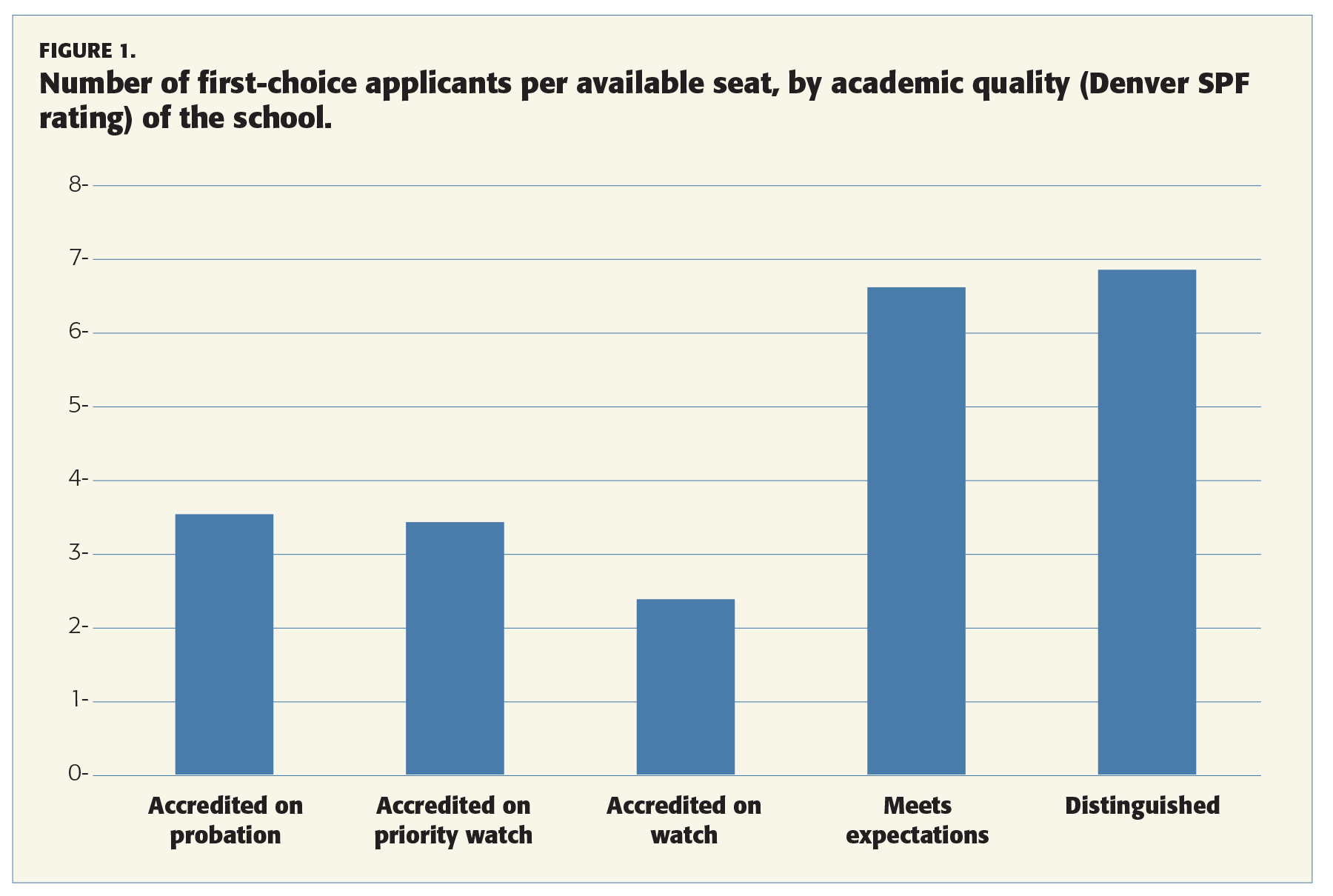
The researchers gauged academic quality using DPS’ School Performance Framework (SPF) rating of families’ first-choice schools, which parents had seen in the information handbooks and other sources. Academic improvement on state exams is the key ingredient of the SPF. But, depending on the age group served by the school, the SPF also incorporates a mixture of other factors, including academic proficiency, college- and career-readiness, student engagement, mobility, dropout rates, and parent satisfaction. In 2012, the SPF ratings for first-choice schools ranged from 26% to 96%. The average SchoolChoice participant selected a school with a rating of 61%.
Researchers measured school demand using the number of first-choice applicants per available seat. Demand-per-seat ranged from less than 1 to 40.
Researchers defined fairness as being characterized by broad and even participation and access to choice information. They were especially focused on providing low-income, minority, and non-English-speaking family access to good information and choices.
Efficiency
When it came to matching families with their first-choice schools, Denver’s one-stop shopping approach was efficient. In Year 1, more than two-thirds of students got their first choice, with 61% ultimately enrolling in their top school. A total of 85% of students were matched with at least one of their choices, with fairly similar matching percentages in subsequent years.
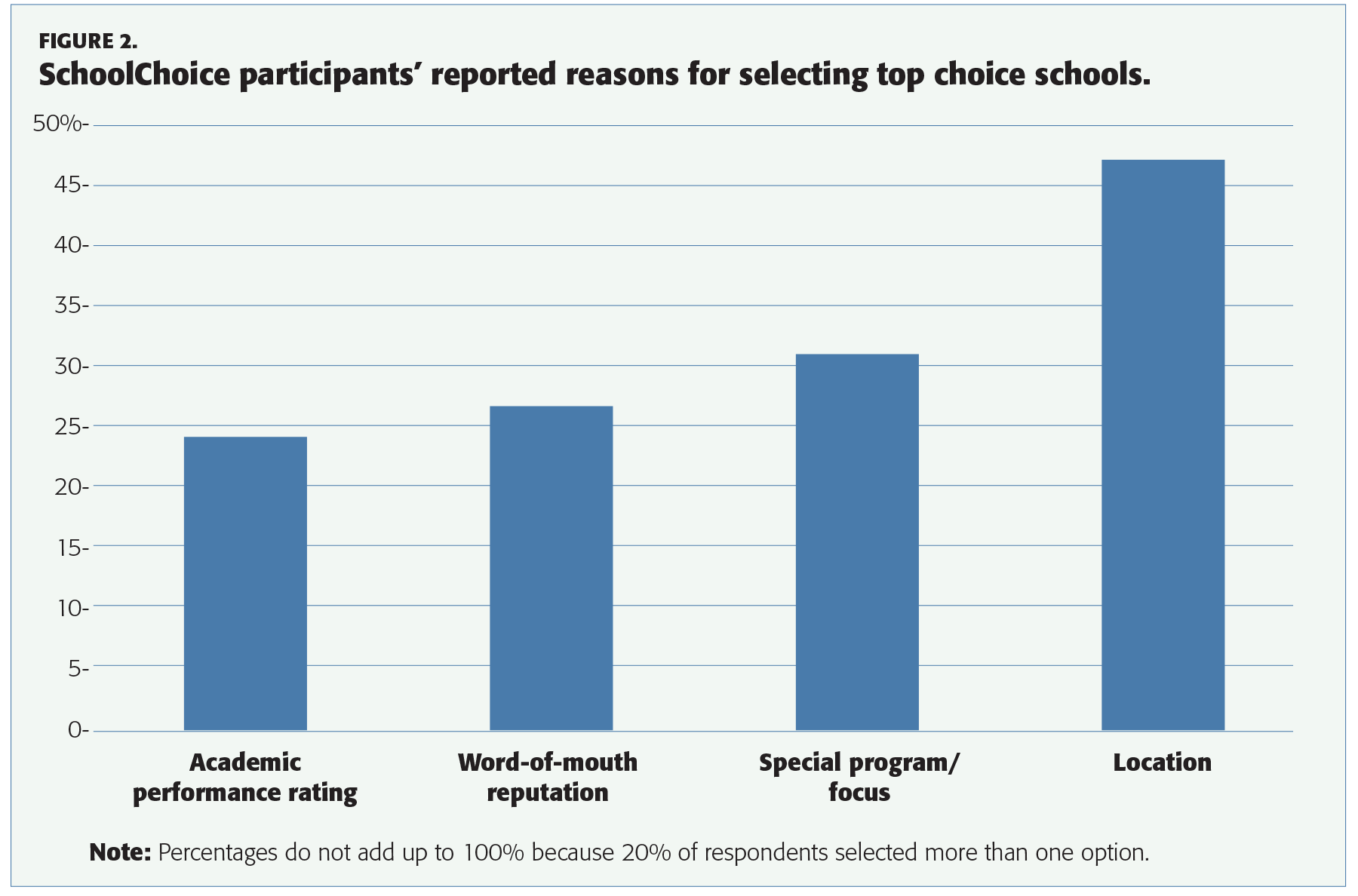
However, these parent choices did not drive future school improvement by prioritizing schools with the highest academic quality. At the school level, academic quality was the best predictor of demand, but there was also substantial demand for lower-quality schools. However, when researchers turned to the survey questions, academic quality was the least popular reason families offered for selecting their first-choice schools.
Instead, nearly half of survey respondents said they selected schools for their proximity to home, family, and/or work. In addition, a third of participants selected their zoned or home schools as their first-choice schools. Even when families were willing to select a school other than their zoned school, they rarely ventured far from home. The Denver district divides itself into five geographic regions that are roughly equal in size. Sixty percent of choosers selected schools in the same geographic region in which they lived.
The priority parents place on proximity raises questions about the ability of even the most centralized and well-designed choice process to drive educational improvement for all students. This is because high-quality schools are not evenly distributed throughout the city’s five main regions. Rather, they cluster in Southeast Denver, a more affluent part of town that was home to nearly half (7) of the 15 schools that earned the district’s top Distinguished rating in 2011. In addition, school bus transportation across regions is limited. Although a few older magnet programs provide free busing to students throughout the city, most families must provide their own transportation if they choose a school other than their assigned school.
How could the district increase the likelihood that parents select a high-quality school? On the transportation side, a potential solution is the district’s four-year-old Success Express program, which provides a fleet of school buses that, at no cost to parents, circulate, mornings and afternoons, within two of the district’s five regions, Northeast and Far Northeast Denver. However, Success Express does not connect these neighborhoods with other areas of the city such as Southeast Denver, home to higher concentrations of high-quality schools. Even with transportation, high-quality schools tend to be fairly full already, with students living in that attendance zone. A more long-term solution, albeit more challenging, is to develop more high-quality schools throughout the city.
A related piece of the solution is to promote access to academic information on parent web sites. After accounting for relevant factors such as parent demographics and location, researchers found that survey respondents who said web sites were the “most useful information” they consulted when selecting their first-choice school ended up picking first-choice schools with significantly higher academic ratings. DPS and the Colorado Department of Education already offer extensive online data, but there is room for expansion: Just 7% of choice participants used parent web sites to select schools, while parents continue to depend more on information from existing social networks.
Fairness
One potential concern about using web sites is that lower-income and other traditionally disadvantaged families might have less access to technology. However, researchers found that low-income participants were only slightly less likely to report that parent web sites were their most useful source of information. Black participants were most likely to report that such sites were most useful, counterintuitive to the supposition that a digital divide separates black families from many important online resources.
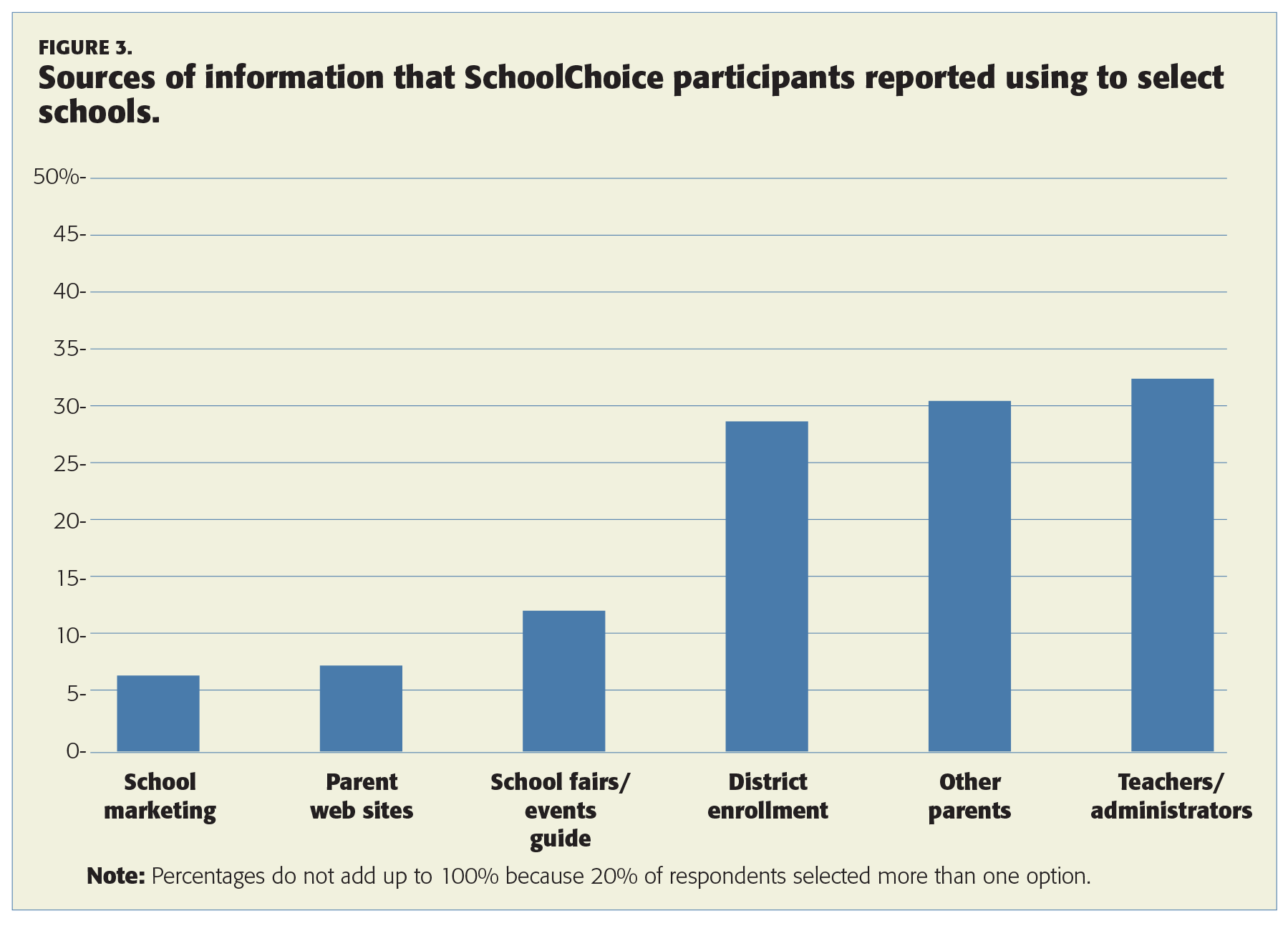
Researchers found that parents who spoke English at home were more likely to use parent web sites as their top information source. This suggests the need to translate parent sites into other languages and ensure that publicly accessible technology is available in neighborhoods with large non-English-speaking populations.
A more encouraging finding was that the demographic profile of SchoolChoice participants was similar to the profile of the district as a whole. Low-income and minority families participated at somewhat lower levels but were still quite active in the choice process.
In addition, Hispanic and non-English-speaking participants were more likely to get their first-choice schools. This positive outcome is tempered by the fact that these participants generally selected schools with lower academic ratings, which tended to attract fewer applicants per seat.
Location was another explanation for selecting lower-quality schools. Participants who chose schools on the basis of proximity also selected schools with lower academic ratings. Non-English speakers were twice as likely to select schools based on proximity. Hispanics were 60% more likely to select schools based on proximity. Low-income Hispanics were two-and-a-half times more likely to select schools based on proximity.
In general, people who reported valuing academic ratings did what they said: They selected schools with higher ratings. However, this was not true across the board. Black participants and low-income participants were more likely to report that ratings were important selection criteria. Yet none of these groups actually selected first-choice schools with ratings that differed significantly from the average first-choice school rating.
By contrast, white participants were almost 50% less likely to report that academic performance ratings were important criteria for school selection. Yet the schools selected by whites had higher than average academic ratings. Proximity likely played a key role here as well: Schools in the most heavily white section of the city (Southeast Denver) also had significantly higher academic ratings. It seems likely that many of these parents were a step ahead of the single-choice process when they had made their decision to move to neighborhoods near higher-quality schools.
Lessons learned
Without question, Denver’s single-choice process is more efficient than the 65 separate application procedures it replaced. Choice participation skyrocketed between 2010 and 2012 when SchoolChoice was implemented. Since 2012, school officials have taken steps toward making the process even more efficient. For instance, they now offer online applications as well as paper forms. They have encouraged principals at neighborhood schools to open up more seats to choice participants from outside their zones. In previous years, principals were overly cautious about offering up too many seats to the centralized choice.
People who reported valuing academic ratings did what they said: They selected schools with higher ratings.
Choice is easier for parents as they no longer need to navigate a labyrinth of processes and run from school to school. Further, the “gray market” appears to have disappeared. Although there is room for improvement, students from traditionally disadvantaged groups are generally treated equitably by the new system in terms of participation and admissions rates. School officials continue to work to raise participation rates of students from such groups by, for instance, reaching out to non-English-speaking families.
Charter schools also appear to be receiving their fair share of applicants. Charter status was not a significant predictor of school demand: Charters overall received about the same number of applicants per available seat as noncharters. This is likely because the Denver district’s current administration is known for being charter friendly. For example, in 2010, the Denver district signed onto the Bill & Melinda Gates Foundation Charter Compact, which calls for districts and charters to work together across multiple spheres.
Some would like to see the single-choice process go a big step further by eliminating zones that guarantee children seats in their neighborhood schools. Every family would participate in this all-choice system, with over-subscribed schools admitting children by lotteries. Those who favor this policy argue that it would increase equity by eliminating the ability to “buy” a seat in a better school by purchasing expensive real estate in the neighborhood. While this idea has to overcome huge political barriers, the district has started to experiment with a number of shared boundary enrollment zones, in which students are guaranteed a spot in one of a handful of zoned schools but not necessarily the one closest to them.
Researchers found that as much as parents value academic quality, proximity is what is really driving choice. In school choice — as in real estate — it is all about location. And, as previously explained, high-quality schools cluster in the more affluent Southeast neighborhoods of the city. This clustering effectively limits the options of those who do not live in neighborhoods where high-quality schools are within walking distance. It also limits the ability of the educational marketplace to foster improvement by expanding higher-quality schools while closing options of lower quality. This is because even the lowest-rated schools will continue to attract “customers” who cannot or will not transport their children across town.
One way to address concerns about proximity would be to increase the amount of free transportation offered by the district by, for instance, expanding the previously described Success Express school bus shuttle program. This option is expensive, and lengthy bus rides may not be ideal for students. An ethnographic study commissioned by local organizations focused on school choice among the Hispanic population that comprises the majority of the district found that school bus transportation was only one piece of the puzzle. Parents worried that, even if their children rode buses, they would be unable to transport themselves to school, which would limit their ability to get involved with their children’s education. Undocumented immigrants were particularly concerned about arranging legal transportation for themselves.
The single-choice process also now provides better-centralized data on student demand, so DPS can understand parent demand and determine where to try to place new schools.
Overall, the new process has reduced administrative demands upon families while increasing fairness, with few downsides. A number of other districts, such as Philadelphia, Detroit, and Hartford, Conn., are looking to make a similar change in how students are enrolled. Ultimately, though, the implementation of such a system demonstrates the continuing need for more high-quality school seats within a district’s boundaries.
CITATION: Teske, P., Yettick, H., Ely, T., & Klute, M. (2015). Denver makes a fairer choice. Phi Delta Kappan, 97 (2), 68-73.
ABOUT THE AUTHORS

Holly Yettick
HOLLY YETTICK is director of the Education Week Research Center.
Mary Klute
MARY KLUTE is a senior researcher at Marzano Research Laboratory, Centennial, Colo.
Paul Teske
PAUL TESKE is dean of the School of Public Affairs at the University of Colorado Denver.
Todd Ely
TODD ELY is an assistant professor at the University of Colorado Denver School of Public Affairs.