School gun violence coverage needs to be revamped so it doesn’t encourage copycats.
By Amanda J. Crawford
I’ve been thinking a lot about how journalists hold bad actors accountable, from school shooters to irresponsible politicians. And I think journalists have yet to adapt to a reality of the modern media environment: naming and shaming often backfires.
I am a journalism professor and former breaking news and political reporter whose research focuses on misinformation and media coverage of mass shootings, including school shootings.
For years, social scientists have been warning journalists about the unintended consequences of how we cover mass shootings and asking us to focus less on the perpetrators.
But last month’s school shooting in Georgia, followed by a wave of copycat threats and hoaxes around the country, showed that many newsrooms still ignore ways to minimize harm when it comes to covering high-profile shootings at schools or elsewhere.
It starts with resisting the urge to name and shame the perpetrator.
More broadly, I believe the nature of the attention economy demands that ethical journalists regularly consider whether and when the spotlight of our coverage serves the public good.
That means not just thinking through whether something is newsworthy, but also considering the consequences of our coverage to avoid rewarding bad actors or contributing the toxicity of the information environment.
It starts with resisting the urge to name and shame the perpetrator.
I started writing this column because Alexander Russo, The Grade’s editor, asked me why I thought so many media outlets were still excessively naming school shooters, despite a wealth of research that shows that media coverage can inspire copycats and that many mass casualty attackers, especially young ones, are motivated by the quest for notoriety through their crimes.
I had angry-tweeted at The Washington Post in the wake of the Sept. 4 shooting at Apalachee High School in Georgia. In their breaking news coverage, the Post was naming the living juvenile perpetrator over and over in every brief update.
Experts recommend that journalists not use a mass casualty attacker’s name excessively or in headlines or show their image (unless there is a search for the suspect). It is also generally frowned upon in journalism ethics to identify a juvenile accused of a crime. (The 14-year-old was charged as an adult, but still there are two ethical red flags on this one.)
The Post was not the only journalism organization that seemed to have reverted to some of the bad old ways of covering school shooters. Though CNN’s Anderson Cooper was among the first well-known national journalists to take the “No Notoriety” pledge back in 2012 to limit attention on mass shooters, when I turned on the network after the Georgia school shooting, there was the perpetrator’s image on the screen, shown over and over again.
About a month after the shooting, a simple search of the young murderer’s name and the name of his high school among news sites in the Lexis-Nexis database returned more than 4,000 hits. A Google News search produced 26 pages of news stories. His mug shot was everywhere, as were videos and images of him from court. The Atlanta Journal-Constitution, USA Today, and Fox News were among the many media outlets that used his name in headlines.
Even at news organizations like NPR and The New York Times, which have made efforts to diminish the prominence of the perpetrator’s name in their coverage, practices seemed inconsistent among sections and shows and across their websites.
Most of the stories I looked at that included the boy’s name could have easily been written without using it at all. Even in stories involving his parents or criminal charges, where many journalists would argue his name is necessary, journalists could have done better by naming him just once later in the story and not using his photo.
Most of the stories I looked at could have easily been written without using his name at all.
Recently, I have had some social scientists tell me that it is clear to them why so many journalists continue to ignore recommendations about how to more responsibly cover school shooters and mass casualty attacks: the quest for clicks, hits, and ratings.
If it bleeds, it leads.
While I don’t discount profit and audience motivations for some outlets, I know that isn’t what motivates most journalists assigned to cover the tragic breaking news of a school shooting — in part because I know that is not what motivated me when I was in the field, covering a mass casualty attack and making the same mistakes.
Twelve years ago, I was in Aurora, Colorado, reporting on the gun attack in a movie theater that left 12 people dead and 70 others wounded. While Cooper was having his epiphany on CNN after an appeal by victims’ families to change how he covered the perpetrator, my byline appeared on Bloomberg News stories with the killer’s face largely displayed and his name prominently featured.
Did I do that for clicks? Of course not. I just did it because it was what we do. The name is an important part of a story, many journalists insist.
While most mainstream news outlets withhold the names of sexual assault survivors and juvenile crime victims — practices that demonstrate how you can cover crime without naming key players — the concept of not naming a bad actor conflicts with journalists’ deep-seated ideas about our role in society.
Most journalists I know take it as a given that “sunlight” serves as a disinfectant: exposing injustice can lead to justice, exposing corruption could lead to accountability, and exposing why a kid becomes a school shooter — shining a light on his bad acts and exploring his possible motivations — might just help stop the next crime.
Except the problem is that we know from years of law enforcement investigations and academic studies of school shooters and other mass casualty attackers that media coverage that focuses on the perpetrator can do just the opposite: it can inspire other would-be killers, lead to copycats, and reinforce the notion that mass murder can provide notoriety in a world in which the distinction between fame and infamy no longer matters.
Naming and shaming a school shooter does nothing to hold them to account; it rewards them with the very attention they often set out to get in the first place.
Not naming a bad actor conflicts with journalists’ deep-seated ideas about our role in society.
I believe this idea about the unintended consequences of naming and shaming extends beyond the coverage of mass killers and applies to others who may be manipulating the media with outrageous behavior.
In mid-September, a Florida sheriff decided to name and shame juveniles who made threats of violence. He posted mug shots and perp-walked children as young as 11 years old in what the Poynter Institute rightly decried as a “horrible precedent” and “publicity stunt.”
Kelly McBride, Poynter’s senior vice president and long-time journalism ethics guru, applauded newsrooms for mostly not following suit, noting that naming and showing images of the juveniles would fly in the face of reforms in how media outlets should cover mass shooters. She also praised the newsrooms who called out the sheriff’s actions and explained why they were harmful.
Still, the sheriff’s stunt earned him international coverage. I’d argue that journalists didn’t resist the sheriff’s bait; they fell for it. Because McBride was right that what this was all about was publicity, and you get that from both kudos and callouts.
Never has the maxim that “all publicity is good publicity” rang truer than it does in our polarized society, riven by distrust and driven by social media virality.
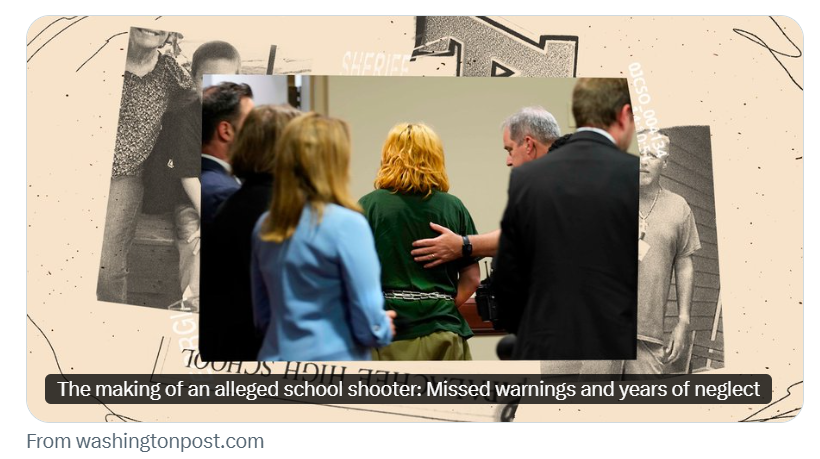
Above: The making of an alleged school shooter: Missed warnings and years of neglect, from the Washington Post.
Recently, about a month after the Apalachee tragedy, the Washington Post published a stunning investigation that revealed missed opportunities for school officials and law enforcement to have intervened before the young perpetrator carried out his attack on the school.
The story was an important example of accountability journalism, but it used the boy’s name excessively — nearly 100 times, including in the very first sentence. Ironically, the story itself illustrates why journalists should make attempts to reduce the infamy bestowed by our coverage: his family told the Post he had studied other school shooters and had name-dropped the perpetrator of the 2018 high school shooting in Parkland, Florida, in late August.
The question now is how long before another shooter name-drops him?
Amanda J. Crawford is an assistant professor of journalism at The University of Connecticut and a former reporter for Bloomberg News, The Arizona Republic, and The Baltimore Sun. She is writing a book on media coverage of mass shootings to be published by Columbia University Press. Follow her on social media at @amandajcrawford. www.amandajcrawford.com
Previously from The Grade
We need to change school shooting coverage in 2024-25
Covering trauma in schools (2020)
The case against focusing on school gun violence (2023)
First, do no harm — but how? (2019)