Education journalists from The Hill, the Boston Globe, and the New York Times share their best efforts and praise work by counterparts at ProPublica, the Washington Post, and the Hechinger Report.
This conversation took place on Friday 2/21/25 at 9AM Eastern and has been edited for length and clarity. You can watch a replay here.
Alexander Russo: Hi, this is Alexander Russo from The Grade. It’s Friday February 21, 2025, and we are just completing the end of a frantic first month of the Trump administration and its efforts to revamp everything. Everyone’s gone through the woodchipper — including perhaps some of the journalists assembled here. I’m really glad to have them here to talk about the coverage that they produced and what they’ve learned, and maybe to hear some war stories. And I’m eager to glean any reflections about week one versus week four. Maybe we’ve all learned some things trying to keep up with the firehose of information? Zach, would you take a second to introduce yourself and tell us who you are and how long you’ve been covering DC based education issues?
Zach Montague: I’m Zach Montague with the New York Times. I’ve been covering the Education Department for just around a year, but coming in from a background in federal courts, which has been interesting now with some of the lawsuits coming down the pipe about student privacy issues and lawsuits against the Department.
Lexi Cochran: My name is Lexi Cochran. I have been on the education beat for a year and a half now at The Hill. I’m the only one who is on this beat at my outlet, so I kind of cover all aspects of education. I do national, I do some state, sometimes local.
Mandy McLaren: I’m Mandy McLaren. I’m an educational reporter for The Boston Globe. Fun fact, my very first print byline ever was December 26, 2016, and it was with Emma Brown at the Post, and it was a Trump school choice story looking in to the start of his first administration. So, it’s been a trip come full circle. Here we are at it again.
Russo: I wanted to start off by asking everyone to just to give us an overview of what it’s been like going through and getting through this month, generally, or compared to other stories or other crises or events that you’ve worked on. Zach?
Montague: Just in the short time I’ve been doing this, it’s sort of a bit of a whirlwind. I mean, it’s hard to overstate the difference between where we are now versus where we were a year ago, looking at things like student debt, which was a pretty traditional thing for the Department to be working on under the Biden administration. Yeah. Everyone expected there was going to be some upheaval for the Department following the Trump inauguration. But we’re all coming to grips with the reorientation of things like the Office of Civil Rights, compared to what they would have been doing for the last several decades. It’s really a change — a bit of a 180 in some ways.
Russo: Mandy, what’s it been like for you, seeing it and covering it from Boston?
McLaren: I think one thing that’s clearly a challenge is I’m not a DC reporter, so I don’t have the contacts that Lexi and Zach have. And also, I’m wanting to be able to translate what’s happening in DC for our Boston Area readers. So it’s been a lot of hitting the phones and trying to build those contacts pretty quickly. Luckily, a lot of the folks I cover know a lot about special ed, a lot of folks in that community have been really great at helping me read the tea leaves. Then you’re trying to think about what content can our readers get from anywhere, versus what can we provide to them that is unique and that they can’t get elsewhere? And we’re still trying to figure that out: how we can provide more tailored stories to the impact that all of these events happening in DC will have on families in our region.
Russo: Lexi, give us a sense of what it’s been like for you?
Cochran: I feel like it’s been a lot of expected and unexpected. Going into this, there’s a lot that happened over the past month that I kind of expected. I wasn’t too shocked. I wasn’t sure how the president was going to go about this. This kind of whirlwind isn’t a shock, but the way that he has decided to go about some of these issues has thrown me off guard a little bit.
Russo: Let’s talk about successes. I’d love for you to describe what you think has been your best or most successful story — or a bit of reporting or a decision to cover something that you feel good about
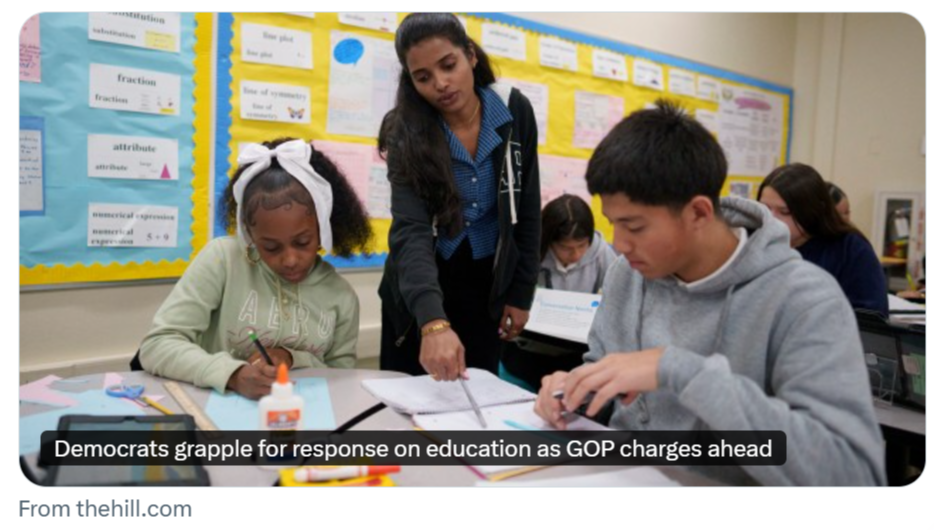
Cochran: There’s a couple stories that I’m pretty proud of, but the one about the Democratic message around education I really like that one because I feel like it’s a pretty important one right now. There’s a lot of news around education on the Republican side. But it seemed a me that the Democrats didn’t really have this clear messaging on what they’re going to do, beyond ‘This thing that Trump announced is bad.’
McLaren: I used to be a Gannett person, and they called them ‘know the score’ stories. And again, it’s translating what’s happening in DC for an average Boston-area reader. So stories that I’ve done have been sort of explaining the implications of the school choice executive order on Title One, and special education funding takeaways from Linda McMahon’s confirmation hearing — what you missed if you weren’t able to tune in. And then one story that I think has done better than we expected, is just what is the US Education Department and what is its main functions?
Russo: What local impact have you been able to find and see and share with people?
McLaren: I’m still working on that, but I think one thing that is really ripe for looking into is obviously what’s been happening with the Office of Civil Rights. Massachusetts families are very active in filing complaints with OCR. And actually a string of those complaints kind of culminated in a federal OSEP investigation of the state special ed system here. That report was finalized under the Biden administration, January 16, and we were expecting it to come out, and it never was showing up. Eventually it came out.
Russo: Zach?
Montague: I’ve been trying to look as closely as I can about sort of the changes in the Department that are happening — some driven by Elon Musk and DOGE — trying to just sort of get any kind of clarity that we can from anywhere, whether that’s through legal filings in these lawsuits where some of the DOGE people have self-identified as point people in the Department, trying to figure out who they are and what their goals are. I had a story last week with Dana Goldstein where we sort of looked into a proposal that we had heard was floating around to sort of replace some of the public-facing tools that the Department has had for things like the FAFSA with AI.
There’s the atmosphere of uncertainty surrounding what’s happening in the Department and who is actually driving these changes, whether these are ideas that originated from Trump’s appointees that are leading the Department now, or whether these are being passed down from the DOGE team or from outside activists that are just like lobbying for changes — pushing DOGE to implement stuff like that. Any kind of tidbits that we can get about what’s actually happening inside the room is something that I’ve really tried to look into.
Russo: What’s the best quote or fact or name that you’ve been able to dig out that people really seem to appreciate, because, like you said, there’s so much uncertainty?
Montague: In that story, which really shout out to Dana, because she did so much of the work on that, we were able to see how there’s, a few DOGE folks on the team. One is Adam Ramada, who declared himself as the sort of education guy in in court filings recently. Another is Brooks Morgan. Whether inadvertently or intentionally, there’s just sort of a culture of secrecy surrounding this. I mean, we don’t know a whole lot about why these particular folks were detailed at the Department. We don’t know if they have sort of free rein to pursue the projects that they’re interested in, or if they take their marching orders from someone higher up.
Russo: Are there any lessons or adjustments or full-on regrets that you might share? Is there anything that you wish you’d done differently — or you’re going to do differently in the next month?
McLaren: Well, I wonder if one of the issues that you’re thinking about is ICE enforcement raids [at schools] that didn’t come to fruition. I know you’ve been outspoken about some of those stories, and, yeah, I think it’s a difficult position to be in. You want to report on the news and folks’ reaction to the news, but you don’t want your reporting to inflame the reaction.
So I think a lot of education reporters across the country had the charge to go out and report on how are schools responding to this possibility of schools no longer being a safe zone. And you know, regardless of what we as the sort of middlemen, choose to do, like that message is hopping over us and going straight to those families and so, there is a responsibility to report on how they’re reacting to it — whether or not there is actual evidence to stoke the fear.
One thing that we’re following up on is how [the threat of ICE raids at schools] has actually impacted school attendance. We can get into this, this debate about, well, was it what Trump said that impacted attendance, or was it all the media flurry around it that impacted attendance? And it’s kind of hard to just separate those two things.
Montague: Like Mandy said, you have to really be diligent about disentangling the rhetoric from what follows. I was thinking about that just this week with our coverage of this new Dear Colleague letter about race-based programs, because that’s such an expansive policy guidance from the Department. I mean, they’re basically telling schools that any kind of program that includes even a hint of conferring benefits on a group based on race is now grounds for an investigation or pulling your funding.
That’s kind of an explosive guidance to send, and to say that you have to correct this within 14 days. And it also cuts against some of what we had heard. I mean, I listened to Craig Trainor say in an internal meeting two weeks ago when he met with the OCR team and said that OCR is just going to be a antisemitism kind of investigation shop from now on. So if that’s what’s being said inside versus what’s being signaled out to all of these schools with a limitless constellation of different programs that are now under question, what is the threat versus what is actually coming down in action?
Russo: Do you feel like the coverage of the Dear Colleague has been a bit more careful now, or different now about assuming the implementation?
Montague: It’s tricky, for all the reasons that Mandy just spoke to, because you don’t want to downplay this as just something that is just signaling, when we did see them turn around and launch investigations after some of these other things.
Immediately after the guidance on transgender athletes in schools, they turned around with several, several investigations. So it’s not the kind of thing where I think you want to be overly cautious right off the bat, thinking maybe this won’t really have any effect. But I do think that you have to be mindful about the fact that this is all happening with the backdrop of them slashing staff and downsizing. These investigations take time, or at least they have historically. So maybe the guidance and the enforcement action are not going to completely, completely go hand in hand. It’s something that you have to just keep an eye on, I think,
Cochran: It is hard looking at these stories and trying to figure out what’s going to be real and what’s not going to be real — what’s kind of just lip service. We know what the Trump administration is saying. We don’t know if it’s going to be real or not.
Russo: Does anyone have a story that they saw that they really admired? For example, I really liked, appreciated a Vox story about whether there were legitimate concerns about DEI programs.
Montague: The one that I’ve been thinking a lot about this week is the that big story that the Post did, that some of the some of the data that had been taken from agencies like the Education Department recently had been fed out into external AI models outside the Department. And, you know, that’s the kind of thing that just sort of seems technical, and not like anything you might expect. And it invites a lot of legal questions,
Cochran: I liked the story that Zach and one of his colleagues did about how the Trump administration was putting people on administrative leave based on DEI programs that happened in the previous Trump administration. Since I cover such a large swath of education issues, sometimes I don’t have the time for that, so I appreciate reading stories that kind of get into the little bit of the details that aren’t necessarily super huge deals first but are an important backdrop to what we’re seeing.
McLaren: Jody and Jennifer over at ProPublica, they are just an amazing duo. And so their story on OCR investigations or the lack thereof is one of those where you’re like, ‘Yeah, the data was right there. It’s a public database.’ But of course, they have great sourcing within the Department. I also think Jill [Barshay] has done some work on the impact of cuts to IES. These are folks who are grounded in these content areas, making use of their sourcing and their knowledge to help everybody else, understand what’s going on. I think is really important.
Russo: What’s coming up next?
McLaren: I think we’re all waiting for Linda McMahon to be officially confirmed and for potentially the Executive Order to begin the dismantling of the Department to come out. I don’t particularly love a Friday news dump. But you know, the world has other decisions sometimes.
Cochran: What I’m working on is trying to report on what this OCR deadline might actually mean. What does the expanded version look like? What fights we might see? How might the Trump administration try to make policies based on it?
Montague: It’s beyond a week from now, but I think all of us will be forced soon to reckon with what’s happening in Congress. We’ve seen cuts made just through the Department’s own identification of programs. And we’ll keep seeing this fight over impoundment, but at some point, when it comes to renegotiating Trump’s tax cuts and offsetting that with cuts throughout the budget, I think we’re really going to have to be laser-focused on what educational things fall by the wayside there.
Russo: Yes, that big and important point in the larger context. I want to thank you all for joining, and I want to thank everyone for watching live or on replay. I really appreciate all your reflections. Bye for now.