
A top-down approach alone focusing on greater requirements won’t bring needed improvement in world language classrooms. Add a bottom-up approach that includes professional development for best results.
When I took my licensure test for prospective secondary French teachers almost 20 years ago, the multiple-choice test was primarily questions asking me to choose the most grammatically correct response; very few questions related to my knowledge of Francophone culture. I felt prepared by my university, and I was excited to embark on my journey as a French teacher. The only standards I knew were my own, which were very high and ambitious for secondary students who might end up in my classroom. I had struggled willingly in my university French courses to participate in communication, student-centered, immersion-based activities so I could develop my oral and written proficiency. My high school teachers had not taught me to use French — they only had taught me to talk about it.
I wanted to teach my students better than my high school teachers had taught me. I wanted students to learn to negotiate, express, and interpret French in oral and written form. My students were going to understand and appreciate Francophone culture. I had studied in France for an academic year, lived with a family, and swam on a French university team. I was ready to share my cultural experiences and knowledge with students. No one ever told me these should have been my goals; my beliefs and values developed because of my experiences as a French student, methods student, preservice teacher, and student teacher.
Now, as a university professor and program coordinator of world language education, I find that my students, who are preservice teachers, are facing so many top-down reform initiatives that one might wonder why anyone would consider a career in education. My students must take four different licensure exams, and then they must prove themselves through state-mandated evaluations during their first four years of teaching. These top-down reform initiatives were put in place to improve the quality of teaching and learning, but, with little to no support for teachers once they are in the classroom, I don’t foresee meaningful and viable change occurring in world language classrooms without more collaboration between teachers, researchers, and consultants.
New tests, new problems
Universities that want to be accredited to prepare world language teachers must meet standards set by the American Council on the Teaching of Foreign Languages (ACTFL). Those standards require that 80% of program finishers who want to teach French, German, or Spanish must achieve an identified proficiency level on two high-stakes exams, one in writing, one in oral proficiency. To promote equity, all teacher candidates from accredited universities are being held to the same standard in order to graduate and become licensed teachers. Although no research shows that a proficient teacher actually teaches her class in ways that promote the development of student proficiency, ACTFL representatives have been adamant that teacher candidates meet these standards. Some states have turned away potential student teachers because they could not achieve the proficiency standards. Worse, at a time when there is a shortage of world language teachers, some teacher education programs are cutting world language programs because too few students graduate and earn licensure due to these high-stakes requirements.
Too many students were studying world languages for many years without being able to carry on a genuine conversation in that world language.
ACTFL also is trying to change how teachers teach world languages and, in 2010, encouraged teachers to use the target language at least 90% of the time during classroom instruction. To achieve the 90% goal, teachers would have to create an immersion environment. As Stephen Krashen suggested in the early 1980s, teachers would have to use body language, visual aids, technology, cognates, etc., to get students to understand what they were saying or doing in class (Krashen, 1981). Creating this kind of environment also means teachers step back and listen to what students can produce in the world language that is comprehensible to peers and teachers. ACTFL’s implicit message was that too many students were studying world languages for many years without being able to carry on a genuine conversation in that world language.
For the most part, teachers have responded well to the challenge of speaking the target language in class more often — at least in theory. Teachers have arrived in droves at conferences and workshops to learn strategies to increase target language use and improve student proficiency. But what do these teachers do when they go back to their classrooms? Do they implement the proficiency-based methods they learned about? And what is happening with the many teachers who can’t or don’t attend conferences?
To affect world language education in a meaningful and viable way, teachers need professional development that is experiential and collaborative.
By requiring teacher candidates to pass high-stakes proficiency tests and announcing the 90% target language use challenge, ACTFL hoped students would become more proficient in the language. But just because a teacher is a native speaker or an advanced speaker doesn’t mean she has the skills to enable students to use their world language. If the language profession really is going to move forward with more proficiency-based techniques such as immersion, teachers will need more support. Professional development can begin at conferences, workshops, and during online discussions, but to affect world language education in a meaningful and viable way, teachers need professional development that is experiential and collaborative.
Bottom-up learning
I responded to these twin challenges by creating Experiential Professional Development (EPD) to allow world language teachers time to experiment in their classrooms with the support of a researcher-consultant. The Expeditionary Learning Outward Bound design, inside-out professional development, job-embedded learning, and action research influenced the EPD model. With the appropriate professional development, I believed teachers would learn and use activities that would encourage students to use more of the target world language during interpretive, interpersonal, and presentational tasks. Although teachers used proficiency-based methods during the professional development workshops, they still were resistant to changing their traditional instruction both during and after EPD training.
Four Spanish teachers in one high school participated in the EPD, which was offered as a 10-week graduate course at the school. Teachers learned a variety of proficiency-based methods, participated in peer observations and peer meetings, and spent time with a researcher-consultant who coached them on implementing the new practices. In addition, 28 students from the teachers’ classes met with the researcher/consultant in after-school meetings and responded to an open-ended written questionnaire about changes in the teachers’ instruction.
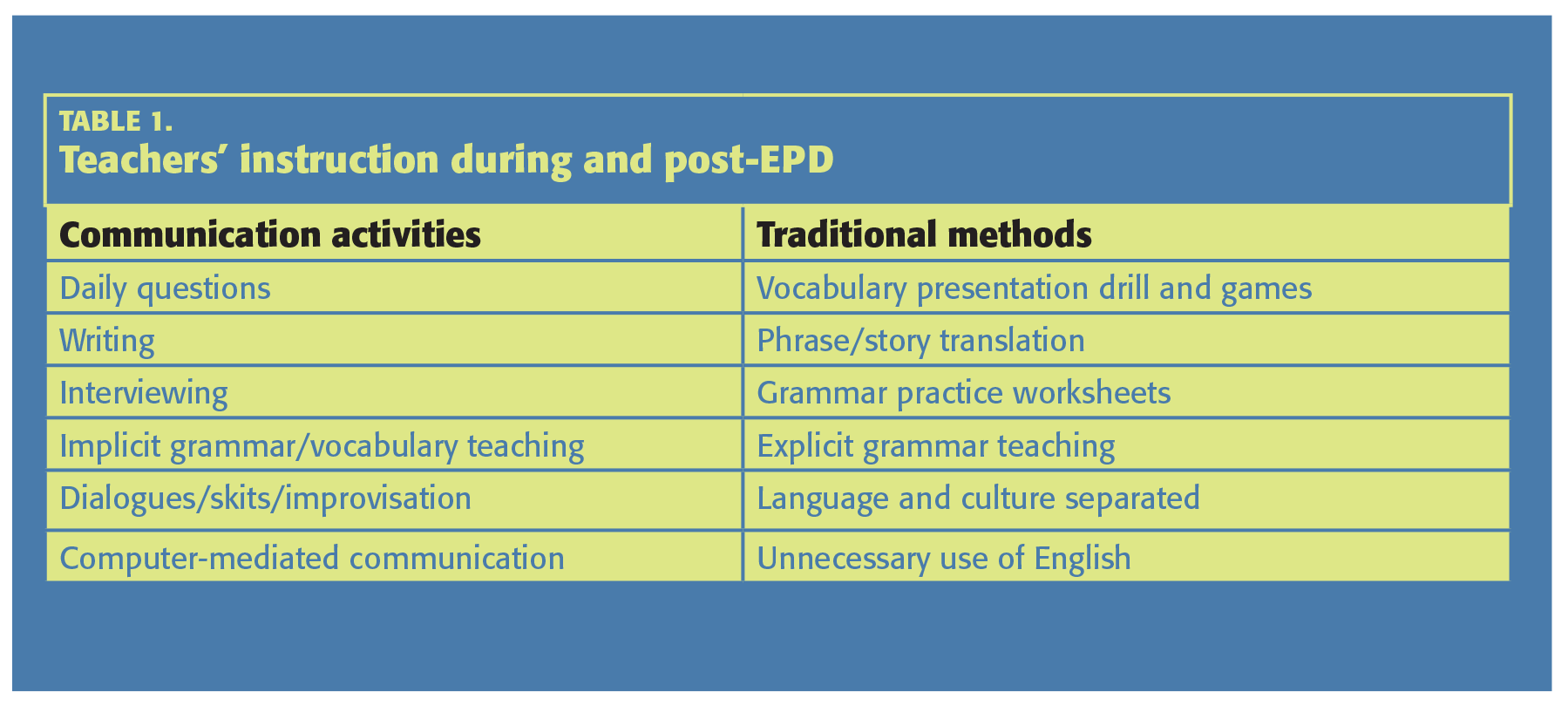
As a result of EPD, teachers implemented such activities as daily questions, story writing, student interviews, implicit grammar and vocabulary lessons, skits, improvisation, and computer-mediated communication. However, the teachers still used traditional methods involving grammar and translation (see Table 1). During the three weeks after the course and then still five months after the EPD course concluded, teachers continued to integrate proficiency-based activities.
Teachers said EPD’s experiential design promoted a collaborative community because it incorporated purposeful meetings, peer observations, and peer and student feedback. They appreciated the on-site coaching and practical application that allowed them time to experiment with communication methods during classes. EPD provided an effective alternative to off-site, classroom-based university courses, and allowed for viable change in classrooms.
Even though students disliked avoiding English during class because of their lack of Spanish vocabulary, they understood the importance of maximizing their Spanish use. They understood why teachers had changed their expectations and were asking them to speak more during lessons. Many students believed speaking more in class improved their confidence in speaking Spanish and lowered their stress level for using it.
Achieving real reform
Developing national and state standards, advising teachers to use the target language 90% or more of instructional time, requiring advanced-level proficiency for newly certified teachers, and mandating evidence of progress in student proficiency may promote some change, but relying on top-down reform alone won’t create meaningful, viable change in world language classrooms. The results of EPD show that world language education researchers and consultants need to consider the Standards for Professional Learning (Learning Forward, 2011) and to collaborate with teachers in their classrooms to create meaningful, transformative, experiential professional development in which they can understand and apply theory and research into practice effectively. EPD doesn’t need to be a university course, but instead can involve a long-term partnership between researchers, consultants, and teachers. To develop partnerships with school districts and engage in participatory action research and/or professional development initiatives, teachers or researcher/consultants can take the following steps:
- Initiate contact with local teachers or researcher/consultant.
- Propose a partnership.
- Researcher/consultant visits teachers’ classrooms, observes lessons, and provides positive and constructive feedback.
- Researcher/consultant asks teachers to reflect on problems they may want to solve in their classrooms, while researcher-consultant also considers possible research or professional development to conduct.
- Decide collaboratively on research questions and/or focus of professional development.
- Determine timeline and schedule for research and/or professional development.
- Begin research and/or professional development.
- Reflect on and analyze research and/or professional development.
- Document collaboration, research and/or professional development outcomes, and present and/or publish results of research and/or professional development.
- Researcher/consultant follows up with support to teachers as needed, or all involved reassess, evaluate, and start new research and/or professional development focus.
Researcher/consultants also can offer experiential professional development on proficiency-based methods for teachers in local school districts by providing regularly scheduled, on-site workshops, coaching in classrooms, and advising sessions for action research projects. To achieve successful reform in world language education, initiatives must be both top-down and bottom-up. Locally, initiatives need to be developed sooner than later, before too many programs are cut at the university and secondary levels as a result of top-down policy. Teachers must be willing to open their doors and researcher/consultants must find time to spend in classrooms to help teachers and students understand how practice can meet theory.
References
Krashen, S.D. (1981). Second language acquisition and second language learning. Oxford, UK: Pergamon Press.
Learning Forward. (2011). Standards for professional learning. Oxford, OH: Author.
Citation: Burke, B.M. (2015). A collaborative approach can improve world language education. Phi Delta Kappan, 96 (7), 69-72.
ABOUT THE AUTHOR

Brigid M. Burke
BRIGID M. BURKE is an assistant professor in the College of Education and Human Development at Bowling Green State University, Bowling Green, Ohio.