|
BEST OF THE WEEK
The week’s best education journalism, all in one place:
|
|
|
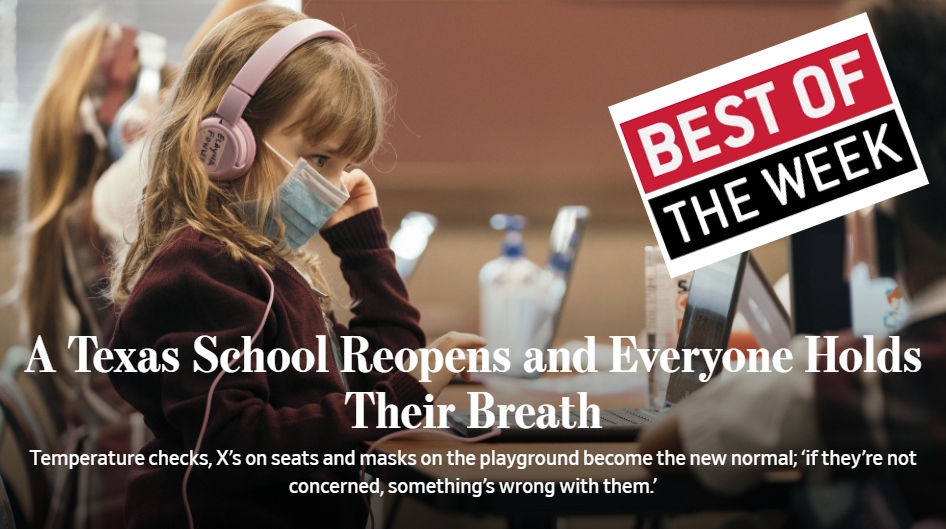
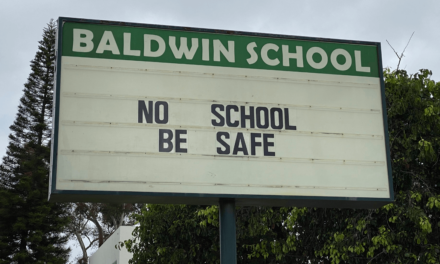
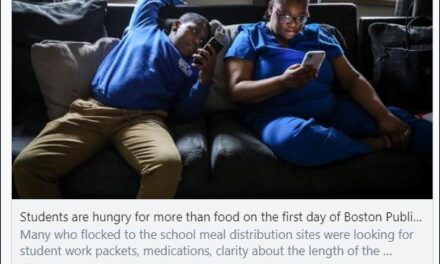
🏆 The best story of the week is A Texas School Reopens and Everyone Holds Their Breath (above), Tawnell Hobbs’ amazing story about a Texas school where a third of parents opted for in-person instruction when school started August 13. The Wall Stree Journal reporter takes us inside the school, showing us what it’s like. You should definitely read it. Great images from Todd Spoth, too.
🏆 Runner-up: This American Life’s recent episode, Long-Awaited Asteroid Finally Hits Earth, features several strong segments including one about a high school math teacher who’s already experienced a month of A/B hybrid in-person instruction school. Depending on how you see the world, the segment will either worry you enormously or reassure you, which is what I like about it. Another segment from the same episode features a school that rolled out in-person instruction carefully but still had to work hard to get parents to return to class. Check them out!
🏆 Bonus reopening stories: As school starts, teachers across the U.S. are trying live virtual instruction for the first time. Will it work? (Chalkbeat); N.Y.C. Delays Start of School to Ready for In-Person Classes (NYT) See also WashPost, NPR; LAUSD kindergarten enrollment plummets for online school (Los Angeles Times); Philadelphia’s school year starts with doubts — and resolve to make virtual learning work (Chalkbeat); L.A. County schools can reopen in-person for their neediest students (LAT) See also NPR; Thousands of North Texas children could be among the ‘lost generation’ of students after they stopped participating in online learning (Dallas Morning News).
In last week’s newsletter, we incorrectly credited the Colorado Sun for a story written by Chalkbeat. Apologies to all. It’s a great story. Read it here. |
|
| HOW TO REPORT COVID CASES IN SCHOOLS |
|
|
Above: CNN’s Chris Cuomo interviews data scientist Rebekah Jones about the struggle to get systematic COVID case data for K-12 schools.
Now that some schools are reopening in person during the pandemic, education reporters have a tough new job.
First, they have to get accurate school-based COVID case data from reluctant state and local agencies. Then, they’ve got to produce smart stories about what the data really mean.
That’s the focus of this week’s column, which highlights the troubling lack of systematic reporting and the many challenges of reporting COVID cases without confusing readers, demonizing schools, or amplifying fears.
Big thanks to the Society of Professional Journalists for tweeting out a quote from our recent column on alarmist reopening coverage: “Finding the right balance between conveying real risks and reminding readers of important contextual factors is difficult but important.” Much appreciated! |
|
|
MEDIA TIDBITS
Thought-provoking commentary on the latest coverage:
|
|
|
📰 THE MEDIA OBSESSION WITH LEARNING PODS: For several weeks now, there’s been a LOT of coverage of learning pods. But it turns out that the pods might not be nearly as common or consequential as it may have been made to seem. A new survey from Education Week finds that just 1% of parents say they’ll participate in pandemic pods. Just 8 percent of teachers, principals, and district leaders say they have personally interacted with even one parent in their district who plans to take this approach, according to EdWeek. Only 5 percent say they are at least somewhat concerned about losing enrollment to pods. It’s possible that the pods are highly clustered in certain places, or that parents are keeping the pods on the down low in order to avoid pushback from educators or endangering funding for their kids’ schools, but the pod coverage could just as well be an example of stupid media stampede.
📰 MISLEADING COVID COVERAGE: There were at least two instances of worrisome COVID coverage in the past week, from NPR and the New York Times. First, NPR ran a story on Friday morning about tracking COVID cases in schools that seemed to conflate cases and transmission — two very different things. “It’s important to understand how #COVID19 is spreading in schools, but we need to be cautious about interpretation here,” tweeted Julia Marcus. “Cases reported in schools do not necessarily reflect transmission in schools.” The Times published a story about kids and COVID that one knowledgeable observer described as “one of the most misleading use of data on the subject of children and COVID I have seen to date.” Of particular concern was the story headline and the accompanying graphs. “At best, they’re uninformative,” tweeted another critic. “At worst, wildly misleading.”
📰 BACK TO SCHOOL PODCASTS: Nice White Parents and Fiasco’s “Battle Over Boston” got a paired review in the New Yorker. Reviewer Sarah Larson quite accurately observed that the most distinguishing sound of Nice White Parents is Joffe-Walt’s narration, which is “abundant, direct, and full of zingers.” She also reminded us that NYC Mayor Bill de Blasio’s antipathy toward busing comes in part from his childhood near Boston. “De Blasio, who grew up near Boston in the seventies, believes that busing there ‘absolutely poisoned the well,’ and is a model to be avoided: ‘I think history is on my side here.’ ” Meanwhile, Nashville Public Radio’s Meribah Knight is out with Season 2 of The Promise; A Tale of Two Schools. What happens when you have two schools so close together yet so different? And what happens when people in the neighborhood finally start to notice? Check it out!
Missed some previous editions? You can see the archive of past newsletters here. |
|
|
PEOPLE, AWARDS, JOBS
Who’s going where & doing what?
|
|
|
Above: Time to add Johann Calhoun (above) to the people you follow. He’s the new Philadelphia bureau chief for Chalkbeat’s latest team. Welcome Johann! Can’t wait to see what you and your new team do.
🔥 Former AJC education reporter Marlon Walker recently became the No. 2 at the Clarion Ledger. “Covering education has afforded me the chance to better understand teaching and leadership, and reaching people ‘where they are,’ ” tweeted Walker. “I’ll miss holding folks accountable here, but cannot wait to work with the brilliant minds with whom I’ll have the privilege of collaborating.”
🔥 Great to see a new story from Erin Einhorn, who helped found Chalkbeat’s Detroit bureau then left for NBC News. She and Nigel Chiwaya produced this piece: How Minneapolis re-segregated its schools and set the stage for a national crisis.
🔥 Former KPCC education reporter Priska Neely announced that she’s headed to run a joint regional collaboration between NPR and Gulf State affiliates. “This is an alignment of so many dreams and goals and such a unique opportunity to build something new,” she tweeted. Great news. Can’t wait to see what she does next.
🔥 “When done well, education coverage is about race, gender, class, and politics,” writes Chalkbeat’s new story editor, Cara Fitzpatrick, in what she calls “a little love letter” to education journalism. “Covering education isn’t just worthwhile for news organizations that are invested in their communities. It’s essential.”
🔥 The Poynter Institute rounded up what it’s like to be an education reporter covering the pandemic, featuring folks like Kenya Hunter, Shelby Webb, and others.
Did someone forward you this newsletter? You can sign up here. |
|
|
Above: Yes, that was USA Today’s Erin Richards on “CBS This Morning”, talking about remote learning, her first national broadcast appearance, she says. Great job, Erin!
⏰ The Boston Globe has an event Sept. 10 about how to minimize harm in reopening schools. Education editor Sarah Carr is moderating.The Globe also redesigned their Great Divide page. It looks really nice and is easier to navigate than their old page. Meanwhile, the Globe’s Bianca Vázquez Toness was on EWA Radio.
⏰ Congrats to the Tampa Bay Times’ Jeff Solochek, who has apparently covered education for 25 years now. “I don’t know of an @EdWriters member who’s been more committed to the hard work of the daily beat,” tweeted EWA’s Emily Richmond. Go, Jeff!
⏰ Journalist’s Resource put out a new guide for reporters, Reopening schools amid the coronavirus pandemic: 5 studies to consider, by Denise-Marie Ordway. CNN and EdWeek partnered to show where schools are open, and who’s making the decisions about when and how to reopen.
⏰ You can still sign up for SPJ’s annual conference, which will be held virtually September 12-13. And don’t forget to sign up for IRE’s annual conference September 21-25, featuring an education panel with Kim Clark of EWA, Tawnell Hobbs of the Wall Street Journal, and Krista Torralva of the San Antonio Express-News. |
|
|
“Brooklyn writers need two kids,” tweeted Alice From Queens in my favorite quip of the week, “so they can send one to private school and still have one in public school to write about.”
|
|
|
That’s all, folks. Thanks for reading!
|
|
|
|
|