|
The big story of the week is that, despite pockets of resistance and predictions of doom, school staff vaccine mandates continue to succeed, with student mandates on the horizon:
🔊 Confronted with losing their jobs, 99% of LAUSD teachers meet COVID-19 vaccine requirements (L.A. Times)
🔊 Chicago schools staff more likely than police, fire employees to be vaccinated (Chalkbeat Chicago)
🔊 Amid U.S. Anti-Vaccine Movements, Puerto Rico Vaccinates 89% of Eligible Youth and 98% of School Staff (The 74)
🔊 Parents in California protest student COVID-19 vaccine mandate, keep kids home (L.A. Times) See also: EdSource, San Diego Union Tribune, Sacramento Bee, San Francisco Chronicle
🔊 California is mandating the COVID vaccine for kids. Could Connecticut be next? (CT Mirror)
🔊 Biden admin: New effort to start COVID vaccination sites at schools on the way (Chalkbeat)
Did someone forward you this newsletter? You can sign up here.
|
RELUCANCE TO LIFT MASK MANDATES
Best education journalism of the week.
|
|
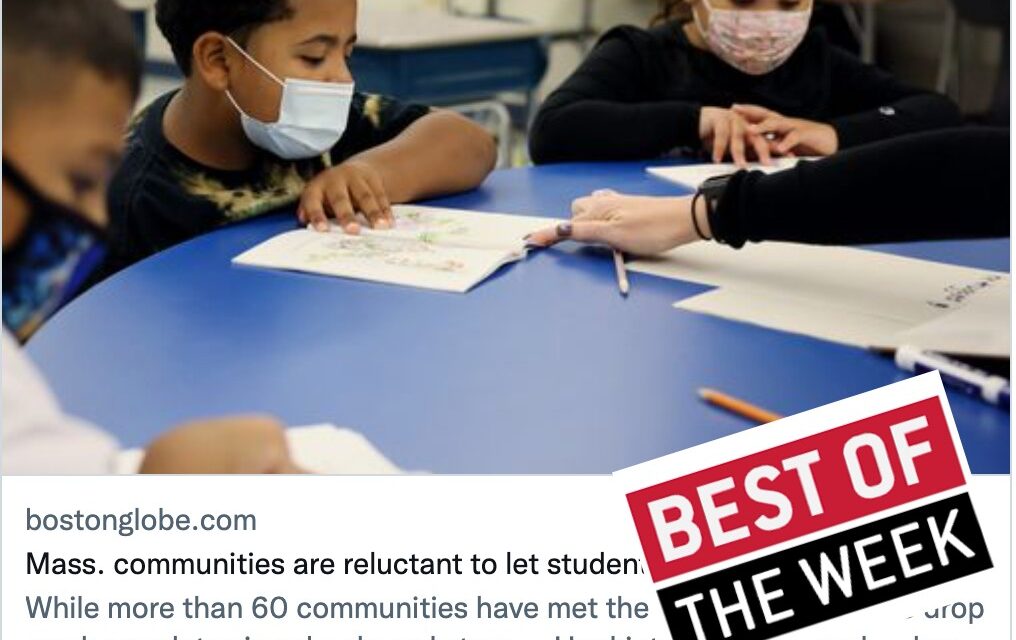
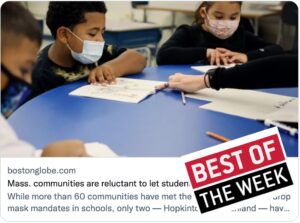
| 🏆 BEST: The best story of the week is Mass. communities are reluctant to let students remove masks in school — even when they can by Boston Globe health reporter Kay Lazar, which explores the ongoing cautiousness with which some New England communities are still responding to COVID. As Lazar reports, more than 60 Massachusetts communities have met the state’s 80% teen vaccination threshold for removing mask mandates, but only two school districts have sought and received permission. One reason is that some school leaders are hesitant to end the rules that seem to be working and keeping cases down. Another is more political. This is the first story I’ve seen that puts numbers to this phenomenon, but I suspect it’s a story in many other places too. It’s a good reminder for reporters to look beyond the anti-mask protests at what else is going on. We’ll see more about this when vaccines become available for younger kids.
🏆 RUNNER-UP: This week’s runner-up is California Accounts for 12% of U.S. Students, but Only 1% of Covid School Closures by the New York Times’ California-based Soumya Karlamangla. Karlamangla begins with statewide protests against California’s COVID vaccine mandate for students, which hasn’t yet gone into effect. But, she writes, “At the heart of this fight is a complicated truth … The state already has a remarkably low number of outbreaks at schools.” So why the need for a vaccine mandate then? Some experts say it’s the best safety measure against COVID, and a sensible next step. But for some parents, it’s an unnecessary intrusion in their ability to choose. Like the Boston Globe story, this one also gets at the fact that often schools with the strictest COVID safety measures are the ones that need them the least.
BONUS STORIES:
🏆 Black teacher workforce declined sharply as Michigan students left city districts — study (Chalkbeat Detroit)
🏆 Amid Pandemic Turmoil and Curriculum Fights, a Boom for Christian Schools (New York Times)
🏆 The law that prompted a school administrator to call for an “opposing” perspective on the Holocaust is causing confusion across Texas (Texas Tribune)
🏆 420,000 homeless kids went missing from schools’ rolls last year. They may never be found (The Hechinger Report)

‘SQUID GAME’ SCHOOL BOARD COVERAGE
New from The Grade |
|
|
There’s a problem with media coverage of school board protests that amplifies liberal fears and focuses on the visual spectacle of yelling, angry people rather than the substance of their worries. It creates the perception that protests are engulfing the nation’s 14,000 school boards and that protesters are illegitimate and even dangerous. Coverage that provides more context, explores protesters’ motivations, and de-escalates the rhetoric used to describe the protests will help.
ALSO: Sometimes, even the most skilled and careful journalism unintentionally frames its subjects in an incomplete and potentially destructive way. That’s what happened with Casey Parks’ recent piece on the “tragedy” of rural schools in the New York Times Sunday Magazine, according to Mara Casey Tieken and Sheneka Williams. Presenting rural schools as tragic not only downplays their many successes, it sets rural schools up for closure or consolidation — much like coverage of Black schools has done in the past.
MEDIA TIDBITS
Thought-provoking commentary on the latest coverage. |
|
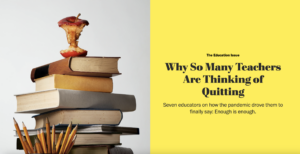
| Above: Washington Post Magazine’s education issue is out, including the story Why So Many Teachers Are Thinking of Quitting. The 74’s Mike Antonucci laments that the lengthy feature never actually quantifies how many teachers are, well, quitting.
📰 LEARNING LOSS IS REAL – BUT NOT INEVITABLE OR PERMANENT: “Based on the conversations I’ve had with educators, very few profess that the concept of learning loss is a complete farce, nor do they believe an entire generation is doomed,” writes the L.A. Times’ Laura Newberry in a recent newsletter. “Most seem to think the truth lies somewhere in the middle. But you wouldn’t know that by reading some of the news coverage on the issue.” For a great look at the pre-existing issues and current efforts to recover from a prolonged period of remote instruction, check out the L.A. Times’ new piece, Falling grades, stalled learning.
📰 ‘HARDENED’ SCHOOL BOARD MEETINGS & NSBA DRAMA: I’m being told that a few districts have begun “hardening” their board meetings in response to recent protests and extensive media coverage of them: beefing up security, moving to more secure locations (like hotels), and even going back online. Has this trend been covered to the extent that it’s really happening? What are the costs, financial and otherwise, of locking down school board meetings? Remember that some school boards have long histories attempting to limit public participation and that the response to perceived threats from school shootings ended up being expensive and (to some observers) wasteful. Meanwhile, there’s a mini-scandal about that NSBA “domestic terrorism” letter that deserves more attention than it’s getting.
📰 ACCOUNTABILITY FOR THEE, BUT NOT FOR ME: Journalists like to hold other people accountable, but apparently not to be held to account themselves. That’s what inevitably comes to mind reading a recent AP story that finds that efforts to track newsroom diversity following the murder of George Floyd are lagging. It’s nothing new, just more surprising given the past few years. Transparency around newsroom diversity has also been a challenge in education journalism, where a number of teams and outlets still refuse to provide demographic information about their journalists for The Grade’s annual roundup.
📰 ALT CERT FOR JOURNALISM? “American journalists look less and less like the country they cover — in terms of race, class, and background,” according to Nieman Lab’s Josh Benton. “An idea from K-12 education might help.” Benton’s idea — alt cert for journalism — has some appeal, but not everyone was buying. “I think this exists! It’s called community college,” tweeted Clark College journalism Professor Beth Slovic. “Thank goodness we have people at Harvard helping us.”
Looking for media commentary and analysis all day, every day? Follow me at @alexanderrusso.
|
PEOPLE, JOBS, KUDOS
Who’s going where & doing what?
|
|
|
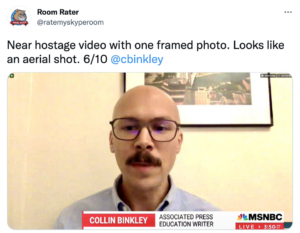
Above: AP education reporter Collin Binkley got what may have been the worst rating ever on Room Rater, but he’s owning it: “Brutal, but not wrong,” he tweeted.
🔥 New hires & job moves: The 19th has hired Nadra Nittle, a former teacher with 15 years of journalism experience, as their first gender and education reporter. Avid readers of this newsletter may remember that Nittle was featured here before, talking about how the media over-generalized from a few isolated incidents of “sneaker violence” to create the false impression that it was at epidemic levels. The Washington Post’s Perry Stein is taking a three-month break from the education beat to fill in for the paper’s Brussels correspondent. Keep an eye out for her return in 2022! And Linda Perlstein, former public editor for EWA and Washington Post education reporter, is joining the Center for Reinventing Public Education as its newest director of impact.
🔥 Jobs! The Wall Street Journal is hiring an education beat reporter to cover K-12 schools nationwide. Chalkbeat is hiring tons of interns for their bureaus in New York City, Indiana, Detroit, and Chicago, as well as for their national and data teams. WLRN, South Florida’s NPR member station, is looking for a Miami-based education reporter. The Minneapolis Star-Tribune is hiring a metro reporter to cover statewide K-12 education. The Atlanta Journal Constitution is hiring an education reporter. The Seattle Times Ed Lab is hiring a reporter. WBUR, Boston’s public radio, is hiring a new education editor. Any new job opening out there that folks might want to know about? Let us know.
🔥 Everybody’s got a side gig these days. Former Chalkbeat reporter (and current politics editor at the Des Moines Register) Nic Garcia is making reporter’s notebooks that have taken over journalist Twitter. “When you’re in the classroom or talking to a parent outside a school, you can’t take notes on a laptop,” he tells us. “You need a notebook that won’t bend while you scribble observations and quotes.”

|
APPEARANCES, EVENTS
What just happened & what’s coming next?
|
|
| Above: Keep an ear out for me on Sunday night on the 8 Black Hands podcast talking about the role of the media in education. You can catch it here.
⏰ Upcoming: WPLN’s Meribah Knight and ProPublica’s Ken Armstrong, who wrote an incredible investigative story earlier this month about Black children being arrested in school and jailed for nonexistent crimes, will speak about their story in a virtual event Oct. 25. The Atlantic’s Adam Harris will speak with Education Secretary Miguel Cardona at The Atlantic’s Education Summit Oct. 26. Also that day, EWA is hosting a webinar on what reporters need to know about learning in quarantine.
⏰ Podcasts: WBUR On Point featured a segment on why school boards are a nexus of America’s culture wars, featuring Washington Post Virginia politics reporter Laura Vozzella. And the San Francisco Chronicle’s Fifth & Mission Podcast tackled desegregation efforts in Marin County, asking, is it working? The podcast follows WNYC’s previous podcasts on the same topic: Two Schools in Marin County, which we named one of 2020’s best pieces of education journalism, and Desegregation By Any Means Necessary by Marianne McCune and Kai Wright.
⏰ Media appearances: The Hechinger Report’s Jill Barshay spoke about pandemic “learning loss” and “missed learning” on NPR’s All Things Considered on Oct. 16. Also that day, Meribah Knight was on NPR’s Weekend Edition to talk about her story on the illegal arrests of kids in school in Tennessee.
⏰ Looking for a fellowship to support a long-term reporting project? Applications for the Spencer Education Reporting Fellowship at Columbia Journalism School are now open. “This will change your life,” says the Baltimore Sun’s Liz Bowie. She’s not wrong.
Did someone forward you this newsletter? You can sign up here.
|
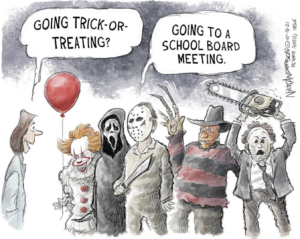
It’s spooky season in ed world. (Credit: U.S. News.)
|
|
|
That’s all, folks. Thanks for reading!
Reply to this email to send us questions, comments or tips. Know someone else who should be reading Best of the Week? Send them this link to sign up.
Using Feedly or FlipBoard or any other kind of news reader? You can subscribe to The Grade’s “feed” by plugging in this web address: http://www.kappanonline.org/category/the-grade/feed/.
Read more about The Grade here. You can read all the back issues of The Grade’s newsletter, Best of the Week, here.
By Alexander Russo with additional writing from Colleen Connolly.
|
|
|
|
|
|
|
|
|
|
|
|
|