In this week’s newsletter: Parents demand better for their children with special needs who are falling further and further behind in the pandemic. A majority-Black school in Oakland closes and devastates the community it built. Education journalists in states like Florida offer tips on how to cover “culture war” stories without fanning the flames. And one journalist writes a heartfelt tribute to the high school teacher that inspires him to this day.
FAILING STUDENTS WITH SPECIAL NEEDS
The big story of the week, according to us:
The big story of the week is one I’d like to see even more coverage of. As we learn more about the effects of remote learning on education — and outlets slowly start to admit this (looking at you, New York Times) — the patterns showing who was most deeply affected become even more obvious. Kids with special needs are among the most vulnerable, even with classrooms open. But in the pandemic, they fared especially badly in many places. Now, parents are demanding better and schools are trying to figure out how to remedy the problems:
🔊 LAUSD failed students with disabilities during pandemic, federal investigation finds (LA Times)
🔊 LAUSD to Address Compensatory Education Needs of Students With Disabilities (NBC Los Angeles)
🔊 What the shutdowns taught some WA parents about special education (Crosscut)
🔊 Why some special ed services worked, and some did not, during remote instruction (District Administration)
🔊 Parents rally for creation of special education ‘watchdog’ for students with disabilities (Providence Journal)
🔊 L.A. Agrees to Do More After Failing on Special Education. Could Other Districts Be Next? (EdWeek)
Other big stories of the week: I was happy to see several poll and survey stories this week shining a light on context often missing in coverage of education controversies — such as how parents really feel about their kids’ schools and curricula and what kind of COVID precautions they want to see at school (HuffPost, Chalkbeat, WBUR, Commonwealth Magazine).

DO’S & DON’TS OF CULTURE WAR COVERAGE
New commentary from The Grade
Education is in the news a lot these days, but not always in a helpful way. The pressure to cover hot-button proposals and protests is strong. News outlets probably don’t feel that they can avoid giving them at least some attention.
So what’s an education reporter or editor to do?
“Give real examples of what it would mean, rather than just the Dems saying this would be a disaster and Republicans saying they’re protecting kids,” says one Florida education reporter.
“It’s equally important — if not more so — to fill readers in on what we don’t know, and what public officials aren’t telling us,” says another.
We spoke to several journalists who regularly cover these so-called “culture wars” for tips on how to do it right without fanning the flames.
Special thanks to Detroit News K-12 reporter Jennifer Chambers, South Bend Tribune education reporter Carley Lanich, The 74’s Beth Hawkins, EdWeek’s Stephen Sawchuk, Tampa Bay Times education reporter Jeff Solochek, and others for speaking with us.
WHEN A MAJORITY-BLACK SCHOOL CLOSES
The best education journalism of the week, plus a runner-up and some bonus stories.
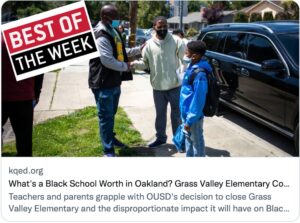
🏆 BEST: The best story of the week is What’s a Black School Worth in Oakland? Grass Valley Elementary Community Braces for 2nd Closure in a Decade by Vanessa Rancaño in KQED, her last story on the education desk before she moves onto another beat. In February, the Oakland Unified School District voted to close or consolidate 11 schools, including Grass Valley, which enrolls the district’s highest share of Black students at 65%. Rancaño goes deeper than the outrage headlines and finds out exactly what this will mean at the individual student level. She tells us she spent three days on campus to report the story, and it shows. Officials say under-enrollment and poor test scores are reasons for the closure, but Rancaño reports that the school shows up for students in less tangible, but perhaps more important ways. One parent transferred his son from a school with hardly any Black students to Grass Valley and immediately noticed a difference in his mood and attitude toward school: “Seeing the joy when he walks out that door, it’s everything to me,” he said.
🏆 RUNNER-UP: This week’s runner-up is Alabama lawmakers claim LGBTQ school bathrooms are an ‘issue’. Here’s what we found by Trisha Powell Crain for AL.com. Just last week, Grade contributor Greg Toppo warned journalists not to run with political talking points without first looking into their claims. This week, Powell Crain did just that, debunking a state representative’s claim that “almost every single school district in this state is dealing with this issue with opposite genders wanting to use opposite bathrooms.” Rather than amplifying his statement, Powell Crain called multiple school districts and asked them directly if this was an issue at their school. The answer? No, said all those who responded. Kudos to Powell Crain for doing the real work in reporting this story rather than just getting clicks off a headline with an inflammatory statement from a public official, as we’ve seen so much of lately.
BONUS:
🏆 Half of States Set to Ban Abortion Have No Sex Ed Requirements (The 74)
🏆 Without state leadership, Michigan’s patchwork tutoring programs struggle to address learning loss (Chalkbeat Detroit/Bridge Michigan)
🏆 The most important desegregation case you’ve never heard of, and why it’s still relevant (GBH)
🏆 The Real Origins of the Religious Right (Politico)
🏆 Oakland school board member who supported school closures slams teachers union in fiery resignation letter (SF Chronicle)
🏆 Learning More: Why did U.S. schools make so much progress in the 1990s and early 2000s? (New York Times)
🏆 A closer look at Florida’s rejected math textbooks (Tampa Bay Times)

PEOPLE, JOBS, AWARDS
Who’s doing what, going where.
Above, clockwise from top left: The Philadelphia Inquirer’s Bob Fernandez, Spotlight PA’s Charlotte Keith, the Texas Tribune’s María Méndez (formerly of the Austin American-Statesman), and WLRN’s Jessica Bakeman were among those honored with National Headliner Awards for education coverage.
🔥 Awards: Education reporters were all over the list of National Headliners Awards winners this year! Congrats to the Philadelphia Inquirer’s Bob Fernandez and Spotlight PA’s Charlotte Keith for their first-place win in education writing for their story on the nonprofit Milton Hershey School. The Post and Courier, the Christian Science Monitor, the Dallas Morning News, the Seattle Times, AL.com, and the Hechinger Report took home second place for their “Reading Remedies” series, and María Méndez, who’s now at the Texas Tribune, won third place for her work at the Austin American-Statesman. WLRN’s Jessica Bakeman also won second place for radio station documentary for her story on how COVID impacted Florida’s most vulnerable students. And Fox45 in Baltimore won first place in broadcast public service for their “Failure Factory” story on how the local school system is failing students.
🔥 Comings and goings: The Baltimore Banner has announced its first new education hire (following Liz Bowie). Jessica Calefati, who’s most recently been covering higher ed at Politico, will be an education enterprise reporter at the Banner with a special focus on Johns Hopkins University. EdWeek assistant managing editor Daarel Burnette is leaving the outlet to be a senior editor at the Chronicle of Higher Education. And WFYI Indianapolis digital editor for education Lindsey Erdody is leaving the station to work as an associate editor for Axios Local. Erdody helped launch WFYI’s new education initiative, and we’re told they’re hiring someone internally to replace her.
🔥 Jobs: The Baltimore Banner is still looking for two more education reporters, one focused on K-12 and another on higher ed. Politico is hiring an education newsletter writer and K-12 reporter. USA Today is looking for an education editor to replace Chrissie Thompson. They’re also still hiring a K-12 enterprise reporter to replace Erin Richards. The Washington Post is hiring a higher education investigative reporter. The Dallas Morning News is hiring a reporter for their Education Lab. Check previous editions of the newsletter for other listings that may still be open.
🔥 Upcoming: Keep an eye out in the next month for a big story from the Hechinger Report’s Tara Garcia Mathewson, who tweeted a long thread about corporal punishment in schools. “My forthcoming story will dig deep into how and why paddling remains widely used at one of Mississippi’s elementary schools and the implications of that,” she tweeted.
🔥 Books: Shoutout to Gannett’s Danielle Dreilinger, whose book on the history of home economics is now out in paperback! If you missed it before, listen to her talk about it on WBUR’s Here & Now.
EVENTS, RESOURCES
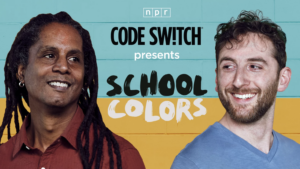
Above: The much-anticipated second season of School Colors is now out! In it, hosts Mark Winston Griffith and Max Freedman dive into the fallout at a Queens school district over a suggested school diversity plan. The duo spent two years reporting the story and talked to more than 100 people, so it should be good listening. You can find Episode 1 here.
⏰ Speaking of School Colors, anyone want to write a thought-provoking review or critique of the first few episodes? We’d love to commission something for The Grade. No journalism experience required. Send an email to thegrade2015@gmail.com if you’re interested. We pay $600 for about 1,200 words.
⏰ ICYMI: Watch Grade contributor Greg Toppo’s April 15 discussion about education news coverage with CNN’s Brian Stelter. And check out NPR’s Anya Kamenetz on the Future U Podcast this week talking about the pandemic, learning loss, and K-12 mental health.
⏰ So long, 8 to 3: After just one year, the LA Times’ 8 to 3 newsletter geared toward parents is saying goodbye. Writer Laura Newberry says the newsletter no longer serves its original purpose — to help inform parents when kids were still largely out of school and unvaccinated. This follows the recent demise of the New York Times’ Education Briefing newsletter, which seems to have come back, though as a shell of its former self.
⏰ Resources: Trying to get more context into stories on how parents really feel? Check out this new Bellwether Education “parent perception barometer,” which tracks data from various polls over time. Neat!
THE KICKER
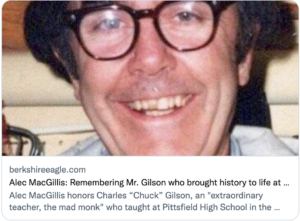
Education journalists often had quite impactful school experiences themselves — some good, some bad, some wild, as we’ve reported before. ProPublica’s Alec MacGillis is no exception. In this warm tribute to his high school history teacher Mr. Gilson, he remarks on the lessons he learned in the classroom and how they factor into his reporting today.
“Last fall, I had the chance to do a four-month fellowship at the American Academy in Berlin,” MacGillis writes, “and so 30 years after I last sat in the middle row of Mr. Gilson’s classroom, I was suddenly re-immersed in the history he’d introduced to me.”
That’s all, folks. Thanks for reading!
Reply to this email to send us questions, comments or tips. Know someone else who should be reading Best of the Week? Send them this link to sign up.
Using Feedly or FlipBoard or any other kind of news reader? You can subscribe to The Grade’s “feed” by plugging in this web address: http://www.kappanonline.org/category/the-grade/feed/.
Read more about The Grade here. You can read all the back issues of The Grade’s newsletter, Best of the Week, here.
By Alexander Russo with additional writing from Colleen Connolly.
ABOUT THE AUTHOR
Alexander Russo
Alexander Russo is founder and editor of The Grade, an award-winning effort to help improve media coverage of education issues. He’s also a Spencer Education Journalism Fellowship winner and a book author. You can reach him at @alexanderrusso.
Visit their website at: https://the-grade.org/