
Leaders can learn skill sets and disciplines that will help them stay focused on improving teaching and learning.
School leaders are increasingly recognized as an important factor in enhancing teaching and learning, yet we have been relatively random in how we prepare and support them. We at Teachers21, in our collaboration with district and building leaders throughout Massachusetts, have spotted four obstacles that often block or diminish leaders’ effectiveness. Avoiding or overcoming each of these — outlined below — requires an underlying set of skills and knowledge that we believe can be learned and practiced and thus transform administrators into proficient, even exemplary leaders.
#1. Undervaluing the importance of culture.
While we understand how effective teachers develop a positive and inspiring classroom climate, leaders are less comfortable acknowledging and embracing the importance of climate in influencing adult learning. Leaders can significantly shape the climate within organizations, and the environment they create affects the quality and richness of adult learning. Similar to successful classroom teachers, skillful leaders help educators learn from error, persist in the face of setbacks, listen carefully to the voices of fellow practitioners, understand that trust is foundational to learning, and engage in ongoing dialogue and conversations about problems of practice. Harvard Business School professor Amy Edmondson, in her study of organizations that relied on innovation and creativity, found that organizations that figured out how to balance psychological safety with accountability thrived (2012). Psychological safety, a hallmark of a vibrant learning culture, allows people to take risks, learn from error, and openly challenge the thinking of their colleagues and supervisors. Leaders can learn the skills required to foster a psychologically safe environment without sacrificing accountability.
#2. Letting the problems of the moment move the organization off course and away from strategies that will lead to improvement in student learning.
Leaders often ignore or lack the skills needed to stay focused on long-term goals in the face of emotionally draining but demanding day-to-day problems. Staying strategic in the face of urgent but less important issues requires a 21st-century skill set. Issues that demand their attention constantly bombard leaders. These issues can easily become black holes that absorb huge amounts of energy and time. Problems related to a boiler malfunction, a student’s weapon violation, an irate parent group, or a controversial athletic event can distract leaders from their primary responsibility of improving instruction. Learning how to stay strategic and continuing to move the organization forward is one of the most challenging aspects of modern leadership. For some leaders, being able to do this is a function of their innate abilities. Those who lack these competencies can learn and practice skills that will enable them to be strategic.
When blame substitutes for responsibility, organizations stop continually improving.
#3. Balancing our focus on what we are doing with the effect of what we are doing.
Leaders need to balance planning and implementing initiatives with a focus on measuring the effect of those activities. While educators and researchers have invested heavily in establishing and documenting best practices, those best practices are only probabilities. Leaders and the people they supervise must continually assess their impact along the way to be able to make necessary adaptations so that hoped-for results are achieved. Each lesson, each unit, each initiative must be assessed as to how it affects learners or participants. Based on that data, leaders and teachers can make adjustments to better meet the needs of those they serve. Without this balance between action and results, blame often substitutes for responsibility, and that keeps the organization from continually improving.
#4. Underestimating the importance of skillful practice.
Competence matters. As Linda Hill and Kent Lineback describe in Being the Boss (2011), leaders need to know not only what to do but how to apply that knowledge to the circumstances at hand. In our current circumstances, the “what” and the “how” that leaders need to know have evolved beyond management and operations. Skillful leaders now must be able to observe and analyze instruction, collect, examine, and mine data, run effective meetings, manage conflict, deepen collaborative skills in others, and influence organizational learning.
These skill sets are part of the core knowledge base that all leaders must develop and model for others, regardless of their particular roles and responsibilities. While leaders in education may have some of these skills, leaders also must model their own learning and by doing so develop and hone these skills so that they continually improve their own effectiveness. When we allow leaders to develop and practice these skills and support them with effective coaching and targeted feedback, new skills blossom and more effective leaders emerge.
Figure 1 illustrates the four conditions critical to improved and inspired learning. The first three are:
- Reflective learning culture;
- Strategic alignment to a common vision; and
- Continuous improvement process informed by evidence-based adjustments.
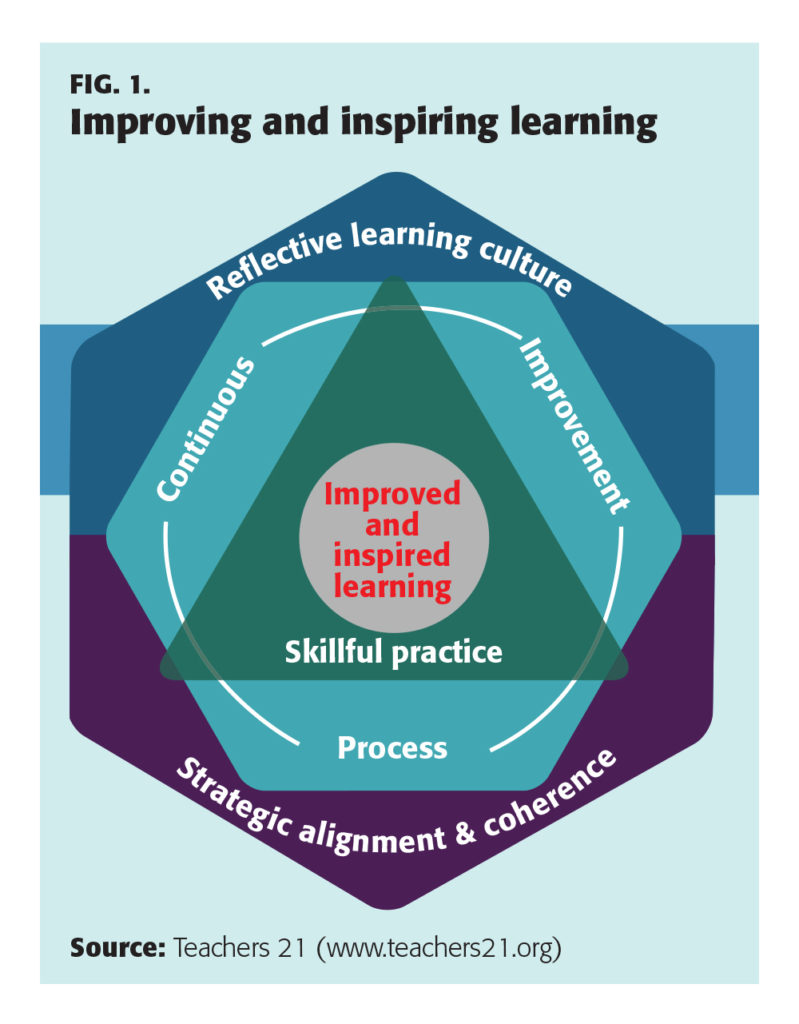
The fourth condition within the triangle represents skillful practice, and it is at the core of our work in classrooms, teacher teams, schools, or districts. All four key conditions, when aligned and operating effectively, lead to improved and inspired learning. The dynamics within the figure relate to each classroom where students are the learners but also equally apply to schools or districts where the learners at the center of the diagram are educators.
Figure 2 provides more detail by showing the components that make up each of the four conditions. Factors that can shift the culture of a school include trust, dialogue, feedback, and strengthening what Carol Dweck calls a growth mindset (2007). Each of these factors has a knowledge base and skill set that can be learned and practiced.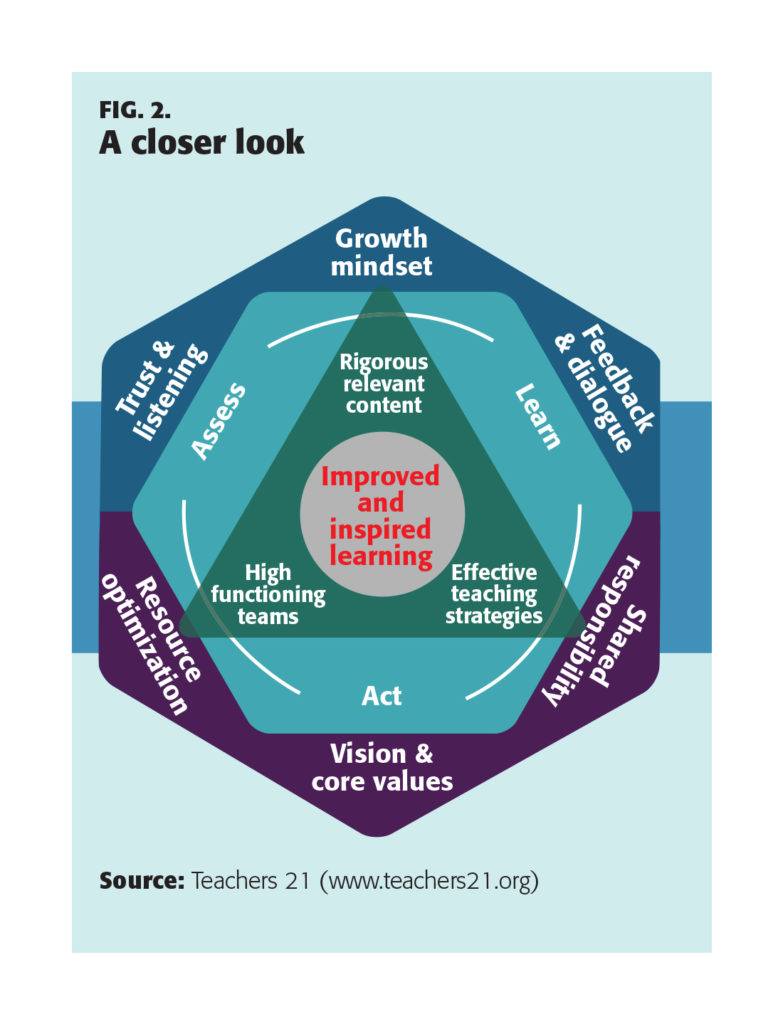 Staying strategic in the face of what Ash and D’Auria refer to as “the debris field” of problems that administrators face on a daily basis requires a clear, shared vision, adherence to a set of core values, resources aligned to that vision, and accountability (2013). Again, while some of these abilities may be intuitive, many need to be learned and practiced.
Continuous improvement requires a process by which educators develop habits and routines for assessing their effect; they must learn from what is working, in what way and for whom, and then adjust their practice accordingly. Skillful practice requires three critical competencies:
- Deep understanding of rigorous and relevant content;
- A wide repertoire of effective teaching strategies; and
- Knowledge of how to develop and support high-functioning teams.
Leaders can significantly shape the climate within organizations, and the environment they create affects the quality and richness of adult learning.
Skillful practice can describe the competencies of a classroom teacher in that they also need content mastery, dexterity with a range of teaching strategies, and the ability to create strong teams in order to be optimally effective. Those same competencies relate to administrators. The content of leadership includes knowledge of good instruction, adult development, and school culture. The teaching strategies relate to the skills needed to manage conflict, observe and analyze teaching, and manage people and processes.
Finally, the ability to develop and support high-functioning teams schoolwide is essential to ensuring improved and inspired learning for all learners — adults or children. While the main factor within effective teams — collaboration — is currently highly valued, it is a dynamic that needs to be learned and developed.
Teachers21 uses this framework for improved and inspired learning to assist leaders to become clearer and more strategic about addressing all of the critical aspects of their work. We also use the framework to shape leadership development programs that teach and strengthen these skills in aspiring and experienced leaders at all levels. We have discovered that the factors within this framework are central to what makes a classroom, a school, or a district effective at improving and inspiring learning for students and adults.
References
Ash, P. & D’Auria, J. (2013). School systems that learn. Thousand Oaks CA: Sage.
Dweck. C. (2007). Mindset: The new psychology of success. New York, NY: Ballantine.
Edmonson, A. (2012). Teaming: How organizations learn, innovate, and compete in the knowledge economy. San Francisco, CA: Jossey-Bass.
Hill, L. & Lineback, K. (2011). Being the boss: The three imperatives for becoming a great leader. Cambridge, MA: Harvard Business Review.
CITATION: D’Auria, J. (2015). Learn to avoid or overcome leadership obstacles. Phi Delta Kappan, 96 (6), 52-54.
ABOUT THE AUTHOR

John D'Auria
JOHN D’AURIA is president of Teachers21, a nonprofit education leadership consultancy based in Wellesley, Mass. He also is author of Ten Lessons in Leadership and Learning: An Educators Journey and coauthor of School Systems That Learn .