
Education leaders sound off about what they need to support their decisions about artificial intelligence.
Although debates about the implications of using artificial intelligence (AI) in K-12 schools have abounded since the launch of ChatGPT in November 2022, related research studies are only now emerging (e.g., Dunnigan et al., 2023; Hays, Jurkowski, & Sims, 2023; Kasneci et al., 2023; Lambert & Stevens, 2023; Lo, 2023; Mintz et al., 2023). And educators have begun exploring some of the opportunities for learning that come with AI (Beck & Levine, 2023; Volante, DeLuca, & Klinger, 2023).
As Judy Lambert and Mark Stevens (2023) have explained, the use of AI — and generative artificial intelligence (GenAI) in particular — in K-12 schools has the potential to transform educational practices, while at the same time presenting some significant risks. This puts K-12 school leaders in the difficult position of having to make decisions about what uses of AI to allow in their schools, and under what conditions, during a time of great uncertainty. What are the main challenges K-12 school leaders are perceiving in making these important decisions, and how could they be supported?
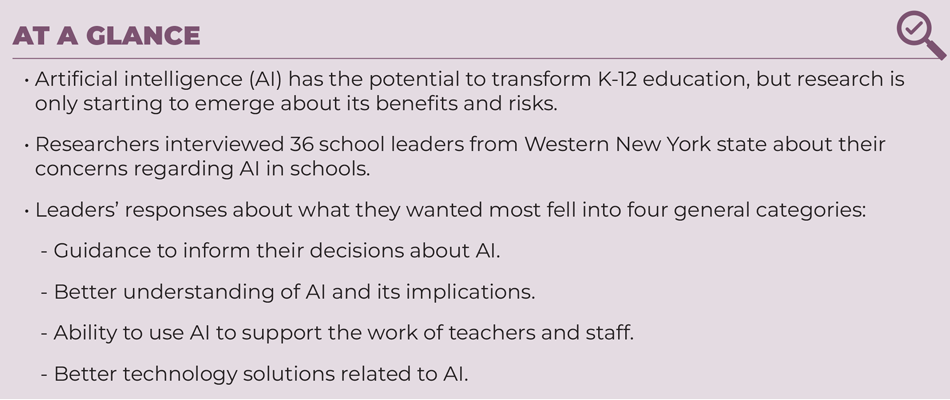
To address these questions, as part of a larger study supported by a National Science Foundation RAPID grant, our research team interviewed 36 leaders across 23 districts in Western New York state from October to December 2023. Interviewees included eight district superintendents, 11 directors of technology, five school principals, two teacher leaders, and 10 other district-level administrators. All the interviews closed with the question: “If you could wave a magic wand, what would you wish for to help with the challenges and opportunities surrounding AI?” Their responses can help education, policy, and technology leaders better understand challenges facing K-12 leaders with respect to AI.
AI priorities for K-12 schools
We found that we could sort the K-12 leaders’ wishes into four categories:
- Guidance to inform their decisions about AI.
- Better understanding of AI and its implications.
- Ability to use AI to support the work of teachers and staff.
- Better technology solutions related to AI.
Guidance to inform decisions about AI
Ten of the K-12 leaders we interviewed (representing a little more than one-quarter of our sample) identified receiving guidance about how to use AI in schools as their highest priority. They recognized the challenge of knowing what to do with these new and potentially transformative technologies, especially given their rapid advances. This comment from a superintendent captured their perspective:
It’s kind of like the early internet, right? You had no comprehension of how this was going to connect us. [AI] might be the next internet, the next revolution, if you will.
Most of the individuals in this group mentioned wanting guidance from the state (which up to that point had been very limited) — especially as they recognized that they would be obliged to follow the state’s mandates once those were established. One of the superintendents told us:
There’s too many things where there isn’t clarity, and it makes it very difficult for districts to navigate some of those challenges. . . . just make sure it’s clear what we can and can’t do, how we can do it, so we don’t waste our time.
A few leaders identified other entities that could offer guidance. Specifically, some wanted people with more technical expertise to be involved, and others suggested that cross-district partnerships could create alignment in policies and practice.
Interestingly, in the spirit of using a magic wand, four individuals in this group also wished for a crystal ball to be able to look into the future to best inform their decisions. An assistant superintendent for instruction and former director of technology said:
I would love a crystal ball to be able to see where we are in increments of five years. . . . imagine being able to see with clarity where we are going to be in this area in five years, in 10 years, and in 20 years. Because I think that sometimes we’re asking all the wrong questions, we don’t even know enough about the power of this, and I’m not . . . able to see the way it’s going to change our society.
Better understanding about AI
The wish of 19 of the K-12 leaders we interviewed (representing a little more than half) had to do with desiring better understanding and appreciation of what AI could do, as well as its risks and implications for K-12 schools.
Six K-12 leaders in this group explicitly expressed concerns about the resistance some stakeholders would have to innovations involving AI. They wanted those stakeholders to better understand what AI is, and what it can do — both positively and negatively — and to have a sense of curiosity and openness about it. A superintendent told us:
If I could wave my wand, I would hope that people would just be at least open and curious. . . . There is potential for improving learning and improving efficiencies, but we’re only going to discover that if we get people in that mindset and give them some space to play and not worry so much.
A director of technology wanted to balance excitement with caution:
I would wish that everyone would understand, this is great, and this is exciting, and this can have really positive impacts, but let’s just really make sure that we understand all of those things that go along with AI, right? There [are] always risks with any technology that you use.
Two leaders identified being able to ensure that AI would be used in ethical ways as a major concern. One district administrator wanted to ensure that students:
Use AI for good . . . with the ultimate goal of furthering their learning, making them critical thinkers that can see through some of the AI that you bump into in your life, in your social media feed.
Five K-12 leaders in this group — including a principal, a superintendent, a director of technology, a director of instructional services, and an assistant superintendent for instruction — specifically wished for more time for everyone in the organization to learn, explore, and have conversations about AI. As one of them said:
Really make sure that AI can have the time dedicated to professional learning around it, because I think it competes with a million other things right now that we’re required to be doing.
Some of the professional learning opportunities that the leaders desired would leverage experts in this emerging area or bring together districts to share best practices and lessons learned about AI. Six leaders expressed the desire to have simple, short, and personalized resources about AI and its possible applications that they could share with teachers, students, parents, and community members. Some leaders wanted exemplars of lessons or curricula, while others wished for a research-oriented “bank of resources” about what works and what doesn’t. Multiple leaders wanted resources to be succinct and clear to help overwhelmed educators get the most essential information. This superintendent’s idea was representative:
If somebody could say . . . if you’re an elementary teacher, here are the top 10 things you need to consider when it comes to AI; if you’re a secondary teacher, here’s some things; and then if you’re working outside of the classroom, here’s some things. I think if there were those pockets of information that were really quick and easy to digest . . . that would be really helpful. Because let’s face it, we don’t have time. This is evolving faster than we have time to react.
Two of the K-12 leaders were overwhelmed enough that they expressed the desire to “pause” AI advancement so they could have the opportunity to catch up and plan next steps — although they recognized how unrealistic this wish was.
Enabling educators to benefit from AI
In response to the widespread belief that educators are overworked, five K-12 leaders wished that AI might free up teachers’ time for more high-level and impactful tasks. An instructional coach summed it up this way:
Taking burden off of the teachers with all the new things that technology has added to our life, whether it’s communication, whether it’s grading assessments, creating authentic experiences for the students — having AI be more of a co-pilot so teachers can spend more time with the students. I’d love for more of that and less of trying to communicate and post assignments and keep track of who submitted what and all that kind of stuff. So if AI can take that piece off . . . I think that would make our workforce happier too.
Wishing for better technology
Two K-12 leaders expressed wishes for better technology solutions. A principal wanted to have a “perfect infrastructure to handle everything.” Better infrastructure would address the concerns of skeptics who resist innovations when they don’t work perfectly, causing them to be shelved. And a director of technology hoped for an AI platform that would be widely adopted, so that districts could work together and learn from each other about how to use it:
[I wish for] an AI platform that is a clear winner so far as supporting students and staff compliance, but also consistently embraced by the districts in this county [so] all the districts could collaborate and work on and then have access across for our staff that struggle.
Reflections and implications for practice
None of the 36 K-12 leaders we interviewed expressed a wish for ways to detect students’ use of GenAI. This may seem surprising, given how predominant the concern about cheating has been in public forums. Other empirical research about K-12 leaders’ perceptions about AI did report potential cheating as a major concern (Dunnigan et al., 2023). However, it’s possible that even just over the last few months, some K-12 leaders have come to accept that AI tools are here to stay and have moved beyond a focus on cheating to searching for ways to make the best possible use of AI in education.
“I think that sometimes we’re asking all the wrong questions; we don’t even know enough about the power of this.”
At the same time, these K-12 leaders seemed aware that using AI tools in K-12 schools will present a new set of risks as well as opportunities that we do not yet fully understand. A feeling of not being prepared to make informed decisions about uses of AI seemed prevalent, as suggested by the desire for guidance from other entities and for greater understanding about AI among stakeholders — desires that showed up in 80% of the responses. This feeling is consistent with previous research (Dunnigan et al., 2023), although our interviews also provide some concrete suggestions about how to achieve the desired understanding and appreciation of AI’s potential for K-12 schools. These include finding dedicated time to learn and explore, offering opportunities for educators to share what they have learned, and creating “succinct” resources accessible to various audiences.
While the need for high-quality resources and professional learning experiences and policies about AI is clear, the rapid developments in AI technologies and applications makes this challenging. As technology evolves, products and resources will need to be continuously revisited, revised, and disseminated. New ways to share resources will be needed, and educators will need to understand that these resources will need to be continually updated.
Finally, while only about 15% of the K-12 leaders identified enabling K-12 educators to use AI in their own work as their top priority, some of their wishes suggest the possibilities for AI to enhance teachers’ and administrators’ productivity so they can dedicate more time and energy to what they care about most — working with students to ensure their success. Given the current stress K-12 teachers and administrators are under, we can hope that AI tools might become available that could help them feel less overwhelmed. This could, in turn, influence their perceptions about using AI tools in other contexts — making them more open and curious about potential applications of AI to support learning and instruction.
Note: This material is based upon work supported by the National Science Foundation under Grant No. 2333764. Any opinions, findings, and conclusions or recommendations expressed in this material are those of the authors and do not necessarily reflect the views of the National Science Foundation.
References
Beck, S.W. & Levine, S.R. (2023). ChatGPT: A powerful technology tool for writing instruction. Phi Delta Kappan, 105 (1), 66.
Dunnigan, J., Henriksen, D., Mishra, P., & Lake, R. (2023). “Can we just please slow it all down?” School leaders take on ChatGPT. TechTrends, 67 (3).
Hays, L., Jurkowski, O., & Sims, S.K. (2023). ChatGPT in K-12 education. TechTrends, 68 (3).
Kasneci, E., Seßler, K., Küchemann, S., Bannert, M., Dementieva, D., Fischer, F., . . . & Kasneci, G. (2023). ChatGPT for good? On opportunities and challenges of large language models for education. Learning and Individual Differences, 103, 1-13.
Lambert, J. & Stevens, M. (2023). ChatGPT and generative AI technology: A mixed bag of concerns and new opportunities. Computers in the Schools.
Lo, C.K. (2023). What is the impact of ChatGPT on education? A rapid review of the literature. Education Sciences, 13 (4), 1-15.
Mintz, J., Holmes, W., Liu, L., & Perez-Ortis, M. (2023). Artificial Intelligence and K-12 education: Possibilities, pedagogies and risks. Computers in the Schools, 40 (4), 325-333.
Volante, L., DeLuca, C., & Klinger, D.A. (2023). Leveraging AI to enhance learning. Phi Delta Kappan, 105 (1), 40-45.
This article appears in the April 2024 issue of Kappan, Vol. 105, No. 8, p. 48-51.

ABOUT THE AUTHORS

Raffaella Borasi
Raffaella Borasi is the executive director of the Center for Learning in the Digital Age, Warner School of Education, University of Rochester, Rochester, NY.

David E. Miller
David E. Miller is the associate director for K-12 education at the Center for Learning in the Digital Age, Warner School of Education, University of Rochester, Rochester, NY.

Patricia Vaughan-Brogan
Patricia Vaughan-Brogan is an assistant professor of educational leadership at the Warner School of Education, University of Rochester, Rochester, NY.

Karen DeAngelis
Karen DeAngelis is an associate professor of educational leadership at the Warner School of Education, University of Rochester, Rochester, NY.

Yu Jung Han
Yu Jung Han is a postdoctoral associate at the Center for Learning in the Digital Age, Warner School of Education, University of Rochester, Rochester, NY.

Sharon Mason
Sharon Mason is a professor in the School of Information, Golisano College of Computing and Information Science, Rochester Institute of Technology, Rochester, NY.