
A vision statement helps districts create lasting school reform, but it must direct plans and focus that allow schools to accomplish their goals.
The North Star was the focal point ancient mariners used to chart their journeys. Without it, they could never have navigated their odysseys of discovery. The start of every course calculation and the reset of every correction began by re-aiming at the North Star. Changing priorities and new conditions constantly complicated a voyage, but the North Star was fixed.
We know that the school district is the unit of sustainable improvement, not individual schools. But district improvement plans need a different approach for improvements to take hold and last.
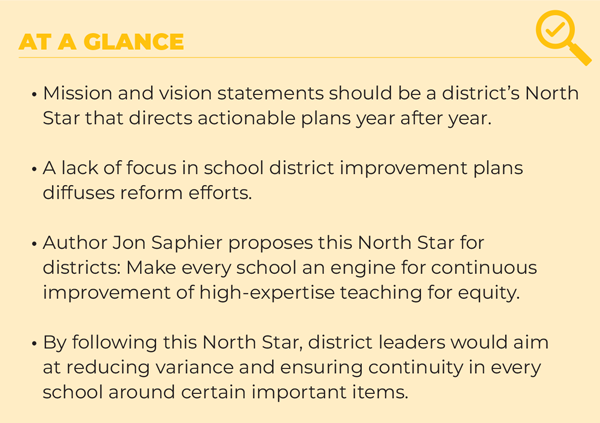
We need a North Star for district improvement plans. Are big-picture vision statements in strategic plans useful? They could be if they served as a North Star, year after year, to direct actionable plans.
Vision statements usually don’t do that. They name idealistic and admirable long-term goals, but they are too abstract. “Students Loving Learning,” “Developing 21st Century Skills,” “Capable, Responsible Citizens.” We need a vision statement that can guide the creation of an animated, goal-directed school district with the capacity to accomplish any goal it sets.
The same is true of education reform. With no North Star, these movements regularly change course. Consider the reform ideas of the past 30 years:
- Individual processes like teacher evaluation or induction of new hires.
- Structures like student advisories, small schools, and site-based decision-making.
- Instructional philosophies like active learning and child-centered learning.
- 21st-century skills like social-emotional learning (SEL), high-level thinking, problem solving, habits of mind, collaborative skills, and digital literacy.
- Project-based learning, relevance and meaning, and student agency connected to deep learning.
Each of these aims springs from evidence-based ideas and values about what is good for children. But as they multiply from year to year, school districts see one reform after another sweeping in and casting a spell over school district strategic plans and individual school improvement plans. Teachers and administrators often are left wondering: “What happened to the goals of last year’s strategic plan?” Over time, districts lose focus on the carefully crafted plans that came before.
Another reason for lack of focus: Strategic goals and school improvement plans can get pushed into the background when local problems (a sudden budget cut, an urgent bullying issue, an influx of emergent bilingual students) demand attention. But the search for solutions to these problems offers little long-term direction to improve teaching and learning capacity.
Focusing on what matters most
What vision statement could serve as a North Star for improving teaching and learning? New methods, better programs, and inspiring student-centered approaches to curricula will always fall short if we don’t first seek more widespread high-expertise teaching. This is because the overall knowledge and skill of the individual teacher is the most important factor in student achievement. It dwarfs everything else.
Tragically for our children, our teacher workforce has been denied access to many of the skills of high-expertise teaching and a workplace environment for constant learning about skillful teaching (Saphier, 2023; Saphier, Haley-Speca, & Gower, 2018). The inconsistency in expertise across our teaching corps has been well documented (e.g., Goodlad, 1984; Pianta et al., 2007; Schmoker, 2019). We see its effects in the literature that documents our students’ low literacy rates and inferior performance in comparison to other developed countries and the inequity of education we offer poor families and children of color.
With this in mind, I offer this vision statement as a North Star for every district’s improvement plan: Make every school an engine for continuous improvement of high-expertise teaching for equity.
This North Star vision statement conjures concrete images of what to do to improve the experiences of children and their learning. It comes with anchors in the research base on instructional improvement, deep roots in the literature of healthy organizational culture, and direct ties to the lived experiences of students.
Collective action for a common outcome
Leadership gurus often put creating a “shared vision” at the top of their pyramid of what successful leaders do. It is the subject of the first module of the National Institute for School Leadership curriculum (https://ncee.org/nisl-program) developed by the National Center on Education and the Economy, the closest we have come so far to a widely adopted program on school leadership. It is at the top of the list for the Professional Standards for Educational Leaders (National Policy Board for Educational Administration, 2015). Neither of these sources pretends to prescribe what that common vision should be. But by prioritizing a shared vision, they demonstrate an understanding that collective action to accomplish anything important comes through successfully mobilizing everyone to work for a common outcome that they can picture and be inspired by.
Why is my suggested North Star vision the answer? How does it synthesize 70 years of key learnings about sustainable improvement of teaching and learning for all students despite social inequalities and the toxicity of racism? How does it provide images of new skills and practices? How can it guide planning to get them in place? I suggest that it accomplishes this by including four key concepts.
Concept 1. Every school
The whole district is the target of the vision, allowing no variance from school to school in quality of certain things that matter. This does not mean that every school looks the same, with the same themes, same décor, and same traditions and no room for individual creativity, different implementation, or idiosyncratic approaches. There is certainly room for autonomy within this vision. But certain practices are common to all schools, and there will be a certain degree of curricular coherence, consistency, and collective initiatives districtwide (Grissom et al., 2021; Leithwood et al., 2004). One example of a shared approach might be how to scaffold complex texts and bring grade-level content within reach of every student. All schools would focus on the same initiative across grade levels with a coherent, common framework for implementation, guided by the statement: “We are ALL learning ways to scaffold complex text for readers” (Reynolds & Goodwin, 2016).
We can’t get “every school” to reach this North Star by going to one school at a time and trying to hire “turnaround” principals. That doesn’t work for enduring improvement. Excellent leaders who steer a school to dramatic improvement can and do leave, and when they do, improvements fade. The district must be the progenitor and the growth engine through its central office structures and processes. Those structures and processes include the hiring, supervision, and development of principals and the districtwide infrastructure for academic improvement (curriculum coherence and interim assessments). Thus, the superintendent’s focus on principals is crucial.
Concept 2. Engine for continuous improvement
“Job Number 1 for a great principal is teacher learning,” said Steve Tozer, the founder of Urban Education Leadership Academy at the University of Illinois, Chicago (personal communication, February 8, 2022). That means developing a particular culture among the adults characterized by constant learning, deep collaboration, and openness and non-defensive examination of practice in relation to student results. All principals can learn behaviors that lead to building that kind of culture, and they can be brought together regularly to assist each other in doing so (Saphier, 2023). The “we” ethos among principals stems from district leadership knowing how to promote collaboration instead of competition between schools.
Concept 3. High-expertise teaching
Elsewhere I have written about the nature of professional knowledge, the size and range of our knowledge base on teaching, and the absence of so much of it from the opportunities to learn that we provide our teacher workforce (Saphier et al., 2018; Saphier, 2023). The starting point for implementing the North Star vision is the recognition and pursuit of constant learning about this huge and complex knowledge base. This insight into expertise in teaching extends beyond what policy makers currently recognize.
Concept 4. Teaching for equity
Building leadership for equity calls for a complex skill set. Where a leader should start depends largely on the readiness of the staff to examine their individual beliefs, their current practices, and their urgency to dismantle racism. Teaching for equity and dismantling racism means changing the policies and the practices that perpetuate messages of “less than” to students of color (Dyson, 2015). Exemplars of anti-racist leadership and programs exist around the country and include:
- Personal adult journeys to building cultural proficiency (Nuri-Robins et al., 2012), engaging in culturally proficient behavior in everyday life, and designing culturally proficient lessons.
- Personal journeys though learning about racial identity, the daily negative experiences of people of color, history of white supremacy and racism, and institutional racism (e.g., Alexander, 2017; Kendi, 2016; Tatum 2017; Wilkerson, 2020).
- Institutional journeys through data gathering and audits to identify and dismantle racist procedures, policies, and tacit judgements in everyday practice (La Salle & Johnson 2018).
Drawing on resources such as these, districts can ensure that each building supports their leaders in orchestrating these profound learning pathways.
Professional conditions for educators’ work
This North Star vision calls for more than just increasing attention or money for professional development. A central problem in American education is the lack of professional conditions for educators’ work (Johnson, 2019). Those conditions include the lack of a personnel pipeline that can equip our teacher and leader workforce with the knowledge and skills to handle the complexity of the work. If we don’t address this problem, no other reform movement has a prayer of accomplishing its goals.
Our system denies our teacher workforce access to and accountability for high-expertise practice. The prime place to show we can provide these professional conditions and access to continuous learning is the school district. A district will benefit greatly from a partnership with a higher education institution with enlightened views and a philanthropic funder that shares similar commitments. But the center of enduring improvement must be the district. The workplace is where structures and culture spur improved practice, and improvement depends on what the district understands and how its leaders act to create that understanding.
The North Star I am calling for would give districts a common vision of uncommon power. It would radiate magnetic waves to change the current picture of alternating growth spurts and decline, of initial excitement and then dissolution of focus. It would balance vital elements usually missing from school improvement efforts. These include:
- Sustainability that comes from having a compelling, clear, and realistic vision that can inspire successive generations of educators.
- Local champions who would make it their business to carry the North Star banner to new leaders and new school boards.
- Acknowledgment of the good work the district already has accomplished with concrete plans to fold these successes into next steps.
- The ability to prioritize initiatives, suspending those that are peripheral to the North Star.
- A detailed roadmap for continuous improvement.
- Annual plans that are appropriate for current circumstances.
- A focused aim to eliminate the achievement gap.
A plan to get started
What would happen if a whole school district committed itself to this vision to make every school a reliable engine for constant learning about high-expertise teaching for equity?
First, leaders would orchestrate a process to develop a districtwide common language for describing what high-expertise teaching is. That would lead to a map of how big and complex that knowledge base is. A working group charged with mapping this information would find agreement in the field about the elements, though different thinkers prioritize different elements (e.g., Bellon, Bellon, & Blank, 1992; Hattie, 2012; Marzano, 2001). The group would find that although all the elements are important and worthy, some are more important than others in their district. Having a map would enable teachers to set their goals, help schools choose their priorities, and enable debates about instructional practices that every teacher should learn because they are so important. A district might prioritize culturally proficient teaching, active reading and writing in every classroom, formative assessment, or leading robust student discussions.
Simultaneously, district leaders would focus on principals. They would put resources into developing principals who recognize good teaching, are committed to dismantling racist structures and practices, and can mobilize teachers to work together openly. Mobilizing teachers would incorporate actions like using data with deep collaboration, non-defensive and constant learning about high-expertise teaching, and exploration of effective approaches for meeting students’ diverse needs as opposed to maintaining a one-size-fits-all mentality. In other words, school leaders would build a “learning organization” culture. That emphasis would show up at the highest level, in the choice of supervisors for principals and the framing of what constitutes their proficiency. There would be a special emphasis on helping principals build a strong adult professional culture.
The whole district is the target of the vision, allowing no variance from school to school in quality of certain things that matter.
The actions of district leaders would aim at reducing variance and ensuring continuity in every school around certain important items — principal leadership capacity, opportunities and access to constant teacher learning about high-expertise teaching, time and structures for deep collaboration, support systems for students, and a relentless focus on equity. Eventually all arenas of school life, including human resources, curriculum, and even transportation and food service, would be included.
Central office personnel would have to look at themselves — their interaction patterns as well as their organization. If we want schools to have adult cultures of trust and constant learning, it must be modeled from the top. Central office leaders would model how people act in a learning organization: how they run cabinet meetings, supervise principals, do problem solving, and develop or choose curricula.
District leaders would put this vision on the wall, in the header of agendas, in the back-to-school speeches and end-of-year summaries. Make it the North Star of every journey and cancel the trips that can’t connect to this destination. Avoid statements too abstract to indicate action, worthy though they may sound. Adopt this North Star: Make every school a reliable engine for constant learning about high-expertise teaching for equity. This vision can be defined clearly enough to create concrete images of action steps and enable the other worthwhile goals to be subsidiary projects that build toward making that vision a reality.
References
Alexander, M. (2017). The new Jim Crow. The New Press.
Bellon, J.J., Bellon, E.C., & Blank, M.A. (1992). Teaching from a research knowledge base: A development and renewal process. Merrill Publishing.
Dyson, A. (2015). The search for inclusion: Deficit discourse and the erasure of childhood. Language Arts, 92 (3), 199-207.
Goodlad, J. (1984). A place called school. McGraw-Hill.
Grissom, J.A., Egalite, A.J., & Lindsay, C.A. (2021). How principals affect students and schools: A systematic synthesis of two decades of research. The Wallace Foundation.
Hattie, J. (2012) Visible learning for teachers. Routledge.
Johnson, S.M. (2019). Where teachers thrive. Harvard University Press.
Kendi, I.X. (2016). Stamped at the beginning. Nation Books.
LaSalle, R.A. & Johnson, R.S. (2018) Shattering inequities. Rowman & Littlefield.
Leithwood, K., Louis, K., Anderson, S., & Wahlstrom, K. (2004). How leadership influences student learning. The Wallace Foundation.
Marzano, R. (2001) Classroom instruction that works. ASCD.
National Policy Board for Educational Administration. (2015). Professional standards for educational leaders.
Nuri-Robins, K., Lindsay, D., Lindsey, R., & Terrell, R. (2012). Culturally proficient Instruction (3rd ed.). Corwin.
Pianta, R.C., Belsky, J., Houts, R., & Morrison, F. (2007). Opportunities to learn in America’s elementary classrooms. Science, 315 (5820), 1795-1796.
Reynolds, D. & Goodwin, A. (2016). Making dynamic texts a reality for all students: Dynamic scaffolding that bridges the gaps between student and text. Voices from the Middle, 21 (4), 25-31.
This article appears in the December 2023/January 2024 issue of Kappan, Vol. 105, No. 4, p. 52-56.

ABOUT THE AUTHOR

Jon Saphier
Jon Saphier is the founder and chairman of Research for Better Teaching, Acton, MA. He is the author most recently of Disrupting the Teacher Opportunity Gap.