
What does it look like when teachers go beyond test requirements and let students’ questions guide their learning?
During a lesson about bacteria, a classroom of 4th graders quickly answered questions on a passage about the discovery of penicillin, but they failed to see how it related in any way to their daily lives. They rebuffed our claims that bacteria were everywhere and declared that in the unlikely event that they were present in our classroom, their nasty effects could be avoided with frequent hand-washing and hand sanitizer. They were ready to call the matter closed — so let’s move on to reading the next passage.
We faced a conundrum — should we simply continue with the regular curriculum or further explore students’ understanding (or lack thereof)? The students had met the school’s academic expectation by reading the assigned passage and correctly answering questions about penicillin’s discovery and effects. But their misunderstandings and confusions were still significant. Perhaps with one more activity we could return to the regular curriculum!
This one more activity was a YouTube video on how bacteria grew on different foods. Despite their initial skepticism, the 4th graders asked to conduct this experiment. From there, the students’ questions cascaded into a series of possible follow-up activities. As with Newton’s propositions on gravity, the students’ initial reading — or misreading of a passage — set in motion a series of activities that only ended with the onset of summer vacation, some nine months away. Giving students opportunities to identify and explore personally relevant topics kept the lesson in motion.
This ongoing lesson was part of an experiment in implementing an interest-based curriculum, conducted during the 2017-18 school year. At the time, Sarah had taught for five years at the participating elementary school, and Sam had placed interns and student teachers and collaborated with the school’s teachers for more than 25 years. Students in the school’s upper grades regularly complained about test-focused instruction (Miller et al., 2021), and Sam and Sarah wanted to experiment with a different approach. Sarah negotiated with her principal to integrate the approved literacy curriculum into our effort. Our plan was to go beyond what testing required by challenging 4th graders with a more integrative curriculum based on their interests (Miller et al., 2021). Salem and Dixie, through frequent conversations, served as external evaluators and consultants.
The participating urban school was constructed 100 years ago by a mill owner to educate students from families whose parents worked in his textile factories. The original buildings were razed 10 years ago and a new one constructed. Presently, about 600 students attend: 70% are first-generation Spanish-speaking Latinx, 28% are Black, and 2% identify as “other.” More than 98% of students are eligible for free breakfast and lunch due to families’ limited economic resources. About one-third of students qualify for special education because the school is the site for a program for hearing-impaired students, who represent the spectrum of diversity within the school. Only one in four students scored at or above grade level on mandated literacy assessments.
Research and reality
The benefits of developing an interest-based curriculum are obvious. Interested students are motivated to learn by intrinsic rather than extrinsic factors, demonstrate the use of higher-level cognitive strategies, persist in the face of challenges, and experience greater pleasure in learning (Ainley, Hillman, & Hidi, 2002; Lin-Siegler, Dweck, & Cohen, 1987; Waterman, 2005). Educators view such traits as essential for promoting positive learning environments (Ivey, 2014; Miller et al., 2021; Wells, 2011). As a result, theorists advise teachers to find out what students want to learn and build these topics into the curriculum (Brophy, 1997; Willingham, 2009).
This recommendation may seem simple, but it runs counter to the realities of classroom life. In many schools, teachers are expected to follow pacing guides that focus on designated topics and allocate limited time to studying any one of them. Opportunities for student choice regarding the topic of study, discussions of reasons for its inclusion in the curriculum, and comments on its assessment are limited — if they exist at all.
Once we started down the road of letting student questions drive our lessons, we did not view returning to the regular curriculum as an option.
Despite these obstacles, once we started down the road of letting student questions drive our lessons, we did not view returning to the regular curriculum as an option. Our 4th graders had become much more enthused for learning. Building on their interests appeared to be the key. Our main challenge now was staying one step ahead of their many questions. To do so, we quickly realized how interests are not interests are not interests. Let us explain.
Our first goal was to evaluate how an activity might support or undermine our efforts. We wanted to avoid activities where expected enthusiasm for learning would be high, but the effort required for completion was low. Viewing the YouTube video fell into this category. It momentarily addressed the students’ curiosity but required minimal effort to complete. We wanted the 4th graders to acquire the abilities and attitudes needed to study future topics. This would require them to use higher-level cognitive strategies, interact with classmates for extended time periods, become emotionally and personally engaged, and connect any evolving understandings to what they valued in their personal lives and communities. So when the students conducted their own experiments based on the YouTube video, we asked them to generate questions of interest, confront their current beliefs, record observations on self-designed charts, discuss hypotheses, share oral presentations, and debate possible next activities. All these activities supported our goal of teaching beyond the test (Miller et al., 2021). Put simply, watching the YouTube experiment could be interesting, but the more complex activities provided the best opportunity for us to advance the development of students’ academic and social abilities.
From interest to agency
Suzanne Hidi and K. Ann Renninger’s (2006) four-phase model of interest development states that learners move through four phases as their interest in a topic deepens: triggered situational interest, maintained situational interest, emerging individual interest, and well-developed individual interest. These phases gave us a way to evaluate the usefulness of different activities. For example, during the initial activities, like viewing a video, interest is situational, sparked mainly by surprising or incongruous information. Students have not yet had adequate opportunities to engage in sophisticated reading, writing, or thinking about the topic.
Through long-term activities, such as conducting the food experiment, they have frequent opportunities to maintain and deepen their interest as they seek answers to their own questions and work with classmates to find solutions to perplexing problems. We believed such opportunities were more likely to promote the development of an established independent interest versus a momentary situational interest. Consequently, we regularly expected students to share insights and concerns, set goals and monitor progress toward achieving them, and question nascent beliefs based on data and observations. All these activities required students to integrate reading and writing with learning in other disciplines (e.g., math, science, and social studies).
To promote engagement within and across lessons, Sam and Sarah quickly discovered the need for 4th graders to express opinions about what they wanted to study and why (Lave & Wenger, 1991). It was not enough for us to choose activities we thought they would enjoy and that would give them opportunities for higher-level learning; we needed to treat them as autonomous learners who were capable and willing to offer suggestions as to the nature and purpose of daily studies (Ivey & Johnston, 2013). This positioning promotes learner agency, which is defined generally as opportunities for learners to provide input and feedback into the flow of instruction (Akos, 2005; Jackson, 2003; Reeve & Tseng, 2011).
In this project, we wanted students to develop the agency to collaborate with classmates to discover new understandings based on their own questions in a way that would give their learning purpose (Stetsenko, 2020). We wanted education to be a form of autobiographical learning, whereby who students are as learners becomes central to who they are in the classroom (Stetsenko, 2017). Margaret Vaughn (2020) links such opportunities for active learning among disenfranchised learners to more positive learning trajectories because their ideas and opinions now matter within and outside the classroom.
Promoting interest through agency placed certain responsibilities and expectations on us as teachers. Just as interests are not enough to drive curriculum, agency is not enough to maintain engagement over extended time periods, especially if students are not successful with their studies. To maintain engagement and ensure students were learning, we frequently asked students to comment on the purposefulness of their engagement and the extent to which they understood the content of daily instructional activities. We had to find a balance between directing students’ questions toward designated problems of interest and providing necessary supports to ensure their understanding of designated topics (Jackson, 2003). This balance mainly related to the challenge of time: Sarah and Sam sought students’ input and then, as a result, had to modify lessons immediately to address their questions and concerns. When this balance was achieved, students created learning agendas based on topics which they identified as meaningful (Wells, 2011): When this balance was not achieved, we, as teachers, needed to alter the nature of our instruction.
As long as our 4th graders had adequate opportunities to determine the focus of their studies and sufficient support to ensure an understanding of content, they did not resist our efforts to redesign the curriculum. For this year to be successful, interest needed to be conceptualized according to factors that are most important to students’ future academic success and present achievement histories.
Learning across the year
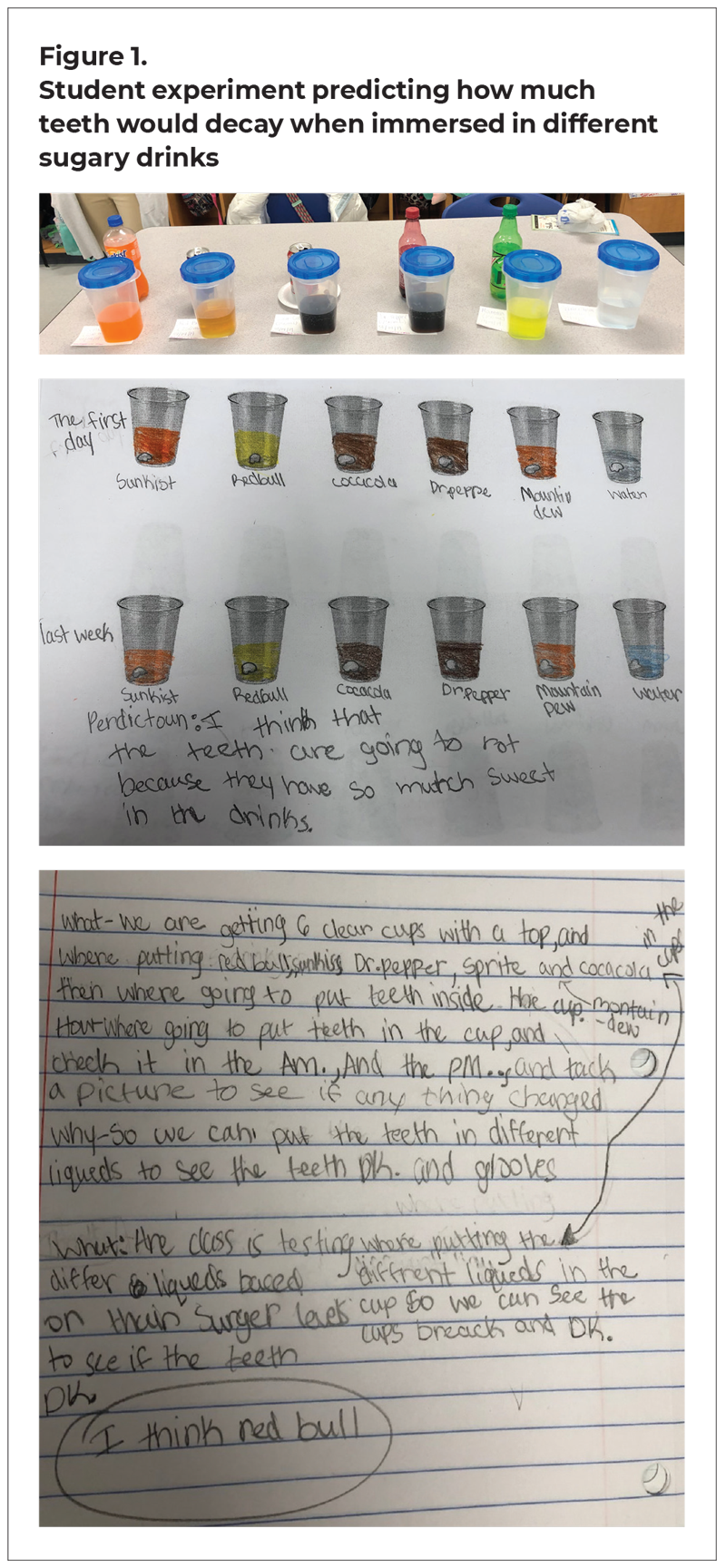
The misreading of a passage set in motion a series of activities, each of which lasted from a single class period to several months. Table 1 shows the path that activities followed through the year. Experiments related to the growing of bacteria on different foods morphed into an investigation of the presence of bacteria in various school locations, which provided the impetus for a study of the influence of popular sugary drinks on tooth decay (see Figure 1) and, finally, the growing of organic vegetables. Across every activity, discussions focused on the need to identify additional information sources, voting and debates to determine an activity’s direction, rules for sharing during discussions and procedures for the use of materials, and suggestions for how to design or redesign the activity.
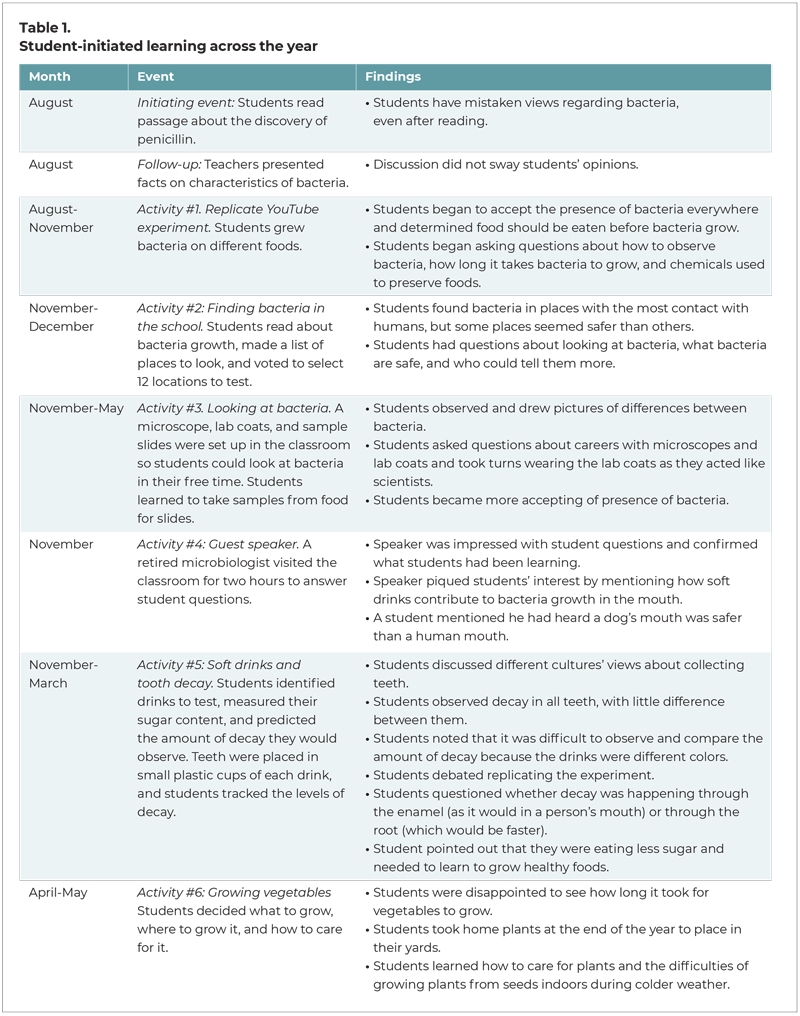
Literacy activities included writing reflections to record observations and insights, reading articles from newspapers and magazines, and designing graphs to note observations. The students wrote across the curriculum, integrating science, literacy, and math explorations throughout the activities. (See Figure 1 for examples of students’ work from an experiment on how sugary drinks affect teeth.) When class discussions revealed students’ interest in scientific topics and how they connected to students’ experiences, we used discussions and literacy activities to support students’ comprehension.
Because we remained flexible and let students’ questions drive the activities, we could spontaneously turn our attention to questions that arose throughout the year. These are just a few of the questions that students explored:
- Why did mold grow on homemade tortillas, but not on the hamburger roll in our experiment?
- Why do families save their children’s teeth? Why were some willing to donate them for our experiments while other families would not?
- How might one approach teachers and their assistants who continued to drink soft drinks at lunch? What’s the etiquette for talking to people about unhealthy choices?
- What is included in compost, and how does it help plants’ health and growth?
Discussions about these questions widened the curriculum beyond literacy and science by providing links to students’ family interests and activities. We didn’t anticipate at the start of the year how much 4th graders’ comments and concerns would provide the impetus for seamless transitions across and within activities.
When Sam and Sarah requested students’ input and feedback, 4th graders expected daily activities to reflect their questions and concerns. This alignment of lessons with interests increased student engagement during lessons and their enthusiasm for learning. They regularly met us early at the classroom door to check on the status of projects and offer new suggestions. We honestly did not know in the first few weeks of school how our instruction would progress after the reading of the penicillin passage. Now we marvel at how quickly the year passed.
The power of student agency
We believe our emphasis on a particular form of agency contributed to this momentum. Consistent with Anna Stetsenko’s (2017, 2020) sociocultural view of agency, students adopted activist stances toward their studies as they became increasingly aware of how their views and beliefs regarding what was important could alter daily learning opportunities. Students now studied collaboratively with classmates to chart new learning paths (Stetsenko, 2009). Their engagement was both emotional and cognitive as they imagined new possibilities for future learning (Roth, 2011; Roth & Lee, 2007).
If a particular experiment was not working as planned or if students had concerns or ideas to share, they spoke up and suggested other options. Because they cared about what they were learning, the 4th graders were more willing to seek help when they encountered difficulties. Instead of passively following an established curriculum, students spoke up about what we could do next and saw that their suggestions could become reality. Future learning paths were ambiguous, and everyone looked forward to contributing to whatever came next.
As teachers, we had to become more spontaneous, imaginative, and creative in our attempts to align daily activities with students’ interests. Overnight, traditional hierarchical decision-making structures became more egalitarian as Sarah and Sam regularly exchanged roles as teachers and learners with our 4th graders (Tudge & Schrimsher, 2003). Our planning for the next activity was an ongoing concern as we had to be ready each day — and quite often, hour-by-hour — to keep up with students’ ideas and insights (Reinking & Bradley, 2007).
Making students’ voices the foundation upended the basic fabric of traditional classroom life — namely, teachers leading students to predetermined answers.
Within our classroom, a new world was co-created in which the successes of any one of us depended on solidarity with everyone else. Someone had access to their baby teeth, others brought in tortillas, another brought in plants from her mother’s garden, students helped classmates to decode unfamiliar words, and a student who seldom talked raised an idea that everyone endorsed. No one individual, including teachers, could accomplish the learning we achieved together across the year.
Instruction for students, not tests
As we reflected on what was occurring in Sarah’s classroom throughout the year, we slowly realized that we were addressing a question important to any discussion of student agency: If students provide the lead for instruction, will teachers follow?
Educators commonly emphasize the importance of beginning instruction based on students’ present levels (Ausubel, 2012; Hattie, 2009; Nelson, Ysseldyke, & Christ, 2015). Unfortunately, such recommendations fail to consider students’ interests as a primary starting point. Instead, reforms usually focus on increasing interest within an established curriculum (Pintrich, 2003). Teachers then face the task of making an uninteresting curriculum interesting. Making students’ voices the foundation upended the basic fabric of traditional classroom life — namely, teachers leading students to predetermined answers. This fabric is resistant to change when traditional instruction remains the primary driver of lessons (Byrk, 2015; Cuban, 1990).
When we aligned instruction with the unique needs of our 4th graders, they were able and quite willing to offer valuable insights and questions. This kind of instruction will require teachers to change what they do from year to year, based on students’ differing interests, but the benefits far outweigh the time required to set up and modify daily lessons. Sam and Sarah both came to know our students in ways that were not available with the standard curriculum. Their concerns and hopes for imagined futures enable us to tailor all our lessons to better meet their most immediate needs. Regarding test scores, Sarah’s students have had above average test scores on the school’s mandated literacy assessments throughout her career. This year’s results were no different.
Over the past 25 years, Sarah’s school has adopted a variety of mandated, scripted, quick-fix, test-focused reforms that have not significantly affected its ranking relative to other sites. And research has shown that these kinds of practices have limited short- and long-term effects (Byrk, 2015). Urie Bronfrenbrenner (2004) questioned whether the conditions for human development remain when educators fail to promote students’ agency. Our findings support the need for a fresh look at alternative approaches to helping students by aligning curriculum and instruction to their interests. As Paul Pintrich (2003) stated almost 25 years ago, children can be controlled by external constraints — the critical question is whether we educators should aspire to something more than control. Our approach offers one such possibility.
References
Ainley, M., Hillman, K., & Hidi, S. (2002). Gender and interest processes in response to literary texts: situational and individual interest. Learning and Instruction, 2 (4), 411-428.
Akos, P. (2005). Advice and student agency in the transition to middle school. Research in Middle Level Education, 27 (2), 1-11.
Ausubel, D.P. (2012). The acquisition and retention of knowledge: A cognitive view. Kluwer Academic Publishers.
Bronfenbrenner, U. (2004). Making human beings human: Bioecological perspectives on human development. Sage.
Brophy, J. (1997). Motivating students to learn (3rd ed.). Routledge.
Byrk, A. (2015). 2014 AERA Distinguished Lecture: Accelerating how we learn to improve. Educational Researcher, 44 (9), 467-477.
Cuban, L. (1990). Reforming again, again, and again. Educational Researcher, 19 (1), 3-13.
Hattie, J. (2009). Visible learning: A synthesis of over 800 meta-analyses relating to achievement. Routledge.
Hidi, S. & Renninger, K.A. (2006) The four-phase model of interest development. Educational Psychologist, 41 (2), 111-127.
Ivey, G. (2014). The social side of engaged reading for young adolescents. The Reading Teacher, 68 (3), 165-171.
Ivey, G. & Johnston, P.H. (2013). Engagement with young adult literature: Outcomes and processes. Reading Research Quarterly, 48 (3), 255-275.
Jackson, D.B. (2003). Education reform as if student agency mattered: Academic microcultures and student identity. Phi Delta Kappan, 84 (8), 579–585.
Lave, J. & Wenger, E. (1991). Situated learning: Legitimate peripheral participation. Cambridge University Press.
Lin-Siegler, X., Dweck, C.S., & Cohen, G.L. (2016). Instructional interventions that motivate classroom learning. Journal of Educational Psychology, 108 (3), 295-299.
Miller, S.D., Metzger, S.R., Fitts, A., Stallings, S.F., & Massey, D. (2021). If you don’t know where you’re going, you might end up where you’re headed! Teachers’ visions transforming praxis through agency. Peabody Journal of Education, 96 (4), 360-375.
Nelson, P.M., Ysseldyke, J.E., & Christ, T.J. (2015). Student perceptions of the classroom environment: Actionable feedback to guide core instruction. Assessment for Effective Instruction, 41 (1), 16-27.
Pintrich, P.R. (2003). A motivational science perspective on the role of student motivation in learning and teaching contexts. Journal of Educational Psychology, 95 (4), 667–686.
Reeve, J. & Tseng, C.M. (2011). Agency as a fourth aspect of students’ engagement during learning activities. Contemporary Educational Psychology, 36 (4), 257–267.
Reinking, D. & Bradley, B. (2007). On formative and design experiments: Approaches to language and literacy research. Teachers College Press.
Roth, W.-M. (2011). Object/motives and emotion: A cultural-historical activity theoretic approach to motivation in learning and work. In D.M. McInerney, R.A. Walker, & G.A. Liem (Eds.), Sociocultural theories of learning and motivation: Looking back, looking forward (pp. 43-62). Information Age Publishing.
Roth, W.-M. & Lee, Y.J. (2007). “Vygotsky’s neglected legacy”: Cultural-historical activity theory. Review of Educational Research, 77, 186-232.
Stetsenko, A. (2009). Teaching–learning and development as activist projects of historical becoming: Expanding Vygotsky’s approach to pedagogy, Pedagogies: An International Journal, 5 (1), 6-16.
Stetsenko, A. (2017). The transformative mind: Expanding Vygotsky’s approach to development and education. Cambridge University Press.
Stetsenko, A. (2020). Critical challenges in cultural-historical activity theory: The urgency of agency. Cultural-Historical Psychology, 16 (2), 5-18.
Tudge, J. & Scrimsher, S. (2003). Lev S. Vygotsky on education: A cultural-historical, interpersonal, and individual approach to development. In B.J. Zimmerman & D. H. Schunk (Eds.), Educational psychology: A century of contributions (pp. 207–228). Erlbaum.
Vaughn, M. (2020). What is student agency and why is it needed now more than ever? Theory into Practice, 59 (2), 109-118.
Waterman, A. (2005). When effort is enjoyed: Two studies of intrinsic motivation for personally salient activities. Motivation and Emotion, 29, 165-188.
Wells, G. (2011). Motive and motivation in learning to teach. In D.M. McInerney, R.A. Walker, & G.A. Liem (Eds.), Sociocultural theories of learning and motivation: Looking back, looking forward (pp. 87-108). Information Age Publishing.
Willingham, D. (2009). Why students don’t like school? A cognitive scientist answers questions about how the mind works and what it means for the classroom (2nd. Ed.). Jossey-Bass.
This article appears in the December 2022/January 2023 issue of Kappan, Vol. 104, No. 4, pp. 48-53.

ABOUT THE AUTHORS

Samuel Miller
Samuel Miller is a professor in the Department of Teacher Education and Higher Education at the University of North Carolina at Greensboro.
Sarah Stallings
Sarah Stallings is a doctoral student in the Department of Teacher Education and Higher Education at the University of North Carolina at Greensboro.
Dixie Massey
Dixie Massey is an adjunct professor in the Department of Teacher Education at Seattle Pacific University, Seattle, WA.
Salem R. Metzger
Salem R. Metzger is a recent graduate of the doctoral program in the Department of Teacher Education and Higher Education at the University of North Carolina at Greensboro.