|
A (REMOTE) DAY IN THE LIFE OF 3RD GRADERS
The best education journalism of the week |
|
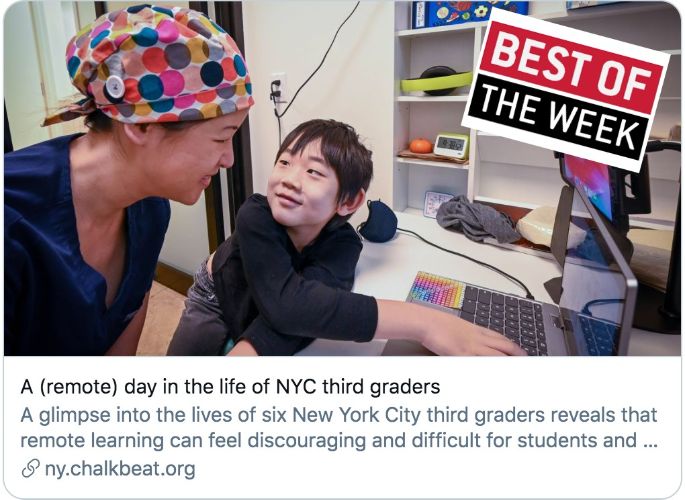
| 🏆 BEST: This week’s best story is an all-staff effort from Chalkbeat NY, A (remote) day in the life of NYC third graders. The story follows six NYC 3rd graders navigating the challenges and emotional roller coasters of remote learning. It offers details that show just how difficult this is for entire families: “One time, the battery on Drew’s laptop died, and he didn’t know the password to log back in. He called his mom about a dozen times, but she was performing surgery.” It receives high praise from other ed reporters, including the NYT’s Eliza Shapiro and Dana Goldstein, who wrote, “This is touching and informative in a million small ways.”🏆 RUNNER-UP: WHYY Philadelphia reporter Avi Wolfman-Arent’s story In-person classes. Old buildings. Almost no COVID. Are Philly Catholic schools a blueprint? shares the lessons of an archdiocese that, while facing many of the same infrastructure and contractual issues as the public schools, has kept 100 elementary schools open full time the entire school year. As Wolfman-Arent reports, this success is the result of a great degree of trust and “scary-mary safe” measures. And while Wolfman-Arent notes differences between the public and parochial schools, the School District of Philadelphia superintendent asks: “If it’s safe for those children to come back to school, why isn’t it safe for our children?” For more great WHYY coverage, check out Sojourner Ahébée’s recent piece about the benefits Black children experience from having Black teachers.
🏆 HONORABLE MENTIONS:
‘I hate the dark’: For Texas kids dealing with COVID-19 losses, isolation and food insecurity, the winter storm is another blow (Dallas Morning News)
Eight years after Walsh’s promises, Boston prekindergarten is still not universal (Boston Globe)
Pandemic drives parents to put older kids in day care; providers ‘literally had to become teachers’ (LA Times)
|
|
|
REPORTING ON IN-PERSON LEARNING, EVEN WHEN YOU’RE NOT THERE
New from The Grade |
|
|
When veteran reporter Susan Dominus published her latest feature story in the New York Times magazine earlier this month, it generated a lot of attention — for good reason.
The story focused on Rhode Island, one of the few Democratic-controlled states where officials managed to reopen schools in the fall for in-person learning.
And it provided a vivid and relatively uncommon depiction of what it’s like inside a reopened school system, even though Dominus reported the story after the fact, remotely.
In this week’s new piece from The Grade, Dominus shares her strategies for reporting on schools that are reopening, even if you have to do it remotely.
Upcoming: News outlets announced last summer that they were going to make a big push to address racism in newsrooms and in media coverage. But has any of that really happened? Consulting editor Amber C. Walker is looking to find out. DM her if you want to talk about your experience with newsroom diversity and related issues.
|
|
|
MEDIA TIDBITS
Thought-provoking commentary on the latest coverage.
|
|
|
Above: Some of these editorial cartoons on education in U.S. News & World Report are brutal, including this riff off Norman Rockwell’s famous “The Problem We All Live With” by Tom Stiglich. Click the link to see them all.
📰 DISTRICT REOPENING PLANS ≠ CDC GUIDANCE: While some districts have used the CDC guidance as justification for modifying their reopening plans, many others have continued down paths that were already in the works. Kudos to US News’ Lauren Camera, who matched up district plans against the CDC guidelines and found that many are ignoring them. “The vast majority (all except 2) push the new school reopening guidance to the max,” according to Camera. “Most exceed what’s deemed safe.” All hail the New York Times’ Amelia Nierenberg and Kate Taylor for their latest newsletter, which describes how many West Coast districts are “so far down a path of extreme caution and risk-avoidance that the guidance is unlikely to change their course.” For example, the SF Chronicle is reporting how one Bay Area district has proposed reopening for one hour per week.
📰 WHY COVER THE NAME-CALLING: Last week’s controversy over Oakley, California, school board member comments was pretty easy to cover, especially after the board members resigned. But who wants to cover name-calling stories where the issues aren’t so clear-cut? In one recent instance, a La Mesa-Spring Valley School Board member, who is Black, decried the district’s proposed reopening plan as racist and supremacist (and voted against it). In another instance, an Oakland teacher and local union leader tweeted about rich white parents “suddenly concerned about mental health.” My view is that the controversies usually highlight widespread tensions going on behind the scenes, and are worth coverage for the purpose of exploring those tensions. The figures involved don’t have to be education secretaries to make their comments newsworthy.
📰 DISSECTING THE NYT’S SMITH COLLEGE STORY: Speaking of complex coverage decisions, thanks to journalist and The Grade contributor Issac Bailey for reflecting on the New York Times’ write-up of the treatment of a Black student by Smith College staff. “I believe this story is well done and raises important issues that must be grappled with,” begins Bailey’s commentary. However, “I wish it included more of: Why a black person would feel threatened by a few white people in a situation like that, even if there was no racial profiling going on.” For another perspective, check out journalist Will Oremus’ tweets calling the Michael Powell story “an interesting case study in how the objective style in journalism can sometimes serve as cover.” |
|
|
PEOPLE, JOBS, AWARDS
Who’s going where & doing what?
|
|
|
Above: Congratulations to everyone involved in the Washington Post’s Polk Justice Award for its series on George Floyd’s life, including the piece education reporter Laura Meckler contributed about of the lack of accountability and opportunity in too many urban high schools that motivated the school reform era.
🔥 Congratulations also to Robert Lee and Tristan Ahtone of the High Country News magazine who won the Polk Award for Education Reporting for a two-year investigation that found that a 1862 federal law enabled the transfer of 11 million acres seized from Native American tribes to fund the establishment of 52 land grant colleges. And the WSJ’s Lee Hawkins was nominated for an NYABJ Adam Clayton Powell Jr. Award “in honor of Black pioneers who have inspired us all to do more and be more.”
🔥 Job moves: KPCC education editor Tony Marcano has been promoted to managing editor. The Grade featured Marcano in a 2019 piece about editors of color in education journalism. April Bethea has been named deputy education editor at the Washington Post. Welcome to the ed beat, Ally Markovich, a former teacher, who started covering schools for Berkeleyside earlier this month. Billy Jean Louis is now a diversity, equity, and inclusion reporter at the Baltimore Sun.
🔥 Job openings: The Seattle Times Ed Lab is hiring a reporter. Chalkbeat is hiring for several positions, including bureau chiefs in Newark and Tennessee, a national story editor, and a Detroit reporter. EWA is hiring a managing editor for digital content. WFYI in Indianapolis is still looking for an investigative reporter, an enterprise reporter, a daily reporter, and a digital editor for their exciting new education reporting initiative. And Seattle-based Crosscut is looking for an education reporter.
🔥 Au revoir to longtime education writer Joy Resmovits, who announced she’s leaving the Seattle Times to be a senior editor for local impact at The Trace. In her farewell message, she says she isn’t leaving the education beat entirely and shares some hard-won reporting wisdom: “Always talk to students.” Ari Plachta, who covered education for the LA Daily News, is no longer at the paper, which is owned by Alden Global Capital. |
|
|
EVENTS, APPEARANCES
What just happened & what’s coming next?
|
|
|
Above: Starting this week, Odessa is a four-part audio documentary series from the New York Times about one West Texas high school reopening during the pandemic. “For the past six months, The New York Times has documented students’ return to class at Odessa High School from afar through Google hangouts, audio diaries, phone calls and FaceTime tours.”
⏰ Upcoming: Aliyya Swaby will be speaking about how to investigate mental health in a pandemic for the Ida B. Wells Society on March 2. She will also be hosting an education networking session at NICAR with The Fresno Bee Ed Lab’s Isabel Sophia Dieppa on March 5. SXSW EDU has some ed/journalism events the second week in March, just before the anniversary of the school shutdown on March 13. And you can register for EWA’s virtual 74th national seminar taking place May 2-5 on the topic of “Now what? Reporting on education amid uncertainty.”
⏰ ICYMI: You can still catch Nikole Hannah-Jones and AFT president Randi Weingarten talking about The 1619 Project in a free on-demand recording of the event last week. SF Chronicle reporter Jill Tucker was on the California Sun podcast to talk about the contentious school debates there. The Courier Journal’s “The Last Stop” series about busing in Louisville is now available for non-subscribers. An interview with the two reporters behind the series is forthcoming!
⏰ Books: David Zweig, who’s written about school reopenings for the New York Times, Wired, New York Magazine, and The Grade, is writing a book about the “schools debacle in America during the pandemic” called “An Abundance of Caution.” Casey Parks turned in the first draft of her book “Misfits.” Here’s a 2018 interview Casey was kind enough to grant, in which she discusses how she puts together her impressive work in the New Yorker and other places. Amanda Ripley has a new book out called “High Conflict” about “people who were trapped in miserable, ugly conflicts (personal & political) and who found a better way.” Sounds like the reopening debate, right? Ripley talked to us two years ago about the importance of complicating education narratives rather than reducing them to superficial cartoons.
⏰ Chicago’s Eve Ewing, who’s helped large numbers of education reporters with her insights (and who recently penned a NYT op-ed calling for the end of the charter school wars) is curating a free speaker series this spring. Check it out! |
|
|
“For today’s issue of @the_dailycampus, i wrote an article on student reactions to receiving the vaccine,” tweeted UCONN journalist Grace McFadden. “Except the word ‘vaccine’ somehow got cut off the end of the headline in the design process.”
|
|
| By Alexander Russo with additional writing from Michele Jacques and Colleen Connolly. |
|
|
|
|