
The daily work of special educators requires them to
be architects of collaboration within a school. It’s time
to recognize that.
At a Glance
- Special education teachers often act as hidden leaders in schools, juggling multiple roles, but that work is rarely recognized as leadership.
- One way to define their work is through a collaboration architect framework, with three pillars:
- A facilitator and innovator who leads peers.
- An administrator who leads support staff.
- An advocate who leads decision-making.
- To support special educators, administrators should give them formal recognition as leaders, include collaborative time in their schedule, and provide training on leading adults..
It is 7:10 a.m. The sun has just risen, and the school hallways are still quiet, but Sarah, a special education teacher in her fifth year, is already conducting a high-stakes meeting. She is there early at the request of a working mother who needs to get to her job site. Around the conference table sit the frayed mother, a defensive district transportation director, a worried general education teacher, and the school principal.
The issue is complex and volatile: A student with autism on Sarah’s caseload is experiencing severe behavioral escalations on the bus. He arrives at school dysregulated, highly anxious, and unable to learn, a situation that threatens his least-restrictive placement. Sarah validates the mother’s anxiety, interprets the behavioral data for the general education teacher, and negotiates logistical constraints with the transportation director.
By 7:40 a.m., Sarah has persuaded the four parties to agree to a creative two-pronged solution. First, the school will provide the student with noise-canceling headphones to reduce overstimulation from the noisy bus environment. Second, she will create a visual schedule and map showing photos of major landmarks along the route. The student will be able to trace the bus’s movement with the map, providing a sense of predictability, control, and agency to help him regulate.
The meeting is over at 7:45 a.m. Sarah grabs her now-cold coffee and heads to her classroom as her official workday begins. One of her dedicated paraprofessionals calls in sick, requiring Sarah to quickly redesign the daily support staff schedule so that all high-needs students receive their mandated support. Then she briefly meets with a veteran science teacher and gently suggests a scaffolded graphic organizer to help a student with a specific learning disability. The science teacher is considering using this for the entire class. Before first period begins, Sarah drafts a carefully worded email to a concerned parent, helping de-escalate a potential conflict in another classroom.
The multifaceted role of the special educator
Sarah’s morning routine is typical of many special educators, and it shows just how many roles they juggle. To her principal, Sarah is a classroom teacher with a caseload. To her district, she is a provider of specialized services. But to her school community, she is the glue that holds the entire inclusion model together.
Informal leadership can be more challenging than traditional hierarchy because it depends heavily on building relationships.
Special educators are classroom teachers, yes, but their daily reality involves managing adults, facilitating interdepartmental communication, and leading instructional planning. This kind of leadership — collaborating with other school professionals to influence teaching and learning beyond their own classrooms — is a form of teacher leadership. Yet this important work often goes unnoticed, without formal titles or support (Bagley & Tang, 2018; Katzenmeyer & Moller, 2009; Patterson & Patterson, 2004).
Lack of formal recognition for special educators’ leadership can become a serious retention issue (Billingsley & Bettini, 2019). When teachers feel isolated and disconnected from school leadership, burnout and stress often follow (Brunsting et al., 2025; Herman et al., 2023). To keep talented teachers and support inclusive education, schools should view these professionals as collaborative leaders.
Leading without authority
Leadership in K-12 education tends to be traditional and hierarchical, typically defined by titles such as principal, assistant principal, or department chair. These roles come with formal authority, stipends, and clear organizational power. However, special educators often lead without formal authority. They influence and collaborate with a wide range of people, such as general education teachers, paraprofessionals, speech and occupational therapists, transportation staff, and families, none of whom technically report to them.
This informal leadership can be more challenging than traditional hierarchy because it depends heavily on building relationships. Recognizing and developing people in these informal roles is key to school stability and successful inclusive programs (Billingsley, 2007). When a special educator coordinates a team meeting to align the efforts of a Board Certified Behavior Analyst (BCBA), a classroom teacher, and a family, they engage in high-level organizational leadership that ensures consistency for a child. When they mentor a new colleague on behavior management strategies, they build the school’s instructional capacity.
If special educators are engaged in high-level facilitation, innovation, administration, and advocacy across the entire school ecosystem, why are they not universally recognized as leaders?
However, because this work does not conform to the conventional standards of leadership, it remains unnoticed. To make it visible, we need new vocabulary and a framework to understand this essential form of leadership. We propose a three-pillar collaboration architect framework to map the complex work of special educators and to illustrate how their leadership operates in practice across the school and the community (Figure 1).
We developed this framework based on:
- The four domains of special education teacher leadership: facilitation, innovation, administration, and advocacy (Bagley & Tang, 2018).
- Standard 7 (collaborating with team members) in the Council for Exceptional Children’s (2020) Initial Practice-Based Professional Preparation Standards for Special Educators.
- Special educators’ leadership characteristics identified in research by Daniel Maggin, Marie Tejero Hughes, and others (Hughes et al., 2025; Maggin et al., 2020).
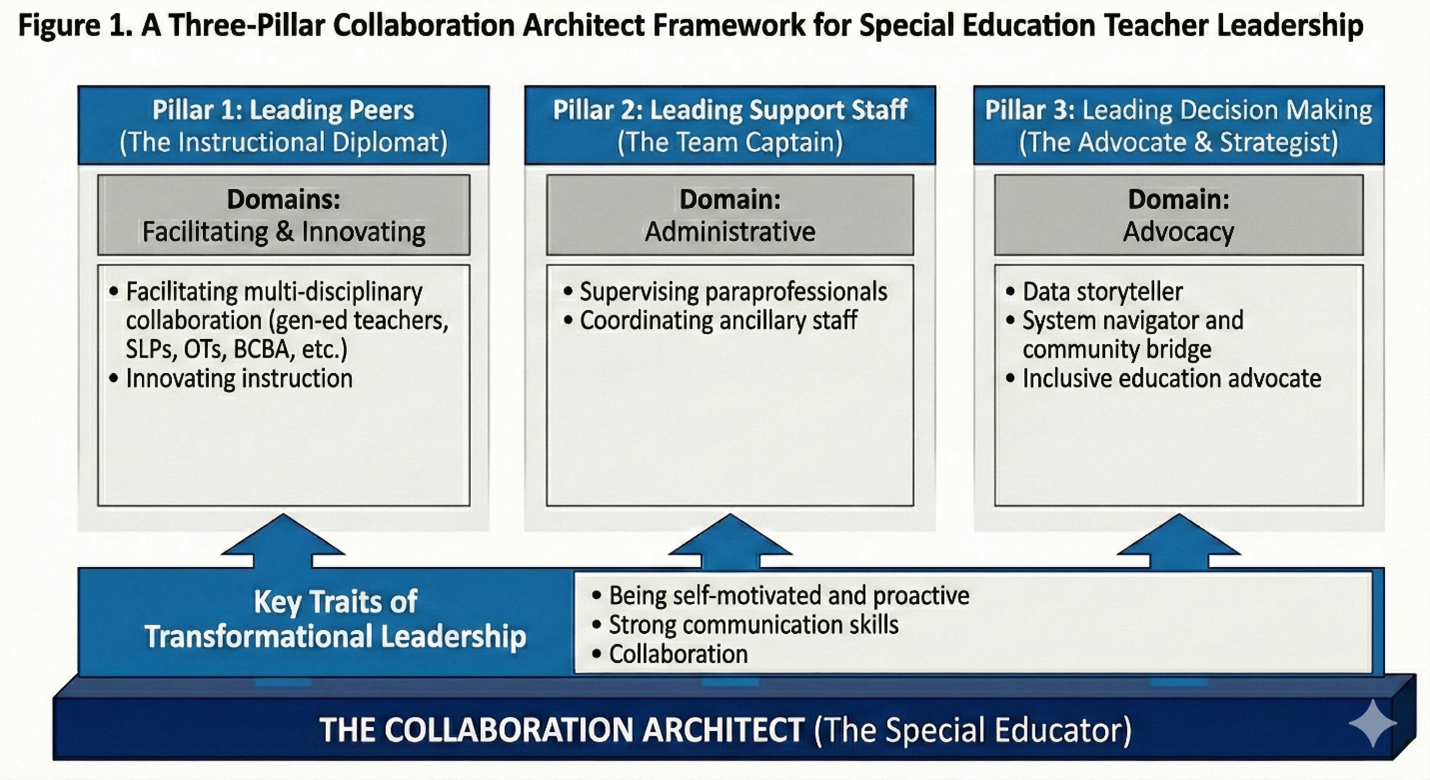
Figure 1. A three-pillar collaboration architect framework for special education teacher leadership
Pillar 1: Leading peers (The instructional diplomat)
The most visible aspect of special educators’ leadership is their work with professional colleagues. In the collaboration architect framework, this pillar integrates the facilitating and innovating domains identified by Sylvia Bagley and Kimmie Tang (2018) and emphasizes the need for strong collaboration skills across diverse groups.
Facilitating multi-disciplinary collaboration
The push for inclusion has made co-teaching common, but effective co-teaching doesn’t just happen. It requires special educators to act as instructional diplomats, navigating the delicate dynamics of entering another teacher’s classroom to modify instruction (Friend & Cook, 2021). They must constantly balance respect for their partner’s content expertise with the need to advocate for accessible pedagogy. Successful inclusion relies on this specific type of collaboration, where the special educator fosters positive interactions and maintains parity in a relationship that can often feel unbalanced (Hughes et al., 2025; Maggin et al., 2020).
But this diplomatic role extends far beyond partnerships with general educators. The special educator is also the central hub for related service providers like speech-language pathologists (SLPs), occupational therapists (OTs), school psychologists, and BCBAs. Each comes with their own schedule, jargon, and distinct goals. The special educator leads by synthesizing these disparate services into a coherent daily routine, acting as the translator who ensures an OT’s sensory strategies or an SLP’s communication devices are integrated into the classroom when those therapists aren’t there. Without this facilitating leadership, these services remain isolated islands rather than integrated supports.
Innovating instruction
Special educators are often the school’s innovation engine. Since standard instruction doesn’t always work for their students, necessity compels them to be creative problem solvers. They are typically the early adopters of assistive tech, the ones who break down complex standards into accessible targets, and the primary drivers of Universal Design for Learning (UDL). By constantly adapting curricula and environments to meet unique needs, they lead the way toward a more flexible pedagogy that ultimately benefits every student in the building, not just those with individualized education programs (IEPs).
Pillar 2: Leading support staff (The team captain)
Perhaps the most undervalued and stressful leadership challenge for special educators is supervising support staff. This responsibility falls squarely within Bagley and Tang’s (2018) administrative domain, which is rarely associated with classroom teaching.
Supervising paraprofessionals
While a general education teacher might occasionally share their room with an aide, special educators often lead teams of two, three, or more paraprofessionals across multiple settings. For special educators, “directing the work and developing the skills of paraprofessionals” is a critical leadership function (York-Barr et al., 2005, p. 197). They create complex, minute-by-minute schedules; assign instructional tasks; monitor implementation; provide on-the-spot training; and ensure fidelity to legally binding IEP documents. The weight of this administrative work cannot be overstated.
Special educators need to ensure that paraprofessionals, who often have limited training, are delivering specialized interventions correctly. They also need to navigate personnel issues, including tardiness, conflicting educational philosophies, and interpersonal conflicts among staff. This work would merit a manager title in the corporate world but is just part of the job in schools.
Coordinating ancillary staff
This team captain work often extends beyond the classroom. Special educators often collaborate with and guide other staff, such as bus drivers, cafeteria aides, and recess monitors. Ensuring a student’s success means ensuring that supports don’t end at the classroom door. A student can have a perfect day in the classroom and have it entirely derailed by an unstructured interaction in the cafeteria. The special educator needs to translate a student’s IEP into practical strategies for a bus driver managing 30 students. By doing so, special educators extend their leadership into the school district’s infrastructure to ensure a seamless, supportive environment for students, a task that requires significant organizational and interpersonal leadership skills.
Pillar 3: Leading decision making (The advocate and strategist)
The final pillar involves using expertise to drive schoolwide culture, high-stakes decisions, and family empowerment. This aligns with the advocacy domain (Bagley & Tang, 2018), which includes advocating for students, families, and the profession itself.
The data storyteller
In an era of accountability, special educators are the school’s data experts. Assessment practices, from progress monitoring to IEP development, are essential to their daily work (Zarate, Tejero Highes, & Maggin, 2022). But they don’t just collect data; they translate it. As data storytellers, they synthesize complex reports into coherent narratives that families and administrators can understand. This storytelling drives high-stakes decisions, from placement to graduation pathways. By leading these discussions with empathy, they ensure that a student’s trajectory is shaped by evidence rather than assumptions.
The system navigator and community bridge
The special education system is a bewildering labyrinth of legal complexities, acronyms, and bureaucratic hurdles. The special educator serves as a crucial guide, interpreting the system for overwhelmed parents, helping them understand their rights, and empowering them to be equal partners in their child’s education. This leadership often extends into the broader community (Friend & Cook, 2021). When schools cannot meet every need, the special educator becomes a de facto case manager, connecting families with external resources such as respite care and mental health services. They bridge the gap between school, home, and community — work that is essential for family stability yet rarely included in a job description.
The inclusive education advocate
Advocacy is perhaps the most distinct leadership domain for special educators. Bagley and Tang (2018) describe it not merely as securing accommodations, but as challenging the status quo to fight for equity.
This leadership is about shifting culture. For example, the special educator may speak up during faculty meetings if a proposed discipline policy could unintentionally impact students with sensory needs. Similarly, they might question ableist assumptions in the staff lounge or push for more accessible field trips. Such leadership often requires moral courage and can be uncomfortable, but it is essential in supporting marginalized students.
Transformational leadership across the three pillars
Examining these three pillars reveals a comprehensive image of the special educator, one that goes well beyond a conventional job description. This is the essence of transformational leadership. Research highlights several key traits of effective special educators that embody this leadership (Hughes et al., 2025; Maggin et al., 2020).
- They are self-motivated and proactive, such as when Sarah designed visual supports for a student’s bus ride without being asked.
- They possess strong communication skills that enable them to effectively bridge the gaps among therapists, teachers, parents, and many others.
- They are committed to collaboration, which benefits not only students with disabilities but also enhances the school’s overall culture and capacity.
Essentially, the special educator is a collaboration architect, a transformational leader operating without the formal title.
Why is this work invisible?
If special educators are engaged in high-level facilitation, innovation, administration, and advocacy across the entire school ecosystem, why are they not universally recognized as leaders? Research suggests a significant gap between the work that special educators do and how administrators and teachers perceive it.
The administrator’s view
Principals play a decisive role in validating teacher leadership, but they often view special education through a narrow lens. Administrators’ perspectives are often limited to special educators’ roles as IEP and legal matter experts, and they may have limited awareness of the instructional coaching or team leadership aspects of the job (Maggin et al., 2020).
This disconnect is often due to a lack of specialized knowledge and experience. Many building administrators lack a background in special education. Consequently, they may fail to recognize the administrative work of special educators who manage paraprofessionals and facilitate co-teaching. Or they may view them as merely technical duties, required for compliance, rather than leadership.
Special educators’ self-identity
The invisibility is not only external; it is internal. Special educators often struggle to identify themselves as leaders (Hughes et al., 2025). Their leadership does not resemble the traditional authoritative role they are used to. For example, they do not formally observe other teachers or have a budget. Instead, they often view themselves as simply “doing their job” when they are shaping instruction, setting schedules, or facilitating meetings.
Reframing the special educator as a leader serves the purpose of both retaining teachers and improving schools.
This is complicated by their advocacy role, which can sometimes make them feel like administrative antagonists or troublemakers, rather than partners. If a special educator is constantly fighting for resources or challenging school policies, they may be viewed (and view themselves) as outside the system rather than an integral part of it. This identity struggle contributes to their feeling of isolation. When they perform the work of a leader but lack the title, recognition, and self-identity, the emotional burden becomes heavier.
Strategies for school leaders
For special educators to move from invisible leaders to recognized collaboration architects, school administrators must take intentional steps to reframe this role. We cannot simply hope that special educators will continue to perform these complex tasks out of altruism; we must build structures that support them. Based on the literature, here are three actionable strategies for school leaders.
Formalize the role and create career ladders
We cannot expect high-level leadership for free, nor can we sustain it on altruism. Bonnie Billingsley (2007) suggests cultivating these roles by formalizing them. Schools should create designations such as lead special educator, inclusion coach, or multi-tiered systems of support (MTSS) coordinator. These should not be hollow titles; they should acknowledge the administrative and innovative work already being done. For example, a lead special educator might be formally tasked with mentoring novice special educators, leading UDL professional development for faculty, or serving as the liaison for paraprofessional staffing.
Ideally, these roles should align with career ladders that offer stipends, reduced caseloads, or pathways to administrative licensure, while acknowledging the time-intensive nature of this leadership work. By formalizing the role, administrators signal to the entire faculty that the special educator is a source of instructional authority and expertise, not merely a helper.
Schedule for collaboration, not just co-existence
You cannot be an architect without blueprints, and you cannot be a collaborative leader without time. The facilitating work of Pillar 1 requires consistent, protected time. Administrators must prioritize common planning time in the master schedule. If a special educator is expected to co-teach with a math teacher, they need planning time with that department. In addition, they need dedicated time to coordinate with related service providers to align goals. Without this, they are merely reacting rather than leading.
These functions cannot be relegated to “catching up in the hallway.” For teacher leadership to flourish, schools must create organizational conditions that enable interaction (York-Barr et al., 2005). Without protected time, the instructional diplomat cannot negotiate the curriculum or innovate instruction. They are reduced to being a reactive aide.
Provide training in supervisory skills and adult learning theory
Since managing paraprofessionals and coordinating with ancillary staff is a major function for special educators, districts must provide professional development specifically on adult leadership. Bagley and Tang (2018) note that the skills required for administrative and facilitating roles, such as conflict resolution, giving feedback, delegating tasks, and running effective meetings, are distinct from pedagogical skills.
We spend years teaching educators how to teach children; we spend almost no time teaching them how to lead adults (Biggs et al., 2018). Schools should provide training for special educators in supervisory skills and adult learning theory. Administrators should also explicitly support special educators when they face challenges with support staff, reinforcing their authority to direct paraprofessionals’ work. Empowering them with the skills and backing to lead their teams effectively reduces role ambiguity and stress.
Leaders already
The field of special education is facing a critical shortage, driven in part by the untenable working conditions of professional isolation and role overload (Herman et al., 2023). We cannot simply recruit our way out of this crisis; we must retain the experts we have by making their work sustainable, visible, and valued. When we treat special educators solely as case managers, burying them in paperwork and isolating them in resource rooms, we accelerate their burnout.
But when we recognize them as leaders who facilitate diverse professional teams, innovate instruction for all learners, manage essential support staff from the classroom to the bus ramp, and guide families through complex systems, we validate their true professional identity. Reframing the special educator as a leader serves the purpose of both retaining teachers and improving schools. The skills that special educators possess are exactly the ones that modern schools need to serve an increasingly diverse student population.
Sarah, the teacher we met at the beginning of this article, is already leading. She is already an architect, designing bridges between students and curriculum, between general and special education, and between families and schools. It is time for her school leaders to hand her the blueprints, provide the tools, and acknowledge that the structure of the school depends on her leadership.
References
Bagley, S.S., & Tang, K. (2018). Teacher leadership in special education: Exploring skills, roles, and perceptions. Journal of Interdisciplinary Teacher Leadership, 2 (1), 44-63.
Biggs, E.E., Gilson, C.B., & Carter, E.W. (2018). Developing that balance: Preparing and supporting special education teachers to work with paraprofessionals. Teacher Education and Special Education, 42 (2), 117-131.
Billingsley, B.S. (2007). Recognizing and supporting the critical roles of teachers in special education leadership. Exceptionality, 15 (3), 163-176.
Billingsley, B. & Bettini, E. (2019). Special education teacher attrition and retention: A review of the literature. Review of Educational Research, 89 (5), 697-744.
Brunsting, N.C., Morin, L.E., Gómez, L.R., Jones, B., Bettini, E., Cumming, M.M., Garwood, J.D., & Ruble, L.A. (2025). Burnout and occupational wellbeing of special education teachers: Recent research synthesized. Review of Educational Research.
Council for Exceptional Children (CEC). (2020). Initial practice-based professional preparation standards for special educators.
Friend, M. & Cook, L. (2021). Interactions: Collaboration skills for school professionals (9th ed.). Pearson.
Herman, K.C., Sebastian, J., Eddy, C.L., & Reinke, W.M. (2023). School leadership, climate, and professional isolation as predictors of special education teachers’ stress and coping profiles. Journal of Emotional and Behavioral Disorders, 31 (2), 120-131.
Hughes, M.T., Passmore, A., Maggin, D.M., & Kumm, S. (2025). Teacher leadership: Exploring the perceptions of special educators. International Journal of Leadership in Education, 28 (4), 821-836.
Katzenmeyer, M.H. & Moller, G.V. (2009). Awakening the sleeping giant: Helping teachers develop as leaders. Corwin Press.
Maggin, D.M., Hughes, M.T., Passmore, A., Kumm, S., & Scaletta, M. (2020). School administrators’ perspectives on special education teacher leadership. Journal of Special Education Leadership, 33 (2), 78-89.
Patterson, J. & Patterson, J. (2004). Sharing the lead. Educational Leadership, 61 (7), 74-78.
York-Barr, J., Sommerness, J., Duke, K., & Ghere, G. (2005). Special educators in inclusive education programmes: Reframing their work as teacher leadership. International Journal of Inclusive Education, 9 (2), 193-215.
Zarate, K., Tejero Hughes, M., & Maggin, D.M. (2023). Special education teacher leadership: Toward a teacher leadership framework for professional development. Exceptionality, 31 (2), 149-163.
This article appears in the Summer 2026 issue of Kappan, Vol. 107, No. 7-8.

ABOUT THE AUTHORS

David D. Yang
David D. Yang is an assistant professor of special education in the Department of Education Leadership and Inclusive Teaching, Woodring College of Education, Western Washington University, Bellingham.
Lindsay Foreman-Murray
Lindsay Foreman-Murray is an associate professor of special education in the Department of Education Leadership and Inclusive Teaching, Woodring College of Education, Western Washington University, Bellingham.