The education conferences I attended during the dot-com bubble of the 1990s and early 2000s were fueled by optimism and venture capital. Those events radiated with the heady promise of education technology. These new digital tools were going to spark an education revolution, upending instruction and spurring students to achieve at ever higher rates.
In some ways, that promise was fulfilled. The internet provides information and resources, including interactive and multimedia-rich content, to students and teachers. It enables remote and personalized learning and creates avenues for collaboration.
In other ways, though, the hype was, well, overblown. Student achievement scores have been steady over the past three decades, while achievement and opportunity gaps between affluent and disadvantaged students remain.
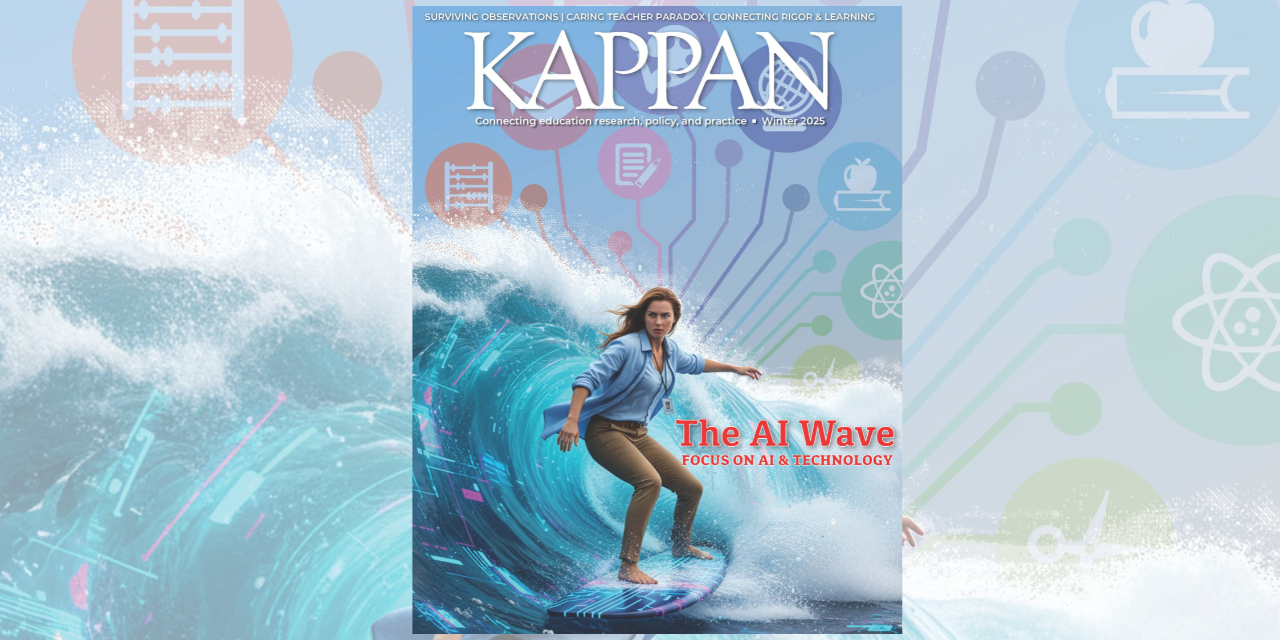
Now, three years after the introduction of ChatGPT — generative AI that creates new content, rather than just analyzing or classifying existing data — are we in the middle of another bubble? Or is AI poised to revolutionize teaching and learning?
The articles in this issue of Kappan reflect the uncertainty of where we are right now. Our authors have diverse opinions, experiences, and data on how AI can and will impact K-12 education.
In their article, “Can artificial intelligence spark an education renaissance?” Rick Ginsberg and Yong Zhao demonstrate how teachers are learning with their students to use AI tools to make structural changes to their educational experiences. They write: “The future of AI is unknown, but its potential for supporting transformative changes to schools as we know them is undeniable.”
Brent Duckor and Carrie Holmberg conducted more than 60 interviews with a diverse pool of middle and high school teachers to find out how they used AI in their classrooms. The results of the interviews, which they wrote about in their article, “Five pillars of ethical AI use for teaching and learning,” revealed that “AI is making noteworthy inroads into how lessons are planned, carried out, and reflected.”
Another article warns that the adoption of AI in classrooms should be tempered with the consideration of its unintended consequences. “On dead classrooms” author John D. Duffy writes, “AI offers a map of learning — tidy essays, efficient lesson plans, instant feedback — so polished that it can obscure the real, uneven terrain of education. If we come to prefer the map to the territory, we also trade away the very qualities that make education meaningful for our students. “
I heard artificial intelligence pioneer Adam Cheyer speak at a 2023 conference. The cofounder of Siri tried to demystify artificial intelligence by telling the audience that his invention and other familiar digital assistants were, in fact, AI. As was spell check, Grammarly, and basically any search engine. Oh, and the algorithm that decides what shows up in your social media feed? AI.
As it turns out, AI has been in our homes and our pockets all along. This won’t be news to the Gen Z teachers entering our classrooms. As digital natives, they don’t need to familiarize themselves with AI. They are neither afraid of the new technology, nor do they view it as a panacea for all the problems in education. Whether AI is a bubble or a revolution, these teachers will be at the helm.
I’m happy to introduce a new column starting in this issue. Inside Instruction by Connie Hamilton will look at curriculum and instructional issues and trends. Hamilton has served as an educator in a variety of roles. She started as an elementary and middle school teacher and then was an instructional coach. She also held administrative positions as a principal at both elementary and secondary levels and worked as a central office curriculum leader.
She is the author of seven books for teachers and school leaders, covering a range of topics including effective questioning, group work, and leadership. She is a consultant, presenter, and instructional coach. Her column will run in our print issues, with four online-only columns posted on Kappan’s website at kappanonline.org.
This article appears in the Winter 2025 issue of Kappan, Vol. 107, No. 3-4. 
ABOUT THE AUTHOR

Kathleen Vail
Kathleen Vail is editor-in-chief of Kappan magazine.
Visit their website at: https://pdkintl.org/