In this week’s newsletter: Cellphone bans & school closing announcements spread across the nation. Schools reconsider discipline, attendance, and grading policies. A new school-related documentary out from Davis (“Waiting for Superman”) Guggenheim. And: The Grade is launching a search for nontraditional education news sources.
CELLPHONE BANS,SCHOOL CLOSINGS,& TOO MUCH LENIENCY
The big education story of the week
The big education stories of the week are the continued spread of school cellphone bans, the increasing numbers of school closings due to enrollment declines, and schools reconsidering academic and behavioral policies that may have been too lenient to be helpful.
Sure, Congress continues to look like it’s going to fund a $5 billion new private school choice plan (NPR, EdWeek, Chalkbeat). The Supreme Court blocked religious charter schools (New York Times, Reuters). A federal court blocked the Trump administration’s bid to shutter the US Education Department and ordered it to reverse some of its layoffs (Washington Post, The 74). Then there’s the never-ending power struggle between Harvard and Trump (New York Times, Wall Street Journal, Boston Globe).
But stories that seem truly significant to me include the continued spread of school cellphone bans (Baltimore Banner, Associated Press, Statesman Journal, NBC News, Ithaca Voice, Park Record, Alaska’s News Source), enrollment declines and announced school closings (Los Angeles Times, Fort Worth Star Telegram, AJC, Pittsburgh Post-Gazette, KXAN) and schools and districts reconsidering overly lenient attendance, grading, and student behavior policies (Ideastream, Texas Tribune, Chalkbeat Chicago).
None of these is as sexy as Trump-related school news, but they seem likely to have a more widespread impact on kids and schools. It feels like newsrooms — and readers — may be missing the story.
Follow The Grade for daily education news and commentary.

MAKE-UP PACKETS & LENIENT GRADES
The best education journalism of the week
The best education journalism of the week is the new Chalkbeat/WBEZ Chicago series looking at whether efforts to encourage students to pass their classes and graduate from high school are working.
Reported by Sarah Karp and Mila Koumpilova, the series features two Chicago high schools and describes how measures intended to keep kids engaged through lenient grading and attendance policies may have backfired.
Seeing kids passing classes when they only intermittently came in or completed assignments “was just crazy to me,” says a student. “You can’t replicate [school] at home with a packet,” says an educator.
The series is perhaps too careful not to lay blame on anyone for the gutting of too many students’ school experiences. But it features nearly everything else you could want: vivid characters, first-person details and images, helpful statistics, and nuanced descriptions of hopeful efforts to make improvements.
I’m curious whether other schools and districts are considering these changes — and hoping education journalists will explore them.
Other stories we liked include one town’s debate over a charter school (WyoFile), how Miami is deploying AI in the classroom (New York Times), an update on efforts to rebalance the racial balance in school vocational and technical schools (GBH Boston), and a profile of a teacher who has become closely involved in George Floyd Square (Sahan Journal).

A BLIND EYE TO CLASSROOM CHAOS
Our latest columns and commentary
How common must student disruptions be if many schools have “classroom evacuation plans” for when students start yelling, fighting, or throwing things in class?
That’s the question veteran principal and current substitute teacher Gail Johnson asks in our latest column, where she writes that the problem of everyday classroom disruptions are persistently downplayed by parents and education reporters.
“The urge to dismiss a show featuring classroom chaos makes total sense,” writes Johnson, referring to Netflix’s “Adolescence” series. “Because to face the truth that we have a fundamental problem with our youth is to admit that adults may well be responsible for this.”
Johnson tweets as The Principal’s Office and her essay is part of The Grade’s renewed effort to highlight nontraditional information sources and platforms that play an increasing role in complementing education coverage from legacy news outlets.
Readers: What are the best places for useful information shared by people who don’t necessarily identify as journalists? What are the platforms that produce education news that readers find compelling — whether or not they’re looking for education news?
PEOPLE, JOBS, & EVENTS
Who’s going where and what’s happening
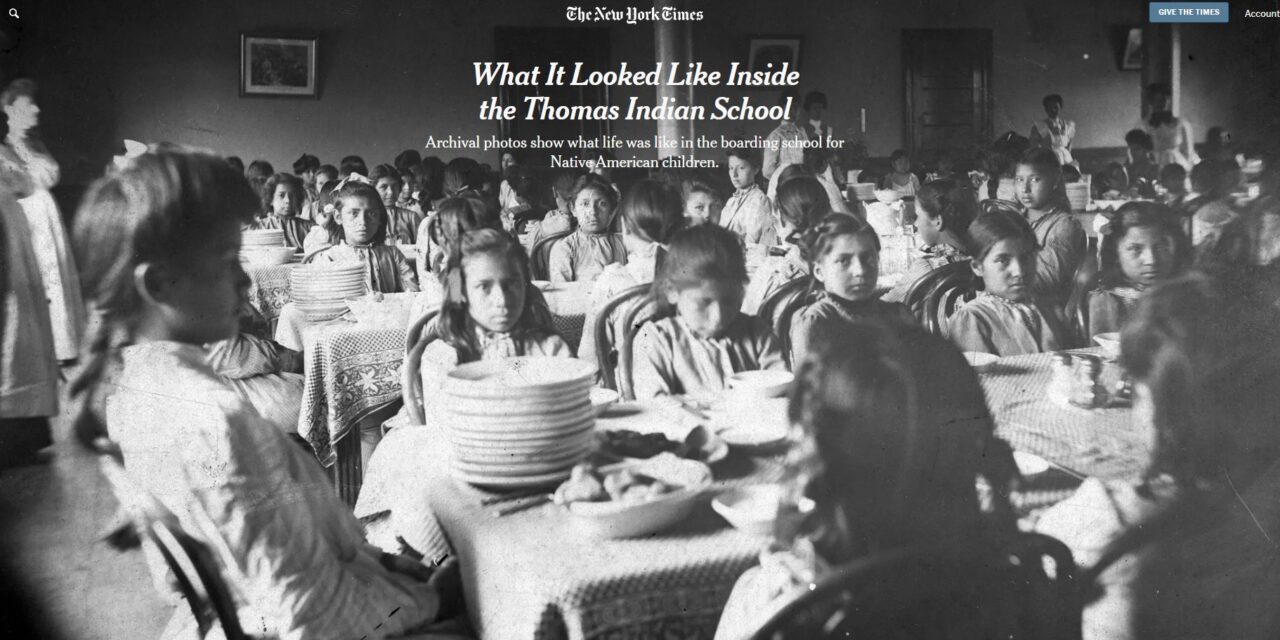
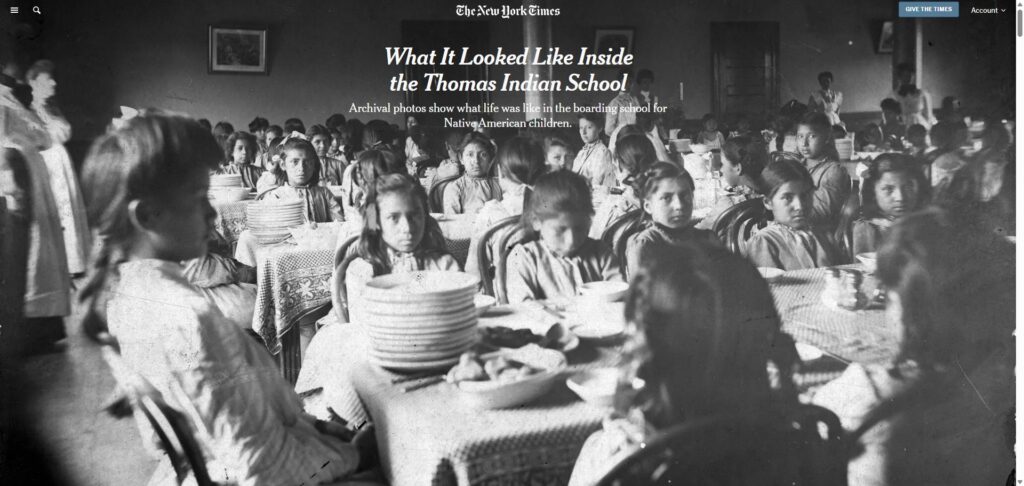
Above: I can’t help but think that pictures of today’s schools will someday look as baffling and awful as the New York Times’ archival images from long-ago Native American boarding schools.
📰 Segments: NPR’s 1A featured a panel segment about red-state education news that doesn’t focus on private school choice: How Can States Improve Student Reading Scores? NPR aired a segment on how educators fear their homeless students could become a target for Trump cuts.
📰 Numbers: Public school funding is quickly approaching $1 trillion annually, notes the Reason Foundation’s Aaron Smith — rising $49 billion in real terms between 2020 and 2023. A Montana study of four-day schedules found that teacher retention was higher under the five-day model, according to a Hechinger Report feature. School lessons aimed to improve mental health are ineffective, according to a study written up in the Guardian. AI-based plagiarism detection services erroneously flag human-written text as A.I.-generated about 6.8% of the time, according to research cited in the New York Times.
📰 Longform: Former education reporter Claudia Rowe’s new book, WARDS OF THE STATE, describes how the foster care system breaks down the children and families it serves — and produces educational outcomes that are worse than those of homeless children. Mike Hixenbaugh’s THEY CAME FOR THE SCHOOLS is out in paperback. The documentary filmmaker behind 2010’s Waiting For Superman is back as co-director of Deaf President Now!, which tells the story behind the campus protests that in 1988 engulfed the nation’s preeminent school for deaf students.
📰 Recognition: The latest cohort of ProPublica’s Investigative Editor Program includes the Washington Post’s Chastity Pratt, Oklahoma Watch’s Jennifer Palmer, the Chronicle’s Daarel Burnette II, and the Texas Tribune’s Nic Garcia. Too many education reporters to name were recognized in Chicago’s annual Lisagor Awards. APM Reports’ Emily Hanford received an Honorary Doctorate from Australia’s LaTrobe University.
📰 Comings, goings, & job openings: Newly-announced Report for America journalists who will be covering education-related beats including Isabela Lisco (KOLDTV-Arizona), Maureen Bohannon (ACIR), Erica Little (Pinal Central), and Dylan Wickman (Today’s News-Herald). Full list here. Former Dallas Morning News education reporter Marcela Rodrigues has now joined the Boston Globe’s ed team. Samantha West has left her job covering education for KUOW to move back home to the Twin Cities area “to be closer to my family.” Claire Withycombe has joined the Seattle Times ed lab to cover early learning. The Seattle Times is looking for an education editor to run the section. EdSource is looking for an executive editor.
THE KICKER
We saved the best for last.

Post your old EWA national conference pics? I’ll start.