In this week’s newsletter: Trump’s 100-day ratings fall — but eliminating DEI remains relatively popular. California tries — and fails — to revamp its literacy instruction. The Supreme Court seems poised to allow religious charter schools to receive public funding. Education reporters share their concerns about covering education. An LA Times reporter spends time with real people to explain how public policy affects the public. Former education reporter Tawnell Hobbs has been scooped up by the New York Times. And: Two longtime The Grade contributors finally meet in real life!
FUNDING RELIGIOUS CHARTERS ¯\_(ツ)_/¯ ?
The big education story of the week
The big education story of the week is the Supreme Court’s consideration of whether a religious charter school in Oklahoma can receive state funds (NPR, Washington Post, NYT, USA Today, Associated Press, Politico, SCOTUSblog, Hechinger Report. Chalkbeat, EdWeek).
By nearly all accounts, the Court seems poised to permit state funding to the religious charter, which raises long-simmering questions about whether charter schools are public or private entities, how the ruling might help or hinder religious schools, and irreconcilable views on the separation of church and state.
However, I’m not sure I buy that the decision will be as world-changing as it may seem right now. Charters exist in 45 states, but educate less than eight percent of American students. Private school choice is a much faster-growing segment right now, though it too remains relatively small in terms of enrollment. Religion and religious schools have been on the decline for decades, and separation of church and state seems like much less of an important issue than it may have been in the past.
Other big stories of the week include a compromise literacy bill in California, district budget shortfalls and school closings, and the debate over the Trump administration’s new Executive Order on school discipline (aka ‘disparate impact’). Follow @thegrade_ for each day’s top education news, Monday-Friday (and often on weekends).

UP-CLOSE REPORTING TO EXPLAIN POLICY
The best education journalism of the week
The best education journalism of the week is Can $1,000 a month help more students land nursing careers? An L.A. pilot effort says yes by Rebecca Plevin of the Los Angeles Times.
In this smart, deeply reported story, Plevin looks into a new pilot program that tackles California’s shortage of healthcare workers by handing 251 community college students $1,000 a month in guaranteed income for a year while they pursue health careers.
By tracking down Adriana Orea, a 32-year-old student, and seeing how she spends (or saves) the money, Plevin offers readers insight into how the cash can change a life and help her get a degree.
It’s a rare look into how relatively small changes in public policy can intimately affect real people, with careful, detailed and sensitive reporting that takes readers along. Orea uses $600 of the first $1,000 to pay past-due bills for her two-year-old son’s newborn check-ups, but she saves the second payment and soon begins amassing an emergency fund.
Things get better from there. Orea can soon treat her family to a Valentine’s Day lunch at Sizzler, celebrate her mother’s 60th birthday at Disneyland, and drive her son to the mountains “to see snow.” She eventually opens a high-yield savings account, and for the first time doesn’t freak out when she gets a parking ticket. She begins the process of enrolling in nursing school.
“Once you feel like there’s one less thing stressing you out, you just feel this relief,” she tells Plevin. “It clears your mind a little more and you just feel less stressed about everything else.”
The details all add up to a kind of quiet revolution for a working mom, a timely counterpoint to forces working against safety net programs and an important journalistic blueprint for how to write about policy changes.
Other education stories we liked include what Texas Democrats can learn from Greg Abbott’s voucher victory (Dallas Morning News), how Tennessee is bucking national trends to help kids improve in math (Hechinger Report) and how California’s literacy reform resulted in a compromise (CALMatters)
COVERING EDUCATION: APRIL IN REVIEW
Our latest columns and commentary
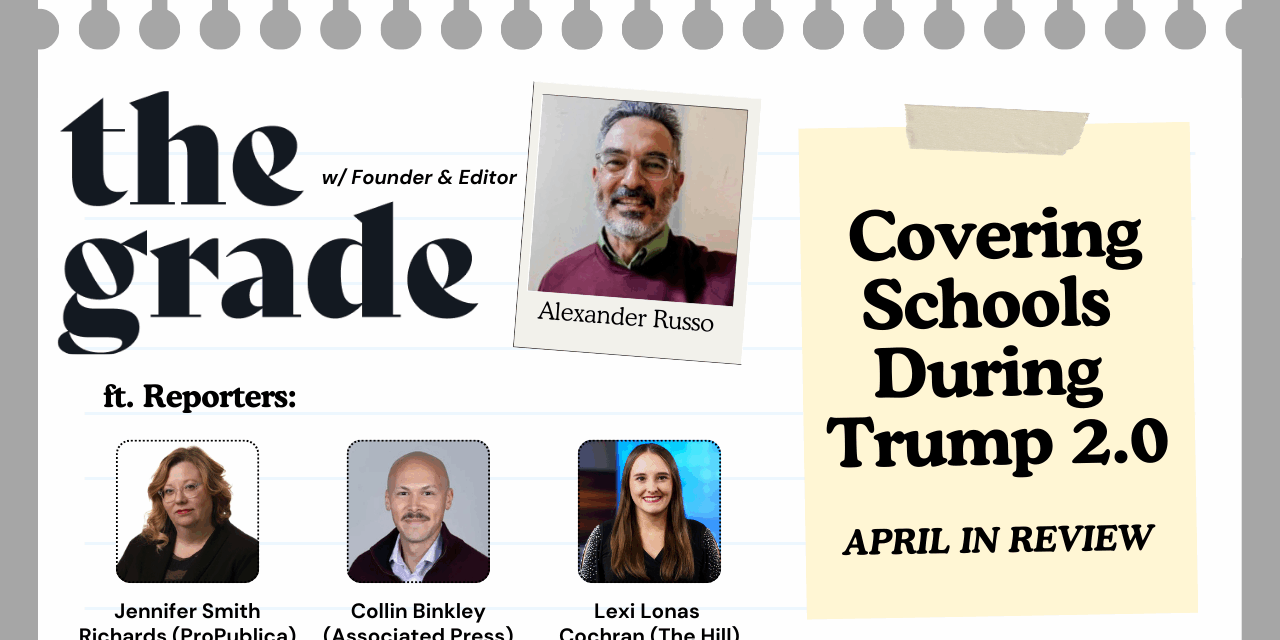
This month’s roundtable focused on covering education in April — the third month of Trump 2.0 and the 100-day mark of the new administration. You can watch the whole half-hour discussion above (or click the link if the video doesn’t render properly).
“My biggest concern is that things are moving so fast that there are a lot of under-the-surface issues that are really hard to get into … There’s no break in the topline news.” – Lexi Lonas Cochran (The Hill)
“Especially as a policy reporter, thinking about the impact is always in the back of my head and trying to move away from what’s happening in Washington and show what it means for people outside of Washington… I think we can all do that and continue to do that better.” – Collin Binkley (Associated Press)
“I saw a lot of stories written about [Trump’s school discipline Executive Order], but some of them didn’t mention the context of what we know through the federal government’s own data collections about how disparate some discipline is.” – Jennifer Smith Richards (ProPublica)

Above: Congrats to the new class of Columbia Journalism School Spencer Fellows: Brandi Kellam, Eleni Schirmer, and friends and contributors to The Grade Tara García Mathewson & Collette Coleman.
PEOPLE, JOBS, & EVENTS
Who’s going where and what’s happening
📰 Awards & Fellowships: In addition to the newly-announced Spencer Fellows (see above), Report For America recognized the work of young student journalists across the country during its Student Journalism Awards. Citizens & Scholars announced 15 Higher Education Media Fellows (including former The Grade contributor Colleen Connolly).
📰 Segments: Freelance journalist David Zweig appeared on Jake Tapper’s CNN show to talk about misbegotten COVID responses. NBC News’ Mike Hixenbaugh appeared on Mother Jones’ podcast to talk about the rise of culture wars around education. KQED aired a segment about how the Black Panthers shaped U.S. schools. The public radio documentary show Reveal aired a condensed version of recent Sold A Story episodes originally from APM Reports. EdSec Linda McMahon spoke briefly at the Trump 100-day Cabinet meeting.
📰 Reports and research: With 78 percent of Republicans and Republican-leaning independents in favor, Trump’s anti-DEI efforts remain popular. Two out of three K-12 teachers are satisfied with their workplace. K-12 financial risks are everywhere, says Edunomics’ Marguerite Roza. Recent college grads are no longer more likely to be employed than the average American. The 15 fastest growing metro areas over 500k from 2020 to 2024 are in “Florida, Florida, Utah, Florida, Florida.”
📰 Comings & goings: Former national education reporter Tawnell Hobbs is moving from the Wall Street Journal to the New York Times’ investigative team. She has shared insights and produced stories that have appeared in The Grade many times before.
📰 Events: EWA has a new Online Caucus for K-12 Reporters and has scheduled a May 8th event featuring the Detroit Free Press’ Lily Altavena and Politico’s Juan Perez Jr. Happy Birthday to the Hechinger Report, which turns 15 this year and has over that time grown from three to 23 full-time staffers.
📰 Notable longform pieces we liked include The Miscalculations of COVID School Closures (New Yorker), How the War Over Trans Athletes Tore a Volleyball Team Apart (NYT Magazine), The Real Story Behind The Telepathy Tapes (The Cut), Columbia Janitors Sue Protesters Who Took Over Hamilton Hall (The Free Press), Emiliano, two languages and a system that doesn’t understand his (palabra), Who Really Runs America? (Atlantic) , and How “The Great Gatsby” Took Over High School (New Yorker).
Books: LAist’s Adolfo Guzman-Lopez has a new collection of writing you can buy here. Don’t miss out on former charter school network head Steve Wilson’s book, THE LOST DECADE, which was released in March. Read about it in EdWeek and on the Fordham podcast.
📰 Quotable:
“Too often, the press has uncritically reported the position of universities without acknowledging that those institutions have a strong financial interest in favoring racial preferences” over economic ones.” says Richard Kalhlenberg in a new piece for The Grade.
“People ask me why I continue at Twitter where my tweets are viewed by probably less than one dozen people, & responses are limited to even fewer; & why the number of (so-called) followers has been dropping daily for a long time… Aa few good friends are far more precious than thousands of “friends.” – Joyce Carol Oates
THE KICKER
We saved the best for last.

What a delight to see this picture of Greg Toppo and Colleen Connolly, two great journalists who’ve helped grow and improve The Grade over the past few years, meeting for the first time in person at the recent Citizens & Scholars conference.