In this week’s newsletter: The downside of school preparations for deportation sweeps. A messy (in the best sense) story about police and schools. Do journalists under-appreciate the power of FOIA requests directed at schools? And ProPublica’s strange obsession with red-state private school segregation.
THE DOWNSIDES OF DEPORTATION PREP
The big education story of the week
The big education story of the week is how students and schools might be affected by the Trump administration’s efforts to limit illegal immigration and remove undocumented persons from the country — potentially including parents and students (AP, Washington Post, NPR, USA Today, New York Times, Chalkbeat).
Thus far, the Trump administration has removed limits on immigration sweeps at school locations and attempted to end the automatic citizenship of US-born children of undocumented parents. Nearly three quarters of a million school-age children are in the US without legal documentation. There are at least 5 million U.S. citizen children with an undocumented parent.
However, no direct action has yet been taken against students or schools — and may never. Interviewed on Thursday’s NPR Morning Edition, the Migration Policy Institute’s Muzaffar Chishti predicted “a storm, not a tsunami” when it comes to immigration restrictions. AP reports that the majority of US adults oppose arresting undocumented immigrants in schools.
Opinions vary on the appropriateness of covering the threat of school-based immigration raids. “The NYC DOE seems to think it’s a possible enough outcome to merit training school staff on what to do if it happens, which I think is noteworthy enough to report,” says NY1’s Jillian Jorgensen.
My view is that education journalists should address the basic question of whether school sweeps are likely, note where public opinion and election results support aspects of the Trump administration’s efforts, and — most of all — include in their stories the learning disruptions that fears of possible school sweeps are creating.
Other big education news of the week includes the effort to eliminate federal DEI programs and staff, the Nashville school shooting, and the appointment of former Tennessee education commissioner Penny Schwinn to the US Department of Education. Follow @thegrade_ to get the day’s biggest education stories.

THE MESSINESS OF SCHOOLS & POLICE
The best education journalism of the week
The best education news story of the week is the Milwaukee Journal Sentinel’s In Milwaukee, police respond to thousands of calls to MPS: ‘Why do we call the police?’ (above), by Cleo Krejci and David Clarey.
Like many other districts, Milwaukee has attempted to limit police in schools amid concerns about over-criminalization of its students. However, police are still regularly called to schools.
What makes this story (and accompanying pieces) stand out is that it takes a close, data-informed look at a messy but still very important topic that directly affects students’ and educators’ lives. Check out the Journal Sentinel’s timeline, data dive, and court rulings.
The debate over school police isn’t going away, nationally or in Milwaukee.
Other education stories we admired this week include a national look at education technology in school (Wall Street Journal), a local story about the handful of schools doing better than before the pandemic (Voice of San Diego), a profile of Education Department nominee Penny Schwinn (The 74), and a school that puts social and emotional learning at the center (Colorado Public Radio).
SCHOOL SECRECY ‘SOFT SPOT’?
Our latest columns and commentary
In Part 3 of our School Secrets series, Newsday’s Jim Baumbach explains how he found out about confidential agreements that Long Island districts and teachers use to avoid publicizing teacher resignations — to the detriment of parents and students. And he calls public records the ‘soft spot’ that allows journalists to figure out what’s going on behind the scenes. “We can get so much more records from both schools and districts than we have yet to appreciate.”
Baumbach tracks records requests and sees that Long Island school districts face “a mere fraction of the records requests that the large government agencies do.” On Long Island, at least, schools are “an area in which not as many people are using open records laws in search of documents to bolster reporting.”
Previously in the series: Former Boston Globe reporter Marina Villeneuve explains how she uncovered sexual abuse in Massachusetts schools. Louisville Courier Journal reporter Stephanie Kuzydym talks about how school efforts at keeping students safe shouldn’t be limited to tornado and bomb threat drills.

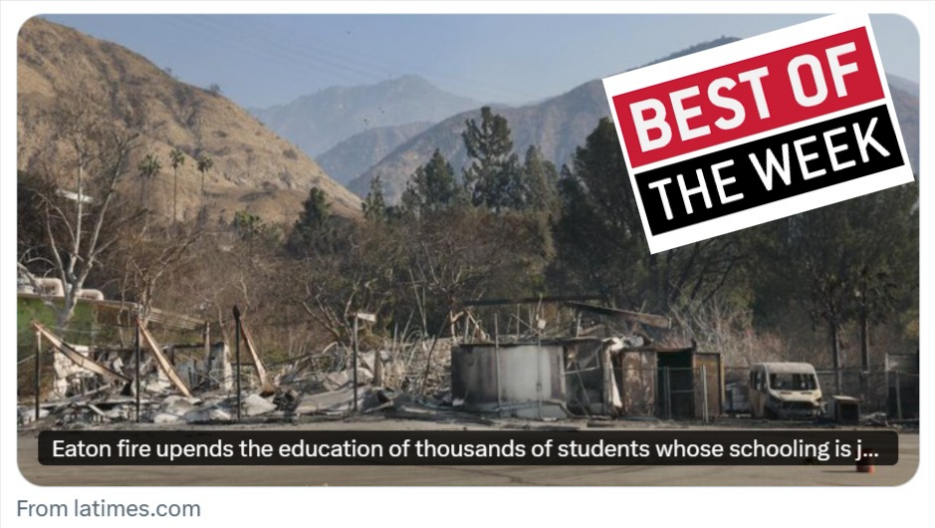
Above: While the education media turned towards speculation about the incoming Trump administration’s next steps, wildfires in LA — including new ones this week — destroyed schools and uprooted students’ lives.
PEOPLE, JOBS, & EVENTS
Who’s going where and what’s happening?
📰 Segments: NPR’s Morning Edition featured an early-January Midwest Newsroom story about the complicated federal system that’s supposed to support K-12 public school students experiencing homelessness. “We found in rural communities in the Midwest, students are getting left behind.”📰 Webinars and events: Boston Globe education editor Melissa Taboada was scheduled to appear last night on a panel discussion about the Garrity decision. Earlier this week, AP education reporter Cheyanne Mumphrey and Denver Post education reporter Jessica Seaman were scheduled to appear on a panel about student mental health and suspensions. Hosted by USC’s Center for Health Journalism, the webinar is available to view on replay. Earlier this month, Education Week Staff Writer Olina Banerji served as moderator of the panel discussion among the four finalists for AASA’s National Superintendent of the Year award at the National Press Club.
📰 Upcoming: ProPublica is hosting a webinar at 3PM EST today on its school segregation database. The Chinese (Lunar) New Year begins Wednesday and Sacramento teacher Larry Ferlazzo has got you covered (via EdWeek). The Connecticut Foundation For Open Government is hosting a January 30 “Stories Behind the Big Stories of 2024” event including CT Mirror reporter Jessika Harkay‘s investigation into a Hartford High graduate who says she graduated without knowing how to read.
📰 Quotables:
“Public schools need better programming, innovation, and funding to compete amid an expansion of school choice,” according to an EdWeek recap of the four 2025 finalists for National Superintendent of the Year.
“If ProPublica wants to address segregation in schools, they should start at home and with the public schools,” writes choice advocate Matthew Ladner.
“We’ll fight to keep the money,” says AFT head Randi Weingarten on NPR about the Trump promise to abolish the US Department of Education.
THE KICKER
We saved the best for last.

“The last time Houston saw this much snow was in 1973, when my mom still lived here,” writes Houston Chronicle education reporter Megan Menchaca in the caption to this uplifting image. “It’s kind of magical to get to experience a once-in-a-lifetime snow in the same city — more than 50 years apart.”