In this week’s newsletter: Wall-to-wall coverage of the Madison school shooting — and some rookie mistakes. A Louisville family’s Kafka-esque struggles to get their kid to school. Are school cellphone bans nothing more than a moral panic? Comparing coverage of Trump nominee Linda McMahon to coverage of DeVos. And TikTok tips from Boston Globe education reporter Mandy McLaren.
🎄Happy holidays! We’ll be back here Friday, January 10th.🎄
SCHOOL SHOOTING (MIS)COVERAGE
The big education story of the week
The big education story of the week is Monday’s shooting at a Madison, Wisc., religious school in which a student attending the school shot and killed two people and herself.
A few outlets did a good job contextualizing coverage, noting that school shootings make up less than 1% of all gun deaths suffered by American children and that female shooters are exceedingly rare (New York Times, Milwaukee Journal Sentinel, Northeastern Global News).
However, numerous outlets neglected to contextualize school shootings or made the rookie error of naming the 15 year-old shooter in the first few paragraphs (AP, NPR, CNN, BBC, New York Times) or even — seriously? — in the original (since-changed) headline (Washington Post).
Naming the shooter encourages copycats — a problem addressed in a recent column by former Bloomberg News reporter and UConn assistant professor of journalism Amanda Crawford.
Other big education news of this week includes school cellphone bans (Washington Post, New York Times, Post & Courier) — a topic discussed in this week’s new column (see below), a U.S. Justice Department report showing that one Washington State district failed to protect Black, Latino and LGBTQ+ students from “pervasive harassment” (Seattle Times), and differing suspension numbers for fights and suspensions in Houston (Houston Landing).
Check out @thegrade_ for each day’s most important education news.
INSIDE A SCHOOL
DYSFUNCTION NIGHTMARE
The best education journalism of the week
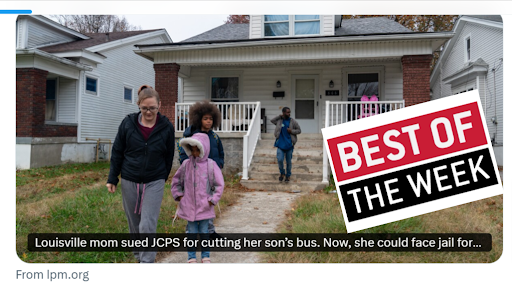
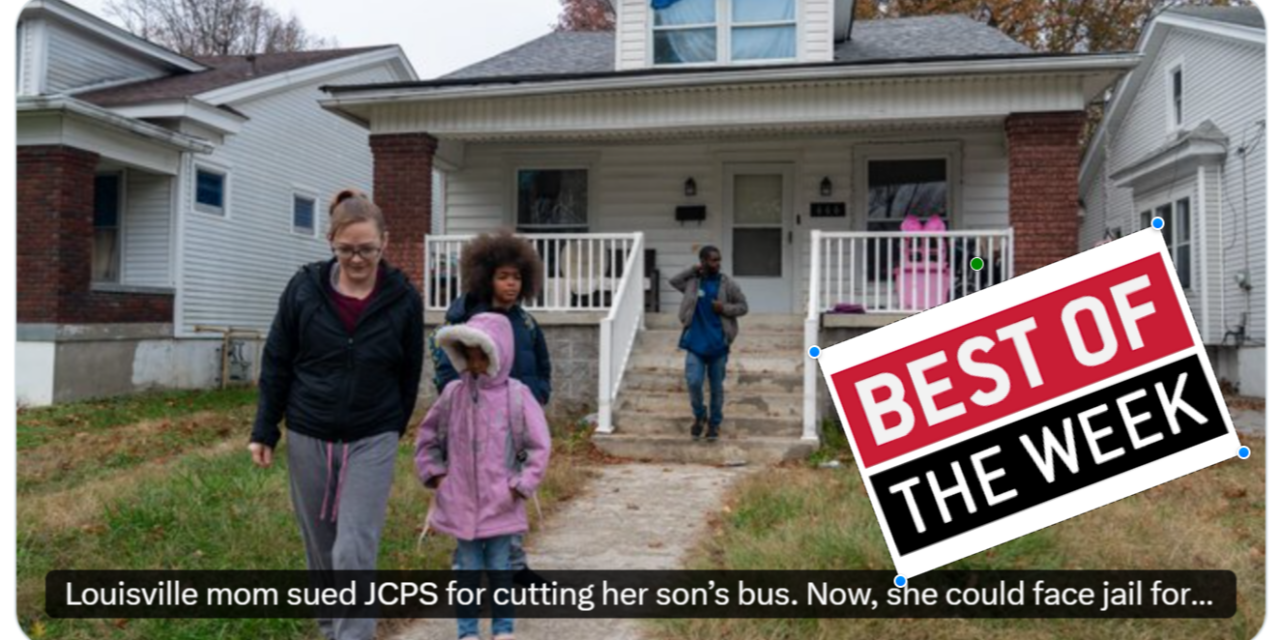
The best education journalism of the week is Louisville mom sued JCPS for cutting her son’s bus. Now, she could face jail for not getting him to school by Louisville Public Media’s Jess Clark.
This may be the most maddening thing you read this month, laying out the Kafka-esque travails of a low-income Louisville family facing school district dysfunction that results in a child who for years attended a beloved magnet school being forced to walk to a neighborhood school that pales in comparison. Starved of students, the beloved magnet school might close.
Clark’s main feat in reporting and writing this story is tying together the many threads — overcrowded schools, a bus driver shortage, cuts to city transit, and a county attorney determined to prosecute parents of delinquent kids — to paint a picture of what it’s really like to be on the receiving end of diminishing public services and get-tough law enforcement.
She describes a slow-motion trainwreck with heartbreaking details. The parents struggle to get their son to school on unreliable city buses, but the district’s solution is simply to give them more free bus passes. The parents repurpose a banner and gold balloon from their son’s ninth birthday by turning the balloon upside-down.
It’s a remarkable, deeply reported piece of accountability journalism that perfectly mines a vulnerable family’s frustration with a system that fails them at almost every turn.
Other education stories we liked this week include allegations of fraud by a shady Minnesota tutoring firm (Minnesota Reformer), how private schools in the South are exacerbating segregation (ProPublica), a Varsity Blues perpetrator who says she was a scapegoat for USC (LA Times), a program to help foster youth earn college degrees (NPR), Democrats wondering how they lost school parents to Trump and the GOP (The 74), and a Connecticut high school grad who can’t read sues the city, district and a special ed case manager — a folo from our October best story of the week (Hartford Courant).
ARE SCHOOL CELLPHONE
BANS A MORAL PANIC?
Our latest columns and commentary
School cellphone bans are all the rage, and they continue to receive a fair amount of coverage, including this week’s New York Times and Washington Post stories.
But what if the evidence for the bans is much weaker than it may seem, and student well-being statistics aren’t closely related to the rise of cellphone use?
What if a bestselling book and its charismatic author (Jonathan Haidt) have resulted in fawning rather than skeptical coverage?
What if concerns around kids and cellphones are nothing more than a moral panic (like past panics over comics and rap lyrics)?
That’s the gist of professor of psychology Chris Ferguson’s new piece for The Grade, The problem with vibes-based cellphone reporting.
Check it out. And read — and report — cellphone ban coverage with these concerns in mind.
LESSONS & PREDICTIONS
What did you learn — and what do you think happens next?
One of the biggest 2024 election surprises to me was the news that educators, parents, and immigrants were concerned enough about immigration and other issues to vote for Trump — a story that was not well told in the media.
One of the many possible things that I think will happen in 2025 is that big stories will include “re-tracking” math and Book Ban bans in Democratic states, and education journalists will renew their efforts to reach readers on social media and podcasts — with mixed success.
Tell us your 2024 insights and 2025 predictions in our five-question survey. It’s not too late!
PEOPLE, JOBS, & EVENTS
Who’s going where and what’s happening
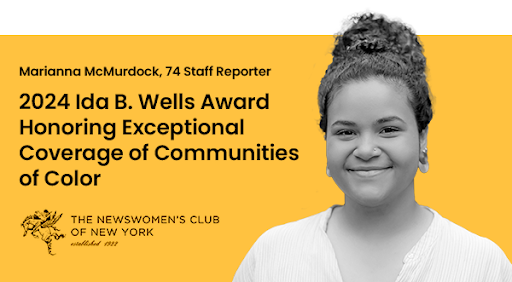
Above: The 74’s Marianna McMurdock won the Ida B. Wells Award from the Newswomen’s Club of New York. Other awardees include NBC News’ K.C. Wassman, Livia Lenhoff and Jillian Eugenios. Congrats to all!
📰 Podcasts, appearances, and video: WNYC’s On The Media has aired the second of its three-part series, The Harvard Plan. WLRN Florida Public Radio’s Natalie La Roche Pietri made her South Florida Roundup debut, talking about a school board proposal to ban religious signage on campuses. I’ve only recently discovered The Disagreement, an education-related podcast run by former A Better Lesson guru Alex Grodd. And there’s a new documentary focusing on Christa McAuliffe’s impact as a teacher you should check out.
📰 New and emerging: Longtime Chicago education journalist Maureen Kelleher has published the first installment of Home Rule, a new newsletter about Chicago school politics. It’s been a big year for EdNavigator’s Tim Daly and his uber-helpful newsletter. If I ran a newsroom, I’d try and get him to write for me. The Free Press has another education story this week (about parents’ conflicts with school districts) — the latest in a spate of education-themed stories from the fast-growing outlet that have made me alternately excited and dismayed.
📰 Reporters as influencers: Asked about her experiences on TikTok, Boston Globe education reporter Mandy McLaren told us that she decided to try it out primarily out of a desire to connect with a new audience and to reach younger readers. Instead, she’s found lots of parents and educators — locally and otherwise — and had a great experience overall. “I’m not very good at making TikTok videos yet, but I still find joy in doing it,” she writes, noting that it scratches a creative itch and gives her a chance to “check the pulse” on a topic (like inclusion, which has so far generated 100 responses).
📰 Research: Time to level up your book ban coverage — or even better, find something better to do with your reporting time — because a recent Knight Foundation video reminds us that just 3% of folks are so concerned about a book that they’ve taken action. ProPublica’s Alec MacGillis describes a new Brookings report on the rise in homicides starting in April 2020, “suggesting that pandemic stress and closures played a major role, even before the onset of “Floyd effect.” The University of Arkansas has a new report tracing the relationship between 5.5 month-long school closures and student learning disruption.
📰 Quotables:
“Philanthropy is increasingly invested in funding ‘narrative change’ and ‘storytelling,’” observes former education reporter Rachel Cohen (now at Vox). “But far less interested in slower, less flashy work of reporting, uncovering facts and new information.”
“The coverage has made little or no effort to explore McMahon’s tenure as chief at the Small Business Administration, her 81–19 Senate confirmation in 2017, or her business acumen,” laments AEI’s Rick Hess in a new piece about The DeVos’ing of Linda McMahon.
THE KICKER
We saved the best for last
Please send images of any education journalists spotted fleeing from newsrooms for the holiday break like these teachers. Will pay good money.