School cellphone bans have strong vibes, thanks in large part to credulous media coverage. But the actual evidence is weak — and the potential downsides are many.
By Chris Ferguson, professor of psychology
Cellphone bans in schools are all the rage in the United States over the past year.
According to Education Week, at least 18 states have either enacted bans on cellphone use in K12 schools or required local districts to develop their own related policies.
But do such bans work either to improve student learning or mental health?
And can we count on news media to cover this issue fairly?
I have my doubts.
The available research does not ratify the case for school cellphone bans, no matter what you may have heard or seen or been.
And the media treatment has played a part in amplifying what can only be described as a moral panic about phones in schools.
One recent New York Times article begins with the sentence, “Cellphones have become a school scourge.”
Can we expect objective coverage to follow? .
News media often cater to panics, neglecting inconvenient science and stoking unreasonable fears. And this is what I see happening with the issue of cellphones in schools.
But all is not lost. An understanding of research, combined with improved journalistic attention to bias and context, could improve the coverage dramatically.
One recent New York Times article begins with the sentence, “Cellphones have become a school scourge.” Can we expect objective coverage to follow?
Editor’s note: The Grade has previously published commentary on coverage of school cellphone bans here, here, and here. If you’d like to comment on media coverage of this topic (or any other related to schools), please send your ideas to thegrade2015@gmail.com.
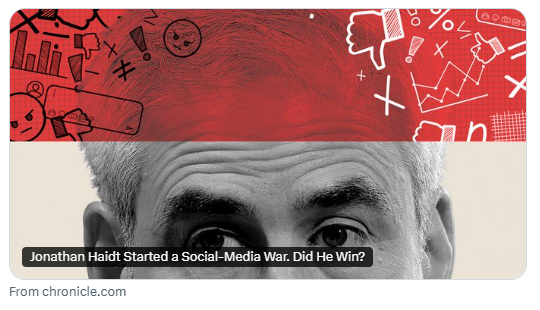
Above: An article from the Chronicle’s Stephanie M. Lee about the debate over Haidt’s efforts.
Over the past year, much of the initiative to limit or ban phones in schools has been driven by a book of popular psychology, The Anxious Generation by Jonathan Haidt (above).
Although this book has been critiqued by multiple scholars for cherry-picking data and distorting the research evidence, Haidt has been center to policy efforts to restrict youth access to smartphones in much the same way Frederic Wertham and his bestselling book The Seduction of the Innocent spurred on a moral panic over comic books.
Haidt is a qualified researcher, and his voice deserves to be one that is considered.
However, it is remarkable how much one researcher has consumed the focus in a research field where he, frankly, has done very little actual research.
It is remarkable how much one researcher has consumed the focus/
A key problem with school cellphone bans is simply that there’s no real evidence that they actually help kids.
Nor are there even clear metrics with preregistered pre-post outcome designs to clarify what they’re supposed to work for.
This creates two rather obvious problems:
First, putting policy before evidence creates sunk costs, wherein policy makers, administrators, and teachers will feel pressured to find any evidence to support the policy and suppress evidence the policy doesn’t work or may be harmful.
Second, without clear goals or plans how to assess the policy’s effectiveness, such policies are likely to linger for years on “feels” even if they are expensive, useless, or harmful, as so many education programs do.
Based on information given to me by Orange County Schools in Orlando, cellphone bans there…in a single school district…resulted in approximately 660 suspensions in one school year. Suspensions are linked to worse grades and conduct and even adult arrests.
Meantime, overall standardized academic scores have remained static for teens, aside from a predictably but small dip immediately post-Covid lockdowns.
According to the CDC, teen mental health has actually improved in the last two years — without cellphone bans.
Reported bullying continues to decline in the social media age, even when cyberbullying is factored in.
Likewise, school violence continued its decades long decline.
A key problem with school cellphone bans is simply that there’s no real evidence that they actually help kids.
Despite these issues, news media have done much to put school cellphone bans front and center — often with little critical evaluation of the merits.
Haidt and the benefits of school cellphone bans have received fawning attention from prominent national news media including the aforementioned New York Times article, the PBS NewsHour, and from influencers such as Oprah Winfrey, an ever-present figure in moral panics and general woo.
In the New York Times “school scourge” article mentioned earlier, claims that “Studies have shown that mobile phones… can distract students and impair learning.”
To make this claim, the report cites two studies of college students, but fails to note that a meta-analysis of such studies ultimately concluded that the evidence did not support that cellphones influenced attention or cognition.
Many news stories such as this one from NPR or this by the Wall Street Journal tend to repeat the claims from The Anxious Generation uncritically.
And many rely rather heavily on anecdotal narratives, whether from teachers or parents.
However, anecdotes are well known to be of limited evidentiary value. People routinely misattribute cause, are biased to see evidence for what they hope will be true, and often simply say what they think they should.
A recent New York Times article based mainly on examples from a single school illustrates the downsides of anecdote-based coverage. The article includes scary quotes from a range of teachers, policy makers, police, and others implying that this is a worsening situation nationwide but neglects to inform the reader of some simple details. bullying and school violence are down, not up, nationally. Put simply, the NYT article is sensationalist nonsense.
Many news stories rely rather heavily on anecdotal narratives.
Critical coverage from other, smaller news outlets including the Guardian and TechDirt have highlighted problems with claims made in the Anxious Generation.
Coverage by the Australian newspaper Crikey on Australia’s ban of social media for youth 16 and under notes that scholars are divided on whether social media or cellphones harm youth or not.
Coverage from the New York Times, notes mixed opinions among students themselves.
Likewise coverage by NBC noted appropriately concerns from both sides of the debate.
We need more balanced, nuanced coverage like this.
We need more balanced, nuanced coverage like this.
About a decade ago, I offered a list of things people can look for to know when we’re in the midst of a moral panic.
Back then, the question related to video games, which were once considered worrisome to many. But a few of them may help people identify cellphone ban coverage that is biased when talking about social media effects – or those charged writing about the topic:
RED FLAG 1: Claims that all the evidence is on one side of a controversial issue.
For instance, this LA Times article begins, “There’s little disagreement on what needs to be done: California schools must ban or restrict cellphones that disrupt learning”.
RED FLAG 2: Reversed burden of proof. “Can you prove it’s not the smartphones?
What else could it be?” Turns out lots of things, but that’s also the inverse of how science works. The impetus is on those proposing a causal mechanism to provide evidence for it. That currently is lacking for this area. Surgeon General Vivek Murthy provides an example of reversed burden of proof, quote as saying, “”At this point, we do not have enough evidence to say with confidence that social media is sufficiently safe for our kids…”
RED FLAG 3: Failing to inform readers that effect sizes from studies are tiny, or near zero, only mentioning they are “statistically significant.”
Much of this is because scientists themselves exaggerate the value of their findings, and science journalists may be ill-equipped to challenge them. For instance, a 2024 Boston Globe article extolled the “dramatic” benefits of a cellphone ban in Norwegian schools. However, a closer look at the study found that the results had been oversold, with mixed findings at best. Some of the findings weren’t actually statistically significant, most others were likely statistical noise.
RED FLAG 4: Comparisons to other well-known causal effects.
Somehow cigarettes and smoking always come up with moral panics. The research field on social media and teens simply is not anything comparable to cigarettes and smoking. As the Wall Street Journal has noted, this is a common, but flawed, comparison often made by politicians.
We are very clearly in a moral panic cycle. News media can promote these moral panics, and often have incentives to do just that. But they can also be part of the solution.
Better skepticism of broad claims and dedicated efforts to be sure to get both sides of a controversial issue can be critical.
So too is remembering that we’ve all been through this before.
Chris Ferguson is a professor of psychology at Stetson University near Orlando, Florida. He has been researching media effects for over 20 years, and he is author of books for the public including How Madness Shaped History, Catastrophe: The Psychology of How Good People Make Bad Situations Worse and the new YA gothic horror novel The Secrets of Grimoire Manor. He lives in Orlando with his wife and son. You can follow him here.
Previously from The Grade
How to improve coverage of school cellphone bans (Sabine Polak)
You’re wrong about cellphone bans
What the Times gets wrong about school cellphone bans (Patrick Hunt)
Previous instances of moral panics amplified in education news include Ebonics, ‘bad’ kids, school gun violence, and ‘bad’ teachers.