The 12 Zoom boxes on my screen made me feel like I had time-traveled to the era of virtual learning at the height of the pandemic. Jazmin Rivera, my colleague and the community education specialist at the UCLA Labor Center, smiled and waved at each student as they logged on even though each individual square box remained black. We had become accustomed to this standard “camera-off” style during the pandemic.
It was March 2024, and Jazmin was conducting a virtual session with the UCLA Youth Source Center which trains Los Angeles Unified School District (LAUSD) working high school students as part of the Labor Center’s “The State of Young Workers in California” research initiative. This programming and research accelerated after the passage of Assembly Bill No. 800 (AB-800) in October 2023, which requires California public high schools, including charters, to annually observe the week that includes April 28 as Workplace Readiness Week. During that week, students learn about their rights as workers.
An engaging curriculum
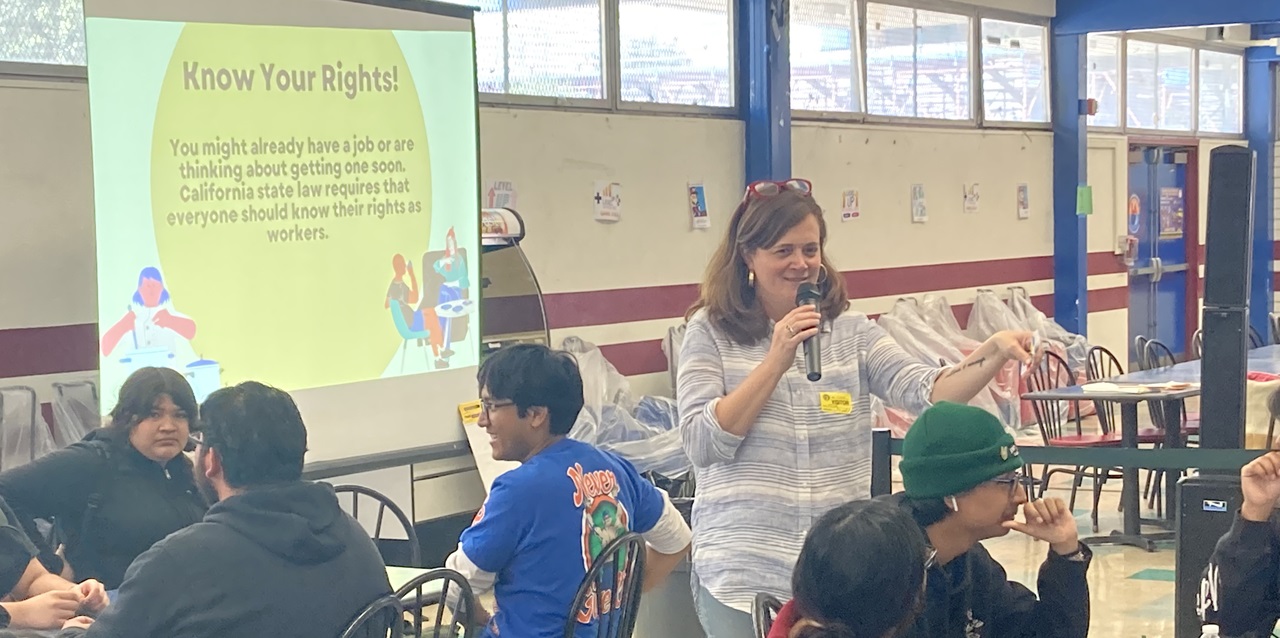
Developed in partnership with the Young Workers Education Project, the workshop Jazmin was facilitating was a pilot of curricula that schools could use in the 2024-25 school year. The five-part modular curriculum called Know your Rights (KYR) is designed to inform young people about their power as workers.
As Jazmin began the session by asking the high school students to distinguish between human rights and rights in the workplace, I watched the nine blank screens nervously. I had taught and participated in enough awkward Zoom classes to remember the uncomfortable feeling of asking a question into what felt like a void. However, the relevance of the content sparked something totally different.
Multiple students unmuted themselves at the same time, offering ideas about workers’ rights. They recounted incidents in the workplace where they felt their rights were violated. The Zoom chat erupted with “same” and “that happened to me too!” while emoji-reactions exploded across the individual Zoom boxes. At the end of the session, one of the students said the session was “mind-blowing.” They were thrilled by the opportunity to learn about the historical and contemporary protections for workers and hear from peers about their experiences. Even though no faces were seen, it was clear that the first session of five was a great success.
A relevant curriculum
The engagement during the virtual session should not have surprised me considering that most 16–24-year-olds are working. A 2023 report by the UCLA Labor Center found that 2.11 million young people ages 16-24 in California — 45% in that age group — were working (Ramakrishnan et al., 2023). Of those young workers, 50% in the 19-24-year-old cohort worked full-time. Nearly 3 out of 4 of California’s young workers were people of color, and 50% were Latinx.
In addition, the majority of California’s young workers are in the retail and restaurant service industries, where 64% earned low wages. Those two industries are among those with the highest rates of wage theft, which occurs when employers do not pay workers the full wages required under law (Lazo et al., 2022).
Youth employment in California mirrors the national picture. According to the Bureau of Labor Statistics, in 2024, 55% of young people (16-24) were employed. The sheer number of young people both working and attending school combined with students’ enthusiasm for the pilot curriculum suggest that there is a need to authentically teach workers’ rights. In this pursuit, California is the vanguard.
In 2023, I wrote in Kappan about the underlying causes in the public school enrollment drop, but missing in my analysis was the reality that many young people are leaving school to work. Even though their state law requires them to attend school every day, many students miss school to attend work (Jones, 2023; Toness & Lurye, 2023). Students who stay in school may engage in paid apprenticeships (Vail, 2024), and the 2024 PDK Poll showed that Americans consider preparation for the workforce a high priority for federal education policy.
Why it matters
Before a young worker earns their first paycheck, they need to understand their rights as paid employees. Child labor violations in the U.S. have reached their highest level in recent years (Stauffer, 2024). The exploitation of young workers can include wage theft, harassment, or overlooking breaks and sick leave.
This is where the UCLA Labor Center’s KYR curriculum comes in. The curriculum begins with an overview of workers’ rights. It then breaks down the components of a paystub, teaching students to identify and understand gross earnings, deductions, federal withholding. Using this information, students can break down their own checks to identify possible mistakes. Finally, students have opportunities to roleplay what they should do if a workplace violation occurs.
Arguably, the most important aspect of teaching issues of workplace readiness is the excitement it instills in students. One student who attended lessons using the KYR modules reported, “It was a great feeling to learn about rights as young workers, as we are often get taken advantage of. After completing the workshops, I taught my sisters about her workers’ rights using the slides provided by Jazmin.”
The impact of teaching students about their rights in the workplace is obvious. As students empower themselves with this knowledge, they can have a better experience in the labor force and provide a better experience for those they may employ in the future.
References
Bureau of Labor Statistics. (2024). Employment and unemployment among youth — summer 2024. U.S. Department of Labor.
Cohen, A. (2023). The forces underlying the public school enrollment drop. Phi Delta Kappan, 104 (5), 30-36.
Jones, C. (2023, September). Soaring chronic absenteeism in California school is at ‘pivotal moment.’ Cal Matters.
Lazo, A., Kuang, J., Kalish, L., Yee, E. (2022, July). When employers steal wages from workers. Cal Matters.
PDK International, (2024). The 56th annual PDK Poll: Federal focus on education initiatives wins broad public support.
Stauffer, R. (2024). Young workers have rights: What to know about your labor protections. Teen Vogue.
Ramakrishnan, V., Rock, A., Herrera, L., Shadduck-Hernández, J., Ángeles, S., Kwong, C. (2023). California’s future is clocked in: The experiences of young workers. UCLA Labor Center.
Toness, B. & Lurye, S. (2023, February 9). Thousands of kids are missing from school. Where did they go? AP News.
Vail, K. (2024). Learning by doing. Phi Delta Kappan, 106 (2), 20-23.
Photo courtesy of Janna Shadduck-Hernández, Ed.D. and Nicolle Fefferman, LAUSD Social Studies Teacher and Prentiss-Charney Fellow 2024-26
Note: Thank you to the teachers and educators who supported this work—LAUSD teachers Nicolle Fefferman, Janna-Shadduck Hernandez, and Jazmin Rivera.
ABOUT THE AUTHOR

Abbie Cohen
Abbie Cohen is a doctoral candidate in the Urban Schooling division at the University of California, Los Angeles School of Education and Information Studies.