Given the struggles in our political world today, schools need to encourage students to become truth-seekers and truth-tellers.
Honesty matters. Whenever citizens must work together to reach a decision or even just figure out how to live together, we engage in civic reasoning. To reason together well, we must seek and tell the truth. But in a world swirling with competing political groups shouting conflicting facts, citizens are left unsure of what is true. The role of honesty is in jeopardy, especially in our current populist context.
As a political philosopher who studies citizenship education, I take up this problem in my latest book, Teaching Honesty in a Populist Era: Emphasizing Truth in the Education of Citizens (Oxford University Press, 2024). Investigating what honesty is, how it is connected to truth, and why both are important to and at risk in democracies, reveals important insights into how we might better educate citizens today, especially our youngest citizens in primary and secondary education.
Honesty as a personal virtue
A traditional philosophical understanding of honesty focuses on honesty as a virtue. Being honest means acting in a way that is truthful, forthright, and sincere. An honest person can be counted on to earnestly seek the truth and express it in open and complete ways without deceiving themself or others. This traditional view assumes that truth reflects an accurate account of an objective reality.
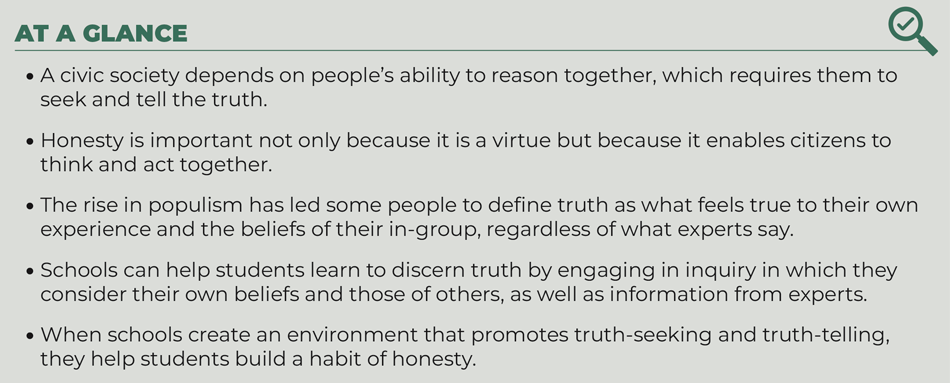
But this description of a virtuous honest person is rather contextually naïve. It focuses just on the behavior of the individual, rather than on how that individual’s actions impact and are impacted by others. Honesty, however, is not merely an individual virtue. We have to consider its role in social and political interactions. When we situate honesty in our social context, where we are interdependent in many ways, we come to see how our ability to understand the world and solve problems in it together relies on honesty.
Rather than considering people who lie as moral failures, we may be better able to encourage honesty by highlighting what is at stake in our civic and political lives. For example, people today are quick to call out our political leaders, especially our presidential candidates, pointing out things they say that aren’t true and calling them liars. Doing so isn’t an effective way to get them to change, nor does it demonstrate for young citizens why such behavior is a problem. Instead of focusing on moral reasons for being a good person, let’s redirect our attention to civic reasons for being honest. Our ability to thrive together in the world depends on our ability to think and act in the world together. To accomplish this, we must have a shared understanding of what is true.
Populism and dishonesty
Rising populism has significantly impacted how and why people are dishonest. Populism sees society as divided between the people and the elite, “us versus them.” The people are celebrated for having common sense that comes from firsthand accounts. Populists helpfully show how the people are capable of revealing facts that experts may have missed or ways in which experts’ policy solutions conflict with the needs or lived realities of the people.
Populists largely push aside commitments to an objective reality, giving personal experiences and opinions greater significance. To lend authority to their views, especially when they are not aligned with the claims of credentialed experts, they proclaim that their opinions are facts. They weave those supposed facts together to create narratives to help explain the unjust outcomes of liberal democracy and to help the people advance political goals. Populism reveals unfairness and hierarchy, which fuels political action. In this way, populism can be a welcome force that brings forward the experiences and struggles of the people, demanding changes to better suit their needs.
But this sort of positive force for democracy is not always done well. Rather than taking information in and weighing it to confirm the evidence or verify what is true, populists tend to push their view outward. They focus on shoring up membership with their political group, with little regard for how they impact others outside of that group.
We should offer genuine opportunities for students to try out truth-seeking and truth-telling, so they can see how honesty leads to better personal and civic outcomes.
Populism taps into people’s embodied and emotional responses to drive them toward like-minded citizens and away from those with a different view. For populists, truth-telling means giving voice to the narrative of the people in a sincere way. In too many instances, voicing the correct view in the eyes of the group is more important than the accuracy of the claims, the deception they may cause, or whether they are presented in a forthright way. Expressing populist views with sincerity is how a person demonstrates that that they are aligned with the people. As a person shares information in a way that produces emotional solidarity, the response of the audience makes things feel true. These sincere feelings and corroboration from one’s trusted group strengthen the person’s beliefs.
Schools as centers for truth
So how might we celebrate the democratizing potential of populism while heading off its tendency toward sharing false information? One place we can start is schools. There, we should emphasize the importance of having expansive communities and how building knowledge and validating truth promote successful civic reasoning within our widened communities.
Taking up an approach rooted in traditional American pragmatist philosophy, we can follow populists in emphasizing the experiences of the people. Like pragmatists, we can recognize that objective reality may never be fully known or can be difficult to discern.
Instead, we should focus on truth as that which works for us. Truth comprises those beliefs that enable us to understand the world and act in ways that serve our needs and those of others. This differs from the approach of populists who may fall into focusing only on what benefits their political group or signals their identity as part of it.
Following pragmatists when attempting to discern the truth, we don’t just stop at our personal desires in the moment or the well-being of our political group. Rather, we go on to look at how our beliefs impact others and what they might lead to in the long run. We determine “what works” through experimenting with our beliefs and testing them in light of our lived realities. We recognize that we may be mistaken at any given time and are ready to discard beliefs that no longer hold up to the evidence.
Learning honesty through inquiry
In most schools, honesty is touched on only briefly, if at all. We need more sustained teaching of honesty to confront problems in our current political context.
This may begin with directly teaching stories and examples that display honesty at work. Or it may entail teachers modeling how they go about determining the truth. But, setting up environments where students practice honesty themselves is even better. In other words, we should offer genuine opportunities for students to try out truth-seeking and truth-telling, so they can see how honesty leads to better personal and civic outcomes.
A key place to begin is engaging students in communities of inquiry that take up real and pressing social problems, things that matter in their everyday lives. The process of determining truth through inquiry connects individuals to others as we seek evidence, verification, and “what works” for ourselves and citizens across our democracy. These inquiries should emphasize how everyone shares a stake in the outcomes.
Students may begin their inquiries with their opinions and personal experiences, but they don’t stay there. They also learn how to investigate the problem at hand. They gather empirical data and learn about others’ experiences. Then they review and revise their beliefs in light of conflicting evidence. Notably, they must include the specialized knowledge of experts, part of the elite that populists too often write off. Importantly, though, in a populist spirit, experts must learn with and from citizens. Often, the public and their needs should significantly shape the research agenda.
When teachers detect that students engaging in inquiry are rushing to conclusions or operating on the basis of unchecked assumptions, they should interject with a call to doubt, introduce nuance, or suggest an alternative view. This may push students to pause, bringing about slower and more careful inquiry. Teachers can use questions, such as “How might I be wrong?” or “What makes you say that?” or prompts, such as “I used to think . . . but now I think,” to foster students’ awareness of the role of emotion and cultivate their intellectual humility. This helps students understand not just what they believe, but how they think, including how politics and emotions influence them.
Next, students must develop potential solutions that they then implement and assess to determine how they impact the lives of various people. As part of this assessment, they should seek to find out whether the solutions bring about useful or improved understanding of the world. In addition, they should seek feedback from various populations to assess whether the solutions bring about improvements for those groups and individuals.
This process presents opportunities for students to communicate their struggles and bear witness to the struggles of others. This is significant given that many who are drawn to populism feel frustrated and unheard. As we seek truth, we must attend to each other and expand our communities to achieve beneficial outcomes for a wider range of people. We must invite the complexities and conflicts of democracy into classrooms.
Making honesty a habit
Focusing on honesty as a personal virtue misses the point when it comes to democracy as a way of life facilitated by civic reasoning. Instead, we must cultivate habits related to honesty. Habits are not merely dull routines. Pragmatist philosophers argue that they are predispositions for how we act and proclivities to act. Honesty is a way of acting that involves verifying truth with others and having a disposition to attend to others.
Habits are shaped by our environment. When lying and deceit surround us, some habits are likely to become bad. They no longer serve our needs well, an increasingly widespread problem. Efforts to change those habits through simple direct instruction or moral goading fail to account for the deep impact of our environment.
Importantly, however, we can adopt and improve our habits if we shape new environments that positively affirm new patterns of behavior. Again, this is where schools come in. They can provide communities of inquiry where students participate in and witness the positive impact of truth-seeking and truth-telling. Our ability to reason together well depends on cultivating the disposition to honestly determine and share the truth.
This article appears in the November 2024 issue of Kappan, Vol. 106, No. 3, p. 39-41.

ABOUT THE AUTHOR

Sarah M. Stitzlein
Sarah M. Stitzlein is a professor of education and philosophy at the University of Cincinnati, OH. She is the author of five books, including most recently Teaching Honesty in a Populist Era: Emphasizing Truth in the Education of Citizens (Oxford University Press, 2024) and Learning How to Hope: Reviving Democracy through School and Civil Society (Oxford University Press, 2020).