
A North Carolina district uses its pandemic strategies to bring back and keep students in school.
The rate of students who are chronically absent from school — defined as students who miss 10% or more of enrolled school days — surged during the COVID-19 pandemic, nearly doubling from about 15% in 2018-19 to more than 28% in 2021-22 (Dee, 2024). Chronic student absenteeism can worsen educational harms and inequities stemming from the pandemic, which has already led to substantial setbacks in student achievement (Lewis et al., 2022) and well-being (Golberstein, Wen, & Miller, 2020). It also may signal persistent challenges families face beyond the classroom, such as economic hardship or homelessness (Gottfried, 2014; Weathers et al., 2021).
Grappling with the root causes of chronic absenteeism is a tall order. A wide range of factors, including student health, family dynamics, neighborhood conditions, and poverty, can contribute to student absenteeism. Many of these factors are beyond the control of district administrators, school leaders, and teachers (Childs & Lofton, 2021).
So where should schools begin? Despite the daunting nature of the problem, some districts and educators have been working to strengthen ties between schools and families since the start of the pandemic. The pandemic responses of Guilford County Schools in Greensboro, North Carolina, offer insights on how strategies schools embraced to navigate the COVID-19 crisis can inform practices moving forward to curb student absenteeism and support student engagement.
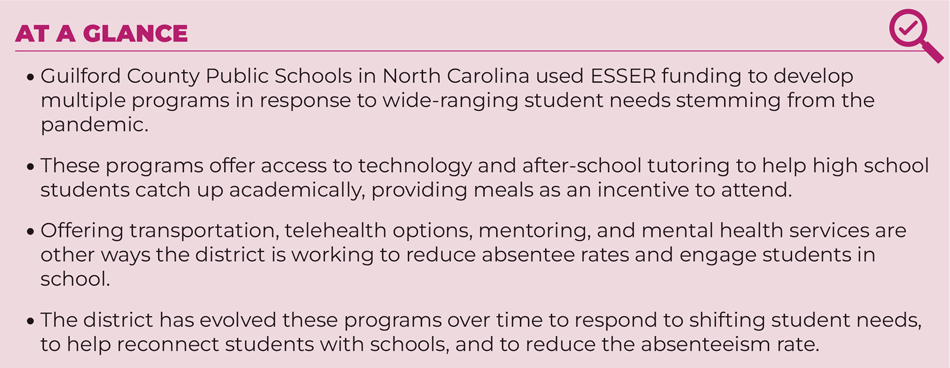
For the past two years, researchers from Northwest Evaluation Association (NWEA), American Institutes for Research’s National Center for Analysis of Longitudinal Data in Education Research (AIR-CALDER), and Harvard University have partnered with district leaders to assess the implementation and outcomes of Guilford’s efforts aimed at pandemic recovery, which were supported by the federal Elementary and Secondary School Emergency Relief Fund (ESSER).
Through this partnership, we interviewed senior district leaders, program administrators, school principals, teachers, support staff, and community members from across Guilford, which enrolls nearly 68,000 preK-12 students across 120 schools. As part of this work, we examined how the district has worked to improve student attendance and foster student engagement. Guilford has made small gains in reconnecting students with schools. Since resuming in-person schooling, Guilford’s chronic absenteeism rate declined from a high of 34.89% in 2021-22 to 31.05% in 2022-23.
We created seven key insights based on what we have learned from Guilford. Crucially, a common thread ties these insights together: Schools must work as “resource hubs” to meet shifting student needs. Schools have the opportunity and responsibility to offer a diverse range of resources, services, and supports that can strengthen ties between schools, students, and families, thereby improving student attendance and engagement.
Key Insight 1: Resources should evolve in response to student needs.
Initially, Guilford focused on locating students who were either chronically absent or who had not re-enrolled in school after the pandemic. District leaders hired an external vendor to execute an extensive outreach plan targeted at thousands of students. This plan included phone calls and written communication to families, home visits, and services such as tutoring and wraparound social supports.
Recognizing the immense challenge of locating students after they have disconnected from schools, Guilford decided to focus on prevention, aiming to build school-level capacity to encourage regular attendance and reduce absenteeism before it becomes chronic. With money from ESSER, Guilford has contracted with the nonprofit organization Attendance Works to help develop and implement core attendance plans in the 20 schools with the highest chronic absenteeism rates. These plans not only identify and provide supports to chronically absent students and families, but also include strategies to keep students at school (e.g., rewarding attendance, fostering inclusive school climates).
Guilford’s Learning Hubs, an after-school program implemented across the district’s 15 comprehensive high schools, offer a mix of academic, college- and career-readiness, and social-emotional programming, complemented by nutrition and transportation services. The idea of Learning Hubs originated from the connectivity hubs established during the pandemic to provide a structured and supportive environment with computers and high-speed internet access for high school students struggling with remote learning. As Guilford transitioned back to in-person instruction, the need for connectivity hubs diminished, so district leaders repurposed them to provide after-school support to the same students. The hubs began providing services such as tutoring, credit recovery, and social and emotional learning.
Notably, these hubs supported regular school attendance. Guilford’s internal analysis of data from the 2021-22 to 2023-24 school years shows a strong and statistically significant correlation between numbers of days students attend the Learning Hubs and school attendance. Students attending the hubs more often have fewer absences from school. Moreover, in focus groups at four Learning Hub sites, students shared that the hubs have helped them improve their grades and take more ownership and responsibility for their learning.
Key Insight 2: Distributing technology supports continuity in learning.
During remote instruction, Guilford, like many other school districts, distributed more than 80,000 digital devices and Wi-Fi hotspots to students, teachers, and other staff, and provided technology support to ensure students and staff could access remote learning. Guilford also deployed 124 “smart buses” to apartment complexes, mobile home parks, and other areas of the community that lacked broadband access so that students could learn online. Through the use of ESSER funds, each student in Guilford now has access to a digital device for learning.
When the district resumed in-person learning, schools continued to provide access to technology and online lessons so students could learn when they had to stay at home due to illness. This practice remains despite the relaxation of COVID precautions.
At the same time, Guilford educators are actively addressing lingering expectations among families and students that remote learning is a comparable alternative to in-person instruction. Research suggests that this misconception continues to contribute to student absenteeism and disengagement from school (Saavedra, Rapaport, & Silver, 2021). Guilford school leaders and staff have engaged with families to reset expectations, emphasizing that in-person instruction remains the primary mode of education in the district.
Key Insight 3: School nutrition can improve academic performance.
Food insecurity is a significant threat for many low-income families. During the spring of 2020, Guilford served approximately 34,000 meals daily. Like many school districts, Guilford has since transitioned from delivering nutrition to families outside of school during the pandemic to providing meals at school as an attendance incentive.
Meals are available during after-school programming geared toward improving academic performance, such as the Learning Hubs. School staff shared that providing students with different food options on occasion — “something that is not the cafeteria food” — helps attract kids to the Learning Hubs. For many students living in poverty, eating takeout from a fast-food restaurant every once in a while can be a luxury that makes all the difference in motivating a student to stay after school for small-group tutoring. Research shows that providing low-income students free meals can be a cost-effective strategy for improving attendance and achievement (Anderson, Gallagher, & Ritchie, 2018; Bartfeld, Berger, & Men, 2020; Schwartz & Rothbart, 2020).
Key Insight 4: Transportation reduces barriers.
Transportation has always been an attendance barrier, especially for low-income families that face inflexible work hours and lack reliable access to transportation (Edwards, 2023). Guildford’s leaders have sought creative solutions to ensure students have transportation to and from school. These solutions include purchasing more buses, hiring more bus drivers, offering bonuses to bus drivers, adjusting bus routes and schedules, and partnering with public transportation providers to provide free transit passes to students for attending school (both during and after the school day), and to keep bus drivers employed with Guilford.
During the pandemic, the district provided transportation to essential in-person services, such as special education and the connectivity hubs. With the return to in-person instruction, district leaders continued to leverage transportation to maximize student attendance. Providing transportation and informing families about options has helped increase student participation at school and in out-of-school programming, such as summer school and the Learning Hubs.
Key Insight 5: Telehealth services help keep students at school.
Guilford leaders partnered with Cone Health and the National Education Alliance to pilot a telehealth program in spring 2021. Over time, the district grew the program to serve 14 of the district’s Title I high-poverty schools in the 2023-24 school year. Guilford’s telehealth program aims to overcome health-related barriers that impede student attendance, such as frequent illnesses and lack of access to health insurance or health care.
The telehealth program allows students who feel sick while at school to virtually connect with a pediatrician or family medicine provider. Health care professionals can diagnose student illness and prescribe treatment on-site, often allowing students to return to class instead of going home. Consistent with Guilford’s experience, a recent study of school-based health care centers in rural North Carolina shows that telemedicine significantly lowers the likelihood of students being chronically absent (Komisarow & Hemelt, 2023).
Key Insight 6: Therapy and counseling help students cope.
Our conversations with Guilford leaders, school staff, and community members revealed a widely held belief that students cannot attend school regularly and learn effectively if they are grappling with mental health challenges and lack supportive relationships at school. While pandemic recovery initially focused on reacclimating students to in-person instruction and social norms, Guilford has since hired additional full-time mental health clinicians to provide direct mental health supports. The district also has created partnerships with health providers to offer access to teletherapy. During the 2023-24 school year, Guilford served more than 1,000 students in over 9,000 sessions.
Schools have the opportunity and responsibility to offer a diverse range of resources, services, and supports that can strengthen ties between schools, students, and families, thereby improving student attendance and engagement.
Guilford’s comprehensive approach to health care, addressing both physical and mental health, may be indispensable in improving attendance and engagement. A study on school-based health centers in high schools found that both medical and mental health services can support student attendance and engagement, with use of medical services more strongly associated with improved attendance and use of mental health services more strongly associated with increases in GPA (Walker et al., 2010). A growing body of evidence further suggests that school-based health centers can indirectly improve academic outcomes such as attendance by promoting students’ sense of connectedness to schools (Bersamin et al., 2019; Strolin-Goltzman et al., 2014).
Key Insight 7: Individualized academic support can motivate students.
Guilford used ESSER funding to rapidly expand programs, such as summer school and high-dosage tutoring, to provide students with personalized academic support to catch up on missed learning opportunities resulting from the pandemic. Through partnerships with North Carolina A&T State University, the University of North Carolina at Greensboro, and North Carolina EdCorps, Guilford offered tutoring to 12,000 students in the 2022-23 school year.
Extensive national evidence from pre-pandemic years suggests that summer school and tutoring can improve student achievement (Nickow, Oreopoulis, & Quan, 2020). Programs like tutoring give students the opportunity to form relationships with caring adults who, in turn, can offer regular social reinforcement and feedback to build student motivation and support students’ long-term academic success (Resnjanskij et al., 2021).
The future of schools as resource hubs
Navigating the challenges wrought by the pandemic has required a huge shift in how schools operate, and we believe Guilford’s model serves as an example. By evolving into resource hubs, schools have the potential to mitigate student absenteeism and foster stronger ties with students and families.
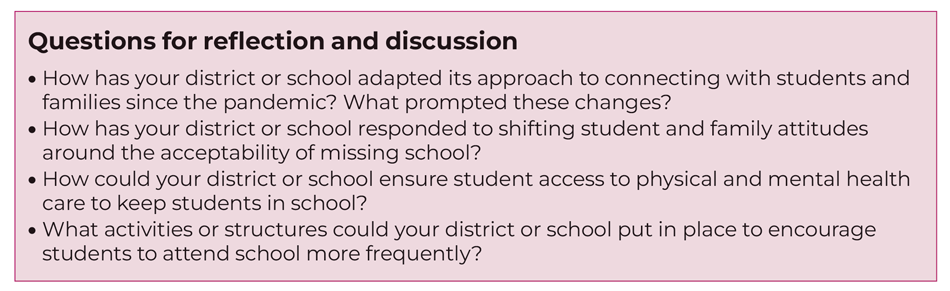
This approach may not fully bridge the gap for the students who are the most vulnerable and disconnected from schools. Indeed, families who take advantage of resource offerings at school could still be more privileged than families who do not (Kearney et al., 2024). Therefore, districts and schools must continuously refine strategies to ensure that all students have access to the support they need.
By capitalizing on the lessons learned during the pandemic and embracing a spirit of creativity and adaptability, school districts can emerge from the pandemic stronger and more resilient, ready to meet the evolving needs of students and families in the years ahead.
References
Anderson, M.L., Gallagher, J., & Ritchie, E.R. (2018). School meal quality and academic performance. Journal of Public Economics, 168, 81-93.
Bartfeld, J.S., Berger, L., & Men, F. (2020). Universal access to free school meals through the community eligibility provision is associated with better attendance for low-income elementary school students in Wisconsin. Journal of the Academy of Nutrition and Dietetics, 120 (2), 210-218.
Bersamin, M., Coulter, R.W., Gaarde, J., Garbers, S., Mair, C., & Santelli, J. (2019). School‐based health centers and school connectedness. Journal of School Health, 89 (1), 11-19.
Childs, J. & Lofton, R. (2021). Masking attendance: How education policy distracts from the wicked problem(s) of chronic absenteeism. Educational Policy, 35 (2), 213-234.
Dee, T.S. (2024). Higher chronic absenteeism threatens academic recovery from the COVID-19 pandemic. Proceedings of the National Academy of Sciences, 121 (3), e2312249121.
Edwards, D.S. (2023). Another one rides the bus: The impact of school transportation on student outcomes in Michigan. Education Finance and Policy, 19 (1), 1-31.
Golberstein, E., Wen, H., & Miller, B.F. (2020). Coronavirus disease 2019 (COVID-19) and mental health for children and adolescents. JAMA Pediatrics, 174 (9), 819-820.
Gottfried, M.A. (2014). Chronic absenteeism and its effects on students’ academic and socioemotional outcomes. Journal of Education for Students Placed at Risk (JESPAR), 19 (2), 53-75.
Kearney, C., Nidia Garza, A., Perez, L., Renzulli, L., & Domina, T. (2024). Offer it and they will come? An investigation of the factors associated with the uptake of school-sponsored resources. American Educational Research Journal, 61 (1), 145-176.
Komisarow, S. & Hemelt, S.W. (2023). School-based health care and absenteeism: Evidence from telemedicine. Education Finance and Policy, 19 (2), 1-31.
Lewis, K., Kuhfeld, M., Langi, M., Peters, S., & Fahle, E. (2022). The widening achievement divide during COVID-19. NWEA Center for School and Student Progress.
Nickow, A., Oreopoulos, P., & Quan, V. (2020). The impressive effects of tutoring on prek-12 learning: A systematic review and meta-analysis of the experimental evidence (working paper). National Bureau of Economic Research.
Resnjanskij, S., Ruhose, J., Wiederhold, S., & Woessmann, L. (2021). Mentoring improves the labor-market prospects of disadvantaged adolescents. CESifo Forum, 22 (4), 38-43.
Saavedra, A., Rapaport, A., & Silver, D. (2021). Why some parents are sticking with remote learning even as schools reopen. Brookings Institution.
Schwartz, A.E., & Rothbart, M.W. (2020). Let them eat lunch: The impact of universal free meals on student performance. Journal of Policy Analysis and Management, 39 (2), 376-410.
Strolin-Goltzman, J., Sisselman, A., Melekis, K., & Auerbach, C. (2014). Understanding the relationship between school-based health center use, school connection, and academic performance. Health & Social Work, 39 (2), 83-91.
Walker, S.C., Kerns, S.E., Lyon, A.R., Bruns, E.J., & Cosgrove, T.J. (2010). Impact of school-based health center use on academic outcomes. Journal of Adolescent Health, 46 (3), 251-257.
Weathers, E.S., Hollett, K.B., Mandel, Z.R., & Rickert, C. (2021). Absence unexcused: A systematic review on truancy. Peabody Journal of Education, 96 (5), 540-564.
This article appears in the November 2024 issue of Kappan, Vol. 106, No. 3, p. 19-22.

ABOUT THE AUTHORS

Ayesha K. Hashim
Ayesha K. Hashim is a senior research scientist at Northwest Evaluation Association (NWEA).

Clark Wright
Clark Wright is the interim director of performance and accountability at Guilford County Schools, Greensboro, NC.

Sonya Stephens
Sonya Stephens is the interim chief of staff at Guilford County Schools, Greensboro, NC.

Miles Davison
Miles Davison is a research scientist at Northwest Evaluation Association (NWEA).