In this week’s newsletter: Three weeks after Hurricane Helene, many schools remain closed or disrupted. Trauma from the experience (which killed four children) may affect students for much longer.* A New York Times story delves into a botched school AI experiment. How the Washington Post and others cover school shootings actually encourages more violence, says a journalist and professor. A brave ed reporter explains why she’s on TikTok. And an AP Stylebook change you’ll want to know about.
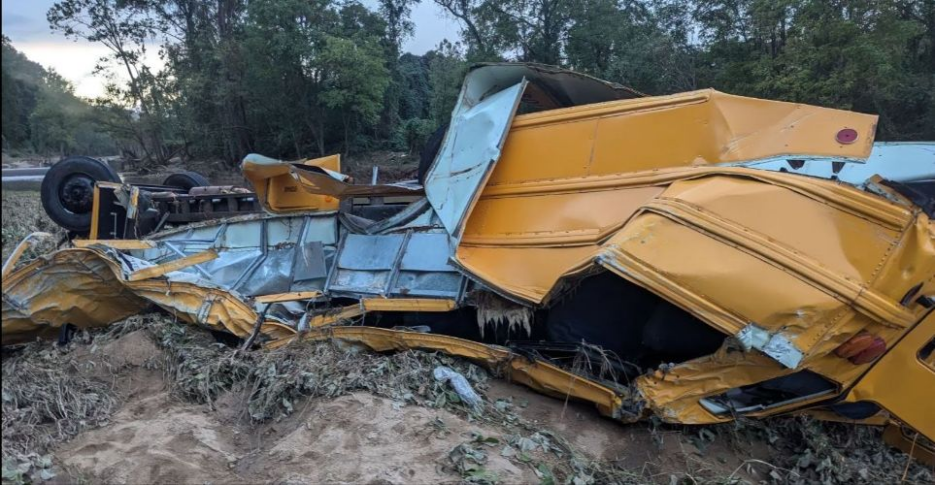
Above: A school bus swept away by the storm in McDowell County, North Carolina.
HURRICANE TRAUMA*
The big education story of the week
The big education story of the week is the prolonged educational disruption and trauma that students, families, and schools are facing in the wake of hurricanes Helene and Milton.
In Florida, many students returned to school over the last few days — a week after Milton (Tampa Bay Times, Today, US News). In North Carolina, some students will have missed up to a month of school (AP, NBC News). Some schools still aren’t sure when they’ll reopen, are only opening for half days, or are relocating kids to different schools to fix buildings that were damaged (WLOS, Citizen Times, WUNC, NPR).
Even after students return to school, the consequences of trauma from the storm and closures will remain (Chalkbeat, USA Today). In Buncombe County, North Carolina, four school-age children were killed (Asheville Citizen Times, WXII).
Hurricane season is over at the end of November, but I hope education reporters will stick with this story in the coming weeks and months. It’s likely to repeat as climate change intensifies.
*Correction: The original version of this email indicated that hurricane season was almost over, but it actually doesn’t end until the end of November. Thanks to an eagle-eyed reader for catching the mistake.
Other big education stories this week include ongoing absenteeism and enrollment declines (with some boosts from immigrant students), school closures in Pittsburgh, and education issues on the ballot heating up as the election nears. Check out @thegrade_ for daily headlines!
WHEN AI MAKES THINGS WORSE
The best education journalism of the week
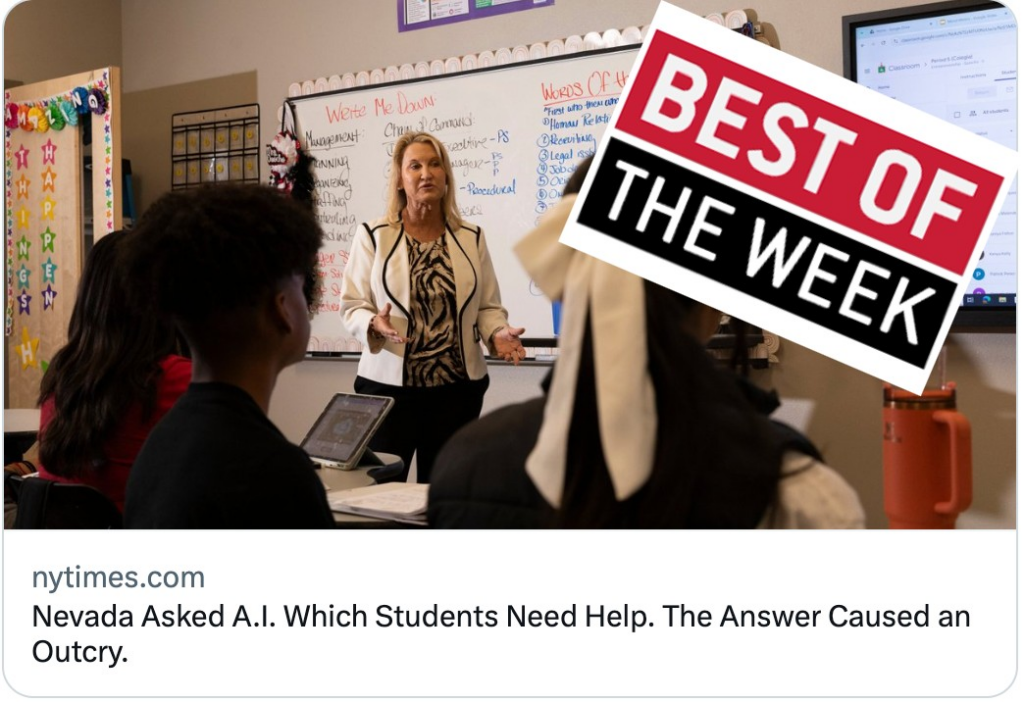
The best education journalism of the week is Nevada Used A.I. to Find ‘At-Risk’ Students. Numbers Dropped by 200,000 by the New York Times’ Troy Closson.
Over the past two years, there’s been no shortage of optimistic-seeming journalism about AI in schools. So it’s great to see this piece examining Nevada’s ill-considered decision to use AI to identify students at risk of falling behind in school.
The system ended up dramatically reducing the number of kids identified as at-risk students from more than 270,000 in 2022 to fewer than 65,000 last year. That forced many schools to slash budgets in the face of reduced state funding.
Closson offers readers several vivid examples of exactly what kinds of mistakes the AI made. In one case, the AI found no at-risk students at a Henderson, Nevada, school that enrolls more than 250 low-income students, a dozen of whom are homeless. “It was a shock,” says the school principal. “We still don’t truly know how it works.”
The founder of Infinite Campus, the state’s AI vendor, told the Times that its model is trained on several years’ worth of student data, but that its methods are proprietary. It removed race, gender, and birth country as factors this year under political pressure. “We’re trying to bring accurate data to the table,” Mr. Kratsch said, and then allow states “to decide what to do with that.”
Education news consumers don’t have to search hard to find credulous AI stories. So Closson’s narrative is refreshing for laying out just what can go wrong. I only wish The Times was more transparent, telling readers more about its reporting and giving credit to outlets like Education Week and New America, which have previously rung alarm bells over Nevada’s efforts.
Other education stories of the week we liked include low uptake of vouchers by working-class Arizona families (ProPublica), a half-hearted effort to defend a graduation exam in Massachusetts (Boston Globe), a peek inside a Houston middle school making big gains (Houston Landing), school choice on the ballot in three states (Stateline), and schools as polling places (NPR).
COPYCAT EFFECT
Our latest columns and commentary
Journalists covering school shootings like the recent one at Apalachee High School think they’re doing the right thing.
But in this week’s new column, journalist and professor Amanda J. Crawford reminds us that the coverage often gives shooters the notoriety that they want — and actually encourages other students to follow suit.
It’s entirely possible to cover school gun violence without naming the shooter, writes Crawford, whose book on mass shootings and the media is forthcoming.
But too many outlets name school shooters and seem to assume that their coverage will help prevent future tragedies — when that’s clearly not the case.
PEOPLE, JOBS, & EVENTS
Who’s going where and what’s happening
📰 Career moves: Former Forbes breaking news reporter James Farrell has replaced Ann Doss Helms on the education beat at WFAE. Recent grad Nadia Scharf is the new Green Bay Press-Gazette education reporter. And co-founder of Inside Higher Ed Doug Lederman says he’s leaving, just a year after co-founder Scott Jaschik announced his retirement.
📰 Impact: Schools in Houston have written new policies to prevent illegal suspension of unhoused students after a May investigation from Houston Landing’s Asher Lehrer-Small. Press Forward is awarding $20 million to 205 small local newsrooms across the country, including many that report on schools. Among the grantees are several university student newspapers; The Bell, which gives high school student journalists a platform to tell audio stories; and Epicenter NYC, founded by former Spencer Journalism fellow S. Mitra Kalita, who says she’s excited to be able to produce “coverage of NYC schools that actually centers and serves the majority of the children within” (including community engagement and Spanish-language content).
📰 Resources: In case you missed it, the AP Stylebook updated its guidance on the words “juvenile” and “minor,” saying the terms can be dehumanizing and “perceived as having racial connotations.” Instead, use words like “child” or “teenager.” The Journalist’s Resource shared some key columns that help journalists better understand academic research methods like polls and surveys — especially important in the run-up to the election.
📰 Research: A Pew Research Center survey shows that most Americans believe schools should ban cell phones during class. A Brown University and University of Virginia study found that the effectiveness of tutoring programs decreases as they scale up (Commonwealth Beacon). A KIDS COUNT report revealed that race and sexual orientation are factors in rates of depression among Rhode Island youth (RI Current). In Connecticut and Milwaukee, different surveys show that less than half of parents are satisfied with their children’s schools (CT Mirror, Milwaukee Journal Sentinel).
📰 Sound-off:
- “The entire premise of the article is deeply flawed,” says EdFund executive director Rebecca Sibilia about a Reuters story about immigrant students.
- A recent Forbes article might have been “the single dumbest thing I’ve read on AI in education this year,” according to education entrepreneur Benjamin Riley. “Which is saying something.”
- “I’m kind of operating with an ‘if you build it, they will come,’ mentality,” brave reporter Mandy McLaren of the Boston Globe tells us. She’s one of the few ed reporters we know who are actively on TikTok for work.
THE KICKER
We saved the best for last

At least they finally updated their banner image, right?
That’s all, folks. Thanks for reading!
Reply to this email to send us questions, comments or tips. Know someone else who should be reading Best of the Week? Send them this link to sign up.
Using Feedly or FlipBoard or any other kind of news reader? You can subscribe to The Grade’s “feed” by plugging in this web address: http://www.kappanonline.org/category/the-grade/feed/.
Read more about The Grade here. You can read all the back issues of The Grade’s newsletter, Best of the Week, here.
By Alexander Russo with additional writing from Colleen Connolly.