
The Center for Education Policy’s Civic Summit model fosters understanding and seeking common ground on complex and contentious education issues.
We live in polarized times. At the local, state, and national levels, our politics have become increasingly divisive — especially, it seems, when it comes to our public schools. As a result, the idea of common ground in matters of education policy can feel almost naively old-fashioned.
Yet dialogue, listening, and compromise are essential elements of living in a democracy. That’s because political legitimacy requires more than a slim partisan majority. Solutions with staying power are the ones that everyone can understand and live with, however unenthusiastically. Moreover, the idea of democracy as a mechanism for solving shared problems presumes that the best answers reflect the fullest range of perspectives.
How, then, can we foster consensus-oriented practices in an era of extreme partisanship, especially as it pertains to how we design, support, and sustain our public schools? Disagreement is inevitable and often productive, but only if people are willing to hold less rigidly to their positions and leave room for understanding others’ views. Even if we continue to differ in our opinions, is it possible to establish common ground when it comes to how best to educate our children in and for democracy?
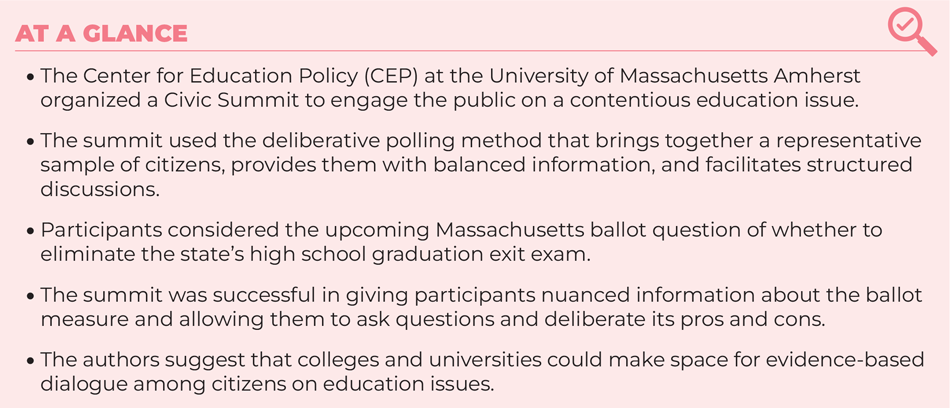
The Center for Education Policy (CEP) at the University of Massachusetts Amherst reinvented itself in 2023 to focus on strengthening preK-12 schooling and higher education through democratic decision-making and the use of evidence. In keeping with that mission, the CEP adopted a modified version of deliberative polling as a signature approach. Deliberative polling is a method used to gauge public opinion on complex issues by bringing together a representative sample of citizens, providing them with balanced information, and facilitating structured discussions.
With a contentious debate emerging in Massachusetts around a ballot question that proposes removing the state’s de facto high school exit exam, the CEP organized a Civic Summit to engage the public on the issue. The chance to deliberate over a complex issue helped participants determine how they wanted to vote. It also fostered curiosity and the kind of nuanced understanding we should be striving for in public decision making.
A divisive question
Massachusetts is one of nine states that currently require high school students to pass comprehensive standardized tests to receive their diplomas. Policy makers created the Massachusetts Comprehensive Assessment System (MCAS) under a 1993 education reform law that sought to boost school performance and increase accountability. The first MCAS tests were administered several years before No Child Left Behind made such testing mandatory in all 50 states, and they became a high school graduation requirement in 2003.
Today, students must pass MCAS exams in English language arts, math, and science. Students who do not pass can retake the exams up to five times, and an appeal process is available. However, approximately 1% of students — roughly 700 each year — are denied a diploma based on their test scores. One-third of students who drop out of high school have not achieved the minimum score required for graduation.
In fall 2023, the Massachusetts Teachers Association (MTA) led a signature-collecting campaign seeking to eliminate this de facto high school exit exam. The Massachusetts Office of the Attorney General (n.d.) summarized the proposed law that will be on the November 2024 ballot:
Under this proposed law, to satisfy the competency requirement for high school graduation, students would either be required to achieve a minimum score on the Massachusetts Comprehensive Assessment System (MCAS) (or other statewide or district-wide assessments) or be required to satisfy school or district requirements for class credits, grades and attendance.
This proposed law would still require students to take the MCAS in the tenth grade, and those students who do not achieve a minimum score would be required to take the test a second time (in either the eleventh or twelfth grades). Students who enter Massachusetts schools in the eleventh or twelfth grades would only be required to take the MCAS one time.
This proposed law would allow former students who were denied their high school diplomas solely due to poor MCAS performance to request and receive their high school diplomas if they previously satisfied school or district requirements for class credits, grades and attendance.
This proposed law would prohibit any information about a student’s MCAS performance from being included on the student’s official high school transcript without the student’s written permission.
Opposing sides form
By December, the MTA had gathered over 135,000 signatures — nearly double the number required to place a question on the ballot. Soon, opponents of the effort, including the Massachusetts Business Alliance for Education and former state secretary of education Paul Reville, began making the case for maintaining the MCAS graduation requirement. The exam-based competency determination, they argued, was the only consistent graduation requirement across all districts and guaranteed employers that job applicants with high school diplomas possessed certain basic academic skills. Opponents, including the Massachusetts Taxpayers Foundation, also maintained that the graduation requirement served as a protection against social promotion.
Supporters of the effort to remove the requirement, including leaders of the MTA, pointed out that while the test may assess content knowledge and skills outlined in state curriculum frameworks, it does not address other competencies that are equally important for success in college, career, and civic life. They also identified a range of troubling unintended consequences, like a narrowing of the curriculum and an increased focus on test preparation. Moreover, they made the case that the use of MCAS as a high school exit exam leads to the disproportionate denial of diplomas to students of color and students from low-income households (Massachusetts Teachers Association, n.d.).
Clear camps soon emerged. As that happened, evidence began to give way to rhetoric that reduced the issue to political quotes and sound bites. Each side accused the other of “harming” students and engaging in “backward” thinking.
Supporters of the measure, such as Citizens for Public Schools, appealed to the public’s emotions by proclaiming that students and teachers have “been deeply harmed” by the MCAS and that removing the graduation requirement would end “the painful, destructive era of test-blame-shame-and-punish” (American Federation of Teachers Massachusetts, n.d.).
Opponents also employed accusations of “harm.” Repealing the MCAS graduation requirement, they argued, “would absolutely be antithetical to 30 years of education reform, and harm students every year who are struggling to graduate from high school” (Lisinski, 2024a). Invoking crisis rhetoric, opponents warned that the measure would dismantle years of progress, calling it “a giant leap backwards in education policy” and a “misguided attempt to weaken our state’s educational standards” (Lisinski, 2024b; Zokovitch, 2024).
Some public discourse was misleading. In March 2024, Massachusetts Gov. Maura Healey weighed in, saying, “We need to be able to assess how our young people are doing. So I do not support getting rid of MCAS” (Young, 2024). The problem with Healey’s statement? Removing the MCAS — the state standardized test taken by students in grades 3-8, as well as by 10th graders — is not part of the referendum. Recognizing that federal law requires standardized testing at those grade levels, the MTA was explicit that its effort would only end the use of the MCAS high school exams as a graduation requirement. Still, opponents of the ballot question had succeeded in fostering confusion about its details and purpose.
A deliberative approach
The godfather of the deliberative poll is Stanford University’s James Fishkin, who first started experimenting with the idea in 1988 as a way of deepening democratic engagement. As he put it:
Most citizens don’t take the time to become anything like ideal citizens or informed citizens. So in a way, this is a way of asking, “What if they did? How would democracy be different?” It turns out it would be very different (De Witte, 2021).
The classic deliberative poll brings together typical members of the public, cultivates an information-rich environment, and has them weigh in on relevant issues. Here’s how the Stanford Deliberative Democracy Lab (n.d.) defines it:
Deliberative Polling is an attempt to use public opinion research in a new and constructive way. A random, representative sample is first polled on the targeted issues. After this baseline poll, members of the sample are invited to gather at a single place for a weekend in order to discuss the issues. Carefully balanced briefing materials are sent to the participants and are also made publicly available. The participants engage in dialogue with competing experts and political leaders based on questions they develop in small group discussions with trained moderators. Parts of the deliberative events are often broadcast on television, either live or in taped and edited form and/or through social media and other mediums. After the deliberations, the sample is again asked the original questions. The resulting changes in opinion represent the conclusions the public would reach if people had the opportunity to become more informed and more engaged by the issues.
When done well, deliberative polling promotes informed decision-making because it provides participants with balanced information about complex issues. Further, it gives attendees a chance to voice their opinions and engage in discussion with other citizens. Structured conversations rooted in evidence foster understanding and promote common ground. And even when participants continue to disagree, the process legitimizes the kind of pluralism characteristic of a diverse and healthy democracy.
There are potential drawbacks and limitations to deliberative polling. It requires a lot of resources, and it can succumb to selection bias and underrepresentation of specific perspectives — particularly if the event organizers have a vested interest in the issue. But there are ways to adapt a deliberative poll to minimize the demands on organizers. And if produced with careful attention to viewpoint diversity, even an imperfectly designed event can yield valuable benefits.
The CEP Civic Summit
The event itself wasn’t without hiccups. Approximately 90 individuals registered through Eventbrite and ultimately 50 came to campus in March of 2024 for the event. Although we recruited widely, the audience skewed white and primarily liberal — in keeping with the demographics of Massachusetts in general and the western portion of the state in particular. Though we gave clear instructions, only about two-thirds of attendees (33) completed both the pre- and post-event polls. A larger number (42) completed a written exercise in which they identified reasons for keeping or dropping the MCAS graduation requirement.
Nevertheless, our summit captured the spirit of a longer deliberative polling procedure in just under two hours. We saw clear evidence that the approach helped people sort through an otherwise contentious issue.
Upon arrival, attendees received an ID number and took an anonymous initial baseline poll. They then entered the auditorium, where they were given a two-page fact sheet
(www.umass.edu/education/media/4341/download?inline) on the use of MCAS exams as a graduation requirement and the ballot initiative. They listened to and considered the expert opinions of four panelists: the president of the Massachusetts Teachers Association (who supports the ballot initiative); a current member of the state Board of Elementary and Secondary Education (who opposes the initiative); a local high school principal; and a national expert in test design. Panelists had two minutes each to respond to a series of questions posed by CEP staff. After the panel, attendees had an opportunity to debrief with summit organizers, each other, and the expert panelists. As attendees were leaving, they were again polled on their views.
The outcomes
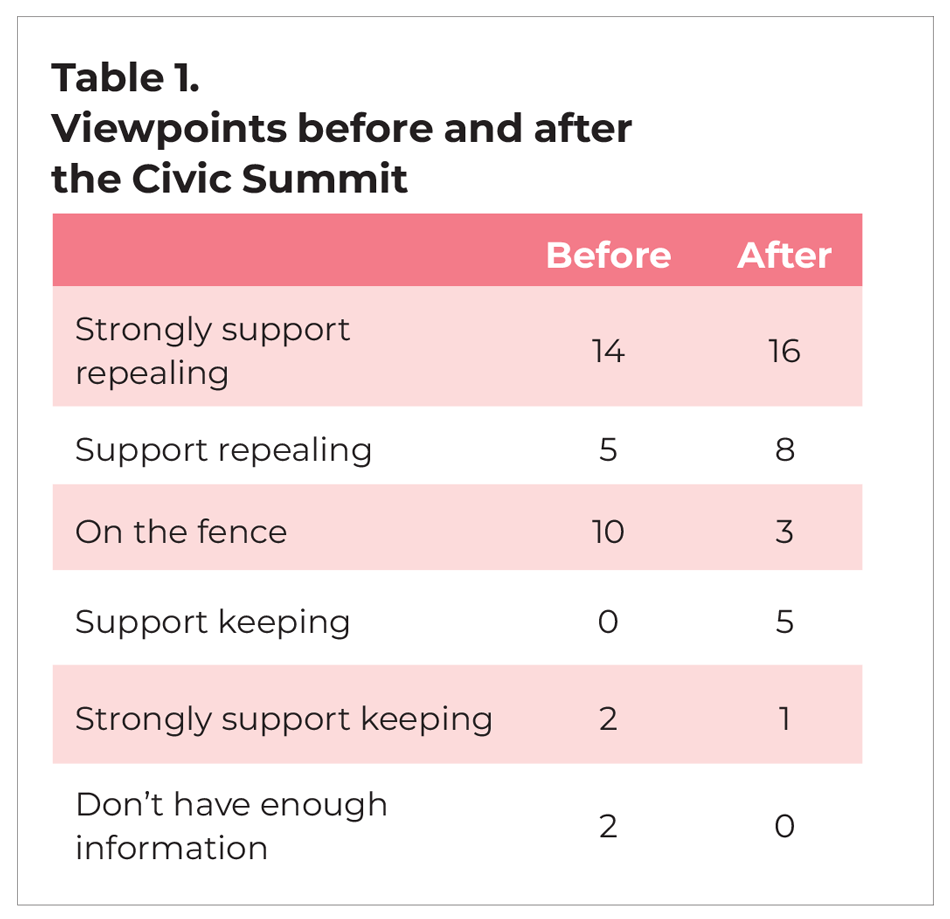
If the summit worked as it was designed to, participants would leave feeling more informed about the issue and gain a deeper understanding of others’ views. In practice, that meant participants who initially identified as being “on the fence” or who responded “don’t have enough information” would move toward firmer stances on the issue. Additionally, we would expect all participants to come away with more nuanced views.
Regarding the former of those outcomes — people moving off the fence — that’s exactly what we saw (Table 1). Roughly 40% of participants changed their positions after the forum, while the remaining 60% maintained their original stances. Importantly, participants who initially reported being “on the fence” or not having enough information were the most likely to change their stances, accounting for the majority of position changes.
We also saw evidence of our other hypothesized outcome — more nuanced views. At the end of the event, participants were asked to identify compelling arguments for and against the ballot initiative. To our surprise, all of them — even those who strongly supported maintaining the MCAS graduation requirement — identified reasons for removing it. In turn, the majority of participants (76%) also identified compelling reasons to keep the graduation requirement, even if they strongly felt that it should be removed. Given the polarizing discourse around this topic, we found it remarkable that so many participants were able to identify compelling reasons to support the opposing viewpoint.
Our analysis of written comments from participants identified themes that went far beyond political slogans. The most prominent reasons for maintaining the requirement included:
- Resisting social promotion, especially for students who may need additional support.
- Maintaining consistency and standardization across school districts.
- Preserving accountability in the system.
The most common reasons for removing the requirement included:
- Disproportionate effects on students of color and students from low-income households.
- Unintended consequences like a narrowing of the curriculum.
- Time devoted to test preparation and testing rather than learning.
Although the topic of the Civic Summit — the impact of high-stakes testing — can be polarizing, participants were sincere and engaged during the event. After the panel session, they asked questions on a wide range of related topics, including curriculum, psychometrics, alternative forms of assessment, and implications for English learners. Even participants who ultimately maintained their initial positions shared that they “gained a much more nuanced perspective” and “enjoyed the dialogue.”
While deliberative polling ideally occurs over multiple days, our Civic Summit lasted only two hours. But even with a relatively short time and limited budget, participant feedback suggests that the summit fostered constructive debate and dialogue. Despite intense discussion about a contentious issue, there were no expressions of hostility, condescension, anger, or antagonism. People were permitted to be curious, and they felt no pressure to change or adopt any particular point of view.
Creating centers for deliberation
Recent years have seen deepening “us versus them” attitudes in the U.S. An increasing number of political leaders and citizens have come to view those with differing opinions as villains. This has been especially true in education, with polarized discourse undermining the social trust necessary for sustaining public schools and American democracy.
How, then, can we make space for evidence-based dialogue? Where can we model the kinds of compromise and cooperation necessary for working through our policy differences? And what, if anything, can we do to carve out some common ground upon which our public institutions depend?
Where can we model the kinds of compromise and cooperation necessary for working through our policy differences? And what, if anything, can we do to carve out some common ground upon which our public institutions depend?
Our work suggests to us that colleges and universities have an important role to play here — as safe environments in which to practice democratic discourse, develop democratic skills, and shape civic consciousness. Public universities, particularly, should embrace the work of fostering the use of evidence, the spirit of inquiry, and the exchange of perspectives. UMass Amherst, for instance, is presently communicating a commitment “to promoting the exercise of free speech and nurturing discussions that foster empathy, broaden perspectives, and diminish polarization.” This is particularly salient for colleges of education, given widespread interest and engagement in public schooling.
Colleges and universities, of course, can’t solve all our political problems by organizing deliberative experiences. Yet by stepping into such work, they can do a great deal to foster public understanding. Moreover, at a time when many wonder what taxpayers get in return for their support of public higher education, institutions like ours can make clear the ways in which they are living out their missions.
References
American Federation of Teachers Massachusetts. (n.d.). Dozens testify in support of Thrive Act—Take Action Today.
De Witte, M. (2021, Feb. 4). Could deliberative democracy depolarize America? Stanford scholars think so. Stanford News.
Lisinski, C. (2024a, March 4). Proposal to remove MCAS scores as graduation requirement sparks heated debate. NBC Boston.
Lisinski, C. (2024b, March 5). State legislators leery of ballot question ending MCAS graduation requirement. Daily Hampshire Gazette.
Massachusetts Office of the Attorney General. (n.d.). 23-01 Summary: An Initiative Petition for a Law to Remove MCAS Performance as a Condition for H.S. Graduation.
Massachusetts Teachers Association. (n.d.). Get the facts: One-pager on the ballot initiative to remove the MCAS graduation requirement.
Stanford Deliberative Democracy Lab (n.d.). What is deliberative polling?
Young, C.A. (2024, March 20). Gov. Healey opposes ballot question to eliminate MCAS graduation mandate. NBC Boston.
Zokovitch, G. (2024). MCAS ballot question passed over for legislative approval, on track to go to voters in November. Boston Herald.
This article appears in the October 2024 issue of Kappan, Vol. 106, No. 2, p. 34-38.

ABOUT THE AUTHORS

Brendan Sheran
Brendan Sheran is a doctoral student at the University of Massachusetts Amherst and an associate researcher at the UMass Center for Education Policy.

Ashley J. Carey
Ashley Carey is an assistant professor in the Farrington College of Education and Human Development at Sacred Heart University, Fairfield, CT.

Jack Schneider
Jack Schneider is the Dwight W. Allen Distinguished Professor at the University of Massachusetts Amherst and director of the UMass Center for Education Policy.

Rebecca Woodland
Rebecca Woodland is a professor at the University of Massachusetts Amherst and an associate director of the UMass Center for Education Policy.

Kathryn McDermott
Kathryn McDermott is a professor at the University of Massachusetts Amherst and an associate director of the UMass Center for Education Policy.