A few days ago, some of my Facebook friends got into a conversation about the teaching of cursive in school. It’s a conversation that comes up periodically among my Facebook friends (and I suspect yours, too). Those of us old enough to have worked our way through multiple handwriting workbooks have a lot of opinions about what the possible demise of cursive says about our schools, our children, and ourselves.
For the most part, the people in this conversation were courteous and reasonable, exchanging witticisms about having a secret code kids can’t understand and discussing what constitutes a valid signature. However, one part of the conversation stuck out to me, considering this issue’s theme.
The person who started the conversation said that not teaching cursive is a sign that schools are teaching less. It was a quick introductory remark that no one had picked up on because they really wanted to debate the merits of cursive writing. But then an actual educator entered the chat. She pointed out that schools are not in fact teaching less, that they’re being required to teach more content than ever. With that being the case, cursive is the thing that some schools decide to let go.
Any educator knows that schools are asked to do a lot, and sometimes good things must be left by the wayside in favor of essential things. Those outside education, however, are not always aware of these tough choices. They have a sense of things, from observing what their kids are doing, what their neighbors’ kids are doing, and what they see on the news. But it’s educators who really know what’s up.
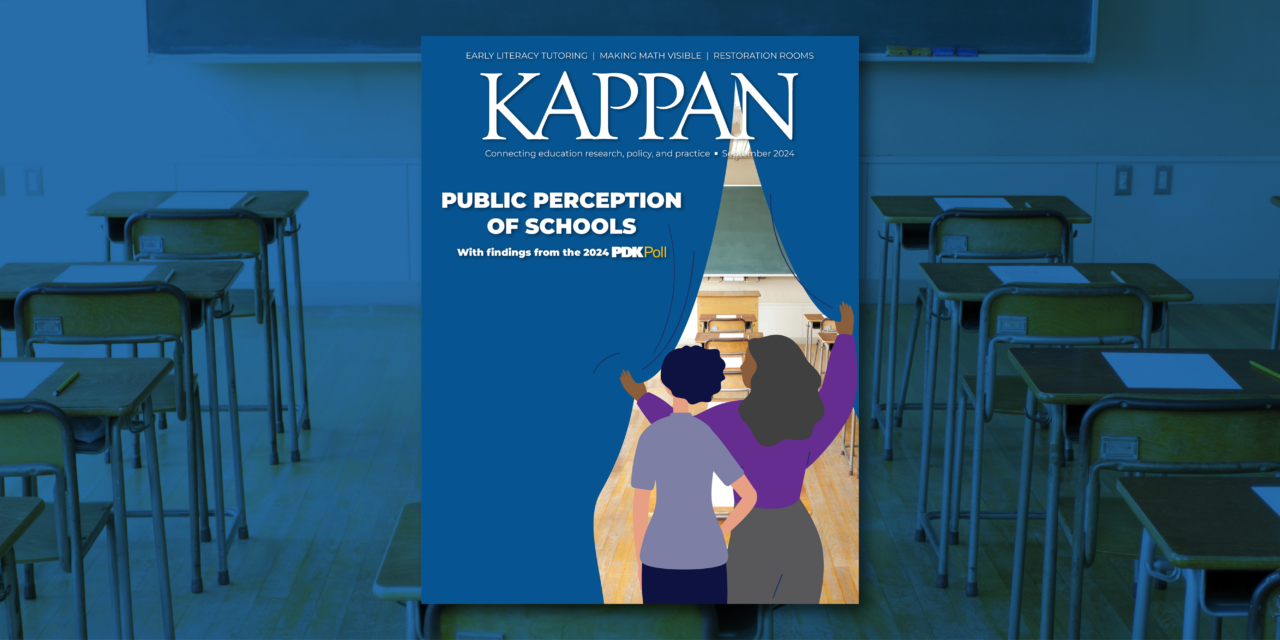
This issue of Kappan delves into what the public actually thinks about schools. It includes results from the 2024 PDK Poll, which finds broad public support for federal involvement in numerous education priorities. But it also finds that only a small sliver of the public has attended a school board meeting in the last year. People have a lot of ideas about education, but they don’t necessarily take the time to understand how the system works.
Researchers at the University of Southern California have been studying public understanding of education for the past few years. In this issue, Amie Rappaport and Anna Saavedra share some of their findings, which show the public doesn’t really know what’s taught in schools, how decisions are made, or what certain hot-button issues might mean for schools. People may have strong opinions, but they aren’t built on a strong foundation of information.
Mark Hlavacik and Jack Schneider describe in this issue how national headlines about failing schools make their way into local news stories, but often with a little more nuance. When stories focus on individual schools, crudely drawn caricatures become a lot less convincing. Rappaport and Saavedra explain that giving people more information about certain education dilemmas can change their views. I wonder, for example, how someone who thinks schools that no longer teach cursive are being derelict in their duties would respond if given a list of all the new things schools had to fit into the curriculum since they were in school.
Interestingly, as University of Southern California researchers point out in this issue, personal experience in schools is the biggest driver of public opinion about what schools should teach. For many people, that personal experience is in the past. The PDK Poll found that less than half of Americans have attended a school event, made a donation, or attended a PTA or school board meeting in the last year. If the public isn’t connected to public schools, then schools need to connect to them. That’s what Kappan’s managing editor Kathleen Vail found when she spoke to multiple experts about how the public conversation about education is affecting the teaching profession. Making these connections is another responsibility on educators’ already full plates, but maybe it’s one with long-term benefits for everyone.
This article appears in the September 2024 issue of Kappan, Vol. 106, No. 1, p. 4.

ABOUT THE AUTHOR

Teresa Preston
Teresa Preston is an editorial consultant and the former editor-in-chief of Phi Delta Kappan and director of publications for PDK International, Arlington, VA.
Visit their website at: https://prestoneditorial.com/