Journalists shut out of schools and classrooms shouldn’t give up, say the journalists behind Poynter’s recent “Shut Out” report, who suggest ways to get around access obstacles.
By Alexander Russo
Lack of access is the lament of nearly every education reporter I talk to — especially when it comes to schools and classrooms. Access limitations increased during the pandemic and have been extended since.
That’s why The Grade has published several articles about the importance of firsthand observations and how to work around them.
Lack of access is enormously frustrating, but it’s no excuse for giving up on offering readers a firsthand look inside schools or ignoring what’s going on in classrooms. APM Reports’ Emily Hanford and former Boston Globe reporter Jenna Russell are just two examples of journalists who overcame being shut out and produced great stories.
That’s what makes Poynter’s recent “Shut Out” report so important — in particular Part Three, titled “When physical barriers get in the way.”
Curious about lessons for education journalists to glean, I emailed and spoke with Poynter’s Fernanda Camarena and Mel Grau, two of the main authors behind the report.
As you’ll see, they describe the importance of journalists building new source relationships, collaborating with other newsrooms, making clear with readers when access is being denied, and — most of all — avoiding the instinct to accept officials’ efforts as insurmountable obstacles.
“What we’re saying here is a recommitment to the core principles of journalism,” Camarena told me in a phone interview. “If we’re not getting answers in the ways that we’re doing our journalism, we need to go back and really look at how it’s been successful.”
Conducted by phone and online, this interview has been edited and condensed.

Above: Poynter report explores how journalists can respond to access restrictions.
Where do schools and education come up in your new report — or in the background reporting process that led to it?
Mel Grau: A few education examples of the issues of access that came up in our reporting include Pittsburgh Public Schools and other entities in Allegheny County, which [as noted in the report] “still held their public meetings exclusively online until December 2023 — more than two years after the law allowing virtual meetings of public agencies expired. Sometimes the school board itself would meet in person, but the doors were still closed to the public, offering no options for impromptu questions or comments.”
There were also several school-related articles reviewed during our reporting process, including Media outlets sue Denver Public Schools for records from closed meeting, Louisville Public Media files lawsuit against JCPS seeking top officials’ communications during bus meltdown, and ‘They keep threatening to arrest us.’ The obstacles facing local news in Uvalde.
This is not from the report, but I always think about education reporter Scott Travis at the Sun Sentinel. I made this video of him and his team and the work they did to investigate the school board after the Parkland shooting. They came up against records denials time and again but got lucky that a redacted version of the report was done poorly. This just shows the impact of never giving up as a reporter.
When it comes to working around access denials, what are some of the things that you learned or heard about that education journalists could consider trying?
Fernanda Camarena: We give a great emphasis on building new source relationships. The alternative for not being able to access the school is to see where the community is, to find the ecosystem outside the classroom that would shed light into what’s happening in it. So talk to the community. Create opportunities with people. Be very intentional about it. We can be a little bit more creative, but we need to be intentional about it.
What’s that mean, “being intentional” about source development?
Fernanda: Being intentional means that newsroom managers take the time to understand their reporters’ needs and support them in their efforts. It might mean giving reporters a little bit more extra time so they can go out and find new sources, taking some existing work off of a reporter’s plate, and letting reporters follow their instincts. Or it could mean writing an editorial about the access problems that the reporters are experiencing.
The alternative for not being able to access the school is to see where the community is, to find the ecosystem outside the classroom. – Fernanda Camarena
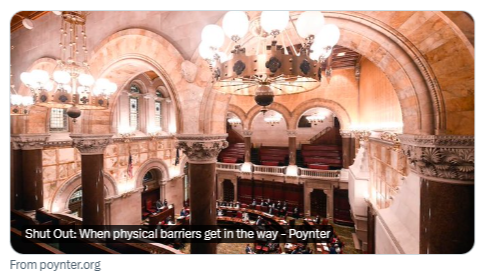
Above: “A community member might be able to enter, take notes, record audio, or even ask questions on a journalist’s behalf,” suggests The Tampa Bay Times’ Justin Garcia in the report.
How can renewed efforts at source development help education reporters produce stronger stories — even without firsthand access to school buildings?
Fernanda: We have to think of more than one way to tell the story. Not one single person should hold all the answers and not one single place should be the source to gather information. Expanding our network and developing better and stronger sources will not only make our journalism stronger, but also give us more ways to gather information that might otherwise be missed. Source development can have a long ripple effect and can take many forms.
Education reporters can expand sources in many ways. There are many families in a given school that experience what is happening inside the classrooms. Not only are parents plentiful and easily identifiable, but they also care deeply, have a lot at stake, and understand the dynamics and what the best for their children.
As journalists we have to be able to articulate to the parents what happens when information is guarded. We have to make sure the audience understands the implications of journalists not being able to hold power accountable. A source’s refusal to provide answers to a journalist is essentially a refusal to provide answers to the community. Journalists should publicize that it is not about us, but rather, it is about the community not being well informed and what that does to democracy.
What do you think about reporters working with students, parents, and other non-journalists to document what’s going on behind closed doors, like former Boston Globe reporter Jenna Russell did?
Fernanda: If the students were minors, a reporter would need to get permission from their parents. And they would need to be able to verify the information that’s being provided. There’s also the issue of risk to the vulnerable source, balancing that against a reporter’s primary loyalty to tell the story and to readers.
What tricks and strategies should education journalists learn from reporters in sports and entertainment, whom your report notes have “long dealt with tightly controlled physical access to their sources and strict rules of engagement”?
Fernanda: Access within that world is also much more controlled than it used to be. With direct access to athletes more limited than ever, today sports reporters often focus more on developing sources “around” the athletes and teams — it could be trainers, assistant coaches, nutritionists, the team equipment manager, etc. — to be able to get information and tell original stories. Entertainment reporters face similar challenges. One thing we’ve learned from our report — it’s OK for reporters to decline access if that access comes with stipulations that compromise our editorial integrity and journalistic standards.
A community member might be able to enter, take notes, record audio, or even ask questions on a journalist’s behalf. – Justin Garcia (Tampa Bay Times)
What are the other main takeaways from the report?
Fernanda: What we’re saying here is a recommitment to the core principles of journalism. You’re talking to people. You’re meeting them in person. You’re making eye contact. You’re making phone calls. You’re going out in the field. You’re creating sources. You’re building your beat.
We need to remind ourselves that if we’re not getting answers in the ways that we’re doing our journalism, we need to go back and really look at how it’s been successful. The notion that a reporter only talks to sources if they’re doing a story about them right now is completely wrong. I think that the way sourcing happens, and the way great journalism happens, is that you are covering a community and you’re covering an individual with the intention that you might need them in the future. And perhaps it’s okay to write a story about their barber shop.
What’s the reaction been to the report?
Fernanda: It’s been good. There hasn’t been any pushback. We’re not inventing anything new here. But we’re calling on ourselves to rethink how we are reporting. There are ways that you can push to hold those in power accountable. And then there are ways for you to share your story.
Previously from The Grade
Classroom access: Getting it & making the most of it
How to report from inside a school — even when they won’t give you access
Lessons from the crime beat
Remote reporting doesn’t work, either.
ABOUT THE AUTHOR
Alexander Russo
Alexander Russo is founder and editor of The Grade, an award-winning effort to help improve media coverage of education issues. He’s also a Spencer Education Journalism Fellowship winner and a book author. You can reach him at @alexanderrusso.
Visit their website at: https://the-grade.org/