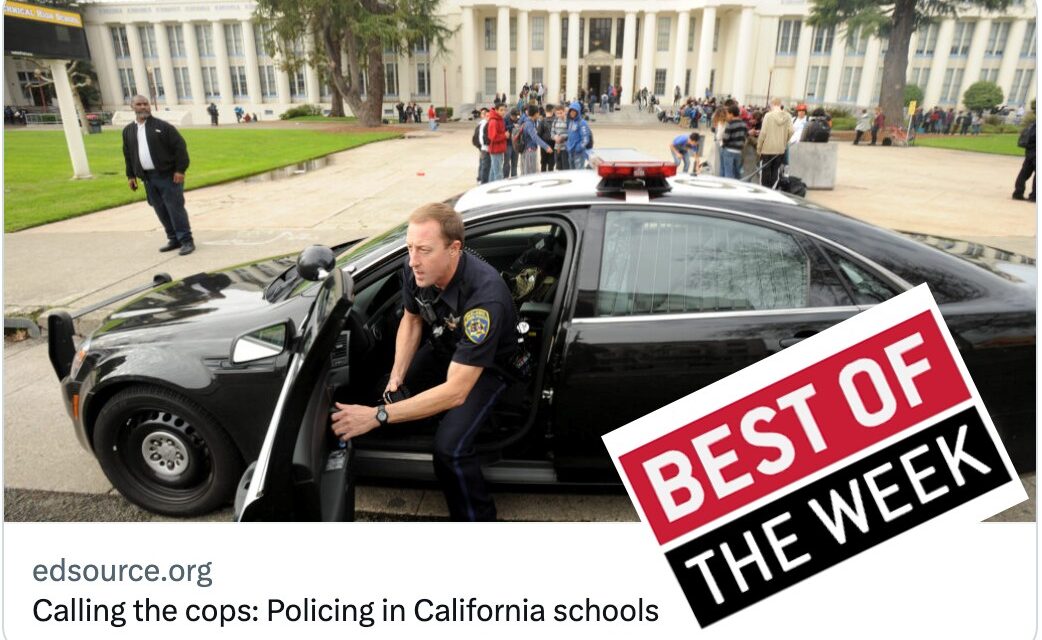
In this week’s newsletter: Districts are proposing record-high school bonds as ESSER ends. A rare look at how often schools call the police — and why. How to cover school choice in a divisive election year. The last education reporter leaves The Atlantic. Five education reporters I recently started following. “Yale, schmale,” says one ed reporter.
BONDS. SCHOOL BONDS.
The big story of the week
The big education story of the week is — yes! — school bonds, long-familiar voter-approved district funding measures that are increasingly essential with ESSER funds soon running out.
Some districts like Modesto, California, have been asking voters to support bonds for most of the past few years (Modesto Bee). The Denver Public Schools Committee is gearing up to propose a nearly $1 billion bond — the most it’s ever asked of voters — mostly for maintenance projects, including installing air conditioning in the buildings that remain without (Denver Post, CBS News). Mired in controversy over the state takeover, a Houston ISD advisory committee is proposing a $4.4 billion bond for things like air purifiers, water bottle filling stations, HVAC and environmental testing, and security (Houston Public Media, The Bond Buyer).
Though bonds can provide schools with the means for much-needed updates, they could also raise property taxes and, as a result, aren’t always popular with voters. School bonds had mixed success in rural Oregon earlier this year (KLCC). In Tamalpais Union High School District in Marin County, California, trustees are proposing a smaller bond for the November ballot after a larger proposal failed to get enough votes in March (Marin Independent Journal). And one district in Idaho finally passed a school bond after a dozen previous rejections lasting decades (Idaho Ed News).
School finance stories aren’t always sexy, but they are increasingly important in the wake of the COVID pandemic, which revealed widespread issues with HVAC systems, and with climate change accelerating (Washington Post).
Other big education stories of the week include district budget woes, schools closing due to heat, and chronic absenteeism. Check out @thegrade_ for daily headlines!
WHY COPS ARE CALLED TO SCHOOL
The best education journalism of the week
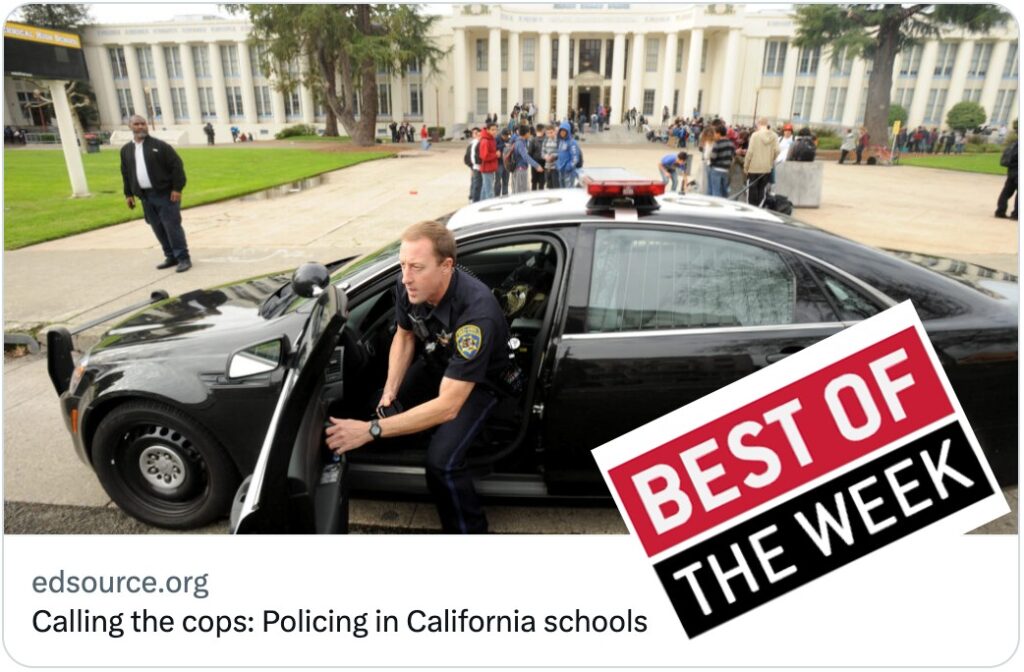
The best education journalism of the week is Calling the cops: Policing in California schools by EdSource’s Thomas Peele and Daniel J. Willis, with local reporting from Emma Gallegos, Lasherica Thornton, Mallika Seshadri, and Monica Velez.
This package — the first in a planned series on school policing in California — is gripping and comprehensive. EdSource looked at nearly 46,000 police call logs and dispatch records from 164 law enforcement agencies in 57 of California’s 58 counties, revealing “the vast presence of police in schools,” even as many communities are rethinking the very concept of cops in schools.
You may not be surprised by the wide range of incidents that call police to schools, including everything from the ridiculous — lost keys and dogs on campus — to the serious: sexual assault, kids with weapons, attempted suicides. But you may be surprised to know that fewer than one-third of calls were for serious incidents — and only one third of those involved violence. You should be impressed by the effort that EdSource has put into tracking down so much information on such an important topic.
EdSource has to tackle lots of challenges in presenting this story. Police reports often lack detail. Agencies aren’t always cooperative about disclosure. As a first foray into the topic, it’s valuable, with journalists bravely getting their arms around the problem in a way few have previously.
Here’s a cheat sheet with highlights of the investigation. EdSource also offers the raw data for exploration. And here’s a look at one district’s mixed experience trying to go police-free.
Other education stories we liked this week: how billions in taxpayer dollars now go to religious schools (Washington Post); how post-pandemic academic recovery has been slow and uneven (AP); how HISD’s polarizing head Mike Miles spends his days (Houston Chronicle); Illinois places virtually no rules on parents who homeschool, resulting in “No Schoolers” (ProPublica); and how an unhoused New Orleans student became valedictorian (The Guardian).
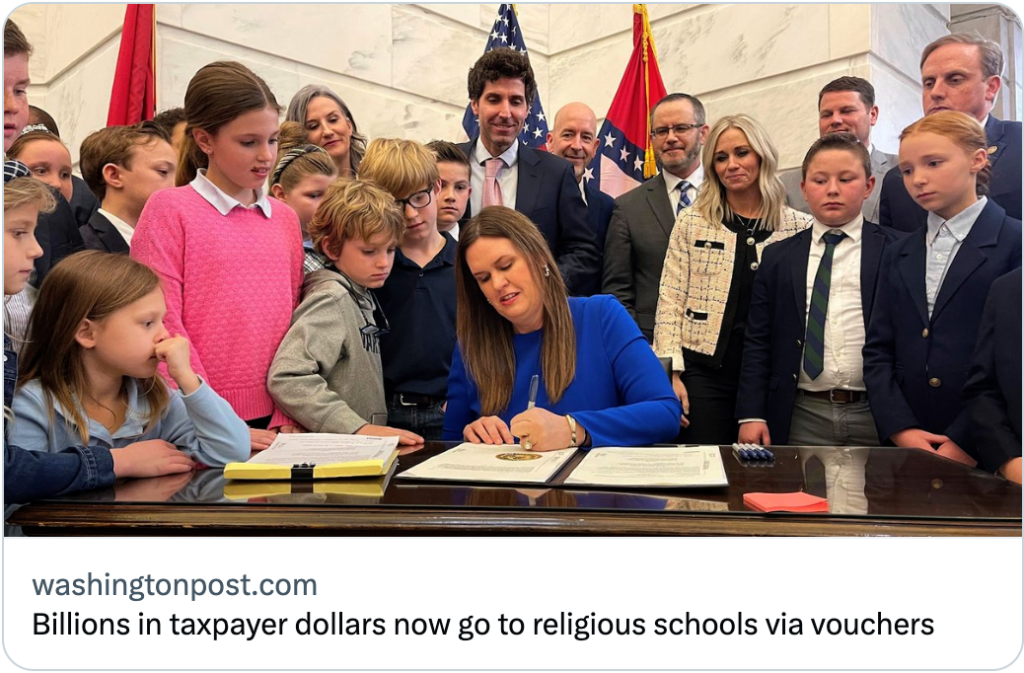
Above: The comprehensive — and controversial — new overview of school choice programs from the Washington Post.
COVERING CHOICE IN CAMPAIGN 2024
Our latest columns and commentary
It’s no surprise that school choice is a hot topic in education and a challenge to cover effectively. But this week’s intense debate over the Washington Post’s school choice coverage makes this new interview with Michigan State’s Josh Cowen all the more timely.
How best to cover choice? As part of our series on this topic, longtime education researcher Cowen praises journalists for their efforts covering the choice story but urges them to be less timid in describing the educational effectiveness of the programs — and clearer in describing how vouchers work.
Bonus: Our bonus piece this week is an essay from the Migration Policy Institute’s Julie Sugarman about good ways to cover immigrant students. There are roughly 1 million kids who are newly arrived in recent years, plus millions more learning English. Let’s give them the coverage they deserve.

Above, clockwise from top left: Five education reporters I’m newly following are the Post and Courier’s Valerie Nava, WABE’s Juma Sei, El Instituto’s Crystal Elescano, the Columbus Dispatch’s Cole Behrens, and Signal Akron’s Arielle Kass. If you’re reading this and I’m not following you, let me know!?
PEOPLE, JOBS, & EVENTS
Who’s going where and what’s happening
📰 Career moves & job openings: The Atlantic’s Adam Harris is leaving for New America. Former Minneapolis Star-Tribune education reporter Faiza Mahamud is joining the International Rescue Committee as a digital content officer. The four-person education team at the Wall Street Journal seems safe from the recent layoffs, and the Journal is still looking for an education editor to replace Chastity Pratt, who’s now at the Post. The Hechinger Report is looking for an investigative reporter.
📰 Appearances, segments, & podcasts: For NPR, Aubri Juhasz reported on a wealthy and mostly white Baton Rouge neighborhood that became its own city to create a new school district. NPR also ran segments on a new form of reading instruction, chronic absenteeism, and the kindergarteners who are missing the most school. Boston-based WBUR show “Here and Now” dove into the lack of bilingual teachers for migrant kids in Chicago, featuring Chalkbeat Chicago’s Reema Amin. The New York Times’ Natasha Singer was on The Daily podcast talking about the deepfake problem. And in the latest episode of GBH News’ and the Hechinger Report’s podcast “College Uncovered,” the hosts ask, what do college students learn anyway?
📰 Sound-off:
- “Some parents are hesitant to go public,” says KUOW’s Samantha West about reporting on disgruntled parents in Seattle. “They all told me they love public schools, but it just didn’t end up working for their families.”
- “In my experience, academics get to your emails either (a) within 10 minutes or (b) 10 minutes after you die,” tweets The 74’s Kevin Mahnken.
- “For all the media attention focused on the coasts, mainstream media largely ignored the protests that swept campuses across the Rust Belt and into Appalachia,” writes P. Nick Curran and Akela Lacy in an Intercept story.
- “I wish all the editors who fixate on super-selective colleges had been at #EWA24,” says the Chronicle of Higher Education’s Eric Hoover. “Yale, schmale.”
📰 Resources: For Poynter, CT Mirror data reporter José Luis Martínez talked about why all outlets should have a data ethics policy. Speaking of data, the AP’s Sharon Lurye recommends checking out Bento for “super granular and specific data on what teachers are actually doing and what materials they’re using in the classroom.” If you’re interested in learning more about education finance, join the new cohort of Georgetown’s Certificate in Ed Finance in September in Seattle or D.C. And for those reporting on chronic absenteeism (which should be just about everyone), there’s a new Ipsos poll out showing 3 in 5 Americans say it’s a major problem.
📰 Books: The Guardian published an excerpt from Sonali Kohli’s new book, “Don’t Wait: Three Girls Who Fought for Change and Won.” And The Nation ran an excerpt from Jennifer C. Berkshire’s and Jack Schneider’s book “The Education Wars.” The book will be out July 2.
THE KICKER
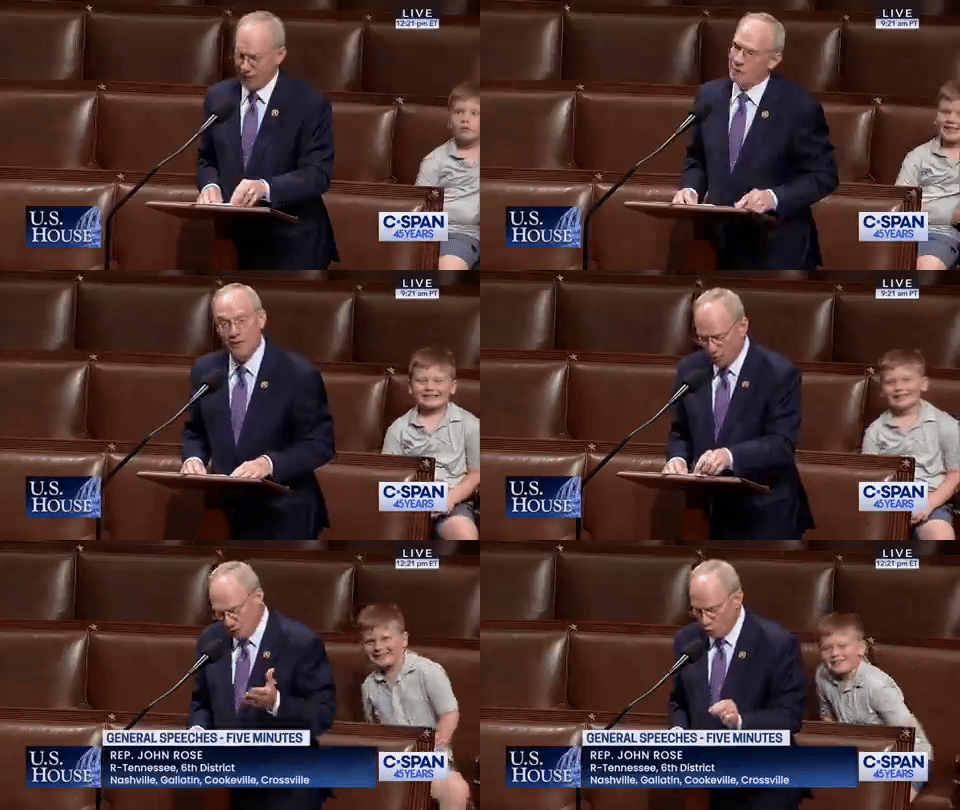
“So sorry I was slow responding to your email, I was tied up watching this over and over again.”
That’s all, folks. Thanks for reading!
Reply to this email to send us questions, comments or tips. Know someone else who should be reading Best of the Week? Send them this link to sign up.
Using Feedly or FlipBoard or any other kind of news reader? You can subscribe to The Grade’s “feed” by plugging in this web address: http://www.kappanonline.org/category/the-grade/feed/.
Read more about The Grade here. You can read all the back issues of The Grade’s newsletter, Best of the Week, here.
By Alexander Russo with additional writing from Colleen Connolly.