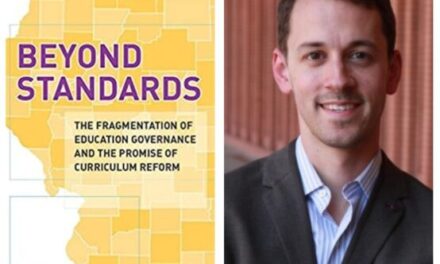
A interview about school culture wars coverage with “They Came for The Schools” author and NBC News reporter Mike Hixenbaugh.
By Alexander Russo
It’s no secret that I’m deeply concerned about school culture wars news coverage that makes it seem like conservative attacks are ubiquitous and inevitably successful.
Not surprisingly, many fellow journalists disagree.
So you can imagine my surprise and delight when NBC News reporter and author Mike Hixenbaugh agreed to talk with me about his new book about school culture wars and about the role of media coverage in covering them.
Hixenbaugh is an award-winning journalist who’s been writing about right-wing school board efforts for roughly four years now. He’s one of the two main journalists behind the popular podcasts Southlake and Grapevine. And now he’s the author of They Came for the Schools, officially published on Tuesday.
While Hixenbaugh and I don’t see eye to eye about much, his insights are thoughtful and constructive. And we agree that some of the culture wars coverage lacked context that would have helped readers make sense of the conservative backlash they were reading about.
“I don’t agree with the idea that coverage of the school board culture wars has, broadly speaking, been overblown or exaggerated,” says Hixenbaugh. “But too much coverage didn’t go beyond combative scenes of parents denouncing critical race theory at school board meetings and didn’t help readers understand why that was happening.”
“The backlash was the story, and you couldn’t really tell from a lot of the stories the reasons for the DEI plans that conservatives were revolting against, where they came from, or why they existed.”
Too much coverage didn’t go beyond combative scenes of parents denouncing critical race theory at school board meetings. – Hixenbaugh
This interview has been edited and condensed.
For those of us who may not know, did you come into covering this topic as an education reporter?
Mike Hixenbaugh: I came up through small newspapers, so I’ve covered a bit of everything: City Hall, zoning meetings, police, courts, all that stuff. And I did, for a period early in my career in a much different era, cover schools in Virginia Beach. I then went on to report on the military, covering the Navy for five years. From there I went on to write about health care and do accountability reporting around patient safety.
The common thread through all of this is, I’ve always been really interested in the human impact of policy, showing how regular people are impacted by systems and by politics. So, it’s true that for the past four years, I’ve essentially been an education and politics reporter. But I came to that by way of interest in how individual people and communities are being affected by this stuff. I was interested in that broader issue of how these political issues were affecting people and communities, and it just so happened that the place to write about that at this moment in history turned out to be in schools.
Are there any unique challenges of covering schools, compared to other beats you’ve covered?
MH: The stakeholders who are most important, the whole reason we have an education system, are children. And it can be difficult to fully capture their perspective, for all the reasons lots of great education reporters out there know, which is that they’re children. And with the stories I’ve been writing — dealing with concerns around racism and discrimination in schools — sometimes these kids have been traumatized.
So it takes time to find young people willing and able to talk and to win their trust. You can’t do very many quick turn stories where you capture those authentic perspectives, because it takes a lot of time. And then often, to get teens to open up and really tell us what they’re experiencing or feeling or seeing, you have to have multiple long phone calls, off-the-record chats with a kid or their parents, before we’ve reached the point where they’re actually at a point of comfort where they can open up. So that’s a huge barrier.
In addition, there’s access. You have to ask for permission, you can’t just show up, poking your nose around in classrooms and offices. And when things get really as intense and political as they have now, schools are way less willing to let you.
About your new book, does the ‘they’ who came for the schools refer to progressives or to conservatives or to something else entirely?
MH: I’d say it’s open for interpretation. Most everyone I spoke to in Southlake repeated a variation of the same line when I asked what brought them to town: They came for the schools. The pursuit of “good schools” is what draws a lot people to affluent suburbs like Southlake where these fights are playing out. Certainly, many conservatives have come to believe that progressives have quietly sought to impose their worldview in classrooms for decades. And now there’s been a surge of organizing from the right that’s fighting to restrict how teachers talk about race and gender and in some instances impose a Christian conservative perspective in classrooms.
The pursuit of “good schools” is what draws a lot people to affluent suburbs like Southlake where these fights are playing out. – Hixenbaugh
How widespread are these kinds of school culture conflicts in diverse suburbs, and have they risen in recent months or are they likely to keep doing so?
MH: It depends on how you define these conflicts. If you’re strictly saying, ‘Has the local community formed a PAC?’ and ‘Are they waging a campaign against critical race theory,’ or ‘Do they have a partisan slate of candidates running for school board?’ I would point you to Ballotpedia, which has done a nice job of tallying up the couple thousand school board contests over the past few years where they found candidates running on those issues.
But I think that zeroing in on that specific version of conflict misses a lot of what’s happening. I think you’d be hard pressed to find a diversifying suburb in America where these issues haven’t affected the school district in some way.
So there’s a much wider problem not always captured by researchers or media coverage?
MH: This is something you and I have talked about on social media. I appreciate the impulse to ask. I don’t have a hard answer. But from what we can see as we report these stories is that this political upheaval is widespread in the culture, and in communities, and it is having a widespread impact.
As a test case, I looked at the county where I grew up in Ohio to see what was happening with schools in this pretty rural, mostly white place that doesn’t get a much media attention. None of the school districts there are on the Ballotpedia’s list, which relied primarily on media reports. But I was able to find debates in a few school districts there over critical race theory, and at least one district even passed a resolution without much attention. There are examples like that all over the place that take a bit of digging to notice. When you’ve got 13,000 public school districts nationally, that’s an enormous lift to try and do something comprehensive.
But there’s another way of measuring, and that’s on the side of how these fights are affecting classrooms. I’ve been pointing to a RAND survey that came out this year, after the book was off to the printer, showing that two thirds of educators across the country reported restricting or censoring subjects or holding back on some of these divisive subjects. That’s in part because dozens of red states have passed state laws restricting this stuff and creating penalties for teachers who cross a line. You’ll read in the book a few stories of educators whose careers were derailed. But the RAND survey found that teachers were self-censoring out of fear even in districts where no restrictions had been imposed — places without Moms for Liberty trying to take over or new state laws being passed.
What about the perception that right-wing efforts including book bans, board takeovers, and bathroom challenges are not only widespread but also successful?
MH: One thing that I have seen, and I think it’s very valid, is the idea that Moms for Liberty-type groups are not dominating or winning most local school board races. The Steve Bannon thesis and Chris Rufo’s hope back in 2021 arguing that the suburban culture war school issues were going to win back disaffected suburban women for Republicans, I don’t see much evidence of that.
What’s really happened is that by making local school board elections about these national issues, what they’ve done really is take all of the national political divides — not just between left and right, but between moderate conservatives and the more far-right MAGA wing of the GOP — and superimpose those divisions onto local elections. That means, if you’re in Southlake, Texas, the anti-CRT candidates are gonna win big, but if you are in a district that’s more toward Biden, then maybe progressives and moderate conservatives are going to fend off Moms for Liberty or whichever group it is.
The net effect of all of it is that culture of fear where teachers are afraid to get in trouble for what they say or show about racism or the existence of LGBTQ people in a classroom.
I think you’d be hard pressed to find a diversifying suburb in America where these issues haven’t affected the school district in some way. – Hixenbaugh
Do you think that media coverage has unintentionally played a corrosive role amplifying parents’ and teachers’ fears or has any responsibility for spreading them?
MH: I think much of the coverage would have been improved with context and nuance which, to be fair, is often difficult to include in quick-turn breaking news stories. I don’t agree with the idea that coverage of the school board culture wars has, broadly speaking, been overblown or exaggerated. There’s been a lot of very good, thoughtful reporting on this stuff by education journalists, many of which are cited in the endnotes of my book. But too much coverage didn’t go beyond combative scenes of parents denouncing critical race theory at school board meetings and didn’t help readers understand why that was happening, whether the political attacks matched the reality of what was happening inside schools, and how it all was affecting children and teachers.
Reporting on school culture conflicts as you’ve done for the past four years, how has your approach to reporting the story changed? Do you do anything differently now?
MH: I think sometimes we tell stories with not enough long-view historical context that helps people understand more fully what’s happening. I don’t have regrets about any of my reporting, but I think I didn’t have a full picture of why what was happening was happening when I started in on this.
In the first third of the book, I really get into a lot of how the suburbs became the places that they are, going all the way back to the 1950s. But the shorter-term history missing from coverage took place during the 2017 to 2020 timeframe. A lot of early coverage —and you criticized some of this, rightfully so — it was a lot of like loud noises at school board meetings. It was this kind of polarizing coverage, saying ‘This side says they want to teach kids this, and the other side says they want to make white kids feel bad about themselves.’ It was often framed in stories as a kind of intractable conflict, and who’s to say what’s true?
But what I found writing the book is that in communities like Loudoun County, Virginia, and Southlake Texas, and a bunch of other places, leading up to 2020, there was a lot of wrestling in school districts over things that were cropping up in the Trump era. There were kids chanting, ‘build the wall’ at school, or racial slurs being carved into bathroom stalls. Lots of issues around diversity and inclusion that had been simmering for a long time in these suburbs were coming to the surface, and many schools began taking steps to address it. That’s the reason why when the anti-CRT backlash exploded in late 2020, early 2021, you could find a whole bunch of school districts that had implemented or were in the process of putting together diversity plans.
Those things were happening in reaction to parents of color and black students and LGBTQ kids coming forward and saying, ‘Hey, this is what’s happening.’ There was a kind of reckoning before the big national reckoning was hitting suburban school districts all over the country. But that context was missing. The backlash was the story, and you couldn’t really tell from a lot of the stories the reasons for the DEI plans that conservatives were revolting against, where they came from, or why they existed.
You couldn’t really tell from a lot of the stories the reasons for the DEI plans that conservatives were revolting against, where they came from, or why they existed. – Hixenbaugh
So what would you do differently?
MH: I would have started covering this all sooner. The news media got activated to report on this stuff when the conservative parents were packing into school board meetings and making a big spectacle. We picked up the story with the Fox News-driven backlash movement that sprung forth. There were journalists covering what I’m talking about — this kind of racial reckoning that was happening in schools across the country — but it did not have the urgent, widespread coverage that we saw in 2021. So, I would go back further. I was covering different stuff then, but I wish I had been paying attention earlier.
There were a lot of interesting one-off stories on it, but it wasn’t until the backlash movement sprung forth that we could kind of look back and say, well, there’s a lot of a lot of conflict in schools over these issues in the Trump era that that were the setup to CRT backlash.
I’ve been writing or commissioning commentary about school culture wars coverage for a while now (see below). What am I missing or getting wrong? Or is there something preventing reporters from covering culture wars differently, even if they wanted to?
MH: To me the political backlash over education is only interesting to the extent we can show its impact on real people. My hope is that readers of my book come away with a sense of how these battles have affected teachers, parents and children, so that everyone can make more informed decisions about what they want and expect from local officials and from their schools.
Previously from The Grade
What happens when education reporters write about politics? (Jennifer Berkshire interview)
What if school board races don’t really matter the way we think they do? (Ballotpedia)
Covering school extremism (Laura Pappano 2023)
‘Grapevine’; more than just another school culture wars clash? (Bekah McNeel 2023)
An expert journalist’s guide to covering book bans (Ann Doss Helms 2023)
A Texas librarian’s guide to book bans (Becky Calzada 2023)
Tabloid-style education news is all the rage (2023)
The school ‘red wave’ that didn’t happen (2022)
Demand concrete examples & avoid ‘emotionalism’: How to cover culture war stories (2022)