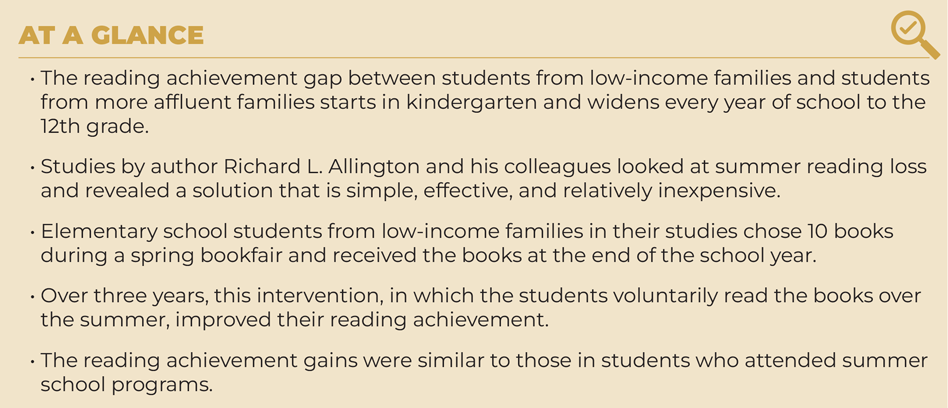
A summer reading program that allows students from low-income families to choose their own books improves reading achievement and reduces summer reading loss.
Over a decade ago, my colleagues and I began to study the impact of access to books on the reading achievement of children from low-income families (Allington et al., 2010; McGill-Franzen, Allington, & Ward, 2021). We designed a summer program to narrow or eliminate the reading achievement gap between children from low-income families and those from wealthier families that remains in place today (Cahill et al., 2013). Schools have narrowed the racial reading achievement gap between Black and white students over the past 50 years, cutting the gap in half. The opposite has been true with the family wealth reading achievement gap, which has doubled over the same period (Allington & McGill-Franzen, 2017).
To address this widening gap, we designed and carried out two large experimental studies addressing summer reading loss. We elected to study summer reading loss because children from low-income families lose roughly two to three months of reading achievement every summer, while children from wealthier families add about a month of reading achievement growth each summer (Alexander, Entwisle, & Olsen, 2001).
From kindergarten to 12th grade, the two- to three-month annual summer reading achievement loss among children from low-income families, plus the one month of reading achievement gain among children from wealthier families, accumulates to become a four-year reading achievement gap by 12th grade (Reardon, 2011). Even though summer reading loss has been documented for more than 50 years (Hayes & Grether, 1983; Heyns, 1978), the topic is not often considered in discussions of underachievement in reading.
My colleagues and I have spent decades studying children who struggle with learning to read, which led us to summer reading loss. We came to understand that children from low-income families do not read much during their summer vacation periods. A major reason is a lack of accessibility to books they wanted to read. Many children of low-income families have little if any access to books during the summer when the school library is closed. There are few bookstores and other stores that sell children’s books in low-income communities, leaving many homes bereft of publications for young readers.
Addressing the impact of summer reading
We conducted our first study of the effects of distributing summer books in 17 high-poverty urban elementary schools in Florida (Allington et al., 2010). This study had a sample of primarily Black children (90%). More than 800 children from low-income families were randomly chosen to select books at a spring bookfair that we organized and staffed at their schools. Likewise, a similar number of their classmates from low-income families were randomly selected to serve as the “no summer books” control groups. The children were 1st or 2nd graders when this study began.
For three consecutive summers, the summer-books children chose 10 books at the spring bookfair and received the books on the final day of school each year. The books came with no requirements, such as book reports or quizzes. Instead, we simply asked the children to read each of the books they had selected. After three consecutive summers, we compared the reading achievement of the kids who received books and those who did not. The summer-books children read significantly better than the control-group kids. The difference in reading achievement between the two groups was almost a full year after three consecutive summers of receiving books of their choice.
This showed us that increased access to books for children from low-income families could improve their reading achievement. We had hoped that putting books the children wanted to read in their hands would lead to the children reading the books. The children who received self-selected books did, in fact, read them, and their reading achievement improved.
Recently, we conducted a study like the one we did in Florida, but with primarily white 1st graders from low-income families in rural communities in east Tennessee (McGill-Franzen, Allington, & Ward, 2021). Using a research design like that of our earlier study, we obtained similar significant achievement results after providing students from low-income families with three years of access to self-selected summer books.
Both studies were designed to test whether improving access to books children from low-income families wanted to read would result in reading achievement gains over their summer break. And both studies had almost identical outcomes even though the second study targeted poor children living in rural east Tennessee — an environment quite different than that of the urban setting in our first study. In addition, virtually all the children in the second study were white children from low-income families, while the children in the first study were primarily Black children from low-income families.
The problem of access
The family-income reading achievement gap, then, seems primarily a problem of access to children’s books (Allington & McGill-Franzen, 2018). When primary grade children from low-income families could select 10 or more books to read during the summer, the reading achievement gap was largely eliminated over the three years in our studies. The cost of the book distribution was roughly $65 per child per summer (under $200 per child for three years). This costs considerably less than summer school, yet the effect on the reading achievement equaled or exceeded the gains observed from such programs (Cooper et al., 1996). The effects were greatest among the students whose families had the lowest incomes. Poverty limits many children’s access to books. Our research shows that expanding their access to books increased their summer reading which, in turn, impacted their reading achievement.
This line of research and development rose from our earlier studies of the experiences of low-achieving children in high-poverty American schools. Children of low-income families rarely had classroom libraries available to them, and the number of books in their school libraries was much smaller than the number of books in libraries in more affluent schools (Allington et al., 1995). In addition, neighborhoods where low-income families live often do not feature public libraries with extensive collections of children’s books. Finally, too many high-poverty schools limit the number of books that can go home with children. In many cases, children could take home neither library books nor content-area textbooks.
This combination of factors means that children from low-income families primarily live in “book deserts” (Tracey, 2015). They have limited opportunities to access books if they want to read when away from school, whether over the weekends during the school year or during their summer break. Their access to books is much more limited than it is for kids from more affluent families.
David Share (2004), the developer of the self-teaching hypothesis, demonstrated that most children acquire much of what they know about the relationships among letters, sounds, and words through self-teaching. He argues that engaging in an activity often leads to new learning. But few folks seem to have read Share’s work, and even fewer have accepted his argument. Nonetheless, if children learn to read (or at least to improve their reading) through reading, then access to books would be a critical aspect of a child’s experiences. The self-teaching hypothesis suggests how reading volume relates to reading achievement. However, little work has focused on self-teaching aspects of reading or even on the effects of reading voluntarily (Allington, 2014; Allington & McGill-Franzen, 2021).
A low-cost, effective intervention
We now have two experimental studies — one in Florida and one in Tennessee — that illustrate that improving access to books over the summer for primary grade children does lead to improved reading achievement. Others have studied the effects of voluntary summer reading on reading achievement, but no other summer books distribution project has targeted children from low-income families nor allowed the children to select their own summer books. While the record of effects on achievement is mixed in these other studies of summer reading (Kim & Quinn, 2013), almost all those studies tested the effects of improving access to books over a single summer, not over the longer term.
We also have evidence that improving access to books is relatively inexpensive when compared to the cost of providing summer school for the same children. The cost of summer reading books is roughly $200 per pupil over three years. Given the funds that are currently spent on addressing impaired reading achievement, it seems that almost every school in the U.S. could afford to implement a summer books intervention.
Decision makers at the federal, state, and local levels must examine their budgets to prioritize funding for summer books interventions (Cahill et al., 2013). Our current research has been evaluated by the Center for Evidence-Based Educational Policies, and we hope that their recognition of the low-cost high-impact value of providing books for summer reading will motivate federal officials to craft the funding streams to support such projects nationwide. However, federal intervention or guidance is not essential for schools to start summer reading interventions on their own.
Leveling the playing field
Given the substantial and ever-widening reading achievement gap found between children from affluent families and children from poor families in America, schools must consider how to narrow or eliminate that gap. The good news is that reading self-selected books during the summer appears to make a difference.
The current four-year gap in the reading achievement between high school seniors from affluent backgrounds and those from impoverished backgrounds occurs because of the slow but steady process of losing a small amount of reading achievement year after year. Our work suggests that if every school district gave children from low-income families the opportunity to take home self-selected books to read over the summer months, American schools would likely produce comparable levels of reading achievement for all children, regardless of family income. They would be leveling the playing field for students who need a boost the most.
References
Alexander, C.L., Entwisle, D.R., & Olson, L.S. (2001). Schools, achievement, and inequality: A seasonal perspective. Educational Evaluation and Policy Analysis, 23 (2), 171-191.
Allington, R.L. (2014). How reading volume affects both reading fluency and reading achievement. International Electronic Journal of Elementary Education, 7 (1), 13-26.
Allington, R.L., Guice, S., Baker, K., Michelson N., & Li, S. (1995) Access to books: Variations in schools and classrooms. Language and Literacy Spectrum, 6, 23-28.
Allington, R.L. & McGill-Franzen, A.M. (2017). Summer reading loss is the basis of almost all the rich/poor reading gap. In R. Horowitz & S.J. Samuels (Eds.), The achievement gap in reading: Complex causes, persistent issues, and possible solutions. (pp. 170-183). Routledge.
Allington, R.L. & McGill-Franzen, A.M. (2018). Summer reading: Closing the rich/poor reading achievement gap (2nd ed). Teachers College Press.
Allington, R.L. & McGill-Franzen, A.M. (2021). Reading volume and reading achievement: A review of recent research. Reading Research Quarterly, 56 (S1), S231-S238.
Allington, R.L. McGill-Franzen, A.M., Camilli, G., Williams, L., Graff, J., Zeig, J., Zmach, C., Nowak, R. (2010). Addressing summer reading setback among economically disadvantaged elementary students. Reading Psychology, 31 (5), 411-427.
Cahill, C., Horvath, K., McGill-Franzen, A.M. & Allington, R.L. (2013). No more summer reading loss. Heinemann.
Cooper, H., Nye, B., Charlton, K., Lindsay, J., & Greathouse, S. (1996). The effects of summer vacation on achievement test scores: A narrative and meta-analytic review. Review of Educational Research, 66 (3), 227-268.
Hayes, D.P. & Grether, J. (1983). The school year and vacations: When do students learn? Cornell Journal of Social Relations, 17 (1), 56-71.
Heyns, B. (1978). Summer learning and the effects of schooling. Academic Press.
Kim, J.S. & Quinn, D.M. (2013). The effects of summer reading on low-income children’s literacy achievement from kindergarten to grade 8: A meta-analysis of classroom and home. Review of Educational Research, 83 (3), 386-431.
McGill-Franzen, A.M., Allington, R.L. & Ward, N. (2021). Low-cost annual book fairs to mitigate summer reading loss in high poverty communities: Two state RCT studies in the U.S. Paper presented at the 4th Baltic Sea Conference on Literacy, Tallinn, Estonia.
Reardon, S.F. (2011). The widening academic achievement gap between the rich and the poor: New evidence and possible explanations. In R.J. Murnane & G.J. Duncan (Eds.), Whither opportunity? Rising inequality and the uncertain life chances of low-income children. (pp. 91-116). Russell Sage Foundation Press.
Share, D.L. (2004). Orthographic learning at a glance: On the time course and development onset of self-teaching. Journal of Experimental Child Psychology, 87 (4), 267-298.
Tracey, M. (2015). The language desert: The condition of literacy and reading in contemporary America. Humanities, 4 (1), 17-34.
This article appears in the April 2024 issue of Kappan, Vol. 105, No. 7, p. 48-51.

ABOUT THE AUTHOR

Richard L. Allington
Richard L. Allington is a professor emeritus from the University of Tennessee, Knoxville, and a past president of the International Literacy Association and Literacy Research Association.