School closings are easy to cover badly. But stories adding historical context, exploring tradeoffs, and questioning superficial explanations show that there’s a better way.
By Tim Daly, EdNavigator
Over a year ago, I wrote about the need for the education world to prepare for a wave of school closures that’s likely on the horizon.
Enrollment has dropped in many districts, leaving incredible numbers of empty seats.
Once federal pandemic relief money dries up, there will be no way for some communities to avoid consolidating kids into fewer schools.
Some school districts have already begun the process. Many others are still putting it off.
Nearly always miserable, closures are often made worse by leaders who live in denial for too long, hoping for a reprieve or running out the clock until they depart the district.
Families lose beloved local institutions and bear the brunt of chaotic, last-minute re-assignments to new schools — which are frequently low-performing and under-enrolled.
Media coverage of school closures often makes things worse.
Media coverage of school closures often makes things worse.
Because the stories are so inherently spicy — emotional parents, conflict-ridden public meetings, blameless children — it’s easy for reporters to paint by the numbers.
When this happens, readers are deprived of an opportunity to understand an issue that is complex and emblematic of the most core tensions in public education, including which constituencies have the power to drive decisions and how public entities should allocate scarce resources.
However, reporters who follow the invisible threads that lead to a school closure will provide readers with a power map of a whole community.
Reporters who follow the invisible threads will provide readers with a power map of a whole community.
Here are some keys to covering school closure decisions in ways that better inform readers about the full range of issues at play — along with some examples of stories that hit the nail on the head.
Tell the story of how the school got here.
When a school is announced as a target for closure, reporters often treat it as the beginning of a saga — a political brawl between a community and the governing bureaucracy. But that’s short-sighted. Closure debates are usually a transition point between the long arc of a school’s decline and its potential end.
Questions to ask:
- When did enrollment peak? When were this school’s glory days?
- When did it begin shrinking — and why? Are we talking years ago? Decades? Did families start choosing other schools? Moving to other neighborhoods? Were new schools opened nearby?
- Who was running the school in recent decades, and what key decisions did they make about the academic program, the faculty, and the school’s relationship with the community?
- Have local property values declined? Why? Loss of jobs? Crime?
Explain the tradeoffs.
Reporters sometimes frame a closure decision as the district’s refusal to find resources to keep a small-but-beloved campus running. But every dollar spent on under-enrolled schools is a dollar that won’t be available for the rest of the schools in the district, which are likely in desperate need.
Ask:
- What if a given school is not closed? What cuts would be made at other schools in the system? Would they have fewer staff? Offer fewer programs, electives, or extracurriculars? The ripple effects are inevitable.
- If the school targeted for closure is very small, what inefficiencies already exist? For instance, did the school recently replace all the windows to be more energy-efficient even though half of the classrooms are unused?
Dig deep on where the students will go.
This is perhaps the most important question of all. Research has generally shown that students whose schools close perform worse in the future. Why? Because they are typically assigned — without any family input — to struggling schools that have empty seats to fill. When you combine the disruption of transferring with low-quality instruction at the new school, it’s pretty obvious that outcomes will be bad for kids.
Ask:
- Are students from closing schools being afforded any advantages in the school enrollment process to ensure access to good seats?
- Will families be given a choice about where their children enroll next? Or will the district decide for them? If the district is making the assignment, why?
- Which schools will absorb the students from the closed schools? Can the district assure families of an opportunity to attend a school that is at least as strong as the one they are leaving?
See the school for yourself — from the inside.
I’ve read some closure stories that are little more than a couple quotes from parents at drop-off or pick-up time. They love their school and don’t want it closed. That’s what parents almost always think about their local schools, though.
If the school is being considered for closure, chances are high that the district does not think the school is as strong as the parents do. The only way to provide clarity and context for readers is to go inside to observe students and classes. You never know what you’ll see, ranging from a wonderful learning community to a total mess. Readers deserve that insight. And be honest. In my experience, many schools that close are not good places for kids, but reporters are shy about saying so.
Ask:
- What are the school’s offerings given limited enrollment? Do students get full access to arts, music, and physical education?
- What is the parent experience? When they call the front office, do they receive prompt assistance? Do parents ringing the school’s doorbell wait for minutes to be let in because the receptionist also supervises lunch?
- How many families are already looking to move their child from the under-enrolled school — whether it closes or not?
Don’t be satisfied with vapid, evasive quotes from public figures.
Superintendents would rather sleep on a bed of tarantulas than talk to reporters about closing schools. Don’t let them — or closure opponents — hide behind spokespeople or middle managers. The standard district storyline is that the district has tried every avenue to avoid closure, but due to circumstances completely outside its control — usually, not enough funding being provided by the state — it has just now concluded that this difficult decision is necessary. This storyline is probably half true on a good day.
Ask:
- What resources have been dedicated to transitioning students? What amount has been set aside financially for additional social work, counseling, and special education supports that may be necessary as students transfer?
- How will the district follow the progress of students in years to come? What will it do if students from the closing school aren’t thriving in their new placements?
- For opponents of closures, what cuts are they willing to recommend elsewhere in the district to free up resources to avoid closures? (Beware of ambiguous responses like “reducing bureaucratic bloat” that don’t mean anything to anyone.)
Many schools that close are not good places for kids, but reporters are shy about saying so.
Here are a few stories that go beyond the usual superficial/simplistic school closings narrative:
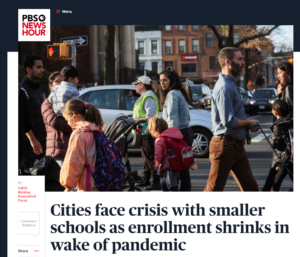
Above: Cities face crisis with smaller schools as enrollment shrinks in wake of pandemic by Collin Binkley, Associated Press.
While this story leaves some questions unanswered as to the causes of declining enrollment, Binkley does a nice job bringing the numbers to life, quoting a Chicago community advocate who says of one school: “We’re spending $40,000 per pupil just to offer the bare minimum. It’s not really a $40,000-per-pupil student experience.”
The reporting captures the difficult choices parents face between sticking with a school in decline or uprooting their child to seek an education elsewhere.
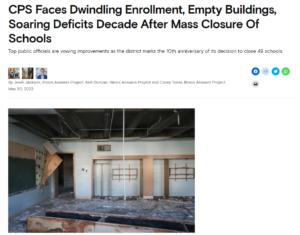
Above: CPS Faces Dwindling Enrollment, Empty Buildings, Soaring Deficits Decade After Mass Closure Of Schools by Jewél Jackson, Kelli Duncan, Casey Toner, Illinois Answers Project/Block Club Chicago.
This one truly shines with historical context, clear data, quotes from city leaders, and compelling local voices whose perspectives are nuanced.
There have been hundreds of articles in the past decade about school closures in Chicago. Too many of them functioned as tedious skirmishes in the long war between the Chicago Teachers Union and the district.
You’ll leave this article feeling like you finally got the coverage you always wanted. Reporters address how charter schools and demographic changes have influenced enrollment declines, but they also quote neighborhood voices who are skeptical of continuing to funnel money into “something that’s not working.”
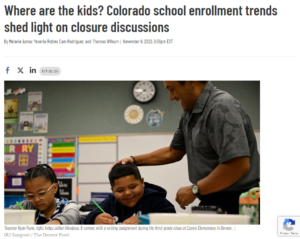
Above: Where are the kids? Colorado school enrollment trends shed light on closure discussions, by Melanie Asmar, Yesenia Robles, Cam Rodriguez and Thomas Wilburn, Chalkbeat Colorado.
These reporters dig beneath common explanations for declining enrollment — which drives closures — to determine the validity of each. They marshal a wealth of data. Their conclusion? Declining birth rates should prompt every district to update their long-term forecasts. Enrollment may not be rebounding anytime soon.
Start reporting now.
Closures are coming.
The public deserves to know.
Tim Daly is the co-founder and CEO of EdNavigator. He previously served as President of TNTP. He writes a monthly newsletter, The Education Daly.
Previously from The Grade
Messy times ahead for school spending
A more inclusive approach to covering school shutdowns
The scarcity mindset that plagues education news
Media accountability for school closings
School closures require digging deep
ABOUT THE AUTHOR

The Grade
Launched in 2015, The Grade is a journalist-run effort to encourage high-quality coverage of K-12 education issues.