High-quality materials, professional learning supports, and a schoolwide PBL culture are markers of successful PBL programs.
Engaging students with learning requires more than the traditional but still dominant mode of schooling — often referred to as “sit-and-get” — in which teachers lecture and assign textbook readings to students who take notes, memorize content, and restate the content in assessments. This is not an engaging way to learn for many students. In contrast, project-based learning (PBL) can be far more engaging.
In high-quality PBL, teachers serve as facilitators, guiding their students, alone or in groups, to address real-world challenges and problems through projects (Hmelo-Silver, 2004). As a form of inquiry-based learning, PBL has driving questions at the core of every project. While seeking to answer these questions, students investigate and address authentic challenges, typically over an extended number of weeks, rather than during one or two class sessions (Parker et al, 2011). Students have opportunities to work productively with others, practice leadership, develop project management skills, use their creativity, present their work to external audiences, and develop other inter- and intra-personal skills. While lecture is part of PBL, its timing is strategic, used when students have developed a need for certain content or skills to complete their project (Schwartz & Bransford, 1998). Long-term projects culminate in a product students share with external audiences — this could be a presentation, video, card game, graphic novel, play, or event, among many other possibilities. Formative and summative assessment, using feedback from peers and teachers and the students’ self-appraisal, is woven throughout project cycles (Barron & Darling-Hammond, 2008).
Studying PBL approaches
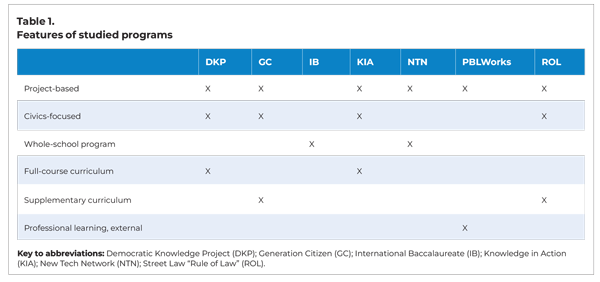
Over the past 15 years, we’ve researched or advised seven inquiry-based programs and approaches: International Baccalaureate (IB), Knowledge in Action (KIA), Generation Citizen (GC), New Tech Network (NTN), Street Law “Rule of Law” (ROL), PBLWorks, and the Democratic Knowledge Project (DKP). Six of these are project-based and one (IB) is inquiry-based but well-suited to incorporation of projects. The specific characteristics of these programs and approaches vary and are summarized in Table 1.
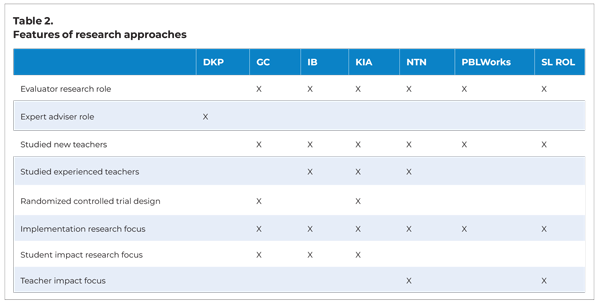
Our approach to studying each of these programs also varied (see Table 2 for a summary). For one program (KIA), we used a “gold standard” randomized controlled trial design (another, the GC study, is in progress through 2025). We have studied program implementation in all programs in which we’ve played an evaluator role, student-level outcomes in three, and teacher-level outcomes qualitatively in two. We used a broad range of research approaches, including interviews and surveys with students, teachers, school leaders, and program staff; analysis of administrative data; observations of classroom practice; and examination of website metadata showing teachers’ use of online portal materials.
We have shared results from these studies in a previous Kappan article, (Saavedra et al., 2021) as well as several peer-reviewed publications (Saavedra, 2012, 2014, 2016; Saavedra, Lavore, & Flores, 2014; Saavedra et al., 2022). Across projects, we’ve learned lessons we believe are valuable for educators and policy makers to consider when making decisions about how to incorporate more PBL instruction, hopefully maximizing its benefits in enhancing student engagement.
Improving engagement, achievement, and “soft” skills
The consensus among teachers, students, and school leaders across our studies is that PBL is more engaging for students, can lead to more sustained learning of content, and is more authentic and relevant for students than more traditional lecture-based approaches. Plus, it builds “soft skills” that benefit students beyond school. For example, in our KIA study, approximately half of the interviewed teachers who incorporated PBL talked about students’ growing persistence, responsibility for their own learning, accountability to others, research and discussion skills, note-taking skills, and more. They also referenced students’ newfound appreciation of the need for daily effort, attendance, and lack of procrastination. One teacher explained how opportunities to submit drafts or components of work throughout the project helped students to develop their time management and “really pushed them to do high-quality work.” This teacher felt that by requiring “redesigns,” PBL does not allow students “to settle for mediocre work.”
Student feedback aligned with that of teachers in our KIA study and others. NTN students valued learning skills that “will help us in the real world.” One student said, “let’s say you’re working for a company. They won’t ask you to take a test. They’ll ask you to solve a problem.” NTN students also shared that, when working on group projects, they needed to learn their peers’ points of view and “combine our ideas and evaluate,” an important skill in the working world.
This kind of engagement need not come at the expense of academic skills. Our work is part of a growing body of research evidence empirically demonstrating benefits of PBL for academic outcomes across subjects, grade levels, and household incomes (e.g., Lucas Education Research, 2021). For example, students in Advanced Placement (AP) U.S. Government and AP Environmental Science courses that used the Knowledge in Action PBL approach earned higher AP exam scores than their peers in more lecture-based versions of the same courses (Saavedra et al., 2022). This finding persisted among students from lower-income and higher-income households. In our study of the inquiry-based International Baccalaureate (IB) Diploma Programme high schools in Chicago Public Schools, IB students had higher ACT scores and greater probabilities of graduation from high school and enrollment in college than comparable peers in non-IB schools (Saavedra, 2014).
Maximize your chances of success
District and school staff want PBL to be effective for their students but don’t always know the key levers for success. Our studies suggest that three areas are of primary importance: materials, support, and culture.
Expert-created, high-quality, adaptable curriculum materials
Most of the programs we’ve studied rely heavily on expert-created curriculum and instructional materials. Two of the programs (KIA, DKP) are designed for teaching a single civics-focused course, while others (GC, ROL) are made up of expert-developed supplementary curricula for teachers to integrate into their civics or social studies course. Experts spent years designing the materials for teachers to use “off-the-shelf” to the extent they desire, adapting them as needed to fit their classrooms and students.
The whole-school NTN and IB models provide teachers with copious materials, but teachers still need to create more of their own materials than in the course-specific programs. For example, some schools using the whole-school models may offer courses for which materials are unavailable or less comprehensive. Teachers may also need to adapt their assessments to ensure they are addressing local district or state standards. PBLWorks provides professional development to help teachers develop their own PBL materials. In response to demand, they now also provide teachers with expert-created materials through their new PBLNow program.
We heard across multiple studies that having expert-created, high-quality materials facilitated PBL-implementation (Polikoff, 2021). A lack of such materials in a teachers’ specific subject area (or specific to state-standards) was a major hindrance to implementing PBL or continuing to use it in their classroom. This was particularly true for new teachers or teachers new to PBL. For example, a teacher shared:
I don’t get paid to write PBL curriculum, but I have spent countless hours doing exactly that. I am doing that while also teaching a full course load. . .. Seriously, we aren’t paid enough to do all this. I am bought in on PBL, but we definitely aren’t equipped to do it well.
Although teachers value having expert-created materials, they want to be able to adapt materials to their local context in ways they feel make the most sense for their students. They appreciated it when materials were designed with the expectation that they would adapt them.
Aligned professional learning supports
As important as expert-created materials are, materials on their own without professional learning support are not enough. As literature about best practices in professional learning shows (e.g., Desimone, 2009), teachers new to PBL most value supports that are personalized, ongoing throughout the school year, and designed to work in conjunction with professional learning communities.
Teachers new to PBL could benefit from professional learning focused on the following areas we’ve observed that teachers find most challenging:
- Teaching fundamental content and skills through projects. Projects should not be situated at the end of a given unit as a way for students to showcase their learning but should instead be a core mechanism through which students learn.
- Fostering a collaborative culture. Across studies, we saw powerful models of students accepting shared responsibility, listening to one another, and building on each other’s ideas. However, many teachers struggled to build this environment.
- Developing a grading system. Teachers also crave support for developing a grading system that fairly holds students accountable for both individual and group contributions and makes expectations clear to students.
- Facilitating group and project work to build complex thinking skills. We have observed teachers creating opportunities that could promote complex student thinking (Levy & Murnane, 2005), but then undermining them by answering questions themselves rather than guiding students to find their own answers. We also observed teachers — often ones with less experience — creating group projects but then not engaging or pushing students during class time.
- Building authenticity, student choice, and empowerment in ways that promote learning. Projects that are authentic give students agency to work on topics or build skills relevant to their lives, include a public audience, or use the same tools professionals in the field (e.g., historians, scientists, mathematicians) might use (Polman et al., 2018). We often found that teachers allowed students to choose topics and apply learning relevant to their lives but struggled to keep learning simultaneously intellectually rigorous.
Even teachers with PBL experience can benefit from additional support in these areas, though they also want help keeping their projects fresh and relevant over time. While in our KIA study we found that most of the gains in participating teachers’ students AP performance occurred in teachers’ first year (when they received more support from external coaches), we also found in our KIA and NTN studies that teachers value ongoing professional learning beyond their first year.
A schoolwide PBL culture
Across projects, we learned about the importance of school- and district-level support, including buy-in and culture. PBL approaches to instruction look different from traditional teaching methods. When high-quality PBL is working well, teachers stand in front of the classroom less frequently, desks are moveable and organized in group formations, students move fluidly throughout learning spaces and even leave the classroom. Both energy and noise levels can be high as students brainstorm, discuss, and build on each other’s ideas. How students demonstrate knowledge might look quite different from a traditional test. They may present something to the class, design a website, create a zine, produce a play. Instead of being due at the next class session, assignments stretch across weeks. These approaches can feel more comfortable when everyone in the building — educators and students alike — understands and agrees with the mechanisms and philosophies of inquiry-based instruction. Fostering a schoolwide PBL culture can help ensure that expectations for students are consistent from class to class, and from grade to grade.
Though our results show success on standardized tests, teachers and school leaders in our studies have felt the most observable impacts from PBL were in areas not as easily measured and less systemically prioritized.
Our research showed that group work particularly benefited when there was a schoolwide culture of inquiry-based and project-based learning. Students expected to work with others on group projects and were accustomed to what that entails. Similar expectations and norms within and across grade levels enabled students to grow a collaborative mindset and culture from grade to grade.
In studies of PBL instruction that was not schoolwide, teachers struggled as the only adult in the building using the approach. Students experienced “typical” instruction in their other courses (and grade levels) but would then come to this one class with vastly different norms and expectations. For example, grading policies in PBL classrooms — designed to account for group contributions — can conflict with grading policies for other classes, based exclusively on individual effort and products. For a student immersed in a traditional school, a PBL classroom can feel new, different, and unfamiliar.
High-achieving students, in particular, struggle with a new class format when they have been successful in the traditional format. We especially heard this concern from students in project-based AP courses. One teacher explained, “Traditionally academically successful kids are being asked to do something that’s not comfortable when they’ve been always really good at school, and they understood the rules of school.” In schools where students transition from mostly traditional classes to one PBL class, students can feel they’re not getting enough content in their PBL class. This student concern did not emerge in the schoolwide PBL settings we researched, where classrooms across courses are more similarly structured.
Challenges to implementing PBL
Shifting classrooms and schools to predominantly PBL methods is challenging. Teachers and schools need experience and support to build effective pedagogical skills and create a classroom and school culture conducive to PBL. Educators, particularly those new to PBL, struggle. This is the case even in highly supportive whole-school models that provide far greater levels of support than teachers receive when trying to adopt PBL approaches in an otherwise non-PBL school. Transitioning to effective implementation of PBL requires patience because pedagogical skills and culture take time to evolve.
Being aware of the primary challenges that emerged across multiple studies can enable educators and education systems to effectively plan, prepare, and position their schools and classrooms for effective PBL implementation.
Tension between breadth and depth
PBL requires students to spend a lot of time deeply exploring fewer content areas to develop skills that can then transfer to other content and contexts. This requirement can be in tension with the need to teach the breadth of content and skills in district and state learning standards. Our research has demonstrated that inquiry-based learning can be intellectually rigorous and cover a sufficient breadth of content and skills. Students learning through these approaches outperform comparison students on meaningful outcomes, including probability of high school graduation and AP scores.
However, sufficiently addressing the breadth of learning standards while also maintaining intellectual rigor and authenticity is challenging for teachers. In particular, teachers new to inquiry instruction have a learning curve to reach appropriate pacing so that all essential topics are covered.
Keeping projects central
Even when teachers understand that students should primarily learn content and skills through sustained projects, rather than simply completing a short project to demonstrate learning at the end of a unit, translating this understanding to practice can be hard. Too often, we heard students describing projects as “a short one- or two-class project that you just get done and then submit it to your teacher.” School leaders experienced in leading whole-school PBL interventions described this as a key challenge for teachers new to PBL.
Misalignment of standardized assessments
District and state accountability systems are typically built around metrics like standardized tests. Though our results show success on standardized tests, teachers and school leaders in our studies have felt the most observable impacts from PBL were in areas not as easily measured and less systemically prioritized. These include such “soft” skills as problem-solving, persistence, communication, and creativity. For this reason, the fixation on standardized assessment could be a barrier to deep and sustained PBL implementation. As one KIA teacher explained, “The scores are a big thing, and so there’s always a pressure on the part of the teacher to push their kids to do well with the tests.”
The IB Diploma Programme’s approach to assessment helps teachers overcome this barrier. On end-of-course exams, students can choose which questions to respond to, perhaps selecting two of six options. This means that teachers can delve deeply, using PBL approaches, into specific areas of the curriculum, confident that students will have the choice on the exam to address questions related to those areas without being required to delve into others.
Financial requirements
Teaching PBL well requires materials and professional learning support that can be costly for schools and districts. Many curriculum resources are open access, including those for DKP, KIA, PBLWorks, and ROL. Other resources require user fees, including those housed within the GC, IB, and NTN online portals. These fees make sense given the extensive time and expertise needed to require the materials, but they can pose a barrier to schools and districts.
Even when the resources are free, professional learning workshops and coaches have costs, as does providing teachers with the time for extra course planning and professional learning community meetings. These costs add up and can make transitioning to PBL a costly budget item for schools and districts that may already be strapped for cash.
Worth the effort
PBL — and inquiry approaches more generally — may be critical to engaging students with school-based learning, even encouraging their attendance (Bonilla, Dee, & Penner, 2021). Our studies of multiple PBL programs show that educators who decide to move toward more student-centered learning value its benefits, as do their students. The transition can be challenging, but we hope that an awareness of the potential barriers and the keys to success will help pave the way for more successful implementation of inquiry-based instruction in schools — and more engaged students.
References
Barron, B. & Darling-Hammond, L. (2008). Teaching for meaningful learning: A review of research on inquiry-based and cooperative learning. In Powerful learning: What we know about teaching for understanding. Edutopia.
Bonilla, S., Dee, T.S., & Penner, E.K. (2021). Ethnic studies increases longer-run academic engagement and attainment. Proceedings of the National Academy of Sciences, 118 (37).
Desimone, L. (2009). Improving impact studies of teachers’ professional development: Toward better conceptualizations and measures. Educational Researcher, 38 (3), 181-199.
Hmelo-Silver, C.E. (2004). Problem-based learning: What and how do students learn? Educational Psychology Review, 16 (3), 235-266.
Levy, F. & Murnane, R. (2005). The new division of labor: How computers are creating the next job market. Princeton University Press.
Lucas Education Research. (2021). The evidence is clear: Rigorous project-based learning is an effective lever for student success.
Parker, W., Mosborg, S., Bransford, J., Vye, N., Wilkerson, J., & Abbott, R. (2011). Rethinking advanced high school coursework: Tackling the depth/breadth tension in the AP U.S. Government and Politics course. Journal of Curriculum Studies, 43 (4), 533-559.
Polikoff, M. (2021). Beyond standards: The fragmentation of education governance and the promise of curriculum reform. Harvard Education Press.
Polman, J.L., Stamatis, K., Boardman, A., & Garcia, A. (2018). Authentic to whom and what? The role of authenticity in project-based learning in English language arts. In J. Kay & R. Luckin (Eds.), Rethinking learning in the digital age: Making the learning sciences count, 13th International Conference of the Learning Sciences (ICLS) 2018: Volume 3. International Society of the Learning Sciences.
Saavedra, A. (2012). From dry to dynamic civic education curricula. In D. Campbell, F. Hess, & M. Levinson (Eds.), Making civics count. Harvard Education Press.
Saavedra, A. (2014). The academic impact of enrollment in International Baccalaureate Diploma Programmes: A case study of Chicago Public Schools. Teachers College Record, 116 (5).
Saavedra, A. (2016). Academic civic mindedness and model citizenship in International Baccalaureate Diploma Programmes. The Social Studies, 107 (1), 1-13
Saavedra, A., Lavore, E., & Flores, G. (2014). The International Baccalaureate Diploma Programme in Mexico as preparation for higher education. Compare: A Journal of Comparative and International Education, 46 (3), 344-368.
Saavedra, A., Rapaport, A., Lock Morgan, K., Garland, M., Liu, Y., Hoepfner, D., Hu, A., & Haderlein, S.K. (2021). Project-based learning in AP classrooms: Lessons from research. Phi Delta Kappan, 103 (3), 34-38.
Saavedra, A., Rapaport, A., Lock Morgan, K., Garland, M., Liu, Y., Hoepfner, D., Hu, A., & Haderlein, S.K. (2022). The impact of project-based learning on AP exam performance. Educational Evaluation and Policy Analysis, 44 (4).
Schwartz, D. & Bransford, J. (1998). A time for telling. Cognition and Instruction, 16 (4), 475-522.
This article appears in the February 2024 issue of Kappan, Vol. 105, No. 5, p. 19-25.
ABOUT THE AUTHORS

Anna Rosefsky Saavedra
ANNA ROSEFSKY SAAVEDRA is a research scientist and co-director of the Center for Applied Research in Education at the Dornsife Center for Economic and Social Research and the director of research for the EdPolicy Hub at the Rossier School of Education at the University of Southern California .

Amie Rapaport
AMIE RAPAPORT is a research scientist and co-director of the Center for Applied Research in Education at the Dornsife Center for Economic and Social Research, University of Southern California.