Covering what she calls ‘the bullying beat,’ an education reporter does what she wishes adults had done when she was a child.
By Jessica Votipka
Censorship of student newspapers is a well-known story to education journalists.
But the out-and-out permanent closure/shuttering of a high school paper called for reporting on more than free-speech issues.
It required an examination of bullying of LGBTQ students — first by other students and, eventually, by the adult school administrators whose job it was to protect them.
What I hadn’t foreseen about covering the story was how it would bring back memories of my own school days when I was routinely mocked and rejected, simply for being different — and how my reporting would make clear to me what a big difference a voice of support, even if it’s a single voice, can make.
Little did I realize at the time that reporting on the story would help me confront my own painful past.
Reporting on the story would help me confront my own painful past.
The story I was called on to cover started with Marcus Pennell, a transgender senior who in June 2022 decided to byline a story about the state’s “Don’t Say ‘Gay’” bill, using his chosen name.
This was the Pride Month issue devoted to LGBTQ issues, including the history of gay rights. It was the second time that student journalists had used their chosen names and pronouns. And it would lead school administrators to shut down the paper.
It was a brave choice for a then-17-year-old who had continually been taunted at school.
When we spoke, Marcus told me that “meow” had started as a gay slur at the school and eventually became a catch-all for anyone outside the “norm.”
His fellow students’ cat cries followed him throughout the building practically every day.

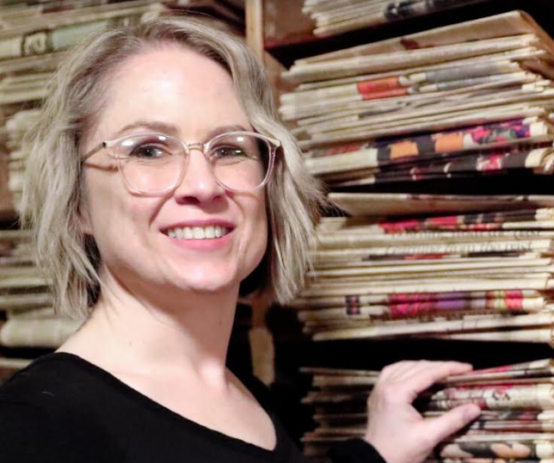
Above: Reporter Jessica Votipka. Credit Josh Salmon, Grand Island Independent.
Part of my job in those days was to learn more about the atmosphere on campus for LGBTQ students.
Bullying was a regular feature of their days, they told me.
“I’ve been told to kill myself so many times, I just tell them, ‘Can’t you come up with something better?’” one 17-year-old told me.
Others recounted the taunting and insulting messages on social media and in the hallways, which had become so routine that it was as if they were telling me what the school was serving for lunch that day.
But then on August 24, 2022, my story was published in the Grand Island Independent.
The cancellation garnered national attention and eventually spurred a lawsuit from American Civil Liberties Union of Nebraska against the district and its superintendent, Jeff Edwards.
The lawsuit eventually dismissed because Marcus had graduated by the time the newspaper was killed off, and thus had no legal standing.

Above: ‘Nurseries of democracy’: Northwest student journalism elimination a ‘Saga’.
For me, this was more than an important story about a school district discriminating against LGBTQ students or those who were allied with them.
It was also a personal trip down an ugly stretch of Memory Lane.
I had been bullied growing up. Not for being gay, but for whatever things mark a child as somehow different.
Being bullied carries with it shame and fear. Shame because we’re different and are constantly told that we’re inferior, unworthy of affection and respect. Fear because when you’re being bullied, all you think about is what the next day will bring, how to escape or if it will end.
For me, third through ninth grade was hell. I got bullied for everything: how I looked, how I walked, what I wore, what I said and how, for my family and the things I did for fun. I’m not sure what started it all, but I don’t think anything could rationalize it.
I slept a lot and was chronically absent. I was usually in bed well before the sun dropped from the sky. The more I sleep, the faster time will go, I told myself. The faster time went, the closer I was to getting away.
When having a sore throat was no longer enough reason to miss school, I started making myself vomit before the school bus arrived.
I had no adults who showed concern or stood up for me.

| Above: Jessica Votipka as a child.
As an adult, interviewing LGBTQ students, my background helped me report with empathy and create an environment where students were seen, heard and treated kindly.
But I was a bundle of nerves the first school board meeting after student newspaper story broke. My boss already had received phone calls from some district leaders who were in a roundabout way trying to get me fired. Despite my efforts to stay away from social media, I knew the comments were brutal, insulting our publication, my profession and, most significantly, the students.
The hate at the board meeting that night was palpable. I had brought shame to the district. I was a liberal journalist with an agenda.
“Hi Jessica. How are you?”
It was one of the elementary school principals. I will never forget his voice.
My head turned stiffly to look at him. I mumbled something about being “pretty good.”
“It’s good to see you,” he said.
His eyes were soft and his smile sincere.
I took my seat. I felt better.
I still felt hated, but I was OK with it.
I was hated for doing the right thing – telling the truth.
But I had someone in my corner. |
|
| As it turned out, the meeting was shockingly uneventful.
But the weeks after the story ran were far from quiet.
Tips from readers started trickling in about the high school’s discriminatory climate.
One person anonymously sent me screenshots of anti-LGBTQ memes allegedly posted on social media by one of the district’s science teachers and liked by a handful of faculty members.
A Twitter user pointed out a Northwest Board of Education member’s old post about transgender college swimmer Lia Thomas: “Lia Thomas is a MAN!! Stop it already!”
I found out through the ACLU’s public records request that the principal had referred to me in an email as an “over zealous [sic] reporter” who “misconstrued multiple facts.”
The judge in the case warned that “school administrators would be wise to remember that policies and decisions to restrict speech in student newspapers, even those operating as nonpublic forums, may run afoul of the First Amendment if they reflect ‘an effort to suppress expression merely because the public officials oppose a speaker’s view.”
Since then, the student newspaper has started up again, if only online.
Months after the ACLU’s lawsuit was filed, in an unrelated story, I went to interview students who had won a national award. They would be honored before a national convention of other students.
A student – I think she was a sophomore – met me at the front office to lead me to the classroom.
She was nervously outgoing, telling me breathlessly about the activities she was involved in and how lucky she was to go to school there.
We got to the classroom. I went in first.
“Meow.”
I turned to my left. A group of girls, perfectly popular in every way, was snickering.
My companion looked down at her shoes.
The interview was a decent one. Of course, some of the students were reluctant and were likely told they were going to be interviewed for the newspaper rather than asked.
My sophomore guide was still chatty, bubbling over with nerves.
In the background, the mean girls snickered and made comments when some of us spoke.
The teacher said nothing to stop them or support the speakers.
Interview over, my guide started to lead me out of the classroom, back to the front office.
As we approached the group of girls, my companion looked down and became silent, shuffling towards the door.
“Meow.”
For a split second I debated whether to say anything. It probably wasn’t my place. It definitely wasn’t professional.
I meowed back and hissed, “I know what ‘meow’ means, ladies. Keep it cute.”
“I know what ‘meow’ means, ladies. Keep it cute.”
Walking out of the room, I caught the glance of my student companion – a silent “thank you.”
This was new to her. An adult was supporting her.
Her demeanor changed. She was chatty again, without the nervousness driving the last hallway saunter.
I shook her hand and thanked her for guiding me.
Before I exited, I turned around and said, “I can’t wait to watch you kick ass at everything. I hope I get to see you again.”
“Me too,” she said.
Jessica Votikpa is an award-winning K-12 education reporter at the Arizona Daily Star. You can follow her at @GI_Jesca.
Previously from The Grade
‘I used to be an education reporter.’ (Dorie Turner Nolt)
‘So, are YOU a parent?’ (Ruth Serven Smith)
On motherhood and education journalism (Lauren Camera Smith)
How I survived being laid off from my first newspaper job (Aaricka Washington)
How I missed the phonics story (Patti Ghezzi) |
|
ABOUT THE AUTHOR
Launched in 2015, The Grade is a journalist-run effort to encourage high-quality coverage of K-12 education issues.