In this week’s newsletter: Districts are reporting on last year’s progress and implementing new reading programs. Chronic student absenteeism remains stubbornly high, despite recent efforts. There’s a new podcast series from the folks who brought last year’s “Southlake.” And how Taylor Swift could single-handedly save the journalism industry.
READING EFFORTS
The big story of the week
Momentum has been growing and this week’s big education story is — finally! — schools’ efforts to improve literacy instruction. The latest news includes dyslexia screening struggles in New York City (Gothamist/WNYC), an Indianapolis-area district’s success raising reading scores (Indy Star), and reports of progress in Chicago and Albany (Chalkbeat, Times Union).
To be sure, some states like Oregon and school districts like Clark County (Las Vegas) have not yet changed course or seen substantive progress (Review Journal, The 74). Parents in many places including Fort Worth have no idea how far behind their children are (Star Telegram). And districts including New York City have struggled to change reading instruction approaches (NY Post).
However, literacy efforts have made the nightly national broadcast news — a sure sign of growing awareness and urgency (NBC). Teachers lamenting low literacy levels are going viral on TikTok. And local education reporters are increasingly taking up the topic on their own initiative.
“I decided to do the story after seeing Warren Township had the greatest growth this past year on the state’s IREAD-3 scores out of the districts I cover,” explained the Indy Star’s Caroline Beck. Beck wasn’t able to pick the school or to report from multiple schools, but one school was enough to get the job done. “I kept chipping away at this story while working on other stories… I just stuck to my guns and kept doing the work.”
Other big stories of the week:
📰 SKY-HIGH ABSENTEEISM: Chronic absenteeism continues to plague schools, with the latest data from the 2023-23 school year showing that rates are still far above pre-pandemic levels (Chalkbeat). The problem is particularly bad in certain districts like Providence, where half of students were chronically absent last year (Boston Globe). Other districts are seeing glimmers of hope, as in Manchester, Conn., where the rate dropped from over 35% in 2021-22 to 25% last year (CT Insider). For schools struggling to get kids to come back, the best methods still seem to be physically knocking on doors and even picking up kids from home (BBC). If you’re reporting on absenteeism, be sure to check out how old the data is. In at least 35 states, the data is 15 months old or more.
📰 EXPANDED FREE MEALS: The U.S. Department of Agriculture announced this week it’s expanding free school meals to cover millions more students in low-income districts (USA Today, AP, Axios). While the change was lauded, the program still isn’t perfect. Some schools will need to help foot the bill, which has proven a barrier to entry, especially in rural communities (KWCH Kansas).
📰 CELL PHONE RESTRICTIONS: With 97% of teens saying they use their cell phones during the school day (K-12 Dive), schools are scrambling to come up with solutions to end the distraction — and also appease parents who want to stay in contact (Education Week). Aside from interfering with learning, some experts still warn that smartphones and social media are bad for students’ mental health (Financial Times). In New Jersey, one district has a new rule that allows school officials to seize kids’ phones in an effort to combat cyberbullying (NJ.com).

FIXING DYSLEXIA IN NYC
The best education journalism of the week
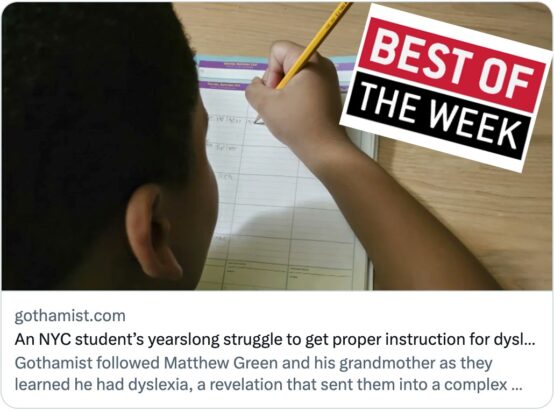
The best education story of the week is Gothamist/WNYC’s An NYC student’s yearslong struggle to get proper instruction for dyslexia by reporter Jessica Gould.
The story focuses on a struggling 9-year-old named Matthew who lives with his grandmother Trenace Green in Harlem. Gould followed the family for over half a year, learning about their long-running efforts to obtain services from the school, the district’s byzantine bureaucracy, and Green’s decision to send Matthew to a private school in Brooklyn.
The piece includes a variety of compelling voices, most notably a dyslexia advocate who’s helped generations of families and a literacy specialist who’s changing her practices after years. “I personally am responsible for probably 40 to 50 children not learning how to read,” says literacy specialist Teresa Ranieri. “That’s a hard thing to admit.”
The central question raised by the piece isn’t so much whether things will get better for Matthew, whose grandmother seems to have worked miracles to get him where he needs to be, but whether NYC Mayor Eric Adams’ reforms will make things easier for kids like him going forward.
You can listen to the eight-minute audio version. There’s also a useful explainer for parents who think their child might have dyslexia. Stephen Brown edited the print version. Christopher Werth and Ave Carrillo were the audio editors.
Other standout stories from the week:
🏆 Wisconsin child care providers aim to cut expulsions, suspensions (Wisconsin Watch)
🏆 Home schooling today is less religious and more diverse, poll finds (Washington Post)
🏆 Disasters are changing the US landscape — both in towns and in schools (USA Today)
🏆 Shaken by post-pandemic disruptions, some states take a harder line on school discipline (Stateline)
🏆 A nasty fight in a rural Virginia school district unearths dark truths (Washington Post)
A BRACING CRITIQUE
Our latest columns and commentary
In our fourth essay focused on literacy coverage, NYU’s Susan B. Neuman gives journalists a “B” — or maybe a “C” — for the stories she’s seen, citing superficial and repetitive coverage that doesn’t provide in-class reporting and often vilifies individuals involved, most notably “balanced literacy” champion Lucy Calkins.
“It’s cancel culture at its worst,” writes Neuman.
Whether you agree with her or not, it’s a bracing critique that’s also full of helpful ideas for improved coverage.
My favorite suggestion? You won’t be surprised. “Get in the classroom.”
Corrections: About this week’s column, ExcelinEd’s Kymyona Burk notes that Mississippi did not mandate a common curriculum but rather gave guidance and provided a list of high-quality options. About last week’s column, the school NYC parent Lee Gaul’s daughter attends was not given an individual waiver or exemption but rather is among the larger set of schools that are not required to change their literacy programs until next year.
POPPING WHEELIES AFTER MATH CLASS
Coverage of promising school innovations & signs of progress
💡 With detail and efficiency, this piece tells the story of a passionate teacher who has created an increasingly popular after-school program that teaches students how to design, maintain, and ride motorcycles (San Francisco Examiner).
💡 As outlets across the country document the chaotic rollout of their states’ universal preschool programs, this piece looks at what’s happening in Canada’s new national child care program, explaining where it’s been successful, how it needs to improve, and what U.S. policymakers could learn from it (Hechinger Report).
💡 Combining the education and climate beats, this story focuses on a California farming town where, through a fledgling CTE program, high schoolers can earn money, get career training in areas like energy efficiency — and lower their school’s carbon footprint (Grist) 9/7.
💡 Compared to its peers, Widener University, a small college in Pennsylvania has recovered remarkably well from pandemic-related enrollment declines — thanks, according to this piece, to a complete recruiting overhaul that involved giving prospective students more opportunities to meet with professors and keeping up frequent contact with admitted students (Philadelphia Inquirer).
Read more about the importance of covering promising innovations and preliminary successes.

Above, left to right: Honolulu Civil Beat’s Megan Tagami, Axios Atlanta’s Wilborn P. Nobles III, and Open Campus’s Kayleigh Skinner.
PEOPLE, JOBS
Who’s going where and doing what
🔥 Career moves: Coming off a Wall Street Journal education reporting internship, Megan Tagami is returning home to cover education for Honolulu Civil Beat. Former Atlanta Journal-Constitution education reporter Wilborn P. Nobles III has a new job at Axios Atlanta. And former Chalkbeat Tennessee reporter Kayleigh Skinner — most recently managing editor of Mississippi Today — is the new managing editor for Open Campus focused on race and equity coverage. Congrats to all!
🔥 Sound off: Oregonian education reporter Julia Silverman reflected on her role as a reporter amid the state’s dour post-pandemic recovery, posting on X, “I know I clearly need to do a much better job at shining a light on the urgency of this level of learning loss.” Education journalist Holly Korbey posted on X about how misunderstanding around student disability often “comes from inside the school building.” Writer Natalie Wexler wrote a letter to the editor in response to Laura Meckler’s Washington Post article on ending academic tracking, saying it “reflected a widespread misconception” that student sorting doesn’t begin until later in elementary school. And lastly, PolitiFact’s Jeff Cercone fact-checked the viral story about a teacher fired for assigning students “Anne Frank: The Diary of a Young Girl” — as Cercone notes, the teacher assigned a 2018 graphic novel adapted from the book, not the book itself.
🔥 Job openings & fellowship opportunities: The Hechinger Report is hiring an executive editor, and they’re hosting an information session next Wednesday for interested candidates. Anyone know when Chalkbeat is going to name a replacement for former Chalkbeat EIC Nicole Avery Nichols, who left to run the Detroit Free Press a while back? Idaho EdNews is hiring a reporter. And IRE is accepting applications for its Chauncey Bailey Journalist of Color Investigative Reporting Fellowship for community reporting projects.
🔥 Kudos & recognition: Congrats to the “Sold a Story” team for being named a Scripps Howard Award finalist for excellence in audio storytelling. Kudos to the team that produced the excellent 2019 “Valedictorian Project” series for the Boston Globe, whose impact continues in a nonprofit established with the same name to mentor high-achieving high schoolers. Huzzah! to The Hechinger Report for (indirectly) taking on its fiscal sponsor, Columbia’s Teachers College, in their story on how Columbia and NYU benefit from property tax breaks. And congrats to Wall Street Journal education editor and proud mom Chastity Pratt, whose son made a dramatic interception in a recent college football game.
🔥 Anniversaries: Former Bethesda Beat reporter Caitlynn Peetz is celebrating one year at Education Week — a “dream job” of hers. And former Florida Times-Union education reporter Emily Bloch is celebrating one year at the Philadelphia Inquirer, where she has one of the coolest ed-related beats: youth, internet, and local culture.

Above: NBC News’ Mike Hixenbaugh and Antonia Hylton have another education podcast out on the heels of the award-winning “Southlake.”
APPEARANCES, EVENTS, & NEW RESOURCES
What’s happening and new research
⏰ Podcasts: NBC News has a new podcast coming out Oct. 4 called “Grapevine,” about a Dallas-area school and a family caught in the culture wars. Former EdSource executive director Louis Freedberg has a new podcast called “Sparking Equity,” with the first episode on arts and music education.
⏰ Segments & appearances: New York Times Magazine reporter Susan Dominus and Inside Higher Ed’s Liam Knox were on WNYC’s “The Brian Lehrer Show” talking about college rankings and admissions. WBUR Here & Now had an episode looking back at a 1971 desegregation program in Boston. The Boston Globe’s Steph Machado aired a story on Rhode Island PBS Weekly about the state’s Early Intervention program. NBC News had segments this week on more schools bringing police back and reading programs.
⏰ Union update: The folks leading the EdWeek unionization effort tell me that they decided to forego an NLRB hearing and adopt a wall-to-wall bargaining unit, “meaning all employees who do not supervise someone will be included.” The election is scheduled for Oct. 11. “Despite the anti-union campaign that is still ongoing, we’re confident in our strong majority!”
⏰ Events: The Atlantic’s Adam Harris will moderate a New America event on Oct. 3 about book bans and inclusive education. On Oct. 19, Grade contributor Leslie Fenwick will speak at the Brown Lecture in Education Research on Black educators and the untold story of their professional superiority. And in case you missed it, Houston Landing’s Jacob Carpenter chatted with Houston ISD’s superintendent at the Texas Tribune Festival and the New York Times’ Erica Green moderated a panel at the National Association for College Admission Counseling Conference.
⏰ Research: An Education Trust study shows that white authors and characters are still far more present in K-12 curriculum than those of other races or ethnicities. U.S. News rounded up the 10 states with the most racial equality across high school dropout rates. According to Brookings, nearly 60% of liberals support the four-day school week, a much higher proportion than their moderate and conservative counterparts. And research reported in The 19th shows that “suicide rates were 3.2 times higher for teenage boys than teen girls between 2018 and 2020 — with guns increasingly playing an outsize role.”
⏰ Media resources: A new finding from the Pew Research Center reveals that “Black Americans are critical of news coverage of Black people and say educating journalists would make coverage fairer.” Scientific American editor Tulika Bose posted a helpful thread on X on how to find sources and stories using strategies including “community sourcing”: “It means staying for dinner. Accepting everyone’s aunties and uncles and cousins on Facebook. Learning, constantly.” And for Nieman Lab, Joshua Benton asks the meta question “What is news, anyway?” The data show that a reader’s answer depends on how much they see themselves in the story.
THE KICKER

“Can we get her photographed reading a newspaper?” – The Seattle Times’ Paige Cornwall.
That’s all, folks. Thanks for reading!
Reply to this email to send us questions, comments or tips. Know someone else who should be reading Best of the Week? Send them this link to sign up.
Using Feedly or FlipBoard or any other kind of news reader? You can subscribe to The Grade’s “feed” by plugging in this web address: http://www.kappanonline.org/category/the-grade/feed/.
Read more about The Grade here. You can read all the back issues of The Grade’s newsletter, Best of the Week, here.
By Alexander Russo with additional writing from Colleen Connolly, Will Callan, and Greg Toppo.
ABOUT THE AUTHOR

The Grade
Launched in 2015, The Grade is a journalist-run effort to encourage high-quality coverage of K-12 education issues.