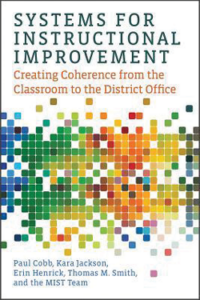
Systems for Instructional Improvement: Creating Coherence from the Classroom to the District Office
By Paul Cobb, Kara Jackson, Erin Henrick, and Thomas M. Smith (Harvard Education Press, 2020)
 As a former instructional coach and administrator, I always grappled with the most effective and efficient ways to foster large-scale, systemic change in schools and school districts. Sure, in my coaching position, I might engage in one-on-one coaching cycles with teachers or provide professional development for groups of teachers across one grade level, a grade-level band, or an entire school. But I knew that, as a coach, I was only one piece of a larger, interconnected puzzle, and all the different puzzle pieces needed to work in concert to support sustained school improvement.
Systems for Instructional Improvement: Creating Coherence from the Classroom to the District Office features a long-term professional development project called Middle School Mathematics and the Institutional Setting of Teaching (MIST). The purpose of the MIST project was to understand how to support teachers in their development of equitable and ambitious pedagogies and to unearth strategies that school districts can use to enhance the teaching and learning of mathematics on a large scale. The authors propose a theory of action that districts can use to achieve the goal of enhancing teaching and learning at scale: a) a coherent instructional system, b) school leaders’ practices as mathematics instructional leaders, and c) district leaders’ practices in building school-level capacity.
This book has been impactful to me in two ways. As a practitioner and former public school teacher, instructional coach, and administrator, I found this book incredibly useful as it provides a comprehensive and detailed framework for others to take up and adapt to their unique contexts to support large-scale instructional improvement. As someone who researches coaching and instructional improvement, I was able to ask different and better questions about the role of coaches in supporting large-scale instructional improvement. Furthermore, this book has influenced me to explore the various micro- and
macro-political forces that influence coaches as they strive to support teaching and learning.
ABOUT THE AUTHOR

Evthokia Stephanie Saclarides
Evthokia Stephanie Saclarides is an assistant professor in the Department of Curriculum and Instruction at the University of Cincinnati, Ohio.