When it comes to in-school reporting, the small but scrappy New Haven Independent shows how it’s done.
By Colleen Connolly
For the last two decades, education reporters at the Connecticut nonprofit New Haven Independent have produced multiple stories on how teachers teach, how students struggle to succeed, and what’s working in the classroom — or not.
The Independent was an early adopter of the literacy story in a region that has been slow to jump on it, and they learned about the issue in part by spending time in classrooms. Their reporting has occasionally led to change. And, perhaps most importantly, they gain readers’ — and educators’ — trust, allowing them even greater access to sources.
Longtime editor Paul Bass summed up their approach as a hyperlocal outlet.
“We’re always trying to find that balance between the big picture and what’s happening on the ground as a daily news site, a community,” Bass said in a phone interview. “In your mind, as the reporter, you know why the story matters, there’s a bigger issue. But you’re starting with what happened with somebody somewhere at school.”
Here’s what past and current Independent education reporters have done to strike that balance and find the story in a school.

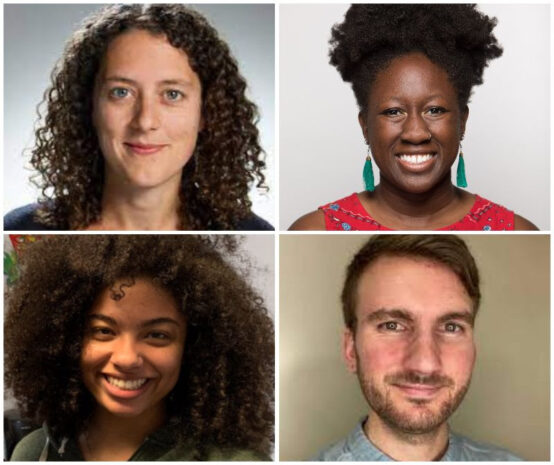
Above, clockwise from top left: current and former New Haven Independent education reporters Melissa Bailey, Aliyya Swaby, Christopher Peak, and Maya McFadden.
Be a part of the community — not just an observer:
According to Independent education reporters we spoke to, their access to classrooms began with former Indy reporter Melissa Bailey, who started there in 2006.
Bailey’s approach echoed what she said is the broader ethos of the outlet: a “deep love for people and the city” and an “unrelenting passion for transparency.”
“It translates to a motto of just ‘show up, show up, show up,’” she said in a phone interview.
By all accounts, Bailey exemplified the idea of showing up as both a reporter and part of the community. She started a book club for educators to get to know them outside of formal interviews. She joined a soccer team with charter school teachers.
Her reputation as a member of the community is part of what made schools trust her and let her in their classrooms — and it paid off big time. Bailey embedded at a different school each year, including one experimental high school trying out competency-based education. She showed up almost every week and produced about 30 stories on the school and students’ progress (or what turned out to be a lack of it).
Notable stories from this series include “Misfit Josh” & Alex Get A 2nd Chance about two students who had failed at other schools but were good fits for the new school’s experimental approach and Solanlly’s Tale Sways Uconn. For the latter story, Bailey spent the year following an undocumented student who was top of the class, but whose immigration status kept her from receiving a scholarship for valedictorians at the University of Connecticut. After Bailey’s story, the university changed its policy.
“The journalism at the Independent just feels so alive to me,” says Bailey. It doesn’t have this jaded sense of ‘things will never change, this is just another story about entrenched inequality.’ The journalism at the Independent to me is this fresh look at every story of how people’s lives are unfolding.”
Do the “granular” stories:
Aliyya Swaby, who’s now reporting on children and families for ProPublica, also got her start at the Independent. Picking up where Bailey left off, she found other ways to gain access to classrooms.
For example, Swaby said she reported on the more “granular” stories that reporters at other outlets, such as the competing New Haven Register, didn’t do.
One example is Hillhouse Principals Warm Students To Transition. Rather than focus on just the structural changes involved in breaking up the city’s large comprehensive high schools into mini-schools, Swaby focused on students’ confusion on the first day and how the principals were addressing it.
Another example is Students Take The Reins, which describes how students at a handful of New Haven schools led workshops for teachers about how to engage and support students.
The granular approach is something you can still see in the Independent’s school coverage today. The page is full of stories about small happenings in schools, like a new student newsletter, a dilemma about uneaten food and the possible solution of composting, and a group of students participating in a U.S. Constitution-focused competition in DC.
While stories like these may not seem that important, Swaby said they helped her gain educators’ trust for addressing even larger issues.
In 2015, Swaby wrote As Common Core Looms, Schools Up Tech Game, which dives into an unexpected challenge of switching to Common Core testing: students’ (and teachers’) struggle to grasp the testing technology well enough to perform up to their abilities on the test.
Swaby reported from inside the classroom where students were practicing typing and the teacher admitted her worries that she wouldn’t be able to grasp the technology herself. These details added color to an otherwise routine story.
“I think a lot of people starting out as education reporters start at the school board meetings and that’s kind of it,” Swaby told me in a phone interview. “But because of the relationships that Melissa Bailey had built with principals and teachers and parents and students, we had access in a way that I think is relatively rare and becoming rarer unfortunately.”
Leverage accountability stories for district buy-in:
Christopher Peak, now at APM Reports and part of the blockbuster “Sold a Story,” spent a few years covering education at the Independent after Swaby. He did his early reporting on literacy there, including Reading Coach Preps Parents about a system-wide effort to boost reading ability through literacy workshops.
While at the Independent, he made a name for himself with his accountability reporting, which led to a “negotiated exit” for a superintendent.
In classrooms, Peak, who had a background in solutions journalism, asked wonky questions about curriculum and delved into what was working — or not. Some of his resulting stories include How One School’s Kids Tackled Math about a school that doubled its math proficiency rates in just one year and Martinez Bridges English, Español about a teaching method that ensures that non-native speakers achieve English proficiency without giving up their first language.
“That was one thing Paul (Bass) encouraged, trying to get into schools and figure out how they worked,” Peak said. “Trying to get deep and wonky and be unafraid of that — and tell a damn good story while doing so.”
While you’d think Peak’s reporting would have made it harder to get access to schools, he used his investigations as leverage to get into classrooms and tell positive stories, too. Following the advice of Bass, he said, “you can’t piss everyone off.”
Utilize comments and connections:
Since the pandemic, in-class reporting has waned pretty much everywhere, including at the Independent. It would be great to see them return to those days, but in the meantime current education reporter Maya McFadden is finding new ways to get into schools.
In an effort to rebuild some of the connections lost or damaged in the world of virtual reporting, McFadden — who started the job during the pandemic — and Tom Breen, who took over as editor in November, have been mining the outlet’s robust comments section.
While many outlets have abandoned comment moderation or even done away with comments altogether, the Independent has spent years cultivating an engaged audience there.
It’s not uncommon for an education story to have as many as 50 comments within a few days. Using those comments, McFadden has reached out to several teachers for interviews, hoping they’ll expand on what they wrote. And some do, including one teacher who shared her story of why she’s leaving the profession, which led to more teachers reaching out to her to share their stories.
While these stories are not reported from classrooms, they are helping McFadden rebuild trust and work her way in. Her efforts paid off in March when she published a story reported from inside a classroom of kindergarteners learning to read using a new pilot program.
The story is filled with the kind of details that matter when reporting on literacy; it’s not just about methodology, but also how kids are responding to it. In this story, McFadden details what happens when the teacher asks kids to point out the writing pattern in a story about Jane Goodall.
“As Giusti read, the students discovered the book’s pattern was repetition of the phrase ‘and watches closely’ as the text named ways Jane Goodall learned about chimpanzees.
“‘Yes! The sentences begin different but end the same,’ Giusti said.
Students cheered once identifying the book’s pattern.”
One difference between McFadden and her predecessors: The earlier education reporters were Yale grads. McFadden was born and raised in New Haven and attended New Haven Public Schools, but not Yale. This also gives her an edge when it comes to finding ways to get inside schools, Breen said.
“Maya still knows a fair number of people who teach and work in the school system, even if they’re not direct contacts or sources,” Breen said. “She really understands what it’s like to be a student in the New Haven Public Schools, and I think that lived experience really helps in winning trust and communicating accurately to readers what’s going on there now.”

Above: New Haven Independent editors Paul Bass (left) and Tom Breen.
While districts bear the brunt of the responsibility for less in-class reporting these days by restricting access to journalists, New Haven Independent reporters show how detailed, community-based education reporting can still be done even with limited classroom access — and why it should be.
Nothing replaces firsthand insights from inside a classroom on a regular school day. And readers deserve to know what’s going on.
Colleen Connolly is a freelance journalist who covers New England for The Grade. Her work has also appeared in The Imprint News, the Minnesota Reformer, the Columbia Journalism Review, The Guardian, The New Republic, Smithsonian magazine, and the Chicago Tribune. See more of her work here. You can follow her on Twitter: @colleenmconn.
Previously from this author
Parents and vulnerable kids ‘slipping through the cracks’ in Providence
Bright spots and black holes in New England education coverage
Globe reporters describe how they cover immigrant English learners
Covering students in foster care
Previously from The Grade
How the NYT’s Susan Dominus reported on Providence schools without going into classrooms
How Chicago public radio breaks free from the hamster wheel of daily education news