A middle school teacher and a university professor offer a model for how teachers and teacher educators can build an ongoing local professional laboratory
Partnerships between preK-12 teachers and university professors can bring benefits and solve challenges that both teachers and professors face. These relationships can provide teachers with professional development opportunities that go beyond one-size-fits-all training. Professors, especially those in charge of teacher preparation programs, depend on local schools to host teacher candidates and to keep up with recent classroom challenges and trends.
Our decades-long professional relationship is an example of this beneficial partnership. Our grassroots professional laboratory started in 1995 when we, a university professor (Geoff) and a middle school teacher (Mike), recognized how much our professional worlds overlap and how interested we each were in the other’s work. At the time, Mike taught 7th grade at Hudson Middle School, a suburban school in Hudson, Wisconsin. Geoff was a professor of teacher education at the University of Wisconsin, River Falls. Our inexpensive, ongoing, improvisational, and self-directed collaborations were tailored to the work we were already doing in ways that not only enhanced our own professional growth, but also benefited administration and support staff, school and campus colleagues, and our respective students.
Mapping the territory of reciprocal professional development
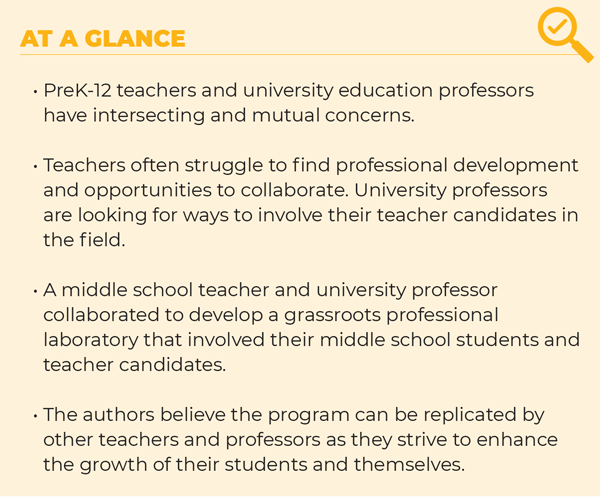
Starting a grassroots professional laboratory begins with an understanding of the intersecting needs of teacher and professor. Teachers like Mike are looking for new classroom strategies. University faculty can use their knowledge of educational research and theory to supply innovative pedagogical and curricular strategies. Professors like Geoff depend on practicing classroom teachers, not only for effective mentorship of student teachers, but also for the opportunity to witness and test new approaches in authentic and ever-changing landscapes. Meanwhile, student teachers who join these collaborations can try out the techniques they learn in their educator preparation program.
Figure 1 shows how the needs of university and preK-12 faculty intersect. Our experiences bringing these areas together can be a roadmap for other teachers and professors as they strive to enhance the growth of their students and themselves.

On-site seminar: Finding the sweet spot
Our first collaboration involved a field trip where Geoff’s class observed Mike teaching his social studies class using the archeological artifacts of Ötzi the Ice Man, uncovered in the Alps. During the lesson, we noticed that students and adults interact with artifacts in similar ways (Yell, Scheurman, & Reynolds, 2004). In essence, the middle school students were engaging in some of the same activities as professional archeologists. This led to an after-school discussion about how the most basic and powerful form of intellectual development occurs when teachers and students are steeped in the same processes as disciplinary experts.
Identifying authentic intellectual work (Scheurman & Newmann, 1998) that ignites curiosity among both college students and middle schoolers was a huge step in our professional growth. Such encounters became the sweet spots in our collaborations: We identified places where teachers, teacher candidates, and younger learners were eager to engage in curiosity-driven inquiry-based conversations using the same concepts, procedures, and raw materials as working professionals. (For a summary of research on authentic intellectual work, see Newmann, Carmichael, & King, 2016.)
Student shadow day: Gaining new perspectives
Field experiences are a staple in most educator preparation programs. But Geoff wondered whether the field experiences he planned for his students were doing enough to help them understand adolescents. The long-standing practice had been for college students to learn by shadowing a teacher. Why not have them shadow a student? Mike solicited the support of his principal and fellow teachers to pair up student teachers and 7th graders. On shadow day, college students met middle school students as they got off the bus and spent the entire school day with them.
We gained revolutionary insights from this experience. After-school debriefings with teachers and teacher candidates were full of candidates’ testimonies, observations, and questions. Teachers lit up as they shared insights and nuances related to how they dealt with issues the teacher candidates just witnessed. Using checklists on child development from Chip Wood’s Yardsticks (2018), student teachers connected what they observed about the cognitive, physical, social, and emotional development of the 12- and 13-year-olds they shadowed with curriculum and classroom practice. Including the student perspective enabled college students to see school through the eyes of a middle school child. At the same time, teachers became more attuned to emotional challenges of teacher candidates, the professor gained new perspectives, and the 7th graders had a wonderful time hosting the college students.
Starting a grassroots professional laboratory begins with an understanding of the intersecting needs of teacher and professor.
The shadow-a-student activity continues to this day, expanding to an additional school and including an opportunity to serve as voluntary group leaders for small teams of 7th graders during a special “Courage Retreat” day.
Trading spaces week: Finding beauty in one another’s worlds
Our partnership transformed into an official laboratory experience when we persuaded administrators to allow us to exchange places for a week — an experience the middle school students called “trading spaces.”
Geoff’s first two days at the middle school were relatively smooth, but, by midweek, the honeymoon was over. Geoff confessed that the 7th graders were “kicking his butt.” On Thursday, to recapture the spark, Geoff invited the class to join him for vocal warmups, complete with video of his larynx in action. His young audience was hooked after connecting movement of air across the vocal cords to how Egyptians were able to transport massive stones. Students soon disbursed to stations to explore different techniques for moving simulated stones (heavy history textbooks) across various surfaces and materials. In the end, they discovered how round pencils representing huge logs were the best solution for “rolling” heavy blocks across sand with relative ease, mirroring how Egyptians were able to move unwieldy obelisks over long distances.
The chaotic post-lab discussion seemed out of control until Geoff remembered that 7th graders’ cognitive disequilibrium during a “sweet spot” inquiry is more socially visible than it is with college students. In short, they might not be able to hold back when trying to figure something out. Geoff found that he had to improvise the lesson plan, allowing pockets of activity to erupt naturally between students as they sought explanations for their findings. He eventually called impromptu “timeouts” for each team to come forward and demonstrate surprisingly sophisticated physical, mathematical, and other creative explanations. Experiencing such dynamics firsthand is useful professional development for any teacher educator.
Meanwhile, on the university campus, Mike capitalized on opportunities to explore and model lessons that he could implement in his classroom. He found it exhilarating to share skills and expertise as a National Board-certified teacher with thoughtful adults just beginning their initiation into the profession. Mike also joked about having an hour each day to read and reflect as part of a college professor’s daily affairs, a rare luxury for a middle school teacher. What began as a role as guest speaker and laboratory for teacher candidates led to an adjunct instructor position at the university for Mike.
If school leaders embrace the value of faculty-initiated collaboration and improvisation, teachers and professors may be more invested in the mission of teacher education and their own professional development.
The two of us came together during trading spaces week after Mike shared how middle school faculty were anxious about new standards the state was rolling out. Geoff was recommended to the principal to lead a pro bono after-school in-service seminar titled “Strategies, Substance, and Standards,” demonstrating how teachers could embrace standards as an opportunity to experiment rather than an externally imposed constraint.
Although we didn’t do another long-term exchange, we continued to frequently do one-day guest appearances in one another’s classes. For example, in some years, Geoff spent a whole day at the middle school as a fully vested “abbot” overseeing a room full of “monks” as part of a simulated medieval monastery. And “Mr. Yell Day” became an annual experiential seminar in the university’s social studies block practicum. Geoff also spent a full trimester filling in for another teacher at a local high school while supervising student teachers in the same school.
Culture month and virtual study abroad: Building bridges to communities near and far
Learning thrives when we are free to take advantage of opportunities that arise organically. The idea of a collaborative interdisciplinary unit occurred when Mike learned about a pair of parents in his school who would be traveling across the Yucatán Peninsula on bicycles. These adventurers were willing to share their experience through reports from Belize. Mike invited the university teacher candidates to create a series of enrichment exercises in preparation for the virtual biking experience. This activity matched the requirements of the culminating activity in Geoff’s Techniques of Teaching class. Both Geoff and Mike guided candidates as they researched, developed, and later implemented station-centered lessons that included a simulated river tour of Belize’s geography, an exploration of the Mayans’ astronomic projections, and a study of the Mayans’ invention of the concept of zero in their unique math system.
Easy communication between the middle school and university, as well as the ability to take advantage of a special opportunity, gave all parties a unique professional growth experience. Teacher candidates got real-world experience as they prepared the middle school students to interact with the bikers on live video feeds, and they saw what happens when even a small group of faculty rallies around a unifying project. Having the teacher candidates deliver lessons across multiple days gave Mike time to coordinate with his colleagues and manage the complexities of the virtual exchange.
This project turned into an invaluable cultural and pedagogical experience that the teachers ended up calling “Culture Month.” Although the project began with Mike and Geoff’s focus on the transdisciplinary nature of social studies, the university students’ enrichment lessons cut across a variety of core subjects. As a result, other faculty reported a spike in excitement for math, science, and literature related to the experience.
Interdisciplinary co-teaching semester: Merging professional worlds
Fueled by our success, the laboratory expanded when Geoff and a university colleague were assigned to co-teach a course on middle schoolers’ development for social studies, math, science, and language arts education majors. Working with Mike’s middle school to prepare an interdisciplinary unit for the course seemed like a mutually beneficial undertaking.
Mike, his colleagues, and a retired middle school principal, along with Geoff and a literacy colleague, met with the teacher candidates. Together, we decided to make the historical novel Out of the Dust (2009) by Karen Hesse the centerpiece of a weeklong unit on the Dust Bowl. English education students and the middle school’s reading and language arts teachers designed literature circles. Science candidates planned lessons with the middle school teacher on Depression-era challenges of weather, soil erosion, and farming. Math majors and their teacher searched for patterns in 1930s economic and environmental data. Mike and his social studies charges searched for primary resources to teach Dust Bowl history, politics, and economics. At the university, Geoff modeled a 90-minute inquiry lesson on historical empathy, devoted to the question of whether the Depression-era photographer Dorothea Lange should be considered an artist, a historian, or something else. Meanwhile, his literacy colleague ensured that each lesson plan was truly interdisciplinary and supported academic language.
Although the project began with a lot of disequilibrium, it came together as a week of lessons co-taught by teachers and teacher candidates. Our grassroots professional laboratory had organized itself into one elegant entity, with school and university serving as equal partners. By immersing themselves in the middle school world, teacher candidates and professors had an authentic experience that exceeded those of a typical practicum, and seasoned middle school teachers reported gaining valuable insights and ideas for how to make their curricula more interdisciplinary in the future.
Collaboration and improvisation in professional development
Teacher educators often find it challenging to refresh their practice through firsthand classroom experience, while the demands of preK-12 teaching make it difficult even for self-starters to initiate bona fide growth opportunities. Creating time and space for partnerships is a great way to empower the players in teacher professional development — teachers, students, professors, and teacher candidates — to become engaged members of a dynamic and perpetual experiment.
In our case, Mike was given leave to come to campus when required, but nothing was institutionalized districtwide on the local level. Our collaboration grew out of two peoples’ willingness to improvise around the connections we found between our respective territories. The beauty of our partnership was that the local activities could be integrated at the middle school and on the college campus with administrative support but without top-down or bureaucratic intervention.
Our overall collaboration has continued in part because we chose to deliberately combine our efforts across multiple domains of our work. In addition to classroom activities, we have collaborated on research, scholarly, and creative activities. We co-edited a special issue of a major journal (Scheurman & Yell, 1998); co-authored a book on engaging students in the study of history (Yell, Scheurman, & Reynolds, 2004); contributed a chapter to The Educator’s Handbook for Teaching with Primary Sources (Yell & Scheurman, in press); and we continue to facilitate workshops and clinics for teachers across the country. Geoff served as Mike’s chief of staff when Mike was president of the National Council for the Social Studies, and Mike served as Geoff’s special assistant when Geoff was project director for a multiyear curriculum development and demonstration grant from the National Council for the Humanities. What better professional development could a principal or dean want for their faculty?
The home base for our professional laboratory has always remained the classroom, which has morphed over the years as new people faculty, trends, standards, and technology have entered the scene. Our work mirrors the dynamic nature of school itself. Adopting a flexible view of teacher professional development generates an organizational spirit in which future individuals will be empowered to take advantage of potential relationships that form within and beyond their own classrooms.
Since the partnership began in 1995, new faculty and schools have come into the fold. For example, Geoff taught a full trimester class at a different school while supervising three student teachers and allowing a high school teacher release time to pursue self-guided research on educational technology. We have also facilitated seminars for historians at Oxford University (Geoff) and medievalists at an International Congress on Medieval Studies (Mike), demonstrating how the same methods and materials we use with college students and middle schoolers work equally well with highly qualified professionals.
Together, we have shown how any teacher-professor duo can create a grassroots professional laboratory from the ground up, for the benefit of teachers, teacher educators, teacher candidates, and the students they ultimately serve. If school leaders embrace the value of faculty-initiated collaboration and improvisation, teachers and professors may be more invested in the mission of teacher education and their own professional development.
References
Newmann, F.M., Carmichael, D.L., and King, M.B. (2016). Authentic intellectual work: Improving teaching for rigorous learning. Sage Publishing.
Scheurman, G. & Newmann, F.M. (1998). Authentic intellectual work in social studies: Putting performance before pedagogy. Social Education, 62 (1), 23-25.
Scheurman, G. & Yell, M. (1998). Constructing knowledge in social studies. Social Education, 62 (1).
Wood, C. (2018). Yardsticks: Child and adolescent development ages 4-14. Center for Responsive Schools.
Yell, M. & Scheurman, G. (in press). In their hands, hearts, and minds: Strategies for helping students touch, inquire, and think deeply using primary sources. In S. Waring (Ed.), The educator’s handbook for teaching with primary sources. Teachers College Press.
Yell, M., Scheurman, G., & Reynolds, K. (2004). A link to the past: Engaging students in the study of history. NCSS Publications.
This article appears in the May 2023 issue of Kappan, Vol. 104, No. 8, pp. 36-41.
ABOUT THE AUTHORS

Geoffrey Scheurman
GEOFFREY SCHEURMAN is a professor of teacher education at the University of Wisconsin, River Falls.
Michael Yell
MICHAEL YELL is a retired National Board-Certified teacher, freelance educational writer and teacher trainer, and adjunct college instructor.