Classroom literature with multiracial characters helps students from this fast-growing demographic feel accepted and embraced in school.
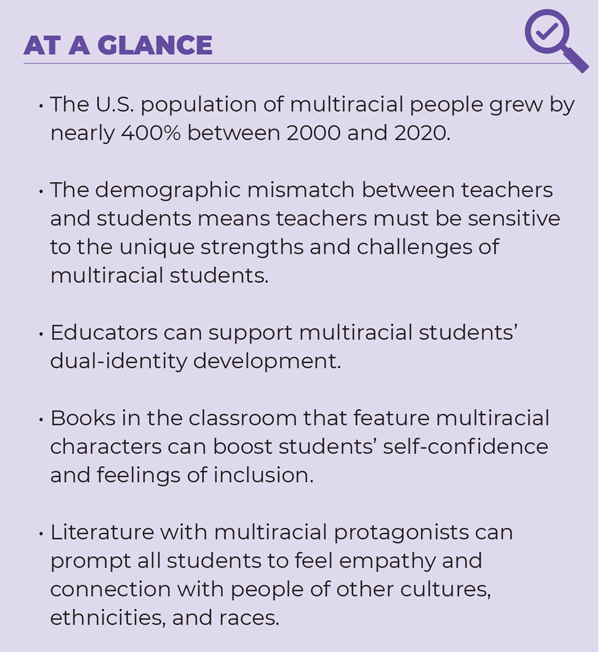
The number of multiracial people in the U.S. grew by 276% between 2010 and 2020, from 9 million to 33.8 million (Jones et al., 2021). People claiming multiracial identities are the fastest growing racial group in the U.S. (Lee & Bean, 2004). By 2050, multiracial individuals are expected to make up 20% of the total U.S. population (Latson, 2019).
The growth in the number of multiracial students highlights the demographic mismatch between educators and students. Currently, 80.3% of American teachers are white, 9.3% are Hispanic, 5.8% are Black, and 2.4% are Asian. Only 1.7% are multiracial (Taie, Lewis, & Spiegelman, 2022).
Recognizing strengths and challenges of multiracial students
How can a mostly white population of educators support multiracial students in our classrooms? We can begin by recognizing the unique strengths and challenges of this population. Multiracial people may have an enhanced capacity for divergent thinking on issues of race (Lou, Lalonde, & Wilson, 2011) and building positive intergroup relations (Glasford & Dovidio, 2011). They often have a heightened awareness that race is a social construct, not defined by biology, and this understanding helps them to reject racial stereotypes (Shih, Bonam, & Sanchez, 2007). They frequently learn to move between different racial identities from a young age, making them more sensitive to social contexts and able to adopt more flexible cognitive strategies for dealing with different social environments than their peers who represent one race (Gaither, 2015).
Multiracial young people also face challenges. Multiracial people, like all individuals of color, experience increased racial discrimination, from slurs to physical threats and attacks (Parker et al., 2015). On top of that, they may have difficulty finding role models who resemble them, even within their own families (Townsend, Markus, & Bergsieker, 2009). Research suggests that biracial individuals are more vulnerable to identity confusion, alienation, drug and alcohol abuse, and suicide (Nuttgens, 2010).
Multiracial young people often find it difficult to forge their own racial identities in a society that still largely acknowledges only single-race categories. They frequently find themselves misidentified, often based on their physical appearance. One common mischaracterization is to assign biracial people with only one Black parent a Black identity, without reference to their other parent. This is the legacy of the Jim Crow “one-drop rule,” which asserted that any African ancestry was grounds for deeming a person Black (Harris, 2018).
Supporting multiracial students through stories
Educators can support multiracial students’ identity development by encouraging them to acknowledge and celebrate their diverse racial heritage (Choi et al., 2006). All school and classroom demographic forms should provide the opportunity for students to select from more than one racial category. Requiring multiracial individuals to choose one racial category sends the message that the individual’s mixed racial heritage is undervalued by society, a feeling that may be associated with higher rates of depression (Sanchez, 2010).
Scholars assert the importance of giving a voice to people from marginalized populations. Their stories validate the lived experiences of others like them and challenge versions of reality held by the privileged (Hughes-Hassell & Cox, 2010). Using classroom literature with accurate and sympathetic depictions of multiracial characters (such as those listed on p. 55) is one way to validate these students’ reality and demonstrate respect and inclusivity toward their mixed-race backgrounds.
Books with multiracial characters have clear value to students who share these identities, but it is important for all readers to see depictions of diverse populations.
Children’s book author Torrey Maldonado, who is Black and Puerto Rican, experienced this kind of validation when his mother brought a copy of The Snowy Day by Ezra Jack Keats into their home in a New York City housing project: “I thought that book was me! I thought the mother was my mom. What made that book so precious to me is it took my neighborhood and made me see the magic in it” (in Flannery, 2020).
I have a story of my own in this vein. As a toddler, my daughter, who is Indigenous, white, and Mexican, had among her collection a picture book about babies. Whenever she came to the page with a brown-skinned baby between one darker- and one lighter-skinned parent, she would clap her little hands together and shout her own name. As these reactions attest, young people need to see themselves reflected in their reading material.
Expanding all students’ awareness
Books with multiracial characters have clear value to students who share these identities, but it is important for all readers to see depictions of diverse populations. Books with multiracial central characters can teach young people of all races to empathize with those from backgrounds different from their own and reduce the prevalence of harmful stereotypes (Newstreet, Sarker, & Shearer, 2018). Reading books with multicultural characters can help young people understand current events with more clarity; increase awareness of the practices of other cultures; and promote interaction, empathy, and unity across racial and cultural groups (Literacy Minnesota, 2020). As students better understand and learn to empathize with others through text, they realize that people are more alike than different, decreasing the potential for prejudice (Newstreet, Sarker, & Shearer, 2018).
Erika Long, a Tennessee middle school librarian, points out that a book is often the best way to help young readers understand people who don’t share their race, religion, sexual orientation, or socioeconomic status (in Flannery, 2020). This is particularly important in a country with continuing segregation in schools. A majority of American public school students attend schools where most of the student body shares their racial or ethnic background (Schaeffer, 2021), making it difficult for young people of different races to connect with and understand each other (Flannery, 2020).
The U.S. is growing more diverse every year, and multiracial students are the fastest-growing population in our increasingly diverse nation. Educators must respond to these changing demographics by supporting multiracial students in their dual-identity development and providing classroom literature with sensitive, authentic depictions of multiracial characters. Our students should experience the magic of seeing themselves in books and learn to value multiracial individuals whose journeys they share through literature.
Middle grades novels with multiracial protagonists
Abby Spencer Goes to Bollywood by Varsha Bajaj (Indian and white)
Absolutely Almost by Lisa Graff (Korean and white)
Becoming Naomi León by Pam Muñoz Ryan (Mexican and white)
Bird by Crystal Chan (Jamaican and Mexican)
Blended by Sharon M. Draper (Black and white)
The Blossoming Universe of Violet Diamond by Brenda Woods (Black and white)
Brendan Buckley’s Universe and Everything in It by Sundee T. Frazier (Black and white)
Caterpillar Summer by Gillian McDunn (Black and white)
Dream On, Amber by Emma Shevah (Italian and Japanese)
Dust from Old Bones by Sandra Forrester (Black and white)
Five Things About Ava Andrews by Margaret Dilloway (Japanese and white)
Full Cicada Moon by Marilyn Hilton (Black and Japanese)
Hold Fast by Blue Balliett (Black and white)
Karma Khullar’s Mustache by Kristi Wientge (Indian and white)
Keep It Together, Keiko Carter by Debbi Michiko Florence (Japanese and white)
Lupe Wong Won’t Dance by Donna Barba Higuera (Chinese and Mexican)
The Other Half of Happy by Rebecca Balcárcel (Guatemalan and white)
The Other Half of My Heart by Sundee T. Frazier (Black and white)
Prairie Lotus by Linda Sue Park (Chinese and white)
Rain Is Not My Indian Name by Cynthia Leitich Smith (Native American and white)
The Science of Breakable Things by Tae Keller (Korean and white)
See You in the Cosmos by Jack Cheng (Filipino and white)
The Sky at Our Feet by Nadia Hashimi (Afghan and white)
Somewhere Along by Annie Donwerth-Chikamatsu (Japanese and white)
Step Up to the Plate, Maria Singh by Uma Krishnaswami (Indian and Mexican)
This Is Just a Test by Madelyn Rosenberg and
Wendy Wan-Long Shang (Chinese and Jewish)
A Thousand Questions by Saadia Faruqi (Pakistani and white)
What the Moon Saw by Laurie Resau (Mexican and white)
The Whole Story of Half a Girl by Veera Hiranandani (Indian and Jewish)
References
Choi, Y., Harachi, T.W., Gillmore, M., & Catalano, R.F. (2006). Are multiracial adolescents at greater risk? Comparisons of rates, patterns, and correlates of substance use and violence between monoracial and multiracial adolescents. American Journal of Orthopsychiatry, 76 (1), 86-97.
Flannery, M.E. (2020, October 26). Why we need diverse books. NEA News.
Gaither, S.E. (2015). “Mixed” results: Multiracial research and identity explorations. Current Directions in Psychological Science, 24 (2), 114-119.
Glasford, D.E. & Dovidio, J.F. (2011). E pluribus unum: Dual identity and minority group members’ motivation to engage in contact, as well as social change. Journal of Experimental Social Psychology, 47 (5), 1021-1024.
Harris, K. (2018). Biracial American colorism: Passing for white. American Behavioral Scientist, 62 (14), 2017-2086.
Hughes-Hassell, S. & Cox, E.J. (2010). Inside board books: Representations of people of color. The Library Quarterly, 80 (3), 211-220.
Jones, N., Marks, R., Ramirez, R., & Ríos-Vargas, M. (2021, August 12). 2020 Census illuminates racial and ethnic composition of the country. United States Census Bureau.
Latson, J. (2019, May 7). The biracial advantage. Psychology Today.
Lee, J. & Bean, F. (2004). America’s changing color lines: Immigration, race/ethnicity, and multicultural identification. Annual Review of Sociology, 30, 221-242.
Literacy Minnesota. (2020, October). Representation matters: Diversity in children’s books.
Lou, E., Lalonde, R.N., & Wilson, C. (2011). Examining a multidimensional framework of racial identity across different biracial groups. Asian American Journal of Psychology, 2 (2), 79-90.
Newstreet, C. Sarker, A., & Shearer, R. (2018). Teaching empathy: Exploring multiple perspectives to address Islamophobia through children’s literature. The Reading Teacher, 72 (5), 559-568.
Nuttgens, S. (2010). Biracial identity theory and research juxtaposed with narrative accounts of a biracial individual. Child and Adolescent Social Work Journal, 27, 355-364.
Parker, K., Menasce Horowitz, J., Morin, R., & Lopez, M.H. (2015, June 11). Multiracial in America: Proud, diverse, and growing in numbers. Pew Research Center.
Sanchez, D.T. (2010). How do forced-choice dilemmas affect multiracial people? The role of identity autonomy and public regard in depressive symptoms. Journal of Applied Social Psychology, 40, 1657-1677.
Schaeffer, K. (2021, December 10). America’s public school teachers are far less racially and ethnically diverse than their students. Pew Research Center.
Shih, M., Bonam, C., Sanchez, D.T., & Peck, C. (2007). The social construction of race: Biracial identity and vulnerability to stereotypes. Cultural Diversity and Ethnic Minority Psychology, 13 (2), 125-133.
Taie, S., Lewis, L., & Spiegelman, M. (2022). Characteristics of 2020-21 public and private K-12 school teachers in the United States. Results from the National Teacher and Principal Survey. National Center for Education Statistics.
Townsend, S.S.M., Markus, H.R., & Bergsieker, H.B. (2009). My choice, your categories: The denial of multiracial identities. Journal of Social Issues, 65 (1), 185-204.
This article appears in the May 2023 issue of Kappan, Vol. 104, No. 8, pp. 52-55

ABOUT THE AUTHOR

April Vazquez
APRIL VAZQUEZ is an educator and doctoral student at the University of Delaware, Newark.