In this week’s newsletter: A sudden surge of coverage about teaching kids to read. Exploring the link between gun violence and student absenteeism. Balancing hope and skepticism in covering schools. And an ed reporter proves that she’s unshakable — on live TV.
LITERACY EVERYWHERE ALL THE TIME
The big story of the week
The big education story of the week is the surge of high-quality literacy coverage, which includes at least four major stories. A frustrating trickle of stories about schools trying to teach more kids to read has — finally! — become something of a flood.
Two of these efforts from the New York Times and the Akron Beacon Journal are front-page stories. The latter is a three-part package. Another from EdNC is the first in a new series. And one more — perhaps the best of the lot — is from the AP’s Bianca Vázquez Toness, whose coverage reminds me of former New York Times education reporter Erica Green. (Yes, I said it.)
All four of these pieces are strong in different ways. But they all avoid stale “reading wars” framing and exhibit restraint when it comes to overstating the effects of recent shifts. They feature reporting that marries urgency with realism.
We need schools to teach more kids to read. It’s not going to be easy to pull it off. And — here’s where education journalism comes in — literacy deserves as much or more attention as book bans or any other culture war conflict. It’s just as important that kids can read as what books are being taught or in the school library. “Wake up, folks,” says educator Teresa Sanders. Don’t let book bans distract from student illiteracy.
Other big stories of the week:
📰 AVERTING STRIKES: LAUSD is increasing teacher pay by 21% over three years and thus avoiding a followup to the recent strike in which teachers joined school staff in closing down schools for three days (New York Times, Los Angeles Times, LAist, AP, LA Daily News). In Oakland, hundreds of parents signed a petition begging teachers not to walk off the job after a call for a strike vote (San Francisco Chronicle).
📰 END OF ESSER: The deadline to spend the third and final installment of ESSER funds is still almost a year and a half away, but most district leaders say they’re almost done spending the money (Education Week). Though transparency remains a problem, many districts are spending the money on efforts to catch kids up in subjects like reading and math (Christian Science Monitor). But with the end of the one-time windfall approaching, districts face tough budget decisions and the loss of positions created to address post-pandemic needs (Washington Post, WXYZ Detroit).
GUN VIOLENCE & ABSENTEEISM
The best education journalism of the week
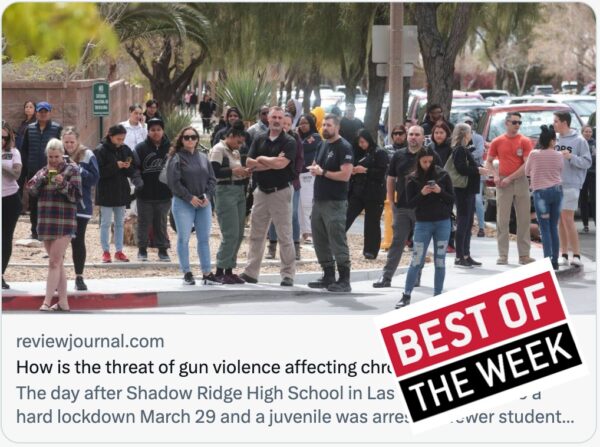
The best education story of the week is Julie Wootton-Greener’s How is the threat of gun violence affecting chronic absenteeism at CCSD? for the Las Vegas Review-Journal. We’ve been reading about school gun violence and student absenteeism for months, but this is the first story I can recall that explores the possible links between the two.
School gun violence has become a widespread concern among students and parents. And it makes sense that it wouldn’t take an active shooter on campus to disrupt students’ attendance in school. In her piece, Wootton-Greener provides anecdotal and statistical evidence showing how Clark County students tend not to come to school after lockdowns, false alarms (aka “swatting”), and students caught with guns on campus.
Concerns about gun violence aren’t the only factor determining student attendance, and the district struggled with chronic absenteeism even before the pandemic and the current wave of concerns. The district disputes the connection. But I appreciate how this story explores the possible link between two major storylines.
BONUS STORIES
🏆 As Migrant Children Were Put to Work, U.S. Ignored Warnings (New York Times)
🏆 What’s happening in Woodland Park? (Colorado Public Radio)
🏆 Why GOP culture warriors lost big in school board races (Politico)
🏆 Feds Demand Action on School Sexual Misconduct. Will California Heed the Call? (SF Standard)
🏆 First-year teachers decide if job is right for them (Atlanta Journal-Constitution)
🏆 High School Journalists Demand Albany Expand Press Protections (The City)
🏆 Minnesota schools want to close for Eid. First they need to figure out what day it is. (Sahan Journal)
🏆 How the war in Ukraine has forever changed the children in one kindergarten class (NPR)
🏆 How SF’s public school enrollment compares to other districts (SF Chronicle)
HOPE & SKEPTICISM
Our latest columns and commentary
How do you find and cover stories about schools making progress or trying new things without having it turn into something cringey and superficial? Veteran freelance education writer Holly Korbey advises a delicate mixture of hope and skepticism.
“Solutions journalism is catching on,” writes Korbey. But solutions coverage “can give the impression that a problem has been solved — or would be if only all schools would get with the program.”
To explore the balancing act that solutions journalism requires, Korbey gets advice and insight from journalist Anya Kamenetz and advocate Karen Vaites and explains what makes stories from EdWeek and the Alabama Education Lab work so well.
Read the piece, then check below for our favorite innovations stories of the week.
TRADE PROGRAM BOOM
Coverage of promising school innovations & signs of progress
💡 Unlike other sections of higher education, trade programs are seeing huge enrollment increases, thanks in part to the popularity of certificates and short-term credentials that allow graduates to start working right away (Hechinger Report).
💡 Thirteen of the largest school districts in the country have spent millions on teletherapy since the start of the pandemic, and though it’s challenging to use for some students, it’s also removing barriers such as long waiting lists and short staffing (Chalkbeat).
💡 The interpretation staff at Brockton Public Schools — half of whose students speak a language other than English at home — recently moved into a single building located near a major bus line, making it easier for parents to access their services (WBUR).
💡 College students in Oklahoma are helping high schoolers improve their math scores through a high-dosage tutoring program whose effectiveness is being measured in a randomized controlled trial (The 74).
Read more about the importance of covering promising innovations and preliminary successes.

PEOPLE, JOBS
Who’s going where and doing what
Above: Education journalist Benjamin Herold’s new book “Disillusioned” — which focuses heavily on schools — will be out Jan. 23 of next year. Preorder it now!
🔥 Impact: Just last month, WPRI Providence’s Steph Machado came out with a blockbuster investigation on kids being denied special ed services. Thanks to her story, the 3-year-old main character in her piece who’d been denied a spot in preschool is finally in the classroom. Kudos to Machado and her team!
🔥 Spotlight: Playing in bands and working dead-end jobs, Voice of San Diego’s Jakob McWhinney didn’t think he was going to become an education journalist. He wasn’t even making much progress getting through college. But then during the pandemic he got the journalism bug thanks to a community college journalism course and threw his hat into the ring when Voice’s previous education reporter moved up to editing. EdSurge’s Emily Tate Sullivan stumbled on her EWA finalist “teacher side hustle” story after hearing so many teachers mention their second jobs as if it was an expected part of the profession. “My reporting had nibbled around the edges of an insidious issue without addressing it directly. I wanted to change that.”
🔥 Career moves: After a year and a half on the job, Chalkbeat Chicago’s Mauricio Peña is “taking time to reset and recharge” before deciding on his next adventure. Chalkbeat Detroit’s Koby Levin is also moving on. Carmen Nesbitt is moving from the Chattanooga Times Free Press to the Salt Lake Tribune. Some months after veteran education reporter Linda Borg’s departure, the Providence Journal’s city reporter Amy Russo has added the education beat to her duties. And lastly, congrats to the 15 journalists chosen for the National Press Foundation’s “Future of the American Child” fellowship, including Vox’s Rachel Cohen!
🔥 Jobs & deadlines: The Honolulu Civil Beat is looking for an education reporter. The Memphis Commercial Appeal is hiring an education reporter to replace Laura Testino, who went to Chalkbeat Tennessee last month. Houston Landing is hiring a Houston ISD reporter. WABE Atlanta is hiring an education reporter to replace Martha Dalton. Searchlight New Mexico is hiring an investigative education reporter. The Solutions Journalism Network’s inaugural (and free) Rural Cohort training program is accepting applications till May 1. And you’ve got just a few more days to apply to the first HBCU Educator/Black Press Academy & LEDE Fellowship to work on a solutions-focused reporting project.
🔥 Awards: The Oregonian’s four-part series “The Safest Place” — about how community gun violence impacts students at one Portland school — won three first place awards in the 2023 Best of the West journalism competition. The Austin American-Statesman won the Taylor Family Award for Fairness in Journalism for its coverage of the school shooting in Uvalde. Education-related stories from the Hechinger Report, Chalkbeat, The City and ProPublica, CNN, and the New York Times are all Deadline Club finalists.
🔥 Newsletters: The Chicago Sun-Times and WBEZ Chicago Public Radio are joining forces to produce an expanded and revamped version of their weekly education newsletter. The premiere edition features WBEZ education editor Kate Grossman recounting her first story as an education reporter way back in 2000.
APPEARANCES, EVENTS, & NEW RESOURCES
What’s happening and new research
⏰ Appearances: EdSource’s Emma Gallegos was on a Bakersfield College panel on uncovering our roots. You can watch it here. The San Francisco Standard’s Ida Mojadad was on KQED talking about hidden teacher misconduct. (More Mojadad in the kicker.) The Akron Beacon Journal’s Jennifer Pignolet moderated an EWA webinar on how to cover COVID-19 federal relief funding. You can watch the replay here.
⏰ Conferences: The ASU+GSV Summit happened this week, with ed reporters from The 74 and EdWeek Market Brief in attendance. Anyone else?
⏰ Upcoming: EdSource’s Diana Lambert is moderating an April 26 panel on the critical first years for teachers and how to retain them. Good news for “Sold a Story” fans — two bonus episodes are scheduled to come out in May! There’s also a second literacy-focused documentary out there in addition to “Right To Read,” called “The Truth About Reading.”
⏰ Research: A new national survey shows that American parents are largely unhappy with the way math is taught in classrooms (USA Today and The 74). Data on the state of children’s health from the National Institute for Health Care Management Foundation finds that 55% of high school students reported emotional abuse during the pandemic. Research recently reported by WBUR On Point shows Black children bear the brunt of gun deaths — the vast majority of which happen outside of schools: “For Black children, specifically, gun violence has been the leading cause of death since 2006.”
⏰ Reports: According to a new story from AP, Atlanta has been one of the only cities in the country to add class time to the regular school day. And indeed, summer school has been much more popular among districts than adding daily instruction, according to FutureEd. Only a handful of districts — New Brunswick, Manchester, Forth Worth, Champaign, Fresno, and Albuquerque — planned to add daily instructional time, according to the Edunomics Lab. It’s not clear how many actually pulled it off.
THE KICKER

“Never a dull day!” tweeted SF Standard education reporter Ida Mojadad about an earthquake that hit in the middle of a live TV interview segment. The camera shakes, but Mojadad barely blinks an eye.
ABOUT THE AUTHOR
Alexander Russo
Alexander Russo is founder and editor of The Grade, an award-winning effort to help improve media coverage of education issues. He’s also a Spencer Education Journalism Fellowship winner and a book author. You can reach him at @alexanderrusso.
Visit their website at: https://the-grade.org/