In this week’s newsletter: A wave of hoax school shooting threats sweep the nation. Thousands of students walk out in protest over growing gun violence. Schools “quiet expel” students in hopes of avoiding notice. New roles for school bus drivers. What’s it like being an education reporter without a blue check mark next to your name?
GUN VIOLENCE & HOAXES
The big story of the week
The big education story of the week is the growing concern over youth gun violence and the spread of false school shooting threats around the nation.
There were student walkouts in places like Nashville, Dallas, and Uvalde in support of measures to keep kids safe from gun violence (USA Today, Dallas Morning News, San Antonio Express-News) — and a heated debate over the expulsion of two Black Tennessee legislators who supported the protesters (Tennessean).
Meanwhile, hoax school shooting threats — aka “swatting” — have emerged as a terrifying, disruptive, and increasingly common occurrence (Berkshire Eagle, NPR).
Incidents of non-school youth gun violence — much less widely reported than school shootings — are widespread problems in big cities (The Trace, WHYY Philadelphia, Financial Times).
And schools are struggling to respond to shooting threats without creating unintended problems (Chalkbeat).
Other big education stories of the week:
📰 STUDENT SHORTAGE: Enrollment declines continue to plague states and school districts, including places like California and Pennsylvania (LA Times, Spotlight PA). But perhaps there is a better way to report on the crisis. 50CAN’s Marc Porter Magee suggests thinking of what’s going on as a student shortage — like the much-publicized teacher shortage. And school choice advocate Nathaniel Cunneen thinks the common term “enrollment crisis” distracts attention from where parents are going. Is your coverage treating declining numbers of students as a mere budget issue — or inadvertently defaulting to the point of view of the school system? Food for thought.
📰 UNION LEADER IN CITY HALL: Teachers union organizer and former middle school teacher Brandon Johnson defeated ex-Chicago Public Schools CEO Paul Vallas in Chicago’s mayoral runoff this week (Chalkbeat Chicago). Outspent by Vallas, who has led school systems around the nation, Johnson ran as the more progressive candidate and pulled off a surprise victory (Vox). Has any other former teacher and union leader won City Hall in a major American city? Not that I know of. Did any mainstream news outlets see the Johnson upset coming? Not that I saw.
📰 SCHOOL VOUCHER DEFEATS: While school choice is gaining in popularity across the country, the fate of voucher bills reveals some hesitancy among lawmakers, even in red states (Atlanta Journal-Constitution, AlterNet).
QUIET EXPULSION
The best education journalism of the week
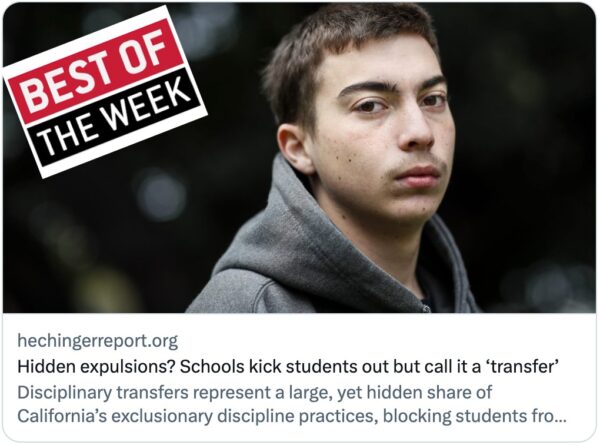
The best education story of the week is Tara García Mathewson’s Hidden expulsions? Schools kick students out but call it a ‘transfer’ for the Hechinger Report and Los Angeles Times.
“Twice a week Ricky Carmona, 16, leaves his La Verne home to attend school in makeshift classrooms a few doors down from the Boot Barn at a nearby strip mall,” opens the story.
Suspended for vaping in the bathroom just a few days into the new school year, Ricky wasn’t expelled from his local high school. He was transferred out.
It’s called a forced transfer. It’s no less disruptive to students than an expulsion but generally happens off the books. And it’s being used on large numbers of kids in many of the 23 California districts whose transfer data was obtained for this story. For example, Sacramento City Schools expelled just 42 kids over a five-year period, but transferred 511 for disciplinary reasons — not counting alternative school transfers.
Forced transfers “are faster, less expensive, and (until now) out of the public eye,” notes García Mathewson. “Good for districts, bad for kids.”
Bonus stories:
🏆 Two Alabama districts show stark divide in pandemic’s toll on schools (Washington Post) See also Sacramento Bee
🏆 Lakewood students say first ever AP African American Studies course provides a clearer picture of U.S. history (Cleveland Signal) See also Lohud, WWNO, Boston Globe
🏆 More than a third of community college students have vanished (Hechinger Report)
🏆 Zillow often lists the wrong Baltimore schools (Baltimore Banner)
🏆 Are the challenges of Puerto Rico’s schools a taste of what other districts will face? (Hechinger/The Guardian)
🏆 California schools face ‘deep trouble’ as flooding danger looms (EdSource)
🏆 In this southwest Kansas classroom, immigrant students’ goal isn’t graduation — it’s survival (Topeka Capital-Journal)
PROTECTING VULNERABLE SOURCES
Our latest columns and commentary
In this week’s new piece, ProPublica and THE CITY policy reporter Abigail Kramer write about finding ways to protect vulnerable kids’ privacy — by offering anonymity while still retaining readers’ trust.
“It’s easy to get caught up in the pressure of deadlines and getting the story,” Kramer told me. But she says it’s good to remind herself that she’s “writing about people’s real lives [and] often asking sources to make themselves very vulnerable.”
While her experience is that wealthier families are more likely to choose anonymity, she gives every family the same options and lets them decide whether to use full names, middle names, or go with something else.
“In the end, I like that we give families the power to decide what’s right for themselves.”
BUS DRIVERS HELPING HOMELESS STUDENTS
Coverage of promising school innovations & signs of progress
💡 One way schools can better support homeless students? Enlist the help of school bus drivers, who are often more familiar with students’ living situations than educators (The 74).
💡 Paying experienced teachers more money to work in poorer schools is one way to solve school staffing disparities, though teachers unions have repeatedly blocked the idea (CalMatters).
💡 Denver has reinstated school resource officers in high schools following a recent on-campus shooting, but the research is mixed on whether police officers make schools safer (Colorado Sun).
💡 Colorado’s recovery school helps students dealing with substance abuse disorder get into rehab and work through mental health issues (Colorado Sun). There are only a handful of such schools nationwide.
Read more about the importance of covering promising innovations and preliminary successes.

PEOPLE, JOBS
Who’s going where and doing what
Above (clockwise, starting from the top left): Chalkbeat’s Cam Rodriguez, the Sacramento Bee’s Sawsan Morrar, AZ CIR’s Maria Polletta, and the Kansas City Star’s Mará Rose Williams.
🔥 Career moves: Chalkbeat data reporter Cam Rodriguez is joining the Chicago Reader’s Racial Justice Writers’ Room, where she’ll work on investigative stories on environmental justice. The Kansas City Star’s Mará Rose Williams is now the paper’s assistant managing editor for race and equity. (A longtime education reporter, Williams drove the paper’s “Truth in Black and White” project, examining past racist coverage of topics including schools.)
🔥 Spotlight: I had a great conversation earlier this week with Maria Polletta, AZ CIR’s education watchdog. She’s one of just a handful of current and former ed reporters with experience covering politics — a handy experience to have, considering how politicized education has become. Other political veterans that come to mind: the Washington Post’s Laura Meckler, who covered the White House, and former WNYC reporter Beth Fertig, who covered City Hall. Who else am I missing? There have got to be a few more.
🔥 Comings and goings: Yesterday was Sacramento Bee education reporter Sawsan Morrar’s last day as she heads off to pursue a PhD in education at UC Davis. You don’t have to be a parent to be a great education reporter, she told me, but you do have to get in tune with what parents are most concerned about. What keeps them up at night? What’s angering (or exciting) their kids. “There are faces and real people behind stories on funding and programs,” says Morrar. “Find them.” Click here for her favorite stories of the past five years.
🔥 Awards: Congrats to the team behind APM Reports’ “Sold a Story,” which won an IRE Award for best longform audio journalism in 2022. Lead reporter Emily Hanford called it a “pinch-me moment.” Other ed beat winners include the Chicago Tribune and ProPublica, the San Antonio Express-News, Houston Chronicle, and Fox Baltimore — along with LSU Manship and the Stanford Daily for student journalism. Check them all out here. Also, NPR education reporter Elissa Nadworny’s series on getting a college degree in prison recently won a Gracie Award from the Alliance for Women in Media.
🔥 New follows: Some journalists I’ve recently followed include CalMatters College Beat reporter Megan Tagami, Northeast Mississippi Daily Journal ed reporter Blake Alsup, The 19th’s Frances Ellen Watkins Harper fellow Daja E. Henry, WFPL Louisville race and equity reporter Divya Karthikeyan, NPR cybersecurity correspondent Jenna McLaughlin — she covers school shooter swatting — Tulsa World ed reporter Lenzy Krehbiel-Burton, US News education reporter Sarah Wood, and Post and Courier investigative reporting fellow Briah Lumpkins. Who am I missing?
🔥 One great job opening: GBH Boston is hiring a K-12 education reporter to replace Meg Woolhouse, who was promoted to editor.

APPEARANCES, EVENTS, & NEW RESOURCES
What’s happening and new research
Above: “It’s 2023 and many newsrooms still don’t reflect the communities they serve,” quipped AP reporter Kat Stafford about the new Pew Research report on newsroom diversity.
⏰ Appearances: Chalkbeat’s Patrick Wall was on WBUR’s On Point talking about how to fix the growing discipline problem in U.S. classrooms. CalMatters’ Joe Hong was on KQED talking about the rise in K-12 students in California experiencing homelessness.
⏰ New reports: Districts are making big investments in labor and vendor contracts with ESSER dollars, but there’s precious little information available on how that spending might be impacting students, according to a new analysis in Education Next. A new report from the RAND Corporation shows that poor and rural students are less likely to end up in STEM due to lack of access to advanced math courses.
⏰ New research: A CDC survey looked at schools’ COVID prevention strategies in 2021-22 and found that schools with nurses were more likely to have them. And Pew Research just released an analysis of school district mission statements. Which districts mention DEI? The more urban, Democratic, and upper income ones.
⏰ Life without verification: Many folks on the beat currently have blue check verification from Twitter. But that could change soon, as Twitter has started charging. Some education journalists already know what life without verification is like. They include NYT metro editor Sarah Garland, Hearst CT’s Jacqueline Rabe Thomas, the Seattle Times’ Monica Velez, the LA Times’ Paloma Esquivel, Chalkbeat’s Matt Barnum, Hechinger’s Jill Barshay, freelancer Sarah Carr, AP national education reporter Bianca Vázquez Toness, former NYT education reporter Dana Goldstein, and USA Today national education reporter Kayla Jimenez.
THE KICKER

Check out the Milwaukee Journal-Sentinel’s Rory Linnane on TikTok, showing us around a school library.
That’s all, folks. Thanks for reading!
Reply to this email to send us questions, comments or tips. Know someone else who should be reading Best of the Week? Send them this link to sign up.
Using Feedly or FlipBoard or any other kind of news reader? You can subscribe to The Grade’s “feed” by plugging in this web address: http://www.kappanonline.org/category/the-grade/feed/.
Read more about The Grade here. You can read all the back issues of The Grade’s newsletter, Best of the Week, here.
By Alexander Russo with additional writing from Colleen Connolly.
ABOUT THE AUTHOR

The Grade
Launched in 2015, The Grade is a journalist-run effort to encourage high-quality coverage of K-12 education issues.