Welcome back and Happy New Year! It’s been a while, so we’ve included some stories from over the winter break.
In this week’s newsletter: Efforts to boost literacy are taking off but enrollment and attendance remain big problems. Complaints about inadequate special education services are on the rise. The week’s best education story explains why schools give out so many detentions and suspensions to homeless students. And two ed reporters shared their journalism origin stories.
LITERACY PUSH
The big story of the week, according to us
State, local, and school-level efforts to improve literacy instruction are the big education story for the first week of the new year:
🔊 How dyslexia became a social justice issue for Black parents (Hechinger Report/Washington Post)
🔊 Memphis Is Changing the Way Its HS Students Read, Syllable by Syllable (New York Times)
🔊 Are we teaching reading all wrong? What parents need to know (WBEZ Chicago)
🔊 Missouri educators hope a new approach to reading will improve low literacy rates (St. Louis Public Radio)
🔊 Students are falling behind in reading, & experts say it’s more than a pandemic issue (Houston Chronicle)
🔊 Oregon teachers want to learn the right way to teach reading. They need funding to do it. (Oregonian)
🔊 Reading Programs Picked For Phonics Pilot (New Haven Independent)
As of last summer, EdWeek reported that 29 states had changed their literacy laws. Read more about state literacy requirements from APM Reports.
Other big stories this week: Public schools in the U.S. have lost more than 1 million students overall since the pandemic began, but enrollments in suburbs, towns, and rural districts are growing. Large numbers of discrimination complaints are being made to the federal Department of Education, the majority of which focus on discrimination over disability. Student absenteeism remains a big problem in Illinois and nationally. And in what seems likely to be a failed attempt to keep kids away from AI, New York City is blocking access to Chat GPT on school networks.

HOMELESS STUDENTS EXPELLED
The best education journalism of the week, according to us
🏆 BEST: This week’s best education story is homeless reporter Anna Patrick’s Housing one of biggest predictors of getting kicked out of WA schools for the Seattle Times. Homeless Washington students are suspended and expelled at almost three times the rate of their housed peers, reports Patrick. “A child’s housing status is an even greater predictor of discipline than race.” There’s nothing particularly new about the notion that homeless students are especially vulnerable to lower grades and dropping out of school. Ditto for students who are suspended or expelled from school. But Patrick’s Dec. 30 story does a particularly good job bringing the interactions to life through its use of data and its sympathetic depiction of an unnamed girl who’s been bullied and received a series of detentions since her family became homeless.
Want more? Check out another story in the Seattle Times series about one district’s success helping more homeless students graduate.
🏆 RUNNER-UP: The runner-up best education story of the week is Paloma Esquivel’s Why do L.A. students have high grades but low test scores for the LA Times. Opening with a Fairfax High School mother who’s confused by the disconnect between student grades and test scores, Esquivel’s story examines the complicated and often contentious intersection of grades vs. test scores. The mom’s high schoolers get good grades in class, but they aren’t meeting grade-level standards. “It feels like they’re still struggling,” she says. It’s a common situation. The LA Times finds that 85 percent of sixth-graders earned A’s, B’s, and C’s in English last spring while just 40 percent met grade-level standards. One factor is the district’s ongoing use of pandemic-era grading policies that make it harder for teachers to give lower grades. District officials say they’re trying to change the policy and give parents a better idea how their children are doing. But it won’t be easy, and this is a story playing out in many other districts.
BONUS:
🏆 Schools masking absenteeism by misreporting truant CPS students as transfers, dropouts, IG says (Chicago Sun-Times)
🏆 In Denmark, who should do the work of school integration? (PBS NewsHour/Hechinger Report)
🏆 Protocols to stop mass school shootings are spreading. Are students’ rights being violated? (USA Today)
🏆 Grades are rising, but test scores are falling. Why the big disconnect? (LA Times)
🏆 The School That Calls the Police on Students Every Other Day (ProPublica)
🏆 Lockdowns, shootings, prostitution. How a school fought a ‘crime magnet’ motel and won (LA Times)

PREDICTIONS
What we’ve been up to at The Grade
This week’s new column features more than a dozen predictions for education journalism, among them the spread of promising new practices to protect vulnerable sources and the over-coverage of school gun violence. I also predicted who the Boston Globe will pick as its new lead education reporter. Check it all out here.
We’re not the only ones making predictions. Check out previews on what education stories various outlets are watching for from Chalkbeat Detroit and Colorado, Bridge Michigan, the Oregonian, Education Week, and the Fordham Institute.
The Grade’s most popular stories for 2022 include some familiar pieces — about “Sold a Story” and a high school journalism teacher who turned out to be a predator — along with some surprises like my interview with WHYY journalist Avi Wolfman-Arent, who became so disillusioned with the education beat he left to become an on-air host. Check out the top 10 here.
Speaking of popularity: 8 out of the 10 most-shared mainstream education articles for December came from Fox News, according to a Whiteboard Advisors update. EdWeek and the Hechinger Report dominated the list of most-shared trade publication stories.
The Grade is all about journalists reflecting on their work and their experiences. Some recent self-reflections of note: USA Today columnist Jill Lawrence wrote about reconnecting with former classmate Pamela Gipson, the Black “exchange” student from Mississippi who attended her white suburban high school on Long Island. AL.com columnist Kyle Whitmire wrote about growing up in Alabama schools designed to preserve white supremacy.
While APM Reports’ “Sold a Story” focuses narrowly on the importance of phonics to help kids learn to read, contributor Natalie Wexler points out, recent pieces in the Courier Journal and Ed Post take the necessary step to include broader issues like background knowledge and comprehension.
Most educators and education journalists probably don’t think twice about the term “special education.” But one disabled journalist wrote a piece for The Grade about why she thinks education journalists should find an alternative term even if schools keep using it.
Four years ago, the Varsity Blues case revealed both a college admissions scandal and a glaring blind spot in higher education news coverage that allowed the athletic referrals loophole to go unreported for many years. This week, the mastermind behind it all got more than three years of jail time.
Follow me at @alexanderrusso for thought-provoking commentary all day, every day.
VIRGINIA MIDDLE SCHOOL BUCKS THE TREND
Coverage of promising innovations & signs of progress
💡 Math scores are improving at a Virginia middle school that makes students “stakeholders in each other’s success.” (Washington Post/Hechinger Report)
💡 Student climate activists find new direction after the pandemic stalled their advocacy efforts. (EdWeek) See also WFYI’s story about new climate science standards coming to Indiana.
💡 A 30-year-old program that pairs college students with middle and high schoolers in need of extra help offers schools an alternative to high-dosage tutoring. (Chalkbeat Indiana)
💡 Teen peer counselors in Oakland help other students recover from traumatic events like school shootings. (KQED)
Read more about the importance of covering promising innovations and preliminary successes.

PEOPLE, JOBS
Who’s going where and doing what. Plus job openings.
Above, clockwise from top left: Journalists on the move Mandy McLaren, Julia McEvoy, Daniela Franco Brown, Jessika Harkay, and Ariella Cohen.
🔥 Arrivals: Jessika Harkay is the CT Mirror’s newest education reporter after a stint at the Fort Worth Star-Telegram. The Philadelphia Inquirer’s Ariella Cohen has moved to the paper’s news desk to collaborate on beats including education.
🔥 Departures: Mandy McLaren announced her departure from the Courier Journal (and posted a mysterious photo from an airplane window that I am guessing is headed to Boston). Indy Star education editor Daniela Franco Brown says she’s leaving the paper after more than three years. KQED education editor and reporter Julia McEvoy has a great story out this week about peer counseling and teen trauma, but emailed that she’s leaving the station for other adventures.
🔥 Recognition: In her inaugural address, the president of the Massachusetts Senate referenced community college enrollment coverage by relatively new Boston Globe higher ed reporter Hilary Burns. The Atlantic praised Brooklyn Deep’s School Colors season 2 as “an account of colossal American dysfunction hiding in plain sight” in their roundup of the 35 best podcasts of 2022. Congrats!
🔥 Job openings: More than 55 positions are open for new Report for America corps members, and we spot eight education positions (including one at the Uvalde Leader-News and another at the new Mississippi Free Press ed lab). The application deadline is Jan. 30. The Salt Lake Tribune is looking for an education reporter. For more jobs, check out URL Media’s career newsletter (where former LA Times ed reporter Sonali Kohli now works). See also previous newsletters.
🔥 Deadlines: The deadline for the Spencer Education Journalism Fellowship is the end of this month. Apply by Feb. 17 for the Poynter Leadership Academy for Diversity in Media held next October.
EVENTS, RESOURCES
What’s happening and new research
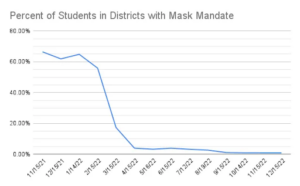
Above: Philadelphia and a handful of other school districts have gone back to mandatory masking after the holiday break, but according to Burbio only 2 percent of students nationally are currently required to wear them.
⏰ Appearances: WBUR’s Here & Now featured WFYI’s Lee Gaines talking about an Indiana school board election where the red wave didn’t materialize. Teach Thought hosted a panel on reading featuring journalists Emily Hanford and Natalie Wexler. The NPC Journalism Institute hosted a helpful webinar on how to push back on restrictive communication policies in education, featuring Politico’s Delece Smith-Barrow and the Dallas Morning News’ Eva-Marie Ayala.
⏰ New research: A Stanford economist predicted pandemic learning loss could cost students $70,000 in lifetime earnings, and a couple of new studies have shown that learning loss interventions may not be going far enough for the students who really need them. Research from NBER shows that youth suicides increased when students went back to in-person learning. The Wall Street Journal reports that high rates of chronic absenteeism are persisting — and Chalkbeat and WBEZ report that it’s getting even worse in places like Illinois where some districts have been accused of under-counting lost students.
⏰ Upcoming: Open Campus is hosting a Jan. 19 webinar on HBCUs featuring the NYT’s Erica Green, the Atlantic’s Adam Harris, and Open Campus’s Naomi Jay Harris. Check out the agenda for the in-person EWA higher ed event in Washington, DC, from Jan. 26 to 27 (and come up and say hello if you see me there).
⏰ Books: NPR education editor Steve Drummond says his book “The Watchdog,” about President Harry Truman, is coming out May 9. David Zweig’s new book, “An Abundance of Caution,” about schooling in the pandemic, is coming out from MIT Press sometime later this year.
⏰ Resources: Check out Mara Aukerman’s critique of science of reading coverage published in the Marshall Memo. Writing about the recent surge of school choice and need some context? Ed Choice has a dashboard showing that 32 states offer vouchers and ESAs, and the Center for Education Reform shows that 46 states have charter schools.
THE KICKER

Too cute! A couple ed reporters wrote recently about their journalist origin stories, going all the way back to grade school. Can you guess who they are?
ABOUT THE AUTHOR

The Grade
Launched in 2015, The Grade is a journalist-run effort to encourage high-quality coverage of K-12 education issues.