In this week’s newsletter: Chronic absenteeism continues to plague schools and districts, though some places have found ways to re-engage kids. A splashy education series is no replacement for everyday beat coverage, says this week’s columnist. USA Today has a new education editor. And the guy responsible for the “Corn Kid” meme gives some great advice for interviewing kids.
MISSING STUDENTS
The big story of the week, according to us
The days of school closures and mandatory quarantines are pretty much over, but a lot of kids are still not showing up at school. For example, nearly 30% of San Francisco students were chronically absent last year. As parents and schools struggle to bring them back, some educators are spinning up new ways to return to a pre-pandemic normal — or better:
🔊 Come to Class, Win a Toyota: Districts Launch Campaigns to Boost Attendance (The 74)
🔊 ‘Families can fall apart over this stuff’: the children refusing to go to school (The Guardian)
🔊 ‘We’re here to help’: Baltimore City Public School staff hope phone bank will return absent students to class (Baltimore Sun)
🔊 Merced County combats chronic absenteeism through S.A.F.E. education (Merced County Times)
🔊 LAUSD makes push to bring chronically absent students back to school (EdSource)
🔊 Most Greater Columbus schools see rise in absenteeism (Columbus Dispatch)
🔊 How the pandemic created a school absenteeism crisis (San Francisco Chronicle)
🔊 Pandemic leads to shrinking enrollment at Hawaii schools (Star Advertiser)
For more about how schools are trying to re-engage students, check out the best of the week stories and the innovations section further down.
Other big stories this week: Most of Florida’s public schools closed in anticipation of Hurricane Ian’s landfall, and schools in Carolinas are now doing the same. A Minnesota court found that school segregation is not unconstitutional unless it is intentional. Chicago is no longer the third largest school district in the nation. Despite a big drop in voluntary enrollment in the pandemic, California’s governor vetoed the mandatory kindergarten bill. The state also reversed course on releasing test scores. Boston’s new superintendent officially took over, with an eye on improving graduation rates. And efforts to stop Arizona’s universal school voucher program seem to be heading toward failure.
RE-ENGAGING KIDS
The best education journalism of the week, according to us
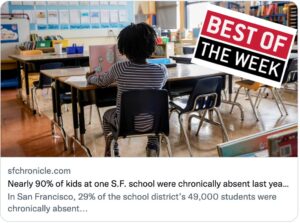
🏆 BEST: The best story of the week is Nearly 90% of kids at one S.F. school were chronically absent last year. What is SFUSD doing about it? by Jill Tucker and Nami Sumida in the San Francisco Chronicle. It’s no surprise that chronic absenteeism is a problem in a lot of places, San Francisco included, but Tucker and Sumida give us a deeper look at what the data says on an individual school basis. Overall, 29% of students in SFUSD were chronically absent last year, about double what it was before the pandemic. While that number alone is concerning, it doesn’t hint at the crisis that some schools are facing. Some saw rates as low as 3%, but others — largely divided along racial lines — were as astronomically high as 89%. “That wasn’t even a category we had in our brains,” said one school attendance advocate. Despite the story’s headline, not enough is being done about the extreme disparity. This story stands out for its use of comparison. Absenteeism numbers are high, but where are they highest? Are they low in neighboring, wealthier schools? That is the story reporters should be telling, and Tucker and Sumida do an excellent job of it.
🏆 RUNNER-UP: This week’s runner-up is ‘The Mary Lyon way’: A Boston inclusion school’s successful approach to re-engagement by Christopher Huffaker in the Boston Globe. It’s the first big feature like this we’ve seen from The Globe in a while, and I’m here for it. Unlike the Chronicle story, this one spotlights an approach that has worked to combat chronic absenteeism and re-engage kids at one school in Boston in which more than a third of the students have special needs. This school relied on the community mobilization it was already known for to keep students engaged. Students were paired up and made accountable for each other, calling the other if they went missing. Social workers joined Zoom classes. And school staff called parents to check on their wellbeing as well. Despite the school not having the best test scores and overall attendance in the district, it’s an example of an approach that other schools could follow in trying to re-engage their students. I love stories that spotlight what’s working, and it’s especially good when it highlights a school that might normally fly under radar.
BONUS STORIES:
🏆 More than 1,600 corporal punishment cases substantiated in New York public schools in recent years (Times Union)
🏆 Young and Homeless in Rural America (New York Times)
🏆 Some NYC schools still teaching literacy curriculum chancellor said must go (Gothamist)
🏆 Fewer candidates are running for Indianapolis school board. Is campaign money and political pressure the reason? (WFYI/Chalkbeat Indiana)
🏆 No ‘overnight’ solutions: How Pa. leaders plan to solve state’s teacher shortage (WHYY)
🏆 How the pandemic saved one of California’s smallest public schools (LA Times)
NO SUBSTITUTE FOR BEAT COVERAGE
New commentary from The Grade
What happens when local education beat coverage disappears, replaced by the occasional deep dive? The citizens of Cleveland, Ohio, are finding out.
The Cleveland Plain Dealer hasn’t had a regular education reporter for the past two years, but it’s currently running a series of stories about one local school based on reporting from a couple of embedded reporters.
Some of the stories are quite good, but Sam Allard in Cleveland Scene points out that splashy reporting is no replacement for beat reporting.
“Given the paper’s depleted newsroom resources in general, and the absence of an education beat reporter in particular, the investment in the series is not just unusual. It’s insane,” Allard writes.
Not everyone agreed with Allard’s assessment, however, pointing out that Cleveland Scene also failed to cover local schools regularly during this critical period.
Follow @alexanderrusso for thought-provoking commentary on education journalism all day, every day.
NOW HIRED: STUDENTS
Promising innovations & signs of progress
💡 Schools across the U.S. are using COVID relief funds to hire students, giving them much needed jobs and helping fill in staff shortages. (Chalkbeat)
💡 A high school in South Carolina grew its graduation rate with check-ins and “power lunches.” (Post and Courier)
💡 A study in Chicago showed that students failed more classes in the pandemic, but also got more A’s. (Chalkbeat Chicago)
💡 School districts, especially in rural areas, are experimenting with four-day weeks, and some are receiving positive feedback from families and teachers alike so far. (The Guardian)
Read more about the importance of including promising innovations and preliminary successes.

PEOPLE, AWARDS
Who’s doing what, going where
Above: Has there ever been an education reporter who’s covered a war as much as Elissa Nadworny? The NPR reporter was in Ukraine again recently. Read her thread about the experience.
🔥 Career moves: In case you missed it like we did, former Politico editor Nirvi Shah is the new education editor at USA Today. Dominic Anthony Walsh is the new education reporter at Houston Public Media, and his first story is out about shrinking enrollment at Houston ISD. Michael Elsen-Rooney, formerly of the New York Daily News, has officially started his new gig at Chalkbeat New York. And say congrats to his colleague Reema Amin, who’s celebrating four years at the outlet!
🔥 Books: “This is the book I’ve been wanting to write since I started my career in journalism more than 10 years ago,” writes former Hechinger Report journalist Emmanuel Felton. “I’m so excited to tell these stories about Black America’s search for home.” The New York Times’ Dana Goldstein reviewed Donald Yacovone’s “Teaching White Supremacy” about enduring racist ideas in American history curriculum.
🔥 Awards: Congrats to all the Online Journalism Award winners, among them the Texas Tribune for their breaking news coverage of the Uvalde school shooting, Southern California Public Radio for their series on caring for children in the pandemic, ProPublica and Nashville Public Radio for their story on Black children being jailed for nonexistent crimes, and The 74 for their investigative reporting on digital surveillance in schools.
EVENTS, RESEARCH
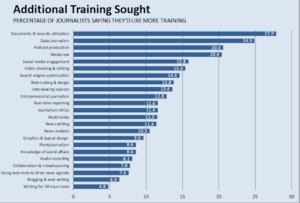
Above: Journalists want FOIA training more than any other topic, according to the 2022 American Journalist survey. It’s a big change from 40-50 years ago when the training journalists most desired was continuing education in subjects related to their beats. The report offers a fascinating look at how much has changed.
⏰ Media appearances: Chalkbeat New York’s Reema Amin and WNYC reporter Nancy Solomon talked about the power of parents in New York and New Jersey on WNYC’s The Brian Lehrer Show. Seyward Darby talked about her Atavist article “Fault Lines,” about rampant grooming and sexual abuse at a Los Angeles charter high school, in an episode of The Creative Nonfiction Podcast.
⏰ Research: USA Today published data about the wildly varied amounts of time kids spend in school, depending on where they live. A study found that a teacher’s race is less predictive of a Black student’s success in math than whether they went to an HBCU. CDC data shows that COVID cases and hospitalizations for kids are not rising dramatically as school starts. And the Reuters Institute shared findings from their Trust in News Project showing that negative perceptions about the news media are widespread, but people separate out news media from “stuff on the internet” and tend to trust the news more. Here’s a thread with more.
⏰ Centering students: The New York Times for Kids published advice from reporters, editors, photographers, and designers about how to start a school newspaper. And PBS NewsHour gave it over to high-schooler Solyana Mesfin for her “Brief But Spectacular” take on the importance of student representation.
⏰ Reporting tip: Covering controversies that might include SEL? Be careful whose parent voices you center, lift up the data about actual parent concerns, find out what schools are really doing to support SEL, and separate genuine concerns about SEL from conspiracy theories, says CASEL’s Justina Schlund, who wrote a 2021 piece for us about covering SEL and is working on a new column about disentangling SEL from school controversies like CRT.
THE KICKER

“I don’t baby the kids and I don’t talk down to them. …It really empowers kids to open up and grow and test ideas.”
Great advice on how to interview kids from none other than the guy who made the Corn Kid famous. H/T to The 74’s Asher Lehrer-Small for the interview. It has the juice.
That’s all, folks. Thanks for reading!
Reply to this email to send us questions, comments or tips. Know someone else who should be reading Best of the Week? Send them this link to sign up.
Using Feedly or FlipBoard or any other kind of news reader? You can subscribe to The Grade’s “feed” by plugging in this web address: http://www.kappanonline.org/category/the-grade/feed/.
Read more about The Grade here. You can read all the back issues of The Grade’s newsletter, Best of the Week, here.
By Alexander Russo with additional writing from Colleen Connolly.
ABOUT THE AUTHOR

Alexander Russo
Alexander Russo is founder and editor of The Grade, an award-winning effort to help improve media coverage of education issues. He’s also a Spencer Education Journalism Fellowship winner and a book author. You can reach him at @alexanderrusso.
Visit their website at: https://the-grade.org/