We should put these predictable performances in their place: on the back pages of the paper, not the front, at the bottom of the hour, not the top.
By Greg Toppo
The journalism out of Uvalde, Texas, has been amazing.
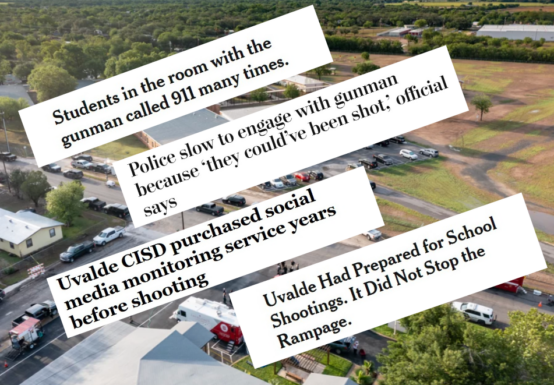
Reporters have been digging deeply over the past week to memorialize children’s classroom 911 calls, uncover Uvalde’s school safety plans, and pierce the police wall of disinformation to report a true timeline of events.
They’ve gently leaned on victims’ families, friends, colleagues, and neighbors to help cobble together a narrative that makes sense.
As a reader, I’ve been captivated.
This piece by The New York Times’ Mike Baker and Dana Goldstein notes that, according to district records, Uvalde actually held an “active threat” training exercise in August 2020, which included the district’s own police officers, Uvalde city police, county sheriff’s deputies, and other local agencies — all of which seem to have come up short when the shooting began.
NBC News dug up the district’s 21-point “Preventative Security Measures” plan and posted it online. Its precautions include threat assessment teams at every school and monitoring of social media threats via a questionable tool called Social Sentinel.
A day after the shooting, NBC’s Mike Hixenbaugh scored an exclusive front-porch interview with a Robb Elementary School teacher who, when gunfire erupted, shouted for her kids to get under their desks, then “sprinted to lock her classroom door” to keep the shooter out.
The coverage, in other words, has been first-rate — aggressive yet sensitive and detailed, bringing all our tools to bear to comfort the afflicted, afflict the comfortable, and offer the people of Uvalde a few valuable answers.
But a week later, I’m struggling with the odd feeling that we’re all suckers.
We’re treating last week’s shooting as a kind of watershed event, the story of the year, forgetting that this happens all the time, in one form or another.
An Education Week database places Uvalde as the 27th school shooting of 2022, meaning we’ve seen, on average, one shooting every 5.3 days since Jan. 1.
We’ve spent the past week borrowing families’ photos to share with the world, in the vain hope that these artifacts will somehow make these people the last to suffer this way.
It’s a noble effort, but it’s also a fool’s errand.
If journalists want to make a difference, we need to try something different.
We’ve spent the past week borrowing families’ photos to share with the world, in the vain hope that these artifacts will somehow make these people the last to suffer this way.
Like many of us, I’ve been thinking this week about the children in my life.
My two daughters are grown, but my grandson Sage just turned 1. Earlier in the week, I thought to myself, “Well, I’m glad we’ve got four more years until he’s old enough for school. By then we’ll certainly have a handle on this problem.”
Then I remembered that Sandy Hook was a decade ago, and that the shooting at Pearl High School in Mississippi, which left two girls and the shooter’s mother dead, took place in October 1997, 15 years before that. At the time, my younger daughter, Sage’s mother, was 1.
Yes, I have been covering these blasted things since the Clinton administration, and I mean no disrespect to the Uvalde victims and survivors when I say that they are all the same: An unhappy young man with a love of guns, plagued by family dysfunction, chronic mistreatment, and mental health struggles, spends his minimum-wage savings on military-style weapons, ammo, body armor, and a GoPro and tells everyone about his plans to take the lives of a random number of blameless members of his community: teachers, peers, police officers, strangers.
Each time, we are there to report breathlessly on exactly how it happened, a perverse journalistic Mad Libs that never substantially changes.
This Washington Post photo gallery, detailing the “cycle of gun violence” in schools since 1999’s Columbine High School shooting, shows that grief is grief is grief. Fill in the blanks with place names and personal details if you’d like, but it will still make no sense.
Significantly, more than two decades into this endless cycle, we as a nation seem unable to do anything different each time, motionless in the face of each nearly carbon-copy attack.
There’s a word for a news event that is the same as the last one but slightly different, where the rules don’t change but the protagonists do – and where the outcome, as spectacular as it seems, changes nothing. We call it sports.
Again, I mean no disrespect to victims and survivors, and I certainly don’t believe that we should cover shootings as games. But we should step back and admit that, like sports, these are news events manufactured by people who want attention – in this case, disturbed gunmen whose continued existence should be proof enough that our words and images don’t stop them – and are probably making more of them, just as covering high school football games each fall helps more young men decide they want to play football.
Previously from Toppo: The Great Math Textbook Hoax of 2022, Making education news more useful, People are fighting. Is that news?
Our words and images don’t stop them – and are probably making more of them.
Many people point the finger at violent video games and movies, saying they draw vulnerable young men into violence. But decades of research have shown that school shooters are typically more interested in novels, poetry, and their own journal writings. The 20-year-old Sandy Hook shooter was obsessed with a multi-player video game: Dance Dance Revolution.
In reality, only one type of media actually causes more school shootings: media coverage of school shootings.
In the wake of mass shootings and their mass coverage, one pair of researchers noted, “generalized imitation” takes hold.
I have no idea if we’ll ever get our arms around our gun problem or our alienated young men problem, but from a media perspective, we can certainly do less harm.
We can put these predictable performances in their place: on the back pages of the paper, not the front, at the bottom of the hour, not the top.
After 27 school shootings in 2022, we must commit to doing things differently. Some media have already begun limiting use of shooters’ names, likenesses, and writings. EWA’s Emily Richmond in 2019 made a solid case for this. Poynter’s Kelly McBride in 2018 warned against using superlatives like “the deadliest mass shooting ever,” which she said could lead to “contagion” among other would-be shooters. And this 2015 New Yorker piece by Malcolm Gladwell helped popularize the theory that school shootings and other performative mass violence events are little more than “slow-motion riots.”
What if we treated mass shootings like the contagious diseases they are? What would the coverage look like? The emphasis, to be sure, would be on prevention, on keeping those around us from catching the disease. Who got it would be far less important than how we keep others from falling prey to the same thing.
Discussions of gun control and mental health services now occupy a major part of the response. But they’d be just a small part of a much larger discussion that included every factor that puts young people at risk of becoming the next school shooter.
The journalist Mark Follman, author of a new book on mass shootings, last week told me that threat assessment, a community-based violence prevention method, focuses on young people’s “cries for help,” whether they’re suicidal, in crisis, or filled with rage. In many cases, he said, “they’ve developed an idea that they don’t have any other solution to their problems, and that this form of violence is the solution.”
If much of the energy we’re now devoting to outstanding journalism could shift from what is essentially crime coverage to something else, zeroing in on ways to protect communities from something we’re by now all too familiar with, imagine the impact we could have.
If much of the energy we’re now devoting to outstanding journalism could shift from what is essentially crime coverage to something else… imagine the impact we could have.
As Americans, we’re already trained, already gritting our teeth to expect the next Uvalde. Actually, scrap that: the Post on Monday pointed out that since last Tuesday, at least 15 mass shootings have taken place across the U.S., 12 of them over Memorial Day weekend. Just yesterday, a gunman killed four and injured at least 10 others at a Tulsa hospital.
Next time, let’s not follow our instincts. Let’s not make the problem worse. If millions of words about these events only bring us 15 more a week later, we’re not just covering these events. We’re helping to make them happen.
Previous commentary on coverage of school gun violence from The Grade:
Warning signs in Uvalde
The limits of ‘threat assessment’
‘If you need to cry, cry.’ 6 education reporters’ advice on covering school shootings
School shootings, gun violence, & student trauma coverage
What really happened before the Oxford shooting started?
Botched coverage of the Columbine school shooting
Why gun violence journalism needs graphic images
The problem with Parkland
ABOUT THE AUTHOR

Greg Toppo
Greg Toppo is a longtime education journalist and author most recently of Running With Robots . You can follow him on Twitter at @gtoppo.